The End? Making sense of judgment

Our 20th stop in the journey together through the book of Revelation has brought us to chapters 15 and 16.  A recording of this will be available on the Shofar Durbanville Youtube channel.

not_fair1
“It’s not fair!”” Our craving for justice.

“Where is the justice?”  How do you feel when another corrupt politician escapes the law through bribery? Or when another rapist go free because of sloppy police work? Or gang members buy off another local police precinct to look the other way?

We are all born with an innate sense of right and wrong, a desire for justice.  Justice affirms there is indeed a universal right and a wrong and particular right and wrong within a community (customs and traditions).  Justice demands retribution (punishment) and reparation (restoration) to allow reconciliation (peace).  A system of justice aims to act for the weak ones in society, who are ignored by the powerful ones in their pleas for justice.   Without justice, there is no peace.

A lot of judgment. The middle section of Revelation (chapters 6-20) is devoted to God’s just judgments.  For fourteen chapters, God’s wrath is poured out as seven seals, seven trumpets, and seven bowls during natural disasters, great wars, cosmic chaos, and celestial visitations. Knowing that this is heavy reading, the Author graciously allows for interludes depicting God’s care for his people and his invitation to participate in his work of redemption. 

These judgments are in response to the rebellious nations’ idolatry, immorality and violence (9:20-21), and in particular, the suffering saint’s cries for justice (6:11; 16:7).  These three sets of judgments illustrate increasing intensity, inviting repentance, yet repeatedly we read the wicked nations “cursed God” and “did not repent”.

Before we make sense of these three sets of judgments together, let’s review the bowls (chapters 15-16). 

Victory in the fire.  The scene opens again with a contrasting view similar to the previous chapter (chapter 14). The saints are depicted as victorious over the Beast, at peace and worshipping while the fires of God’s judgment are lighting up the world (15:2; compare 4:6; 5:10; 14:3).  They sing about God’s “righteous acts” (15:4) from the song of Moses (Deuteronomy 32), the lyrics which describe the judgments being poured out not only in the seven bowls (chapter 16) but also the seven seals and seven trumpets.
bowls_1

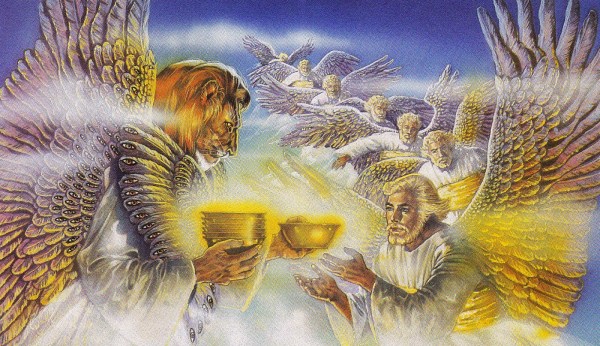
Just holy wrath.  These bowls of judgments are portrayed as coming from the Most Holy Place in the Tabernacle (15:5-8).  By referring to “the Song of Moses” (15:3; Deuteronomy 32), these judgments on the wicked and rewards for the righteous are depicted as the blessing for obedience (Deuteronomy 27-28) and curses for disobedience (Deuteronomy 29-32) recorded in the Law and kept in the Most Holy Place in the Dessert Tabernacle (Deuteronomy 31:24-30).    

Patient in mercy. These bowls of judgments are called “seven plagues” (15:1).  As God demonstrated his patience towards Pharaoh and Egypt, allowing 10 times to repent before every plague, we also see God’s rich mercy allowing for the nations to turn from the rebellion in repentance to him.  But the nations did not repent from their wickedness and cursed God (16:9, 11, 20).

Sound familiar? There are great parallels between the seven seals, seven trumpets and seven bowls, especially the last two sets of judgments (see table below).  All of these contain allusions to the fulfillment God’s promises in the song of Moses (Deuteronomy 32) to which Jesus also alluded in his end times teachings (Matthew 24).  Deuteronomy 32:22-25 (famine, plague, pestilence, wild animals and the sword) is the substance of the first four seals, and 32:41-41-43 is the substance of the last two seals. With a slight change in order, the seven trumpets and seven bowls follow a similar pattern, alluding to God’s plagues in Egypt (Exodus 7-11)…

 [Read the full commentary of Revelation in Faithful to the End]

Faithful to the End is a simple commentary that helps make sense of the encouraging message of Revelation.

Quick links to full THE END Revelation Series posts

1  2  3  4  5  6  7  8  9  10  11  12  13  14  15  16  17  18  19  20  21  22  23  24  25  26

The End? The dragon, the woman and the boy

This 17th study through Revelation focuses on the age-old war between the dragon, the Woman, and her offspring.  We will stop at chapter 12 today.  A recording will be uploaded to Shofar’s YouTube channel

If Jesus is victorious, and Satan is defeated, why are things in such a wrong way?  This question rang in the minds of the oppressed believers in John’s day – the question that gets answered clearly in chapter 12.  The first half of the Revelation focused on the reality of the church (ch 1-3), God’s throne room and Christ’s unfolding reign played out on earth (ch 6-11).  Chapter 12 reveals the cosmic battle in heaven, which results in chaos on earth and persecution of the saints.

Revelation 12 depicts an epic war between a woman with a male child and a great red dragon.  This scene from the middle of the book is the first of seven “signs” or symbols that explore the depth of the scroll’s message.  These seven “signs” depict greater mysteries that govern our world’s realities and are rich in theological substance, helping the church make sense of its struggles on earth. (See 12:1-7; 13:1-10; 13:11-18; 14:1-5; 14:6-13; 14:14-20; and 15:2-4).

You will note again in this chapter that Revelation is not a chronological roll-out of God’s redemptive plan but, in various ways, depicts the church’s struggle with evil throughout history.  Although chapter 11 concludes with a picture of the 7th trumpet as God’s Final judgment and victory in the end, chapter 12 revisits the origin of this battle, starting in Eden, in Bethlehem and Jesus’ ministry.  But this time, the struggle is shown from heaven’s perspective.

This sign introduces three characters: the Woman, the great red dragon, and the male child. Who are they  

woman_Rev12_1
By Ted Larson (2004)

The Woman is said to be clothed in the sun, the moon at her feet, having twelve stars around her head – an allusion to Israel in Joseph’s dream (12:1; Genesis 37:9).  But there is more: this woman “gave birth to a male child, one who is to rule all the nations with a rod of iron” (12:5; compare Psalm 2:9) – representing Mary, the mother of Jesus.  Furthermore the dragon wages war with the Woman and her offspring – an allusion to the curse on the serpent in the garden of Eden and Eve (12:17; compare Genesis 3:15).  And lastly, we read that this Woman’s offspring are “those who keep the commandments of God and hold to the testimony of Jesus” (12:17)– meaning that the Woman also represents the church.

The Woman in Revelation 12’s first sign simultaneously represents Israel, Mary, Eve, and the church—God’s redeemed Kingdom people throughout the ages. This is another depiction of the Lamb’s army, or 144’000 from every tribe, tongue, people, and nation depicted in Revelation 7.

OXYGEN

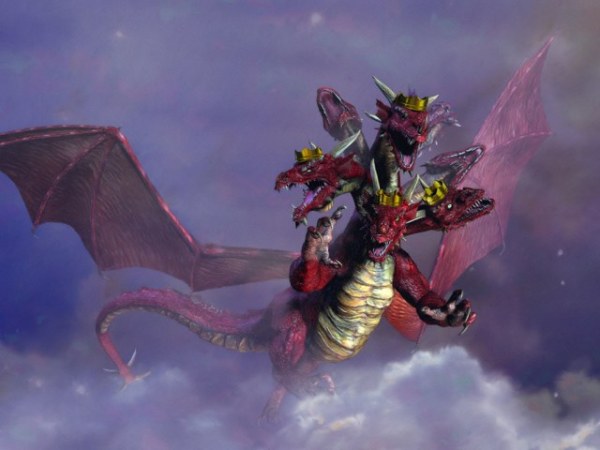
The Red Dragon is “great”, with seven heads, seven horns, seven diadems and a large sweeping tail – a picture of full strength and reign.  This dragon is “the ancient serpent” of Eden, named “the devil and Satan, the deceiver of the whole world” (12:9).  In the chapters to follow, we will see that the Dragon is the source of power behind the beasts (all that is oppressive and intimidating), Babylon the great prostitute (all that is sensual and seductive), and the False Prophet (all that is deceptive).  The Red Dragon symbolises all that is oppressing, seducing and deceiving God’s people.

Revelation-12-woman-child-dragon

The Male Child is the man Jesus, the Son of God, “one who is to rule all the nations with a rod of iron… [and] was caught up to God and to his throne” (12:5, compare with Psalm 2:9 and Acts 1:9).  This is not meant to be read that Jesus was taken away as a child. Still, these things are said so we may know his and the Woman’s identities. This drama focuses on the battle between the Dragon and the Woman.

The Drama. [Read the full commentary of Revelation in Faithful to the End]


Faithful to the End is a simple commentary that helps make sense of the encouraging message of Revelation.

Quick links to entire THE END Revelation Series posts

1  2  3  4  5  6  7  8  9  10  11  12  13  14  15  16  17  18  19  20  21  22  23  24  25  26