
Our 20th stop in the journey together through the book of Revelation has brought us to chapters 15 and 16. A recording of this will be available on the Shofar Durbanville Youtube channel.

“Where is the justice?” How do you feel when another corrupt politician escapes the law through bribery? Or when another rapist go free because of sloppy police work? Or gang members buy off another local police precinct to look the other way?
We are all born with an innate sense of right and wrong, a desire for justice. Justice affirms there is indeed a universal right and a wrong and particular right and wrong within a community (customs and traditions). Justice demands retribution (punishment) and reparation (restoration) to allow reconciliation (peace). A system of justice aims to act for the weak ones in society, who are ignored by the powerful ones in their pleas for justice. Without justice, there is no peace.


A lot of judgment. The middle section of Revelation (chapters 6-20) is devoted to God’s just judgments. For fourteen chapters, God’s wrath is poured out as seven seals, seven trumpets, and seven bowls during natural disasters, great wars, cosmic chaos, and celestial visitations. Knowing that this is heavy reading, the Author graciously allows for interludes depicting God’s care for his people and his invitation to participate in his work of redemption.
These judgments are in response to the rebellious nations’ idolatry, immorality and violence (9:20-21), and in particular, the suffering saint’s cries for justice (6:11; 16:7). These three sets of judgments illustrate increasing intensity, inviting repentance, yet repeatedly we read the wicked nations “cursed God” and “did not repent”.
Before we make sense of these three sets of judgments together, let’s review the bowls (chapters 15-16).
Victory in the fire. The scene opens again with a contrasting view similar to the previous chapter (chapter 14). The saints are depicted as victorious over the Beast, at peace and worshipping while the fires of God’s judgment are lighting up the world (15:2; compare 4:6; 5:10; 14:3). They sing about God’s “righteous acts” (15:4) from the song of Moses (Deuteronomy 32), the lyrics which describe the judgments being poured out not only in the seven bowls (chapter 16) but also the seven seals and seven trumpets.
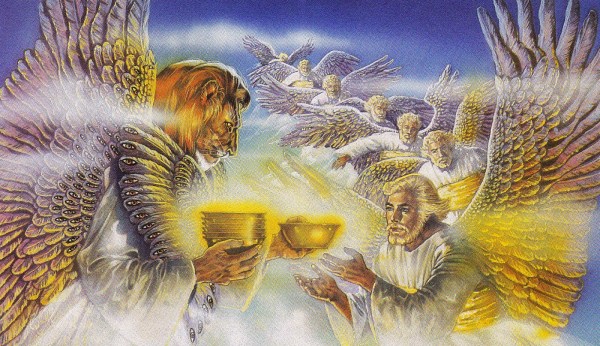
Just holy wrath. These bowls of judgments are portrayed as coming from the Most Holy Place in the Tabernacle (15:5-8). By referring to “the Song of Moses” (15:3; Deuteronomy 32), these judgments on the wicked and rewards for the righteous are depicted as the blessing for obedience (Deuteronomy 27-28) and curses for disobedience (Deuteronomy 29-32) recorded in the Law and kept in the Most Holy Place in the Dessert Tabernacle (Deuteronomy 31:24-30).
Patient in mercy. These bowls of judgments are called “seven plagues” (15:1). As God demonstrated his patience towards Pharaoh and Egypt, allowing 10 times to repent before every plague, we also see God’s rich mercy allowing for the nations to turn from the rebellion in repentance to him. But the nations did not repent from their wickedness and cursed God (16:9, 11, 20).
Sound familiar? There are great parallels between the seven seals, seven trumpets and seven bowls, especially the last two sets of judgments (see table below). All of these contain allusions to the fulfillment God’s promises in the song of Moses (Deuteronomy 32) to which Jesus also alluded in his end times teachings (Matthew 24). Deuteronomy 32:22-25 (famine, plague, pestilence, wild animals and the sword) is the substance of the first four seals, and 32:41-41-43 is the substance of the last two seals. With a slight change in order, the seven trumpets and seven bowls follow a similar pattern, alluding to God’s plagues in Egypt (Exodus 7-11)…
[Read the full commentary of Revelation in Faithful to the End]

Quick links to full THE END Revelation Series posts
1 2 3 4 5 6 7 8 9 10 11 12 13 14 15 16 17 18 19 20 21 22 23 24 25 26
 walklikejesus