The End? The Reason to Endure

In this 19th study of revelation we look at need for salvation and the reality judgment and Hell in chapter 14.  A recording of this will be uploaded at the Shofar Durbanville Youtube channel.

endurance1

“What’s the point of all this hardship? Why push through the pain?  Others have given up, and they seem to be having an easier life! What can be worth this much effort?”  Whether it’s a marathon, long-term studies, a gruelling project or a start-up initiative – somewhere along the road, you will ask that question in agonizing pain.  So, too, in your journey of faith.

The answer to this question is what Revelation 14 offers to struggling churches.  The scenes instil courage in the hearts of believers tempted to give in or give up, but it does not shy away from the sober reality of what is at stake.  The chapter is divided into three logical sections, revealing the role models, the reason and the reward for endurance.

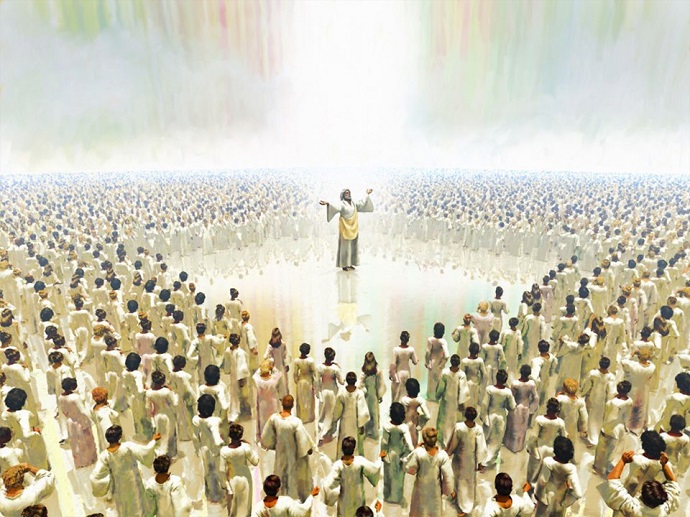
The role models for endurance (14:1-5).  Chapter 14 opens in stark contrast to Chapter 13’s end.  Moving from the Beasts and those who receive the mark, John’s attention falls on the Lamb and his army of 144’000 who bear the mark of His Father on their foreheads.  In our post on the 144’000 from chapter 7, we concluded that this group represents the fullness of people who remain loyal to Christ’s blood and who are saved by Christ’s blood.

From the contrasting groups, John hears contrasting sounds (14:2-3): God’s voice roars from heaven “like many waters” accompanied by “load thunders” (repeated in 8:5; 11:19; 16:18; refer 4:5), alluding to God’s justice and judgment from his Law (Exodus 19:16). This originates from his judgment on the and his worshiper (14:8ff).  John also hears the harpists’ joyful, tranquil music.  These come from the believers singing before the throne the song of the redeemed (compare 4:3 with 5:8-10) – a song that only those who have been saved by the blood of the Lamb can faithfully sing.

many_brides
        Here comes the brides!

The redeemed are described as those “who have not defiled themselves with women, for they are virgins… who follow the Lamb wherever he goes”. (14:4).  This phrase is not a reference to physical celibacy but spiritual fidelity, as it contrasts God’s faithful people to those seduced into “fornication” with “Babylon the Great, the mother of harlots and abominations of the earth” (14:8; 17:6).  Here, drawing from the Old Testament prophets (notably Hosea), John describes idolatry as the Church’s spiritual unfaithfulness to God symbolically with a married person’s immorality and sexual unfaithfulness towards his or her spouse.  Paul uses this imagery when he laments the Corinthians’ backsliding: I betrothed you to one husband, to present you as a pure virgin to Christ. But I am afraid that… your thoughts will be led astray from a sincere and pure devotion to Christ. (2 Corinthians 2:11).  But the ones before the throne are a bride “without blemish” (4:5; compare Ephesians 5:27).

The reason for endurance (14:6-12). The next section in this chapter outlines the basic theology of judgment, revealed by three angelic messengers.  Angel One proclaims…  the “eternal gospel: Fear God and give him glory.”  God is the creator of all the earth, that he is sovereign over all the nations, and that he will judge all people, everywhere – and that hour is soon (14:6-7).  Angel Two announces the destruction of “Babylon” because she leads people everywhere into idolatry and immorality (14:8; compare Isaiah 21, Jeremiah 51).  In chapters 18-19, the author returns to this theme, wherein Babylon is described as a city infested by demons and inhabited by the defiled (18:2).  Angel three decrees God’s wrath on the beast and all who bears his mark: eternal judgment in “fire and sulfur” (14:9-11) – an allusion to Hell…

 [Read the full commentary of Revelation in Faithful to the End]

Faithful to the End is a simple commentary that helps make sense of the encouraging message of Revelation.

Quick links to full THE END Revelation Series posts

1  2  3  4  5  6  7  8  9  10  11  12  13  14  15  16  17  18  19  20  21  22  23  24  25  26

The End? The Beast and his Mark

The Beast and his mark is the focus of this study as our 18th stop in our journey through Revelation brings us to the 13th chapter and its infamous images. A recording of this will be available on the Shofar Durbanville Youtube channel.

Political satires like Swift’s Gulliver’s Travels, Orwell’s Animal Farm, or even cartoonists like Zapiro, comment in their own generation on the need for renewal of human  society and government in particular.  Using creative and often comical images it portrays the politics and people of its day to show the flaws in ideology and society at large. Apocalyptic literature like Daniel, Ezekiel, and Revelation had this same purpose and pattern in its call for reform of God’s people and government in its day.

Beast_Daniel7_4
Four beasts described in Daniel 7.

Revelation 13 opens with John standing on the sand by the sea where he saw Christ standing as Sovereign over land and sea (10:2).  In this way he reminds the readers that whatever happens in the land or sea is within Christ’s control.

The First Beast: Political Power. Then he sees a beast like a lion, leopard and bear combined rising out of the sea having seven heads, ten horns and  crowns (like the Great Red Dragon in the previous chapter who gives him strength) – having a blasphemous name on his head (13:1-2). This image is an allusion to Daniel 7 – a reference to the four successive empires of Babylon, Persia, Greece and Rome. The Beast in Revelation 13, looking like a combination of these four beasts, hints to the Roman Empire of its day, but also represents every other human government that opposes Christ.

The Beast is an image of anti-Christ government.  Although the word anti-Christ does not appear in Revelation, John writes about it in his epistles.  “The world is passing away… it is the last hour, and as you have heard that antichrist is coming, so now many antichrists have come. Therefore we know that it is the last hour. “ (2:17-18)   Fifty years earlier, Paul also wrote about anti-Christ government already at work in the world (2 Thessalonians 2:7, 8-10).  Examples of these range from Pharaoh to Alexander the Great, Nero to Domitian, Ganges Khan to Napoleon, Stalin to Hitler, Mao to Castro, and Mugabe to Kim Jong Un.  The pages of history are filled with the blood from the oppressive regimes of the Beast.

Beast_sea3

What do we learn about this Beast of human government?  It is said to have full strength and great authority given to him.  It speaks blasphemies (13:1,5), implying it defames God and exalts itself to god-like status.  It gets its power from Satan himself (13:2).  Its rule is characterised by intimidation, conquest and carnivorous violence (13:2, 10).  It has the power to revive itself after defeat (13:3).  Christ permits this beast to yield his authority for “42 months” during which it will wage war against the Lord’s servants (13:8) –  implying the redemptive period from Christ’s resurrection to his return (as discussed in a previous post).

The way this beast wages war against the church is through intimidation, leading to suffering and death (as in the church at Smyrna, 2:8-14) or seduction, leading to cultural compromise (as in Laodicea, 3:14-22).

The Second Beast: Seductive Ideology. A second beast coming out of the land is introduced, likened to the Lamb in that it looks like a lamb but roars like a dragon (compare 13:11 with 5:5-6).  Here the relationship between the first Beast and the second Beast alludes to the relationship between Him who sits on the throne and the Lamb in that the second Beast yields the authority of the first Beast and causes all to worship him (13:12).  This second beast performs great signs and deceives many, telling people to worship the first Beast…. 

 [Read the full commentary of Revelation in Faithful to the End]

Faithful to the End is a simple commentary that helps make sense of the encouraging message of Revelation.

Quick links to full THE END Revelation Series posts

1  2  3  4  5  6  7  8  9  10  11  12  13  14  15  16  17  18  19  20  21  22  23  24  25  26

The End? The Lamb’s Army

This post, the 13th in our series through Revelation, is devoted to chapter 7 – the marking and listing of the Lamb’s army. A recording of this will be available on Shofar Durbanville’s Youtube channel as part of the Revelation Series.

Chapter 6 depicts Christ unfolding the scroll containing God’s redemptive plan for creation. This brought about terrible judgments so that eventually everyone on earth hid and cried out “Who can stand before the wrath of Him Who sits on the throne and the Lamb?” (6:17).  Chapter 7 answers this question.

Hold the wind! (7:1-3) Suddenly four angels were seen to hold back the four winds over the earth (7:1). Holding back the wind implies withholding the destructive forces released over creation by the first six seals (6:1-17; compare Ezekiel 5:12).  The reason for the pause in destruction is to wait until “we sealed the servants of our God on their foreheads” (7:3).  This protection from wrath by a seal from God alludes to Exodus 12:21-27 (destruction of Egypt, preservation of Israel) and Ezekiel 9:3-8 (destruction of Israel, preservation of the righteous).

Gideon_army
Gideon’s army defeats the Midianites (Judges 6-7). (Source: Moody Press, Free Bible Images)

The 144’000 (7:4-8).  These servants of God are identified as John hears a roll call of Israel’s fighting men, like in Numbers 1 before the conquest of Canaan.  The 144’000 are said to be 12’000 from every tribe in Israel. Remember that in the apocalyptic language of Revelation, images and numbers are not read literally, but should be read to signify something that comforted and challenged the first readers in their struggle against evil during their tribulation (1:9-11).

This number of 144’000 faithful Israelite have been used – and is still being used – by many cults worldwide who claim their veracity and special election.  But 144’000 is clearly a symbolic number (like the 7 horns and 7 eyes of the Lamb in chapter 5).  144’000 is made up of 12x12x1000.  Twelve in  a (?)literary genre points to God’s covenant people: the 12 tribes of Israel and the 12 apostles of the Church.  1000 is a number meaning innumerable, all or fullness.  So, John hears: “Mark God’s people with his seal!” and is told Israel’s faithful, fighting ones are numbered.

In keeping with the apocalyptic genre, Israel here should also not be viewed from the genetic line or national citizenship, but rather as symbolic of God’s covenant people. Jesus said that “salvation is from the Jews”, not just for the Jews (John 4:22). Paul defined “a true Jew (as) one inwardly” (Romans 2:29)having a “circumcised” or transformed heart faithful to God This tribal list here in Revelation 7 is a picture of “the Israel of God” (Galatians 6:15-16).

But this list of Israel’s tribes is unlike any other found in Jewish scriptures (compare, for instance, Genesis 35:23-26; 49:1-28; Numbers 1:1-46, and Deuteronomy 33:6-25) – and that is the point of this part of the vision.  The discrepancies in this list highlight the truth Jesus wants to show John…  [Read the full commentary of Revelation in Faithful to the End]

Faithful to the End is a simple commentary that helps make sense of the encouraging message of Revelation.

Quick links to full THE END Revelation Series posts

1  2  3  4  5  6  7  8  9  10  11  12  13  14  15  16  17  18  19  20  21  22  23  24  25  26