The End? The reign of peace

This 24th post looks into the 20th chapter of Revelation.  A recording of this study is available on Shofar Durbanville’s Youtube channel.

What is wrong with the world?  And what will make everything right again?  How you answer these questions defines your religion and your approach to and expectation of life itself.  This is the focal point of Revelation 20.  John describes the end of Satan, sin and death, ushering in 1000 years of peace.  This 1000 years of peace,  called the millennium (Latin for thousand), is the cause of much debate in Christian circles.  

If you are new to Christianity, the millennium debate might seem strange.  However, six times in this chapter, 1000 years are mentioned, which is central to the meaning of this chapter.  Moreover, this reign of peace is central to the message of Revelation: the destruction of Satan’s earthly forces (Babylon, the Beast and the False Prophet) in the previous chapters and here the end of Satan, sin and death, signifying the culmination of Christ’s work of redemption – making the 1000 years of peace possible.  From John’s perspective, the millennial reign of peace is central to God’s plan to redeem creation and, therefore, significant for you and me. It is what the church – and all mankind – longs for.  How we make sense of this chapter will impact your view and expectations of life.

What is John’s vision of 1000 years of peace, then? When is it? John’s Millennium can be read in three primary ways.

millennial-views

Premillennialism expects Jesus to return and end the tribulation, reign in peace for 1000 years, and then make an end to Satan, sin and death. This is the most prominent view among Christians in the West today.

Postmillennialism expects the church, through the Gospel, to usher in God’s peaceful reign for 1000 years before Christ returns to judge the world.

Amillennialism reads the 1000 years as symbolic, having been initiated by Christ’s death, resurrection and ascension.  From this perspective, we are now in this thousand years of peace.

All three of these views are held by very learned people who have given much thought to these views.  Sadly, some beautiful truths in Revelation remain unnoticed in all the dust kicked up by the debates about when the millennium will or has commenced (d).  Let’s walk through the chapter and ask ourselves, “What did John see, and what could this have meant to him?”

The end of Satan (20:1-3, 7-10).  An angel descends from heaven and binds Satan in the Abyss, sealing the pit. Satan is tied up not by God, not by Christ, not by a known archangel like Michael or Gabriel. Instead, Satan is bound by some ordinary angel who “came down from heaven.”  This reassured  John that Satan is not God’s equal and never a threat to God’s authority or purposes.  Although Satan persecuted the church on earth and gave power to the empires of the Beast, the Sovereign Lord allowed Satan to roam loose in service of his redemptive plan. Once the Devil had served his purpose, God commissioned an angel to bind him up.  At an appointed time, Satan will be released briefly again to serve God’s redemptive purpose in bringing judgment on the wicked nations.  After that, he will be thrown into the lake of fire forever, joining his servants, the Beast and the False Prophet.

The thousand years (20:2-7). One thousand years” is mentioned six times in these six verses – the only place in the Bible explicitly naming the thousand years of peace.  How do we read it?  For one, we know that we cannot read this as literal ten centuries in the apocalyptic genre. This genre calls for a symbolical interpretation, just as we read the seven horns and seven eyes of the Lamb of God to convey a particular truth about Christ.  We also note this symbolism elsewhere in the Bible.  When we read that God “owns the cattle on a thousand hills” (Psalm 50:10), we don’t ask, “On which thousand hills do God’s cattle roam?”  When reading “with the Lord, a day is like a thousand years” (2 Peter 3:8), we don’t start calculating our age in God-years; instead, we understand that the Ever-living One is not bound by time as we are…

 [Read the full commentary of Revelation in Faithful to the End]
Faithful to the End is a simple commentary that helps make sense of the encouraging message of Revelation.

Quick links to full THE END Revelation Series posts

1  2  3  4  5  6  7  8  9  10  11  12  13  14  15  16  17  18  19  20  21  22  23  24  25  26

The End? The dragon, the woman and the boy

This 17th study through Revelation focuses on the age-old war between the dragon, the Woman, and her offspring.  We will stop at chapter 12 today.  A recording will be uploaded to Shofar’s YouTube channel

If Jesus is victorious, and Satan is defeated, why are things in such a wrong way?  This question rang in the minds of the oppressed believers in John’s day – the question that gets answered clearly in chapter 12.  The first half of the Revelation focused on the reality of the church (ch 1-3), God’s throne room and Christ’s unfolding reign played out on earth (ch 6-11).  Chapter 12 reveals the cosmic battle in heaven, which results in chaos on earth and persecution of the saints.

Revelation 12 depicts an epic war between a woman with a male child and a great red dragon.  This scene from the middle of the book is the first of seven “signs” or symbols that explore the depth of the scroll’s message.  These seven “signs” depict greater mysteries that govern our world’s realities and are rich in theological substance, helping the church make sense of its struggles on earth. (See 12:1-7; 13:1-10; 13:11-18; 14:1-5; 14:6-13; 14:14-20; and 15:2-4).

You will note again in this chapter that Revelation is not a chronological roll-out of God’s redemptive plan but, in various ways, depicts the church’s struggle with evil throughout history.  Although chapter 11 concludes with a picture of the 7th trumpet as God’s Final judgment and victory in the end, chapter 12 revisits the origin of this battle, starting in Eden, in Bethlehem and Jesus’ ministry.  But this time, the struggle is shown from heaven’s perspective.

This sign introduces three characters: the Woman, the great red dragon, and the male child. Who are they  

woman_Rev12_1
By Ted Larson (2004)

The Woman is said to be clothed in the sun, the moon at her feet, having twelve stars around her head – an allusion to Israel in Joseph’s dream (12:1; Genesis 37:9).  But there is more: this woman “gave birth to a male child, one who is to rule all the nations with a rod of iron” (12:5; compare Psalm 2:9) – representing Mary, the mother of Jesus.  Furthermore the dragon wages war with the Woman and her offspring – an allusion to the curse on the serpent in the garden of Eden and Eve (12:17; compare Genesis 3:15).  And lastly, we read that this Woman’s offspring are “those who keep the commandments of God and hold to the testimony of Jesus” (12:17)– meaning that the Woman also represents the church.

The Woman in Revelation 12’s first sign simultaneously represents Israel, Mary, Eve, and the church—God’s redeemed Kingdom people throughout the ages. This is another depiction of the Lamb’s army, or 144’000 from every tribe, tongue, people, and nation depicted in Revelation 7.

OXYGEN

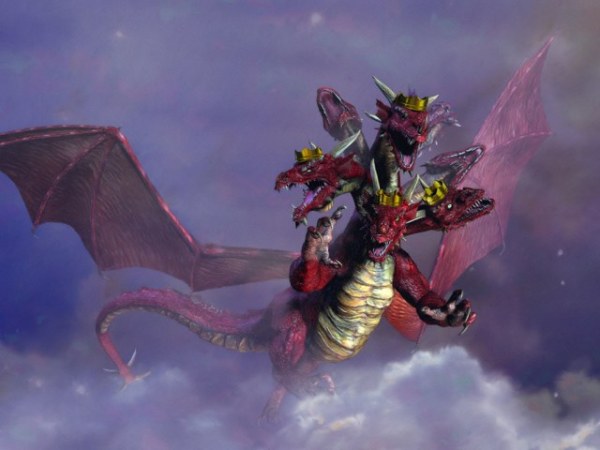
The Red Dragon is “great”, with seven heads, seven horns, seven diadems and a large sweeping tail – a picture of full strength and reign.  This dragon is “the ancient serpent” of Eden, named “the devil and Satan, the deceiver of the whole world” (12:9).  In the chapters to follow, we will see that the Dragon is the source of power behind the beasts (all that is oppressive and intimidating), Babylon the great prostitute (all that is sensual and seductive), and the False Prophet (all that is deceptive).  The Red Dragon symbolises all that is oppressing, seducing and deceiving God’s people.

Revelation-12-woman-child-dragon

The Male Child is the man Jesus, the Son of God, “one who is to rule all the nations with a rod of iron… [and] was caught up to God and to his throne” (12:5, compare with Psalm 2:9 and Acts 1:9).  This is not meant to be read that Jesus was taken away as a child. Still, these things are said so we may know his and the Woman’s identities. This drama focuses on the battle between the Dragon and the Woman.

The Drama. [Read the full commentary of Revelation in Faithful to the End]


Faithful to the End is a simple commentary that helps make sense of the encouraging message of Revelation.

Quick links to entire THE END Revelation Series posts

1  2  3  4  5  6  7  8  9  10  11  12  13  14  15  16  17  18  19  20  21  22  23  24  25  26