The End? The Reason to Endure

In this 19th study of revelation we look at need for salvation and the reality judgment and Hell in chapter 14.  A recording of this will be uploaded at the Shofar Durbanville Youtube channel.

endurance1

“What’s the point of all this hardship? Why push through the pain?  Others have given up, and they seem to be having an easier life! What can be worth this much effort?”  Whether it’s a marathon, long-term studies, a gruelling project or a start-up initiative – somewhere along the road, you will ask that question in agonizing pain.  So, too, in your journey of faith.

The answer to this question is what Revelation 14 offers to struggling churches.  The scenes instil courage in the hearts of believers tempted to give in or give up, but it does not shy away from the sober reality of what is at stake.  The chapter is divided into three logical sections, revealing the role models, the reason and the reward for endurance.

The role models for endurance (14:1-5).  Chapter 14 opens in stark contrast to Chapter 13’s end.  Moving from the Beasts and those who receive the mark, John’s attention falls on the Lamb and his army of 144’000 who bear the mark of His Father on their foreheads.  In our post on the 144’000 from chapter 7, we concluded that this group represents the fullness of people who remain loyal to Christ’s blood and who are saved by Christ’s blood.

From the contrasting groups, John hears contrasting sounds (14:2-3): God’s voice roars from heaven “like many waters” accompanied by “load thunders” (repeated in 8:5; 11:19; 16:18; refer 4:5), alluding to God’s justice and judgment from his Law (Exodus 19:16). This originates from his judgment on the and his worshiper (14:8ff).  John also hears the harpists’ joyful, tranquil music.  These come from the believers singing before the throne the song of the redeemed (compare 4:3 with 5:8-10) – a song that only those who have been saved by the blood of the Lamb can faithfully sing.

many_brides
        Here comes the brides!

The redeemed are described as those “who have not defiled themselves with women, for they are virgins… who follow the Lamb wherever he goes”. (14:4).  This phrase is not a reference to physical celibacy but spiritual fidelity, as it contrasts God’s faithful people to those seduced into “fornication” with “Babylon the Great, the mother of harlots and abominations of the earth” (14:8; 17:6).  Here, drawing from the Old Testament prophets (notably Hosea), John describes idolatry as the Church’s spiritual unfaithfulness to God symbolically with a married person’s immorality and sexual unfaithfulness towards his or her spouse.  Paul uses this imagery when he laments the Corinthians’ backsliding: I betrothed you to one husband, to present you as a pure virgin to Christ. But I am afraid that… your thoughts will be led astray from a sincere and pure devotion to Christ. (2 Corinthians 2:11).  But the ones before the throne are a bride “without blemish” (4:5; compare Ephesians 5:27).

The reason for endurance (14:6-12). The next section in this chapter outlines the basic theology of judgment, revealed by three angelic messengers.  Angel One proclaims…  the “eternal gospel: Fear God and give him glory.”  God is the creator of all the earth, that he is sovereign over all the nations, and that he will judge all people, everywhere – and that hour is soon (14:6-7).  Angel Two announces the destruction of “Babylon” because she leads people everywhere into idolatry and immorality (14:8; compare Isaiah 21, Jeremiah 51).  In chapters 18-19, the author returns to this theme, wherein Babylon is described as a city infested by demons and inhabited by the defiled (18:2).  Angel three decrees God’s wrath on the beast and all who bears his mark: eternal judgment in “fire and sulfur” (14:9-11) – an allusion to Hell…

 [Read the full commentary of Revelation in Faithful to the End]

Faithful to the End is a simple commentary that helps make sense of the encouraging message of Revelation.

Quick links to full THE END Revelation Series posts

1  2  3  4  5  6  7  8  9  10  11  12  13  14  15  16  17  18  19  20  21  22  23  24  25  26
The End? Faithful until death.

This post is the fourth in a series on the book of Revelation. The link below takes you to a video recording of this blog post.

How does one endure hardship, and why? Why does God allow his people to undergo seasons of suffering? And where is God when it hurts? These are some of the questions that Jesus answers in the Revelation, a circular letter written by the apostle John to seven congregations in Asia Minor during the tyrannical reign of Emperor Domitian (AD 90-92).

St_Polycarp_of_Smyrna
Polycarp, Pastor at Smyrna (69 – 155 AD)

“Eighty-six years I have served Him, and He never did me any injury: how then can I blaspheme my King and my Saviour? …You threaten me with fire that burns only for an hour… but you are ignorant of the coming judgment and of eternal punishment reserved for the ungodly. What are you waiting for? Bring on what you will!” 

These were the last words St Polycarp, a famous martyr during another wave of heightened Roman persecution, revealing the church’s grit and attitude in Smyrna.  Polycarp was a pupil of the Apostle John and probably the “angel of the church” (messenger or leader) in Smyrna whom Jesus was addressing in Revelation 2:8-11.

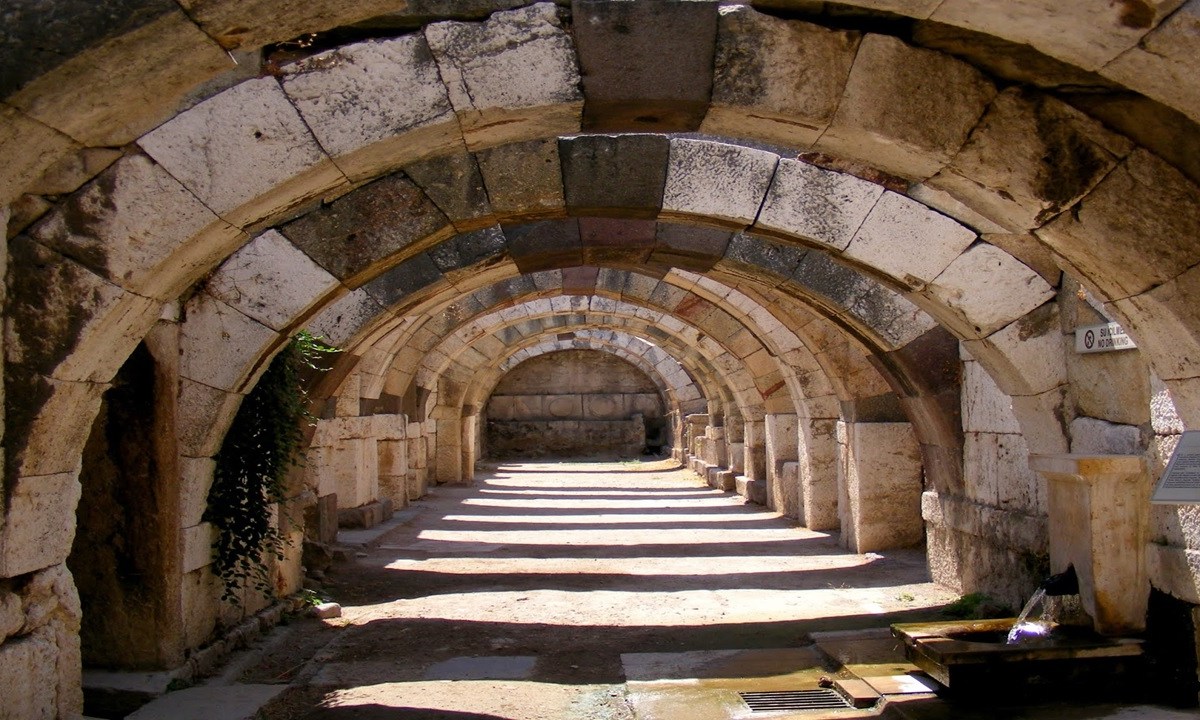
Smyrna, present-day Izmir in Turkey, printed coins which claimed it was “the biggest and most beautiful city in Asia.” This coastal city was prosperous because of the trade routes and its natural beauty.  The town was filled with magnificent temples and statues – some of these are well preserved today.  The figure of Bacchus (Roman) or Dionysus (Greek), god of wine and immoral revelling tells us much about the day’s culture.  So also, the statue Cybele, mother of the gods, reveals that in this city, women were honoured or even venerated within certain people groups.  The citizens of this Greek city were loyal to Rome, dedicating a temple to the goddess Roma around 195 BC.  It also had a temple preserved for the Imperial Cult, devoted to worshipping the emperor.

collage_Smyrna

Persecuted by the Jews. At the end of the first century (AD), Smyrna boasted a large community of Jews, bolstered by the migration of Judeans after the destruction of Jerusalem during The Jewish War (a significant rebellion against the Roman Empire, 66 AD – 73 AD). These Jews were especially hostile to Christians – in part because during the siege of Jerusalem (70 AD) Christian Jews fled the city (prompted by a prophetic Word from the Lord), just before the total destruction of the city and its temple. Also, the Jews viewed the worship of Jesus as an abomination.  These Jews were often the first to hand known Christians over to the Roman authorities for punishment.

Poor Christians. In this city, as in the broader community, Christians were often excluded from the formal employment sector because of the refusal to partake in the worship of the gods of the guilds (first-century trade unions).  In this pagan society, each guild had its god(s) who demanded tribute in exchange for prosperity.  Since Christians refused to worship any other gods, conversion implied the end of their careers.  The only jobs they could take were for the “cursed” in society: garbage removal, sewerage cleaning, the burial of the dead, etc.  Therefore, being Christian was synonymous with being poor in the early Church.

The letter to Smyrna follows the same structure as the other letters: opening with a unique and personal Revelation of Christ to them, it complies with a commendation, a charge, then a warning and finally a promise of reward.  However… [Read the full commentary of Revelation in Faithful to the End]

Faithful to the End is a simple commentary that helps make sense of the encouraging message of Revelation.

Quick links to full THE END Revelation Series posts

1  2  3  4  5  6  7  8  9  10  11  12  13  14  15  16  17  18  19  20  21  22  23  24  25  26

The End? Living from the heart.

This post is the third stop in our reflective journey through the book of Revelation, bringing us to the letter to the Ephesian church (2:1-7).  For a brief video recording of this post, click here or on the image below.

Remember that song “You’ve lost that Lovin’ Feeling” from the Righteous Brothers, popularized by the original Top Gun movie (1986)?  It gets to the heart of Jesus’ first letter to the churches, the church in Ephesus.

Ephesus was a prominent port city in the Aegean Sea, on the Western shore of modern-day Turkey, about 80 km south of Izmir, rich in archaeological discoveries.

Collage_Ephesus

Ephesus became the provincial seat of Roman government into Asia. It was renowned for its scholarship, housing Heraclitus’ first university and the Great Library of Celsus (top left). The city was a cultural hub as witnessed in the well-preserved great Amphitheatre (bottom right).  The city was a religious centre, most notably because of the temple (top right) of Artemis (Greek, central image) or Diana (Roman), and later because of the Christian influence.  In contrast, Ephesus was also known for its “sin industry” through the sailors frequenting its busy seaport.  Its unique setting and well-developed harbour (bottom left) made it a trade hub into Asia and Greece – notably the Silk Trade Route.

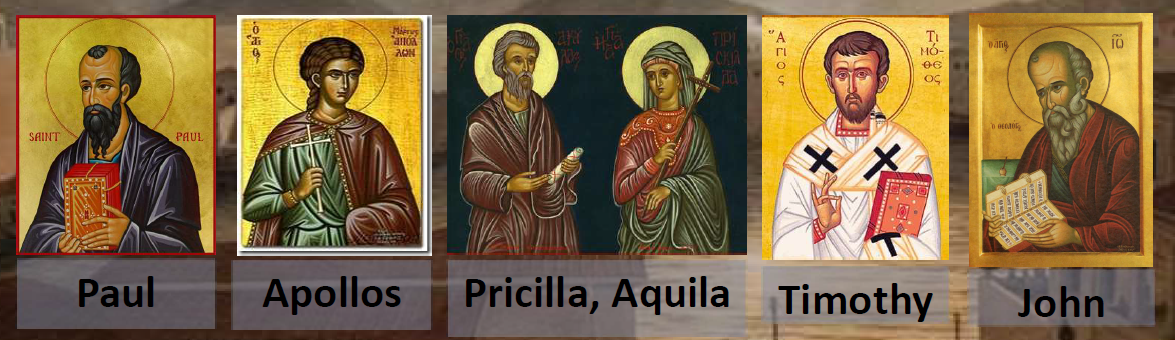
These political, religious, educational, cultural and trade hubs made Ephesus very influential in the region.  No wonder Paul stopped and spent more than 2 years there (Acts 19).  It is fair to say that, after Antioch, Ephesus was the most prominent church in the New Testament.  Other big apostolic leaders made Ephesus their headquarters, including Apollos, Priscilla and Aquila, Timothy and John. In some way, the church in Ephesus still has the greatest influence in the church today because many of the New Testament letters were written either from or to the church in Ephesus.

collage_ephesus_pastors
Apostolic leaders that settled in Ephesus for a significant time in the first century.

It is therefore not strange that the first church Christ addresses in his letters is the church in Ephesus.  By the time John penned these words of Jesus the Ephesian church was more than 50 years old – a second-generation church that had grown significantly and endured a few waves of severe persecution from various emperors.

Keep in mind that this short, personal letter to the Ephesian believers is part of a circular letter to the seven congregations (1:11) with the aim to comfort the persecuted believers and to correct their perspective in their struggle against evil.  As with each of these seven letters, this letter starts with a unique revelation of Christ, followed by a commendation, a condemnation, a charge, then a warning and finally a promise of reward.

[Read the full commentary of Revelation in Faithful to the End]

Faithful to the End is a simple commentary that helps make sense of the encouraging message of Revelation.

Quick links to full THE END Revelation Series posts

1  2  3  4  5  6  7  8  9  10  11  12  13  14  15  16  17  18  19  20  21  22  23  24  25  26