The End? The end of Evil

This 22nd post in our series through Revelation studies the message of chapter 18. A recording of this is available on the Shofar Durbanville Youtube channel.

We use metaphors in our daily conversations to bring across rich ideas.  We refer to “Wall Street” collectively as the market economy system.  “Hollywood” is synonymous with the movie industry.  “Newspapers” rarely refer to printed media but rather journalism as a whole.  The “Cayman Islands” are synonymous with tax havens.   In the same way, we use words like “The East”, “The West”, or “9-11” to bring across collective ideas and, with it, powerful sentiments.

Revelation is full of metaphors that are meant to move its readers emotionally.  We read about Christ being the Alpha and Omega, the Bright Morning Star, the Lamb of God, the Lion of Judah, etc.  Judgments are depicted as seals, trumpets and bowls.  The Church is called golden lampstands, the 144’000, the Bride of Christ, the New Jerusalem, etc.  In contrast, Rome is depicted as the Beast, the Great Harlot, Babylon, etc.  Just as the 144’000 refer to God’s saints through the ages (7:4-8)Babylon also refers to more than Rome.  It refers to all who “want to make a name for themselves” (Babel, Genesis 11:4), any and all empires or ideologies that resist God and his reign.

Revelation 18 paints the picture of the destruction of Babylon with a funeral scene. In it the Author alludes to the judgments of the pagan cities Sodom and Gomorrah (Genesis 19), ancient Babylon (Is 13:19-21) and Edom (Is 34:11-17).  John’s vision reveals three reasons for the destruction of Babylon – a warning to all.

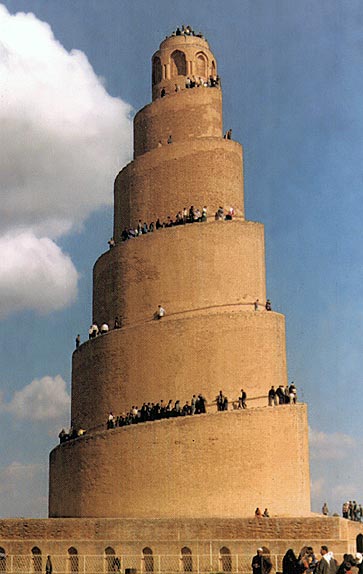
tower_Babel0
Al Samara, Iraq.

Self-glorification (18:7-8). “Because she glorified herself”, God poured out on her the seals and trumpets and bowls.  Six times in this chapter, Babylon is called “great” (18:2, 10, 16, 18, 19, 21); like ancient Babel, this city has succeeded in making a name for herself (Genesis 11:4).  Her boasting alludes to the arrogance of King Nebuchadnezzar who said “Is not this great Babylon, which I have built by my mighty power as a royal residence and for the glory of my majesty?” (4:30).  That very moment God brought the proud king down.  Indeed, “pride goes before destruction” (Proverbs 16:18). Indeed, “God resists the proud, but gives grace to the humble” (James 4:6).

The self-glorification and destruction of Babylon are in stark contrast to the thankful humility and exaltation of the New Jerusalem, which “has no need of sun or moon to shine in it, for the glory of God gives it light, and its lamp is the Lamb.” (Revelation 21:23)

Roman_Wealth
Emperor Crassus, the richest man in his time (www.nationalgeographic.com)

Power, prosperity and perversion (18:3).  The Caesars of Rome promised peace and prosperity to all who submitted to their rule through the Pax Romana.  The life they offered was one of sensuality, wealth and security through its military might.  To the first recipients of Revelation, “Babylon” pointed to Rome.  In this chapter, we see three groups of people mourning its destruction: “Kings” representing the pursuit of power, “merchants” representing the pursuit of prosperity, and “ship masters and sailors” representing the pursuit of immoral pleasures (18:9,11,17).  The Author shows that Babylon is destroyed because it seduces and ensnares people with the lure of power, wealth and immoral living. 

The bulk of the chapter is directed at Babylon’s failed promise of prosperity and its lure of “luxury” (repeated three times 18:3,7,9).  Riches are said to be “deceitful” (Matthew 13:22) because it promises joy and peace – the fullness of life – but Jesus warns that life does not consist in the accumulation of wealth and possessions (Luke 12:15).  The same can be said about Babylon’s lies promising power and sensuality…

 [Read the full commentary of Revelation in Faithful to the End]

Faithful to the End is a simple commentary that helps make sense of the encouraging message of Revelation.

Quick links to full THE END Revelation Series posts

1  2  3  4  5  6  7  8  9  10  11  12  13  14  15  16  17  18  19  20  21  22  23  24  25  26

The End? The Beast and his Mark

The Beast and his mark is the focus of this study as our 18th stop in our journey through Revelation brings us to the 13th chapter and its infamous images. A recording of this will be available on the Shofar Durbanville Youtube channel.

Political satires like Swift’s Gulliver’s Travels, Orwell’s Animal Farm, or even cartoonists like Zapiro, comment in their own generation on the need for renewal of human  society and government in particular.  Using creative and often comical images it portrays the politics and people of its day to show the flaws in ideology and society at large. Apocalyptic literature like Daniel, Ezekiel, and Revelation had this same purpose and pattern in its call for reform of God’s people and government in its day.

Beast_Daniel7_4
Four beasts described in Daniel 7.

Revelation 13 opens with John standing on the sand by the sea where he saw Christ standing as Sovereign over land and sea (10:2).  In this way he reminds the readers that whatever happens in the land or sea is within Christ’s control.

The First Beast: Political Power. Then he sees a beast like a lion, leopard and bear combined rising out of the sea having seven heads, ten horns and  crowns (like the Great Red Dragon in the previous chapter who gives him strength) – having a blasphemous name on his head (13:1-2). This image is an allusion to Daniel 7 – a reference to the four successive empires of Babylon, Persia, Greece and Rome. The Beast in Revelation 13, looking like a combination of these four beasts, hints to the Roman Empire of its day, but also represents every other human government that opposes Christ.

The Beast is an image of anti-Christ government.  Although the word anti-Christ does not appear in Revelation, John writes about it in his epistles.  “The world is passing away… it is the last hour, and as you have heard that antichrist is coming, so now many antichrists have come. Therefore we know that it is the last hour. “ (2:17-18)   Fifty years earlier, Paul also wrote about anti-Christ government already at work in the world (2 Thessalonians 2:7, 8-10).  Examples of these range from Pharaoh to Alexander the Great, Nero to Domitian, Ganges Khan to Napoleon, Stalin to Hitler, Mao to Castro, and Mugabe to Kim Jong Un.  The pages of history are filled with the blood from the oppressive regimes of the Beast.

Beast_sea3

What do we learn about this Beast of human government?  It is said to have full strength and great authority given to him.  It speaks blasphemies (13:1,5), implying it defames God and exalts itself to god-like status.  It gets its power from Satan himself (13:2).  Its rule is characterised by intimidation, conquest and carnivorous violence (13:2, 10).  It has the power to revive itself after defeat (13:3).  Christ permits this beast to yield his authority for “42 months” during which it will wage war against the Lord’s servants (13:8) –  implying the redemptive period from Christ’s resurrection to his return (as discussed in a previous post).

The way this beast wages war against the church is through intimidation, leading to suffering and death (as in the church at Smyrna, 2:8-14) or seduction, leading to cultural compromise (as in Laodicea, 3:14-22).

The Second Beast: Seductive Ideology. A second beast coming out of the land is introduced, likened to the Lamb in that it looks like a lamb but roars like a dragon (compare 13:11 with 5:5-6).  Here the relationship between the first Beast and the second Beast alludes to the relationship between Him who sits on the throne and the Lamb in that the second Beast yields the authority of the first Beast and causes all to worship him (13:12).  This second beast performs great signs and deceives many, telling people to worship the first Beast…. 

 [Read the full commentary of Revelation in Faithful to the End]

Faithful to the End is a simple commentary that helps make sense of the encouraging message of Revelation.

Quick links to full THE END Revelation Series posts

1  2  3  4  5  6  7  8  9  10  11  12  13  14  15  16  17  18  19  20  21  22  23  24  25  26

The End?A Throne set in Heaven.

In this 10th session in our series of Revelation, John is invited to “come up here” and see God’s throne room, and view life from his perspective (Revelation 4).   A recording of this will be made available at Shofar Durbanville’s Youtube channel.

Revelation 4 starts with the phrase “after this” – after the first part of the vision of Christ among the seven churches, addressing each of them with a specific word of comfort and correction (chapters 1 – 3).  Then John looks up – shifts his perspective from down here on earth to what is going on in heaven.  He sees “a door open in heaven” and is invited to “come up here” – to gain a Godly perspective on the chaos and conflict the church endures on earth and to identify with the Sovereign reign of God.

Imagine this! The only instruction the reader receives in this chapter is to “behold” (4:1,2) – to imagine this or picture this.  John invites the reader twice to see what he sees – because this hopeful message to the church is contained in the vision of what takes place in heaven.  John sees a throne, the Ruler, and the response of those around the throne.

A Universal Throne (4:2).  As he enters the door, John sees a magnificent throne. The early church was familiar with a throne over many peoples and nations – and that was not good news to them. Emperor Domitian’s reign (like those before him) was egocentric and brutal.  But this throne John sees was universal over all of creation – he was the true King of kings and Lord of lords who Domitian claimed to be.  The throne was not the problem – the one who sits on the throne determines whether his subjects will weep or rejoice.  And this is what John sees next…

[Read the full commentary of Revelation in Faithful to the End]


Faithful to the End is a simple commentary that helps make sense of the encouraging message of Revelation.

Quick links to full THE END Revelation Series posts

1  2  3  4  5  6  7  8  9  10  11  12  13  14  15  16  17  18  19  20  21  22  23  24  25  26

The End? No more Compromise.

This post is the fifth post in a series through the book of Revelation.  Follow this link to a video recording of this post.

The Revelation John received was sent as a circular letter along a logical postal route through Asia Minor which started at the bustling city of Ephesus, moving north to ancient Pergamum, inland through Thyatira, and southeast to the wealthy city of Laodicea.  This letter contained a prophecy from Christ to these seven churches to comfort them during the tyrannical reign of emperor Domitian (AD 90-92), to correct their perspective in their fight against evil, and to charge them to remain faithful to Christ. There is a reward for those who remain loyal to the end!

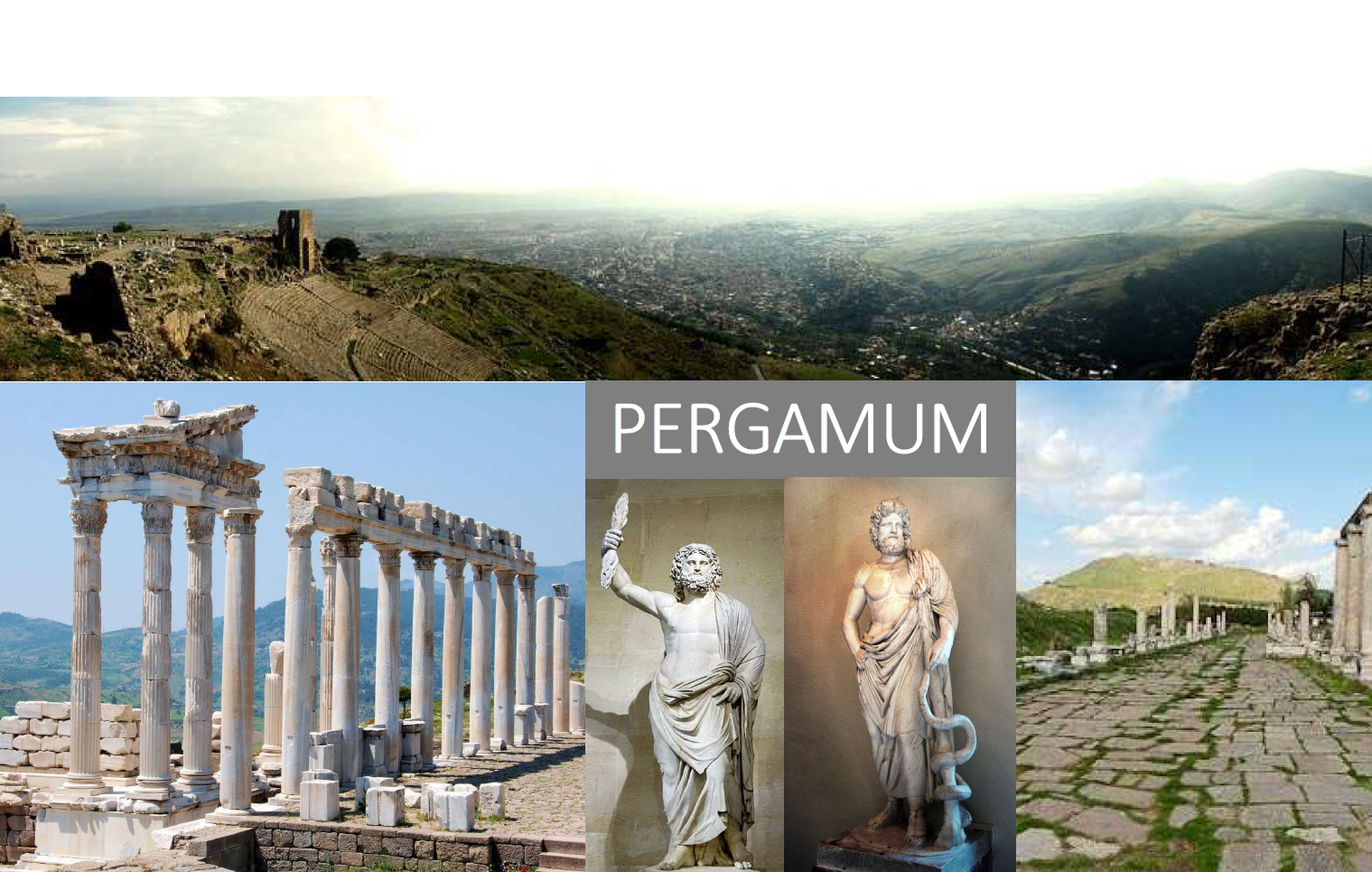
Pergamum, set on a hilltop overlooking the Caicus plain below, was a magnificent ancient city which exited from the springs of civilization in Asia (around 500 BC).  Pergamum (modern-day Bergama) lay about 55 miles north of Smyrna, inland from the Aegean coast.  The archaeological findings in this great city are rich in religious artefacts, including statues and temples of Zeus, Athena, Dionysos (Baccus in Roman mythology), and especially Asklepios, the god of medicine, whose cult was strong and accounted for the prestigious school of medicine in Pergamum. Asklepios’ serpent was a prominent brand in the city, displayed on many of the coins pressed there.

Apart from the medical school, the city was famous for its vast library, university, big parchment industry and the large amphitheatre overlooking the valley.  It was also a strategic Roman stronghold and inland regional administration, boasting the first Asian temple of the Imperial Cult in honour of Augustus (AD 29).  

collage_Pergamum

Within this ancient citadel which worshipped Domitian as king and lord, valued entertainment, education and science, was a vulnerable church who received this letter of comfort and correction, a charge to not compromise their devotion to Christ in word or in deed (Revelation 2:12-18).

The Revelation of Jesus Christ (2:12).  Christ is revealed as… [Read the full commentary of Revelation in Faithful to the End]

 
Faithful to the End is a simple commentary that helps make sense of the encouraging message of Revelation.

Quick links to full THE END Revelation Series posts

1  2  3  4  5  6  7  8  9  10  11  12  13  14  15  16  17  18  19  20  21  22  23  24  25  26