unLimited – embracing the gift of limits

Have you felt stretched too thin lately? Worn out or burnt out? You are not alone. Our culture fights against limits and pushes against the boundaries that frame our lives. We don’t want to miss out. “More is better”, we believe, so we try harder to experience more to get more. Yet, there is always more. This leaves us unsatisfied, angry and exhausted.

Our marketing memes show our belief that “more is better.” Just add the word “unlimited,” and customers will buy whatever you sell. Because we believe the good life is found beyond our boundaries, we always strive for more. We war against the boundaries of our lives but end up fatigued, frustrated, fearful, and flat—in a word, lifeless. How is it that “more” leaves me feeling “empty”?

In a world where limitless is life, we fantasise about superheroes. Yet we are creatures, not gods. We are limited beings, blessed to thrive within our boundaries. Pete Scazzero lists some limits that we all can relate to. My life on this earth is a blessing, but it is brief; I can’t escape death. My mind has its limits, regardless of my learning. My personality or temperament has its strengths and weaknesses in every situation. My gifts are great, but it has their limits. My family or origin gifts me within a particular cultural, financial and social context; this is a blessing, but it holds its limits. Whether I am rich or poor, black or white, male or female – each attribute empowers and impedes me in life. Likewise, my own past (actions and experiences) holds great treasures, but with its limiting consequences. Each season of life has its gifts and limitations; we can’t change that – only embrace the season with its invitation and limitation.

The Apostle Paul also wrestled with his human limitations. In 2 Corinthians 12:7-10, he recounts a life-altering meeting with Jesus that changed his perspective on limits. “…I have received such wonderful revelations from God. So, to keep me from becoming proud, I was given a thorn in my flesh, a messenger from Satan to torment me and keep me from becoming proud. Three different times I begged the Lord to take it away. Each time he said, “My grace is all you need. My power works best in weakness.” So now I am glad to boast about my weaknesses so that the power of Christ can work through me. 10 That’s why I take pleasure in my weaknesses, and in the insults, hardships, persecutions, and troubles that I suffer for Christ. For when I am weak, then I am strong.”

Paul’s reference to “a thorn in the flesh” is often misunderstood as a slight pinch in the foot. But, Pete Scazzero explains that the original language referred to a pike-like military defensive barrier (see image below). Today, Paul might have used “a sharp palisade fences or barb-wire in my flesh.” Pressing against this barrier caused him anguishing pain and left him feeling frustrated (angry and powerless).

Many have speculated about this “thorn in the flesh” in Paul’s letter. Some read Paul’s “thorn in the flesh” as a painful or shameful bodily obstacle that inhibited his life or mission. It might have been a speech impediment, like Peter’s lisp (Matthew 26:72-73) or Moses’ stuttor (Exodus 4:10). Others think Paul lived with a painful and debilitating eye infection (see Galatians 4:13-15, 6:11). Some sceptics believed Paul suffered from episodes of epilepsy (because of his disabling visions, as in Acts 9:3-9 and 2 Corinthians 12:7. Yet, others argue that Paul used the phrase “thorn in flesh” metaphorically to refer to emotional pain caused by his loneliness or the ongoing opposition by the Judaizers who constantly discredited his message and character. A last group believed that Paul’s torment was only spiritual, caused by some demonic “messenger from Satan”.

Whatever it was, we know that this “thorn in the flesh” was painful and limiting. Paul suffered from it and could not fix the problem himself. His prayers were not answered either – the Lord did not relieve him of this burden either.

Our culture does not readily accept the limits of “no.” Our culture believes you can do anything and everything if you put your mind to it. Not accepting limits or “no” leaves us exhausted, angry, and inhibited. What can we learn from Paul’s message?

Flourishing within limits

The Bible includes examples of people who served God with tremendous freedom despite their limitations. These limits did not hamper the ministry or legacy of these faith heroes; instead, these faith heroes flourished within these limits, often because of these limits. Jesus taught that “blessed are the meek, for theirs is the kingdom of heaven.” Meekness means submission to restraints as a horse submits to the saddle and bridle of a rider. We are blessed (better off) when we learn to rest within our constraints and trust that God can and will give us goodness here where we find ourselves.

Moses’ life-long speech impediment did not prevent him from fulfilling his call. It seems ironic that, despite all the miracles performed through Moses, the Almighty did not heal him of his stutter. God chose to appoint a man with a speech impediment as his spokesman. In his weakness, God’s power was made known.

David was small, the youngest and most neglected member of his family. Yet God chose this insignificant shepherd boy to deliver his people from the Philistine giant and unite them in one glorious kingdom.

Daniel and his friends were enslaved, yet his God’s sovereignty was made known through these young Hebrews as they faithfully served their captors in the palace.

John the Apostle was a political prisoner on the Island of Patmos, far removed from the oppressed churches under his care. Yet here, God revealed powerful visions with messages of hope that have served the church for millennia.

Likewise, Paul’s most potent and lasting ministry was from within a Roman prison, as he learned to rely on God’s grace. He discovered that these impediments taught him not to become proud (happy, independent, or self-reliant) but rather to rely on God’s grace. “My grace is all you need. My power works best in weakness.” 

Jesus Christ is God in the flesh, living as a poor Jewish boy raised in an insignificant rural village while the mighty Roman Empire ruled his people. This God suffered hunger, ridicule, shame, betrayal, torture and violent death. Through this, God restored his kingdom and delivered all who trusted in him from death.

My limitations as gifts

Paul discovered that the “thorn in his flesh” did not diminish his life; his life and legacy expanded as he embraced his limitations.

  • Paul’s limitation taught him humility – a life that relies on God’s grace, not his own strength and wisdom.
  • Resting in his limitation gives him a revelation of God’s nearness and grace.
  • His limits were the means to intimacy, the reason to draw near to God and trust him more.
  • Paul’s limiting imprisonment was the door to his most significant legacy — the letters that became the blueprint for every Christian church in history.

Paul’s message to the Corinthians invites me to see my limitations as gifts from God to keep me humble and dependent on Christ. It reminds me that these impediments drive me to draw daily strength from Christ. These limitations are the windows that witness the power of Christ in a world filled with weakness. Paul invites me to see my impediments not as limitations to my life, but as a door to my most significant legacy.

We are limited beings invited to live flourishing lives under the care of our compassionate creator. We will do well to learn the secret of being content in every situation (Phil. 4:11-13). Then, our weakness will become our strength.

The End? The Lion and the Lamb.

In this 11th post on the apocalypse, we come to Revelation 5, where Christ is worshipped as the One who is worthy to unfold God’s redemptive plan for all creation. A recording of this session is available here

John and the oppressed church in his day struggled to make sense of their suffering in the light of their belief that Christ is Lord of all.  Then, while in prayer, John receives the comforting vision that the resurrected Jesus is still among his church (Chapters 1-3), and that God is indeed sovereign over all of creation (Chapter 4).  His vision of the throne room in heaven continues in chapter 5 as he sees a scroll and a shared throne.  

A paramount scroll (5:1-5)

In keeping with the apocalyptic genre of Revelation, the importance of the scroll is indicated in several ways.  (The opening of this scroll sets the script for the next eleven chapters). The manuscript is “on the right hand of Him who sits on the throne”, a position of prominence and power. It is inscribed on the front and back – an unfamiliar practice in John’s day – meaning the scroll was full and complete, with nothing to be added or taken away (compare 22:18-19). The manuscript is sealed perfectly “with seven seals” so that no one can lift a corner to peek into it.  When “no one in heaven or on earth or under the earth was able to open the scroll”, John “began to weep loudly.” John’s response should be our response because this scroll’s unfolding is paramount to ending the tyranny, seduction and deception under which the church and the world are bent.

What is this scroll?  The following chapters will reveal that this scroll contains God’s redemptive plan for his creation – the King’s decrees for restoring his Kingdom.  Chapters six through sixteen will show how this progressive unfolding of God’s redemption of creation aligns with the opening of the scroll.  The scroll is his victory over sin, Satan, and the gentile kingdoms that resist his reign and oppress his church.  As such, this scroll contains the answer to the cry of John and the church in his day, as well as all suffering saints since then: “Lord, don’t you care, don’t you see? If you are the Christ, when will your kingdom come?”

Who, then, is this champion for God’s redemptive quest with creation? “Who is worthy to open the scroll?”  This question reveals the central figure of Revelation – the only one who is worthy to unfold this scroll.  John hears the elder’s reassurance: “Weep no more!  Behold, the Lion of the tribe of Judah, the Root of David, has conquered so that he can open the scroll and its seven seals.”  The elder’s words paint the picture of a mighty Messianic figure, a lion-like leader from the loins of David.

But like so many times in Revelation, what John hears and sees are two different things. Things are not as they seem…

 [Read the full commentary of Revelation in Faithful to the End]

Faithful to the End is a simple commentary that helps make sense of the encouraging message of Revelation.

Quick links to full THE END Revelation Series posts

1  2  3  4  5  6  7  8  9  10  11  12  13  14  15  16  17  18  19  20  21  22  23  24  25  26

(Not) Enough!

At times I feel I need 8 arms like an octopus, just to have hands on everything that is going on.  But I don’t.

The other day I spoke to God about the moments when I do not feel the peace of God, when I feel disconnected from the God of peace.  I concluded that I feel anxious and frustrated whenever I am overwhelmed with all the people, projects and places I am unable to sufficiently connect to and serve.

I find that (my) life is simply too demanding to do everything well.  As a husband, I am at times unable to connect to and love my wife the way I want to.  As a father of two beautiful young children I find that I am at times to busy and too drained to bless them the way I would want to.  As pastor and overseer I am thoroughly aware of all the people going through hardships whom I would want to spend time with to comfort and care for – as well as the people with great potential whom I would want to coach and encourage.  What drains my peace is that in every area of my life I feel that I am falling short; I am too busy to give my wife, my children, my congregation, my friends, my community, my studies and my God the time and devotion I want to or feel I should.  As such I am always aware that I can (and should) be a better husband, better father, better friend, better pastor, better steward, and better Christian.  I am failing everyone, mostly God and myself. I don’t do (well) enough, and I am not (being) enough for anyone.

These are the moments when I am acutely aware of my inadequacy, my insufficiency to be everything for everyone. My emotions dashboard lights up with anxiety, frustration, disappointment, shame, and that familiar sense of being overwhelmed.  At these moments I am acutely aware that I am not enough, and that I just don’t do enough.

I want to be more.  I want to do more. And I feel I should.

If you can identify with these emotions, then cheer up – we’re in great company!

Joshua felt insufficient

intimidated_incompetence

Joshua was apparently also overwhelmed with a sense of being insufficient, unqualified, and uncertain of himself.   Moses was dead, and Joshua had to take the reins of leading Israel to occupy the promised land.[i]  Joshua certainly had the faith in God to face those giants in their fortified cities,[ii] and had shown himself competent in combat.[iii]  The Bible writes that Joshua was faithful,[iv] and full of the Spirit of wisdom, [v] and knowing God intimately.[vi]  Moses had mentored him for 40 year, and now God himself called him to step up and take the lead.[vii]

In spite of all these qualities Joshua was intimidated and for the task at hand.  He needed much encouragement, or rather, much urging to step up and lead.  It was not the giants or the combat that freaked him out.  He felt insignificant, insufficient, incapable compared to Moses whose shoes he had to fill – a mighty leader who regularly demonstrated the power of God.[viii]  And who can blame Joshua for feeling small in comparison to the man who stood in front of Pharaoh and brought down ten plagues that plummeted the mighty Egyptian empire?  Or the man for whom the Red Sea opened up, mountains shook, manna rained down and water gushed out of rock?  The man who brought identity, moral law and formalized worship for the Israelites?  Who would not be intimidated?

The irony is that, when God at first called Moses for his task, he also felt intimidated.  He declared himself incompetent and insufficient for his task.  And I’d say he had a good enough reason – this leader couldn’t speak in public, and had the bad reputation of murderer and deserted in Egypt.  Moses of all people knew where he fell short, where he was not qualified, not good enough for the role he was called to fulfill.

But Moses was not merely sent to do a job for God; he was called to do something with God.  He was not called to bring down Pharaoh and his oppressive empire for God, but with God.  He was not sent to lead the people out of Egypt, through the Red Sea and the wilderness into the Promised Land for God.  He was called to follow God and walk with God as he led the people.  Moses’ significance and success were not determined on his own performance and perfection but on God’s presence and power.  He just had to stay in step with God.

Yes, Moses was incompetent, insufficient, incomplete as father, as husband, as leader, as worshiper.  The Bible records his flaws on purpose.  But Moses appears larger than life in the Sacred Text because in spite of all these imperfections and shortcomings, God was with him.  All the successes attributed to Moses were God’s miraculous compensation for human shortcomings.

Therefore, all Joshua needed to hear to be brave, to be strong, to lead God’s people and to possess the land was the promise that “As I was with Moses, so I will be with you.”

I’m insufficient.  God is not.

Back to my weekend encounter with God about my insufficiency to do everything well: I poured out my heart and told God how I felt insufficient, how I felt that I did nothing good enough because I am too busy, too scattered.  If I had less commitments, perhaps I could do at least a few things well.  But what can I cut from my life?  I am quite confident that I am connected and committed where God has led me.  I feel that it is in fact God’s tasks that make me feel insufficient and incompetent.  Could that be?

As I was praying, I heard God clearly answer me: “I know you are insufficient.  I called you, knowing you are not perfect.  I don’t expect perfection from you.  I don’t expect more from you.  But I am with youMy grace is sufficient.

These words were as refreshing and revitalizing as cold water on a hot day.  I felt as though weights dropped off my shoulders, a burden left my chest.  God does not expect more from me; he knows my insufficiency.

Simply the Gospel

Over against a striving culture that that celebrates performance and perfection, the gospel of Christ sounds the invitation that God’s sufficiency in Christ qualifies and compensates the insufficient and imperfect.  His invitation to the weary and incomplete is to find rest in his sufficiency.[ix]  In Christ, God does not frown upon the insufficient nor does he reject the imperfect.  Rather, God is compassionately drawn to our brokenness and weakness,[x] “because he remembers that we are dust.”[xi]

And that is the gospel: that the Perfect One redeems and embraces the imperfect ones through the sufficiency of Christ’s atoning sacrifice.  God is always with us.

God with me 

“I am with you,” God said to the stuttering Moses,[xii] to the hesitant Joshua,[xiii] to the fainthearted Gideon,[xiv] and the youthful Jeremiah.[xv]  The list goes on.  Yet, aware of (and even intimidated by) their insufficiency in the face of their calling, these believers were inspired to step out, assured of God’s empowering presence.

That’s how the stuttering Moses lead 4 million Hebrews out of Slavery, hesitant Joshua conquered the Promised Land, fainthearted Gideon defeated the powerful Midianites with 300 men, and young Jeremiah faithfully proclaimed God’s word in wicked times.  God’s grace proved sufficient, his strength was perfected in their weakness. [xvi]

Imperfect, but worthy

Realizing our insufficiency is a good thing.  It does not help to brainwash ourselves with Ted Talks, nor to try and persuade ourselves with “mirror-mirror” pep talks that indeed, we are sufficient and have what it takes.   Our inner and outer reality clearly shows that we fall short.  But our imperfection does not diminish our worth or our work. 

God opposes the proud but gives grace to the humble.[xvii]

enough1

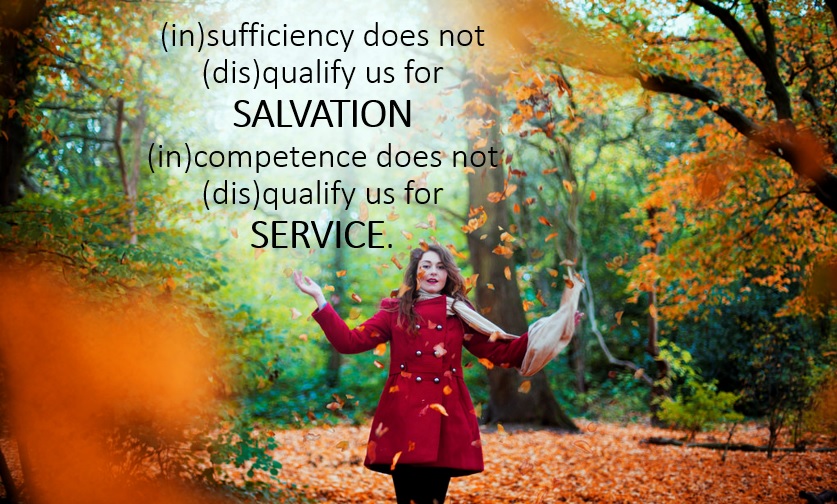
Our (in)sufficiency does not (dis)qualify us from salvation.  Quite the opposite!  The reason why God sent his son into the world was because everyone fall short of God’s perfection; therefore God in Christ has made a way to impart his sufficiency to us, that we might stand sufficient before him. [xviii]  Whoever humbly asks for this gift we call salvation will be made right before God.[xix]

Our (in)competence does not (dis)qualify us from service.  God is not intimidated or irritated by our shortcomings!  Comparing yourself to the accomplishments of others is futile.  Accomplishments does not qualify us before God, the true eternal judge: God alone calls, God alone qualifies, God alone commends us before him.[xx]  Every character in the Bible who played a meaningful role in history reminds us that God calls, qualifies, commends and empowers imperfect people to accomplish significant work with him.  That’s still his way with me and with you.

The Invitation

In those moments that I feel strong, that I feel on top of everything, I usually have courage to exert myself for concerns bigger than myself.  I have courage to stretch myself beyond my own needs.  But God challenged Joshua to do just that when he was intimidated by his own imperfections: to be strong and act courageous in the face of his incompetence.  How?  By the assurance of the Sovereign Lord’s personal presence.

Think about it: what could Joshua possibly face that is too big, too hard for God?  Not the Jordan river in flood, not Jericho with its high walls, not the seven mighty nations in Canaan.  No, not even the rebellious people God had entrusted to him!

That invitation to walk towards God’s Promised Peace today is the same:  in spite of my insufficiency, God is with me.  And that is how my heart is encouraged to act with confidence.  Today, in every place and every situation, God has my back to compensate for every inadequacy and insufficiency.

The reminder

What would I say to myself next time I am overwhelmed by my own incompetence and insufficiency.  I would remind myself that God is not irritated with my imperfections, nor is he not disappointed with my defective performance.  I will remind myself that his grace has made me both accepted in he presence and empowered by His partnership.  He has not sent me to do work on his behalf – he has invited me to live a life of service with him.  I will remind myself that God does expect perfection of me – he knows that I am dust and has perfected me in Christ.  I will remind myself to look beyond my inabilities, to discern God’s presence and trust in his God’s sovereign power.  I will urge myself to look to him and be strong – because it is not the “perfect ones” that do great; the ones who know their God will do great exploits.[xxi]

[i] Joshua 1:1-10

[ii] Numbers 13:16-14:9

[iii] Exodus 17:8-13

[iv] Exodus 32:1-17

[v] Exodus 33:11

[vi] Deut. 34:1-12.

[vii] Deut. 31:14-23

[viii] Deuteronomy 34:12

[ix] Isaiah 55:1-2

[x] Psalm 34:18

[xi] Psalm 103:14

[xii] Exodus 4:10-12

[xiii] Joshua 1:2-6

[xiv] Judges 6:12-14

[xv] Jeremiah 1:6-9

[xvi] 2 Cor 12:9

[xvii] 1 Pet 5:5-6; James 4:6

[xviii] Rom 3:23, 6:23

[xix] Romans 10:13

[xx] 2 Cor 10:18

[xxi] Dan 11:32

Known by my scars

This week I got a new scar.  The doctor says its not going to be a pretty one.  It’s on my calve, so I’m not too bothered about the mark.   Ironically, this scar fills me with gratitude and joy because it reminds me of what could have been – of what I was saved from.

I have another scar on my arm.  This one always brings a smile to my face as it reminds me of the night I got it.  I was was sixteen years old.   Me and my brothers were doing dishes.  I splashed oily water and Conrad ducked away, “accidently” stabbing me in the arm with the steak knife he was drying. There was a lot of blood and screaming. We all got a big fright! But a few stitches and cleaning up restored the peace.  This was thirty years ago; Conrad passed away two years ago.  I’m fond of the scar on my arm, because it reminds me of the love and the friendship we shared.  The sudden loss of my brother left an unseen scar, and somehow this old knife wound represents the loss I feel.

Just like the marks on a tree, our scars bear testimony to the things we lived through.  They give shape to and character to our lives.  The scars can never fully reveal the trauma we encountered, but like the marks in a tree trunk, our scars reveal our growth response to these events. our scars are evidence of how we healed.  As such, our scars tell the story of our resilience – what we endured and survived.

People tend to hide their scars, ashamed of the imperfections and afraid of the painful memories.  In contrast, the apostle Paul boasted in his scars[i] and listed the events which caused these scars (inside and outside) with gratitude and dignity, claiming that his scars are something to be cherished, even honoured. [ii]  How could our scars be something to be thankful for, something to be cherished and even paraded?  What can we learn from Paul about our scars and the trauma which caused it?

Firstly, each scars is a witness to my weakness, and therefore a tangible signs of grace.  We get scars because we are not bullet-proof.  Our scars are a testament to our vulnerability, our frailty.  Paul boasted in this weakness[iii] – his limitations or the end of his ability – because that’s where he experienced grace: the help and intervention from God.  The traumatic events Paul listed scarred his body, soul and spirit.  Violence and disasters left marks on his body; betrayal and abandonment wounded his soul; accusations and demonic torments injured his spirit.  Yet Paul cherished each scar – visible and invisible – as a reminder of God’s sustaining grace.  Without God’s grace Paul would have died, given up, or turned back from the call for his life.

One evening in our high school years, my brother Conrad took a test drive with a friend’s motorcycle – without a helmet.  Somewhere in the ride he accidently switched off the headlights. As he approached our house, another vehicle – who did not see him – turned in front of him without indicating.  Conrad crashed into the car, was flung in the air and landed headfirst on the tar.  We though he was dead, but God showed him grace.  He had a scar above his right eye as a daily reminder of the grace of God.

Likewise, my own scars are reminders of what I was saved from, and how I was restored.  They testify of God’s presence, providence and power at work in every situation that threatened my life.  The scar says “If it had not been for the Lord,[iv] this would have been my end… but God carried me through and restored me!”   As such these scars bring me daily comfort that God is always with me, and will turn everything I face today for my good.[v]  My strength may fail, but His strength will not.[vi]  When fear wants to overwhelm me, my scars remind me that “stronger is He that is in me” than what I may face in the world today.[vii]  I never face anything alone.[viii]

Scars - faith
This fireman has felt the sting of fire.

Secondly, my scars are witness to the tests I have passed.  Each scar – whether visible or invisible – tells a story of pain that I endured, of hardship that I was not spared. And therefore, as a believer in Christ, these scars are signs of faith that remind me that I was tested and purified as through fire.[ix]  Like Job, I kept on believing in the goodness and power of God in spite of the troubles I endured.[x] Through the pain, loss, or shame I kept on trusting in Jesus, believing that he has overcome the world.[xi]  As I walked through the fire of testing, my faith was proven and found to be real because I have come to trust God’s character more than my experience.

Looking at my scars as marks of faith bring me daily confidence.  My scars remind me that “nothing can separate me from God’s love” and that in every hardship I endure “I am more than a conqueror through Christ who gives me strength.”[xii]  In this sense each scar is an affirmation of my faith, adding confidence in the face of adversity.

Scars - hope
This Nigerian Christian faced the brutal hatred of this world. One day this will end.

Thirdly, my scars are witness to a fading, fallible world.   We only get scars on earth because the rule of sin and its decaying effect is limited to this fallen world of ours.  Our scars are caused by things like violence, sickness, calamity – and these have temporal power here.  The driving forces that bring us pain and leave us scars are often hatred, jealousy, greed, betrayal, or abuse – and these are only at work in this age.  But when Christ returns to reign there will be no more pain, no more sickness, no more calamity[xiii] – there will be no new scars in heaven.

Every scar reminds me that our world is fallen, and that this is why Jesus came to earth.  Seeing scars stirs my longing for the day when Christ will come to make all things new.[xiv]  As such our scars are signs of hope, reminders that Christ will bring an end to sin and suffering and establish His universal reign of peace. Looking at my scars in this light brings me joyful endurance, knowing that whatever I might face today is temporal; it cannot compare to the eternal glory that awaits me.[xv]

Lastly, my scars are reminders of Christ’s scars on his body. Jesus has scars on his body because he came to identify with me in my sin and suffering. Moved by love the Eternal Perfect One exchanged his pain-free heaven for our pain-stricken existence.  He willingly embraced our suffering to redeem us to Himself.[xvi]  This sacrificial love left the Eternal Perfect One scarred forever – as a Lamb having been slain.[xvii]

Our scars point us to His scars, a tangible reminder that we are greatly loved.  As such, my scars are signs of love.  He was marred in body, soul and spirit for our healing, peace and forgiveness.[xviii]  In this – His scars – His love for us is proven.[xix]  Looking at my scars in this way stirs my gratitude and devotion to Christ.

What scars do you carry in your body?  Ask yourself: How does this scar remind me of God’s sustaining grace? Can I see this mark as affirmation of my proven faith? How does this injury stir my hope in Christ’s return? And does this healed wound remind me of God’s immense love for me?

Now we can look at your scars and say with Paul: “We do not lose heart. Even though our outward man is perishing, yet the inward man is being renewed day by day. These light afflictions, which is but for a moment, is working for us a far more exceeding and eternal weight of glory…” [xxi]

[i] Galatians 6:17.

[ii] 2 Corinthians 11:23-33, 12:8-10.

[iii] See above.

[iv] Psalm 124:1.

[v] Romans 8:28.

[vi] 2 Corinthians 12:8-10.

[vii] 1 John 4:4.

[viii] Isaiah 43:2.

[ix] 1 Peter 1:6-7.

[x] Hebrews 11:6.

[xi] John 16:33.

[xii] Romans 8:35-37.

[xiii] Revelation 21:4.

[xiv] Revelation 21:5.

[xv] 2 Corinthians 4:17.

[xvi] Revelation 5:9.

[xvii] Revelation 5:6.

[xviii] Isaiah 53:4-6.

[xix] Romans 5:8.

[xx] If you read ‘spirit’ in this sense, it is helpful to think of identity, as well as your relational ability to love, hope and trust.

[xxi] 2 Corinthians 4:16-17.

On Spiritual Maturity : The Error of Balaam

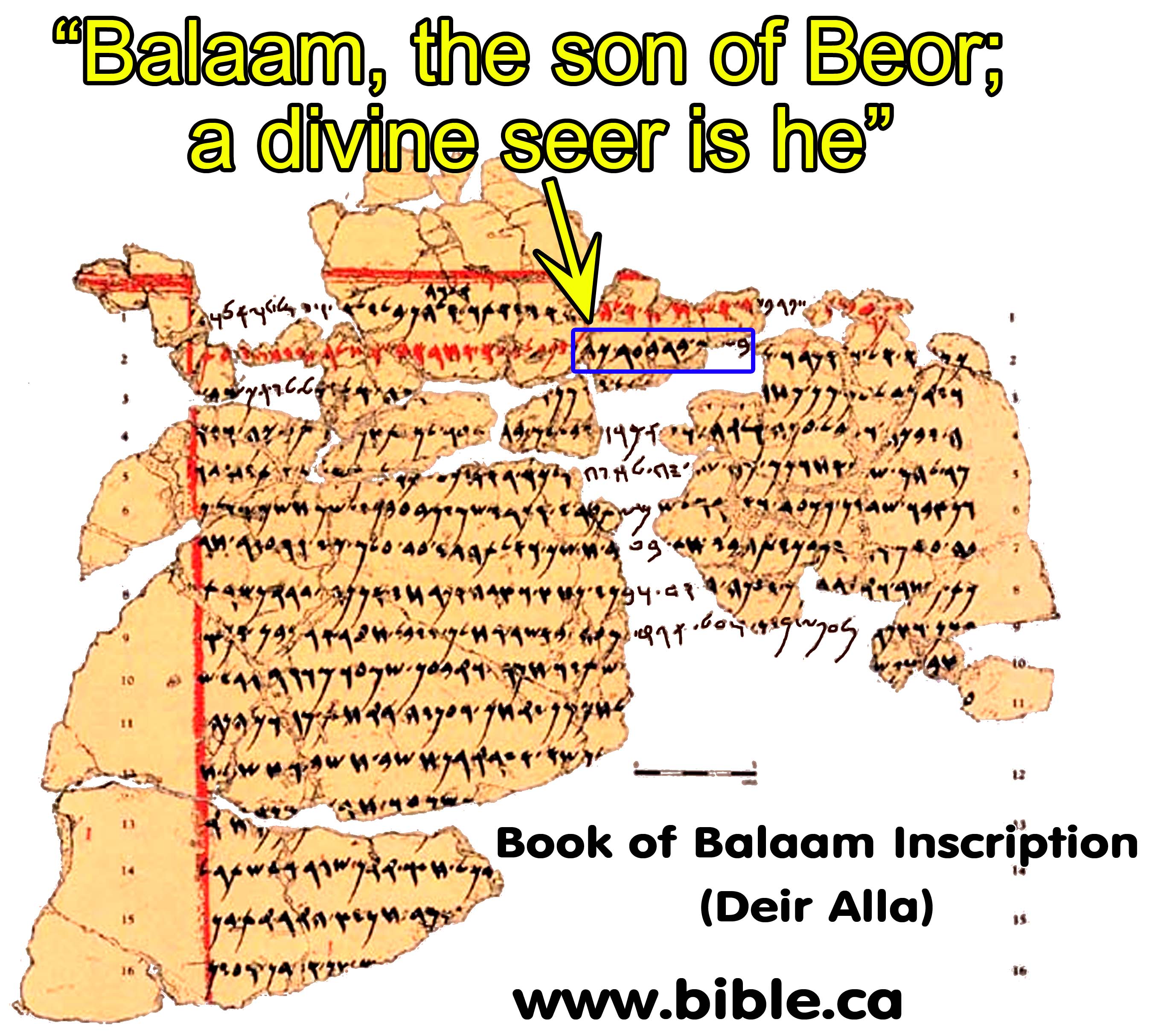
In the book of Numbers, four chapters are devoted to the history of a prophet who had a profound impact on God’s people during their conquest of the Promised Land.  This prophet was not a Jewish man, but a seer who dwelt in Pethor: Balaam son of Beor.  In 1967 archeological evidence was discovered with the inscription of “Baalam son of Beor” prophet of “El Shaddai” – the Almighty God as he was known to the Israelites in the days of Moses.  This archeological evidence adds tremendous historic weight this account in the Bible.

Image of wall tiles inscribed by "Balaam son of Peor, Prophet of El Shaddai" found at  Tell Deir Alla, Succoth (dated to 1406/750 BC). See  www.bible.ca/archeology/
Image of wall tiles inscribed by “Balaam son of Peor, Prophet of El Shaddai” found at Tell Deir Alla, Succoth (dated to 1406/750 BC). See http://www.bible.ca/archeology/

The reason why this account of a foreign prophet speaking to ancient Israel is important to contemporary believers is highlighted by the numerous New Testament references to Balaam.  All of these references of Balaam are warnings: Peter warns the church of false prophets who “have gone astray… in the way of Balaam…” (2 Peter 2:15).  Jude warns of “ungodly people… [who] abandoned themselves for the sake of gain to Balaam’s error” (Jude 1:1, 11).  John wrote of those in the church in Pergamum “who hold to the teachings of Balaam.” (Revelations 2:14).  In each of the three texts the prophet Balaam is used as reference or type of ungodly lifestyles and doctrinal error of believers that is condemnable.  But what is this dangerous “error”, “way” or “doctrine”?

Reading through the historic account of Balaam’s dealings with Israel (Numbers 22:1-25:10, 31:8,16), one has to acknowledge his absolute commitment to relay only what God says: “Though Balak were to give me his house full of silver and gold, I could not go beyond the command of the LORD my God to do less or more” (22:18).  Throughout these three chapters he maintains this stance, repeating his commitment to speak only the words of God another five times (22:38;  23:8, 12, 26; 24:13).  In the end, Balaam’s loyalty to prophesy in truth as God revealed cost him his wages which Balak promised (24:11).  Thus Balaam is an accurate prophet, true to delivering God’s message, not yielding to pressure or bribe to speak falsely.

So why the negative connotations with Balaam?  Numbers 25 records a shameful time in Israel’s travels as they camped on the Eastern side of the Jordan river and started living like the Moabite people.  Swaying under the power of cultural seduction to sexual immorality and idol worship, the Israelites came under the wrath of God through as a plague that killed 24’000 Israelites (Numbers 25:1-9).  This moral decay is attributed to Balaam (Numbers 31:16).  Although he was extremely gifted and graced by God to hear and speak accurately the pure words of God, he himself was an immoral man whose way of life was corrupted with sin (“way of Balaam” 2 Peter 2:15; ““error” Jude 1: 11) and his teachings deceptive (Numbers 31:16).  His lifestyle and teachings were not to be followed, admired or trusted.  In fact, Balaam was executed along with the Midianites under the wrath of God (Numbers 31:8).

The first talking ass - Balaam's donkey!
The first talking ass – Balaam’s donkey!

Although his prophesies is shown to be infallible in the text, the author of Numbers includes the humorous account of his journey on the donkey to Balak (Numbers 22:21-38), which is very deliberately inserted to humble this “great prophet”.  For instance, Balaam the great prophet is hired to subdue Israel with words, but he cannot even subdue his donkey with a stick.  He claims to see visions (24:4,17) but can’s see what the donkey sees on three occasions (22:32).  He claims that his prophetic speech is from God (22:38; 23:5, 12, 16), yet the donkey silences him as its mouth is also opened by God (22:28).  Balaam claims to posess knowledge “from the Most High” (24:16) was beaten in verbal exchange with a stupid donkey (22:30) and then has to admit to the angel “I did not know [what the donkey knows]” (22:34).  Although Balaam is on his way to slay a whole nation with his words he has to draw a sword to kill the donkey (22:29); while lamenting lamenting that he had no sword to slay the animal, the donkey sees the drawn sword in the hands of the angel (22:23) right in front of him.  This irony is meant as a lesson in humility – that the great prophet, like any donkey, can see and speak only what God shows him, and that he simply is graced to serve in the purposes of God.  Secondly, this account shows that although the prophet speaks graceful words by God’s Spirit, he is more beastly than his donkey: where the beast is kind to move his master Balaam out of harm’s way three times, the master is beastly in beating the faithful, kind-hearted, willing animal without considering the motive.

Godliness and our culture

Although Balaam had the ability to speak God’s words accurately, he had lead a whole nation astray.  His life serves as a warning that accurate spiritual discernment without holy living (from a godly character) is dangerous.  What was this ungodliness?  Balaam’s error (2 Peter 2:15) or Balaam’s way (Jude 1:11) simply refers to his lifestyle of cultural acceptance.  Although being a gifted prophet Balaam lived as the Midianites did, and that lead to the corruption of God’s holy people as they followed his “way” and “erred” in his footsteps.  His love for sensual pleasure made him prone towards greed, sexual immorality and cultural festivity surrounding the worship of other gods, plus his independence lead to rebellion.  (See 2 Peter 2:2-14; Jude 1:1, 6-11; Psalm 106:28; Revelation 2:14).

no_rules
The doctrine of Balaam: everything goes! No consequences!

The doctrine of Balaam (Revelation 2:14) teaches that God’s people are chosen, holy and saved in God’s eternal covenant and therefore nothing can change that reality – not even their lifestyle.  So by his example and by his teachings the great prophet Balaam deceived God’s people into a lifestyle of sexual immorality and the worship of Baal of Peor.  As a result, many died under the wrath of God, never reaching the Promised Land (Jude 1:5).  Still today Balaam’s dualism (distinguishing spiritual holiness from moral life) is taught in many places (associated with Gnosticism in the early church and extreme grace teachings).  Apart from formal teaching, the way of Balaam is engrained in our spiritual DNA by the example of our contemporary church culture where Sundays is God’s day, and the rest of the week we live good lives, but find pleasure and security as the rest of society does.

Balaam is not the only example of this fallacy in Scripture.  Samson, the mighty deliverer of Israel was like him: a man empowered by the Spirit of God to lead and deliver Israel, yet always seduced and enticed by his worldly passions and made ineffective. (Judges 14-16)  Giving in to the seduction of sensual sins enslaves God’s people and brings shame to his Name.

In contrast to Balaam and Samson, Daniel and his friends stand out as examples of godliness amidst a crooked world.  Daniel chapter three records how Nebuchadnezzar set up a golden image that everyone in his kingdom had to bow down to whenever the music played. The image was not an image of a particular god, but rather represented the religious culture of the day.  Shadrach, Meshach, and Abednego refused to bow down to the image, and was persevered by God in the fire.  Their refusal to succumb to the cultural pressure in faithfulness to the One True God stands as an example to every believer in our present-day materialistic, promiscuous culture feeling pressures us to conform.

How do we respond?

Considering the the error of Balaam, I find three ways to respond to this in pursuit of spiritual maturity.

  1. Review your definition of “Spiritual Maturity”

The reference to Balaam in Peter’s second epistle pertains to false prophets among the first readers, thus spiritually gifted leaders. This is worth mentioning.  Peter appeals to his readers to note the ungodly fruit of these spiritually gifted ministers, and therefore not following their example of sensuality and rebellion.  Peter looked at the character and behavior of these gifted leaders and was not easily mesmerized by their prophetic ability.  After all, Jesus taught him that a person is “known by [his] fruit” (Matthew 12:33).

Peter needed to write this to the growing young church, since the charismatic gift of prophets is very appealing to especially young believers.  And the display of spiritual gifts is easily taken as signs of spiritual maturity. It is the will of God that we grow up (Ephesians 4:11ff), but how do you define maturity? That is why these warnings by Jesus and his apostles are so strong and clear.  So re-evaluate your view of spiritual maturity: Who do you admire?  Who do you want to follow after?  Consider their character – are they known by their love? What can you learn from their marriage and family relationships, their work ethic and how they manage money?

Take stock of your life spiritually.

  1. Take stock of your own life.

In Jude and Revelations the warning to individuals walking in the error or teachings of Balaam is merely to wrong belief of individuals in their congregations of those in their midst.  Balaam is the image of a spiritually gifted man with the lust of sensual pleasures that are lead by his passions through this life like waves thrown around by their earthly desires (Jude 1:12-14).  Take an honest view of your life your own life, with special reference to you your passions and desires.  Are you leaving it unchecked?  What are you doing about it?  And who are you accountable to about it?

  1. Grow in godliness.

Our aim remains to be conformed to the image of Christ Jesus and to help form others into that image (Romans 8:29; Colossians 2:28-29).  Be purposeful about it.  How have you grown in godliness in the last year, and in which area do you need to grow now?  Are you growing in the will of God?  What does the Lord say, and what will you do to grow in that area of Christ-likeness.  Again, and who knows about that?

While closing with growth in Christ-likeness, remember these words of Paul: “Continue to work out your own salvation with fear and trembling, for it is God who works in you, giving you the desire and ability for his good pleasure.” (Philippians 2:12-13)  Continue, don’t stagnate in your pursuit of Christ-likeness.  Work it out yourself, don’t expect it to automatic or someone else’s job.  As you grow in Christ-likeness you also will grow to emulate the Christ – the Anointed One (Acts 10:38).  Earnestly desire spiritual gifts but let the motive be love (1 Corinthians 12:31).

And work with God – it is he that works in you, leading your through your desires and gracing your with the power needed to grow in Christ-likeness.  Don’t stop!  Work joyfully with the grace God gives.