For a short video recording of this 6th session through the book of Revelation, click here or on the image below.
How much freedom do we have in Christ? What may we do with our freedom? These are the questions that the church in Thyatira grappled with towards the end of the first century. Plagued by trials and temptations under tyrannical Roman rule, John penned words of comfort and correction to this and six other churches in Asia Minor about our victory in Christ; the circular letter is known as the Revelation of Christ.
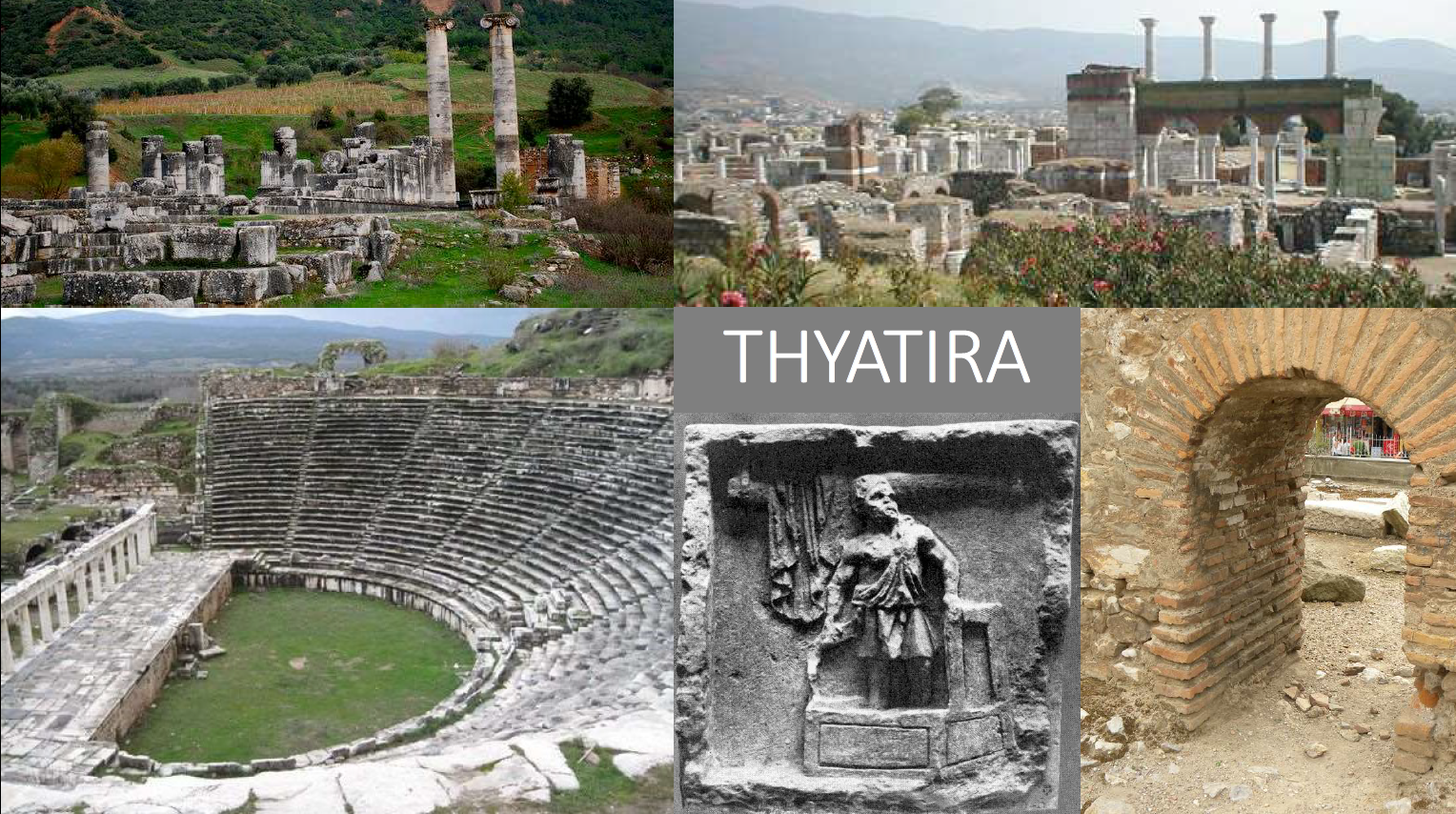
Thyatira is known today as Akhisar in far-west Turkey. This ancient city was strategically located as a buffer to the Roman empire, obstructing the path of its enemies and giving it time to gather military strength. It was found in a rich agricultural area, famous for its purple dye and wine. This city prospered during the Roman Empire through the security of the army and the trade routes through it. The archaeological discoveries of temple ruins, monuments, and amphitheaters give us a glimpse of historical culture. Ancient manuscripts reveal that many Jews settled in Thyatira during the reign of Seleucus I (305-281 BC).
Thyatiran coins of that era reveal strong trade guilds of weaving, leather, pottery, and bronze melting active in this city. These guilds, forerunners to our trade unions, formed leagues that promoted and protected their trade and its workers. In this pagan environment, the guilds worshipped their own gods in the hope of success and prosperity. These regular religious rituals involved sharing in a feast consisting of the meats offered to the gods – ending in revelries and religious orgies, symbolizing the prosperity of their trades.
Because of the pagan association of these trade guilds, Christians found it hard to work in cities with strong guilds: firstly because of a refusal to participate in the worship of pagan gods; secondly because they refused to eat meat offered to idols, and thirdly, because of the perverse nature of these communal meals. And this was a contentious issue for the church in Thyatira at the time of John’s writing.
The letter of Christ to the church in Thyatira is the longest and sternest of all seven letters to the churches (Revelation 2:18-28).
Revelation (2:18). Christ reveals himself as… [Read the full commentary of Revelation in Faithful to the End]
Faithful to the Endis a simple commentary that helps make sense of the encouraging message of Revelation.
Quick links to full THE END Revelation Series posts
This post is the fifth post in a series through the book of Revelation. Follow this link to a video recording of this post.
The Revelation John received was sent as a circular letter along a logical postal route through Asia Minor which started at the bustling city of Ephesus, moving north to ancient Pergamum, inland through Thyatira, and southeast to the wealthy city of Laodicea. This letter contained a prophecy from Christ to these seven churches to comfort them during the tyrannical reign of emperor Domitian (AD 90-92), to correct their perspective in their fight against evil, and to charge them to remain faithful to Christ. There is a reward for those who remain loyal to the end!
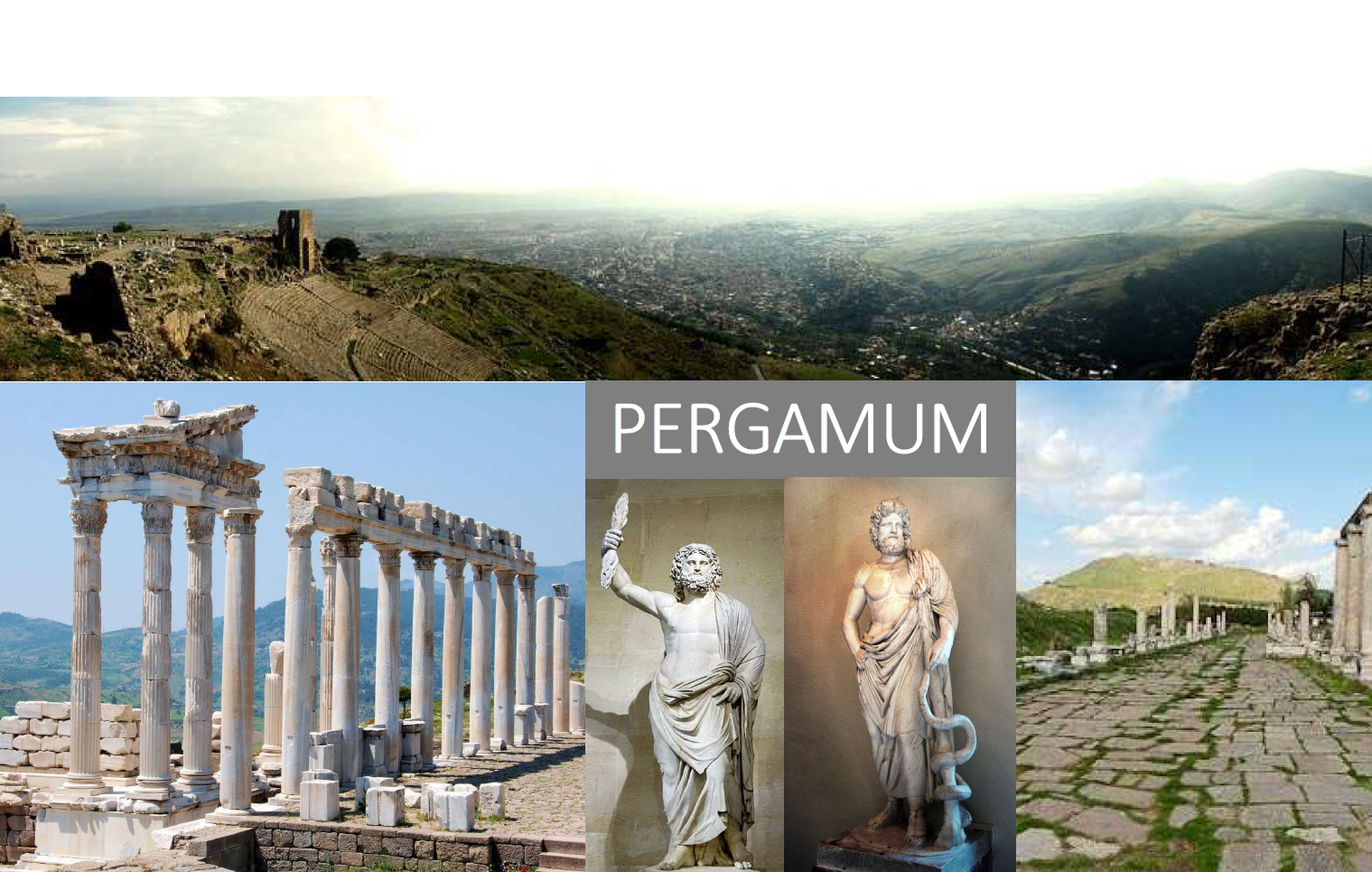
Pergamum, set on a hilltop overlooking the Caicus plain below, was a magnificent ancient city which exited from the springs of civilization in Asia (around 500 BC). Pergamum (modern-day Bergama) lay about 55 miles north of Smyrna, inland from the Aegean coast. The archaeological findings in this great city are rich in religious artefacts, including statues and temples of Zeus, Athena, Dionysos (Baccus in Roman mythology), and especially Asklepios, the god of medicine, whose cult was strong and accounted for the prestigious school of medicine in Pergamum. Asklepios’ serpent was a prominent brand in the city, displayed on many of the coins pressed there.
Apart from the medical school, the city was famous for its vast library, university, big parchment industry and the large amphitheatre overlooking the valley. It was also a strategic Roman stronghold and inlandregional administration, boasting the first Asian temple of the Imperial Cult in honour of Augustus (AD 29).
Within this ancient citadel which worshipped Domitian as king and lord, valued entertainment, education and science, was a vulnerable church who received this letter of comfort and correction, a charge to not compromise their devotion to Christ in word or in deed (Revelation 2:12-18).
The Revelation of Jesus Christ (2:12). Christ is revealed as… [Read the full commentary of Revelation in Faithful to the End]
Faithful to the Endis a simple commentary that helps make sense of the encouraging message of Revelation.
Quick links to full THE END Revelation Series posts
This post is the fourth in a series on the book of Revelation. The link below takes you to a video recording of this blog post.
How does one endure hardship, and why? Why does God allow his people to undergo seasons of suffering? And where is God when it hurts? These are some of the questions that Jesus answers in the Revelation, a circular letter written by the apostle John to seven congregations in Asia Minor during the tyrannical reign of Emperor Domitian (AD 90-92).
Polycarp, Pastor at Smyrna (69 – 155 AD)
“Eighty-six years I have served Him, and He never did me any injury: how then can I blaspheme my King and my Saviour? …You threaten me with fire that burns only for an hour… but you are ignorant of the coming judgment and of eternal punishment reserved for the ungodly. What are you waiting for? Bring on what you will!”
These were the last words St Polycarp, a famous martyr during another wave of heightened Roman persecution, revealing the church’s grit and attitude in Smyrna. Polycarp was a pupil of the Apostle John and probably the “angel of the church” (messenger or leader) in Smyrna whom Jesus was addressing in Revelation 2:8-11.
Smyrna, present-day Izmir in Turkey, printed coins which claimed it was “the biggest and most beautiful city in Asia.” This coastal city was prosperous because of the trade routes and its natural beauty. The town was filled with magnificent temples and statues – some of these are well preserved today. The figure of Bacchus (Roman) or Dionysus (Greek), god of wine and immoral revelling tells us much about the day’s culture. So also, the statue Cybele, mother of the gods, reveals that in this city, women were honoured or even venerated within certain people groups. The citizens of this Greek city were loyal to Rome, dedicating a temple to the goddess Roma around 195 BC. It also had a temple preserved for the Imperial Cult, devoted to worshipping the emperor.
Persecuted by the Jews. At the end of the first century (AD), Smyrna boasted a large community of Jews, bolstered by the migration of Judeans after the destruction of Jerusalem during The Jewish War (a significant rebellion against the Roman Empire, 66 AD – 73 AD). These Jews were especially hostile to Christians – in part because during the siege of Jerusalem (70 AD) Christian Jews fled the city (prompted by a prophetic Word from the Lord), just before the total destruction of the city and its temple. Also, the Jews viewed the worship of Jesus as an abomination. These Jews were often the first to hand known Christians over to the Roman authorities for punishment.
Poor Christians. In this city, as in the broader community, Christians were often excluded from the formal employment sector because of the refusal to partake in the worship of the gods of the guilds (first-century trade unions). In this pagan society, each guild had its god(s) who demanded tribute in exchange for prosperity. Since Christians refused to worship any other gods, conversion implied the end of their careers. The only jobs they could take were for the “cursed” in society: garbage removal, sewerage cleaning, the burial of the dead, etc. Therefore, being Christian was synonymous with being poor in the early Church.
The letter to Smyrna follows the same structure as the other letters: opening with a unique and personal Revelation of Christ to them, it complies with a commendation, a charge, then a warning and finally a promise of reward. However… [Read the full commentary of Revelation in Faithful to the End]
Faithful to the Endis a simple commentary that helps make sense of the encouraging message of Revelation.
Quick links to full THE END Revelation Series posts
This post is the third stop in our reflective journey through the book of Revelation, bringing us to the letter to the Ephesian church (2:1-7). For a brief video recording of this post, click here or on the image below.
Remember that song “You’ve lost that Lovin’ Feeling” from the Righteous Brothers, popularized by the original Top Gun movie (1986)? It gets to the heart of Jesus’ first letter to the churches, the church in Ephesus.
Ephesus was a prominent port city in the Aegean Sea, on the Western shore of modern-day Turkey, about 80 km south of Izmir, rich in archaeological discoveries.
Ephesus became the provincial seat of Roman government into Asia. It was renowned for its scholarship, housing Heraclitus’ first university and the Great Library of Celsus (top left). The city was a cultural hub as witnessed in the well-preserved great Amphitheatre (bottom right). The city was a religious centre, most notably because of the temple (top right) of Artemis (Greek, central image) or Diana (Roman), and later because of the Christian influence. In contrast, Ephesus was also known for its “sin industry” through the sailors frequenting its busy seaport. Its unique setting and well-developed harbour (bottom left) made it a trade hub into Asia and Greece – notably the Silk Trade Route.
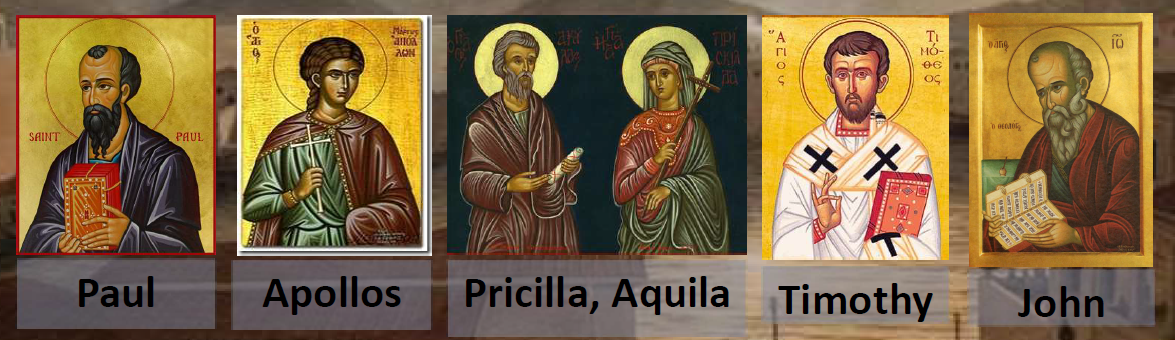
These political, religious, educational, cultural and trade hubs made Ephesus very influential in the region. No wonder Paul stopped and spent more than 2 years there (Acts 19). It is fair to say that, after Antioch, Ephesus was the most prominent church in the New Testament. Other big apostolic leaders made Ephesus their headquarters, including Apollos, Priscilla and Aquila, Timothy and John. In some way, the church in Ephesus still has the greatest influence in the church today because many of the New Testament letters were written either from or to the church in Ephesus.
Apostolic leaders that settled in Ephesus for a significant time in the first century.
It is therefore not strange that the first church Christ addresses in his letters is the church in Ephesus. By the time John penned these words of Jesus the Ephesian church was more than 50 years old – a second-generation church that had grown significantly and endured a few waves of severe persecution from various emperors.
Keep in mind that this short, personal letter to the Ephesian believers is part of a circular letter to the seven congregations (1:11) with the aim to comfort the persecuted believers and to correct their perspective in their struggle against evil. As with each of these seven letters, this letter starts with a unique revelation of Christ, followed by a commendation, a condemnation, a charge, then a warning and finally a promise of reward.
This is our second post in our journey through Revelation.
The letter of Revelation was a message of hope and comfort to help and correct the early church in its struggle with evil – to endure both trials and temptation in faithful witness of Christ’s coming kingdom. Although this prophecy was written for them, it is preserved for us. Therefore, everyone who reads these holy words today and hears its invitation to “behold!” will also see how Christ is near to us, is moving in us, through us and for us his Church to accomplish the culmination of his glorious kingdom. This revelation of Christ’s victory over evil in this world brings comfort and strength to endure until The End.
A note on my approach towards Revelation: In this discovery through Revelation, I will not write scholarly or critical, but rather devotional and encouraging. The posts will be like all my other posts: an attempt to read the text from the view of the first readers. How did these seven congregations make sense of this apocalyptic prophecy from their imprisoned apostle? What was the message of hope to them? For this, I will keep to the explicit nature of the book: Revelation is an apostolic letter to seven congregations in Asia Minor (1:4,11), which contained a prophecy from the Lord (1:3), in the apocalyptic genre (1:1) which is rich in symbolic images and numbers, rooted in (a) their first-century geopolitical context, and (b) Old Testament literature. If we stick with these principles, the symbolism in this remarkable book becomes alive and life-giving. (I expounded more on this in the first post in this series).
Greeting and blessing (Revelation 1:4-8)
This short greeting by John is a masterful introduction and succinct overview of the book’s message. He blesses his readers (and hearers) with grace (divine help) and peace (wellness) from the Triune God. His name for the Father “(He) who is and who was and who is to come” (1:4) takes the readers back to God’s self-revelation to Moses (Exodus 3:14) before His great deliverance from Egypt. The Spirit is titled “Seven Spirits” (1:4) from Isaiah 11:2 in that great chapter that speaks of the Messiah’s divine wisdom and righteousness by which he will destroy the oppressive nations and restore all of creation in peace. Here John says “God had delivered his people before from the tyranny you suffer, and He has promised to end this violence once for all!“
Next, John answers the question “Can Jesus save us?” with a loud “Yes, he can, and he will!” Jesus is first introduced as the “Christ” (1:5) – the long-awaited Messiah who will restore the righteous rule of God on earth. Then Jesus is hailed “the faithful witness” to a church struggling to maintain their faithful witness under brutal persecution and the seduction of a perverse society. He is held as their example who faithfully proclaimed and demonstrated God’s kingdom and eventually accomplished it by His vicarious death and resurrection: the ultimate witness of God’s Kingdom coming to earth is Jesus’ rank “Firstborn from (or over) death” (1:5). Not only does Jesus have authority over every spirit, even death, he is also “Ruler over the kings of the earth” (1:5) – good news to the readers oppressed by Emperor Domitian! These titles stirred flickers of hope to those battered congregations wondering whether Jesus is indeed the Christ who will bring righteousness and peace to the earth.
The next portion answers the question in the heart of every suffering believer: “Does God care about me?” John writes YES HE DOES! Jesus is called “Him who loved us and loves us and frees us from our sin by His own blood” (1:5). This phrase, a reference to the Cross, is a clear allusion to the Passover lambs slaughtered to deliver God’s covenant people from Egypt by judging the oppressors and preserving the Israelites (Exodus 12:21 ff). And as God adopted and honoured the delivered Hebrew slaves, these battered believers were called “kings and priests to God” (1:6, compare Exodus 19:6), sharing in his eternal reign.
“But does God not see how we suffer by the hand of our oppressors?” Yes, he does, and his Day of Judgment will come! Alluding to Zechariah 12:8-10, John writes how the Christ will defend and deliver his covenant people from their oppressors, and how he will reveal Himself in glory to those oppressors so that they will weep at his fierce judgment (1:8).
As the nature of the letter is prophecy, the greeting ends with Jesus introducing himself as “the Alpha and the Omega, the Beginning and the End who is and who was and who is to come” (1:8). For the contemporary reader of the day, the Greek alphabet was known to have each letter attributed to a major Greek god. Thus, Jesus’ self-revelation comforted his hopeless church “I am the All-powerful, Ever-living One – your covenant God and Saviour. Do not despair!”
Section 1: Christ among the Lampstands (Revelation 1:4-3:22)
Want to learn more about Revelation? Click on the link for the book.
Quick links to full THE END Revelation Series posts
This is the first post in a series through the book of Revelation – a letter meant to bring comfort and encouragement during times of uncertainty and hardship.
What have you heard or read about the book of Revelation? How does that make you feel?
For many, their response to this book includes feelings of uncertainty, confusion and anxiety. These feelings are precisely what Revelation aims to address in its readers, leaving them feeling comforted, encouraged and hopeful in Christ’s presence and victory over evil in the world.
How should we read Revelation, then, to make the meaning clear and leave us peaceful and hopeful during times of uncertainty and hardship? John states this clearly in his introduction: this document is an apostolic letter (1:4) containing prophecy from God (1:3), written in the Jewish apocalyptic genre (1:1). Reading the book with this in mind will encourage and exhort you to live confidently in Christ through tough times.
THE NATURE OF REVELATION: A letter containing prophecy in the apocalyptic genre
Revelation is a letter of encouragement and exhortation to suffering believers. This epistle was penned by John (1:1,9; probably the Beloved disciple), while imprisoned on the island Patmos (1:9) addressed “to seven churches in Asia” (1:4; 1:11).
The meaning of the book becomes apparent when it is read from the perspective of the first readers – the seven congregations in Asia minor listed as recipients. Like every other apostolic letter by Paul, Peter, James, Jude and John, this letter answered real questions, brought instruction, warnings and encouragement to the first readers. The message was written to them, yet preserved for us. The truth becomes clear to us as we see what the letter meant for them.
Secondly, Revelation is called prophecy (1:3) – God’s Word to a people in a specific context. Like Isaiah, Amos, Malachi, etc. this book contains prophecy (God’s spoken word) to the seven congregations in the seven towns in Asia minor. This message from the Lord brought real comfort and confidence as the Lord revealed love and care for them, but also corrections and challenges as prophecy always calls God’s people to covenantal faithfulness.
Prophecy is often addressed to his people in a particular time and place. However, Revelation, like many old Testament Prophets, places this Word from God in the context of his cumulative redemptive work through the ages. It is said that 287 of the 404 verses in this book contain allusions to Old Testament texts, notably from Exodus, Isaiah, Daniel, Ezekiel and Zechariah. This means that John, here in a prophetic capacity, aimed to ground this accumulative message to these seven, suffering churches in the history of God’s great redemptive plan for his people. God is bringing his great work of salvation to a climax.
Again, the reader is invited to read this book primarily as a prophecy from God to the persecuted believers in these seven congregations. This message was clear and made sense to them. If we want to understand God’s word to us, we have to understand God’s word to them first.
Thirdly, this book is self-titled as “Revelation [or apocalypse] of Jesus Christ” (1:1). This Jewish literary style, of which Revelation, Daniel, Ezekiel, and Zechariah are prime examples, was at its most popular during the time of John’s writing. Apocalypse means “unveiling” or “uncovering” and aims to show that things are not entirely as they seem – there is more at play than meets the eye. More specifically, it reveals the heavenly drama behind our earthly struggles – that “our fight is not against flesh and blood but against principalities, powers, rulers of the darkness of this age, against spiritual hosts of wickedness in the heavenly realms” (Eph. 6:12). Note how Revelation starts with the earthly reality of the seven congregations and shifts realms to show the cosmic drama behind everyday events.
Apocalyptic writing makes use of symbolism through vivid imagery and representative numbers in dramatic scenes that aim to evoke powerful emotions, and a sense of participation in the story told. Secondly, this genre is rooted in Old Testament literature; Revelation is filled with Old Testament references (but not one direct quotation, as this is uncharacteristic of the style). Thirdly, Apocalyptic language is rooted in the historic-political context of its day; the message of the writing was clear to the 1st Century Greco-Roman believers of their day, and this ancient context is our key to unlocking its meaning. Lastly, this genre (like most Jewish genres) is not chronological. The reader should not ask, “What happens next?” but rather, “What does John see next?” The letter is written in the sequence of John’s visions, not chronological time – and therein is much meaning.










 walklikejesus