Closing Chapters – Making memories (part 2 of 4)

Normal 0 false false false EN-ZA X-NONE X-NONE

Just like a good story, your life has a beginning, and an ending with the middle chapters lived out in different seasons in settings. Each of these life chapters has a unique little storyline that shapes your character and destiny. In the previous post Closing Chapters – Wrapping Up 2020 I said that, especially after a rough season
one needs to conclude a life chapter, to pin it down so that the new chapter begins with a clean slate, not being held back by unresolved issues.

(I have spoken the need for Closing Chapters at Shofar Durbanville’s morning service on 29 November 2020. A recording can be found below; message starts at 44 minutes) 

We close a life chapter effectively by making memories and finding meaning in these memories. We begin our review of the year by looking at those events or trends that had a memorable impact on my life, shaping my identity, relationships or purpose. As we begin our review, we take not of each event’s effects on our emotions or relational dynamics, , self-view or confidence.

Review the 2020 (the highlights and lowlights)

To review of a longer season such as a year or few years at a particular company season may be difficult to initiate.  Where does one begin?  I find it helpful to plot a simple histogram with three or four layers to get my thoughts started.

An example histogram to get your reflection for 2020 started might look like this: three lines showing the highs and lows of your relational life, work life and spiritual life over the 12 months of the year. 

  • Line 1: As you reflect over the year’s events, indicate your general sense relational health (you might want to draw lines for each significant relationship).
  • Line 2: Do the same for your work life.
  • Line 3: Do the same for your spiritual life.
  • You may want to consider lines to indicate your confidence or anxiety levels, your finances, studies, sports or church life – whatever touched you deeply in the year.
  • Now mark a few key events in your life, trigger events or turning points, on this graph.

Some people find these graphs less helpful for reflection. Therefore I share three other ways in which I do reflection on a season, to get to those events and trends that will add to my life story going forward.

  • For each of the key relationships in your life, recall the highlights and lowlights in the year. Which of these events had a lasting impact on me/us, and how?
  • List the big external events (such as the pandemic, drought and civil unrest) or personal crisis (sickness, accident, burglary or separation) and recall how it impacted me.  What do I carry with me since then?
  • Compare every aspect of my life how I entered the year, and how I exit the year. Eg, I entered 2020 with R150’000 of debt and exit with R75’000 debt.  At the beginning of 2020  we were a family of 3 but at the end of 2020 we are a family of 4.  Consider making these comparisons on your personal life, work life, social life, spiritual life, finances etc. How did these changes occur, and how do these impact me?

From these reflections, reduce your Highs and Lows to those you deem most influential on your life in this past year. These are the memories that you will reflect on to find meaning in the year, affirming your identity and refining the purpose that sets your course in the years to come.

Closing chapters start with making memories – your highs and lows of 2020.

Recognize the good (preservation and growth)

Memories by themselves are good, but apart from our life in God, these events do not give meaning to our lives. Next we ground our memories of 2020 in the providence and presence of God.

In reviewing the good things that happened to me in 2020, it is helpful to start with the question: “What bad things did NOT happen to me this year?” In a year filled with devastation and disappointments, it is necessary to recognize and rejoice in God’s protection and preservation.  Record these in jour journal with a heading similar to Psalm 124: “If it had not been the Lord who was on our side…”

Then look at your life, comparing your situation at the beginning and the ending of your year.  Ask yourself (and those close to you): What good things did happen to me?” Don’t rush this section.  Think of the growth in your life in all its totality: physically, materially (possessions), emotionally, relationally, spiritually.  Think of your work and influence.  I used two headings for my reflection, borrowing from 1 Samuel 7:12 “Thus far the Lord has helped us…” and from Psalm 103 “Bless the Lord oh my soul, and forget not all his benefits…” listing according to those aspects form David’s praise.

Especially in a trying year such as this, it is crucial to see and celebrate God’s faithfulness and generous grace, displaying his devotion towards us.  These contemplations ground us in the reality of his abiding presence and steadfast love – the sure footing for our next chapter.

Take these highlights into your prayer time and give thanks to the Lord for his generosity and faithfulness. Indeed, your life is grounded in the presence and providence of God – a sure footing for 2021.

In my next post we will deal with the lowlights, the disappointments and pains of 2020, to live free from regrets and vengeance in the years to come.

Closing Chapters: Wrapping up 2020 (part 1 of 4)

2020 was a surprisingly rough year.  It still is.  How do you muster hope and confidence for a new year after one so tumultuous as this?

From discovering a new Coronavirus strain far away in Wuhan City, China, 12 months ago a global pandemic culminated in the simultaneous lockdown of more than 200 countries just six months later. The lockdowns confined people to their homes, shutting down schools, businesses and all social gatherings.  Governments banned all travel, calling for a state of disaster, restricting countries under martial law.  And now a second wave is in full swing.

The global pandemic pressure exposed the fault lines in vulnerable economies, politics, and social fibres worldwide.  Newsfeeds flooded with reports of large-scale corruption, election rigging, racial tension and wild conspiracy theories.    These compounding disruptions also highlighted the vulnerabilities in societies’ emotional-spiritual wellness, resulting in heightened anxieties, widespread domestic violence and unhealthy coping mechanisms.  No-one escaped the sting of this pandemic.

At several moments during this year, I hoped for someone to call an end to the year, to reset the calendar and start afresh.  I waited for some referee to recognize our fatigue, to throw in the towel or count us out.  At long last, the year is over, but now the entrance into 2021 looks very similar to the exit of 2020.  The difference is: (a) now we know what to expect, and (b) 2020 has had a significant physical, emotional and spiritual impact on each of us.  For that reason, many of us face the new year with a sense of dread.  

Why bother with the past ?

There is a need to properly wrap up the old year and bring meaning to a particular season before starting afresh.  Failure to conclude a life chapter can cause one to get stuck in a destructive cycle.  Trying to move on with unresolved disappointments, hurts, trauma or even blind spots and character flaws will likely cause one to live reactively to past events.  The past will repeat itself like a bad nightmare. There has to be some resolve, some closure before your story can continue in a new chapter.

Biblical books at the end of seasons

It is noteworthy to consider that all the history books in the Bible – from Genesis to Ester in the OT and the Gospels to Acts in the NT – were recorded at critical moments in God’s people’s history.  These records are not merely cold recordings of history.  Each history book is a prophetic reinterpretation of the events God’s people went through, written to help make sense of God’s redemptive purposes through these periods.  It aims to affirm the first readers’ identity and purpose as God’s covenant people.  As such, each of these books is a means to “close a chapter” in a particular people’s history, giving God’s people resolve to move on, helping them understand why they had to endure this.  

What is a life chapter?

Consider every memorable story, and you will conclude that hard times shaped the character and beautify his/her account. Samuel anointed David to be king, but many difficult chapters fill the years before becoming Israel’s beloved king. Yet his story is memorable because these middle chapters tell of familial rejection, battle with a giant, fleeing a vengeful monarch, harsh years in exile, uniting a divided Israel, and later attempted patricide and exile again, to name a few highlights.  God’s journey with him through valleys of shadows of death makes his story beautiful and inspirational.

God promised Joseph prominence and power, and the fulfilment thereof was beyond his wildest imagination.  His story brings encouragement 3800 years later because God’s promise prevailed despite familial betrayal, enslavement, wrongful imprisonment, and neglect of a companion. In particular, his story endures because he could look his brothers loving in the eyes and declare “You intended to harm me, but God intended it for good to accomplish what is now being done, the saving of many lives.” (Genesis 50:20) That is why and how you close a life chapter: make sense of a season to affirm your identity and purpose in the light of God’s presence and providence.

A life chapter brings a conclusion to a season characterized in some unique way.  Some chapters close naturally, like when you progress from primary school to high school or graduate from college or end an internship.  Other life chapters might require help to resolve, due to an unfair dismissal from work, an abrupt end to a long relationship, or a sudden relocating with the family.  Especially after a season of hardship, we struggle to move on because these tend to impact us emotionally and spiritually – leaving lasting scars on our identity (affecting our self-view), relationships and confidence (impacting our purpose and potential).  Such seasons have the power to hold us back or alter the course of our lives – for the good or the bad.  As such, reflection and resolve is paramount. Closing life chapters means making memories and finding meaning in it. Our challenge is to do a personal, prophetic reinterpretation of our experience to discern God’s presence and work in, through and for us.  In particular, it affirms our identity, reforms our relationships and refines our purpose in life. 

How do we properly close life chapters?

We say that “experience makes us wiser.”  But observation tells us that this is not true.  Experience often leaves us poorer, tired, hurt, or lonely. If we’re lucky, experience leaves us happy, enriched or loved.  We tend to repeat past mistakes, suffering the same painful results – unless we intentionally reflect and learn from our experience.  A more accurate statement reads, “evaluated experience makes us wiser.” 

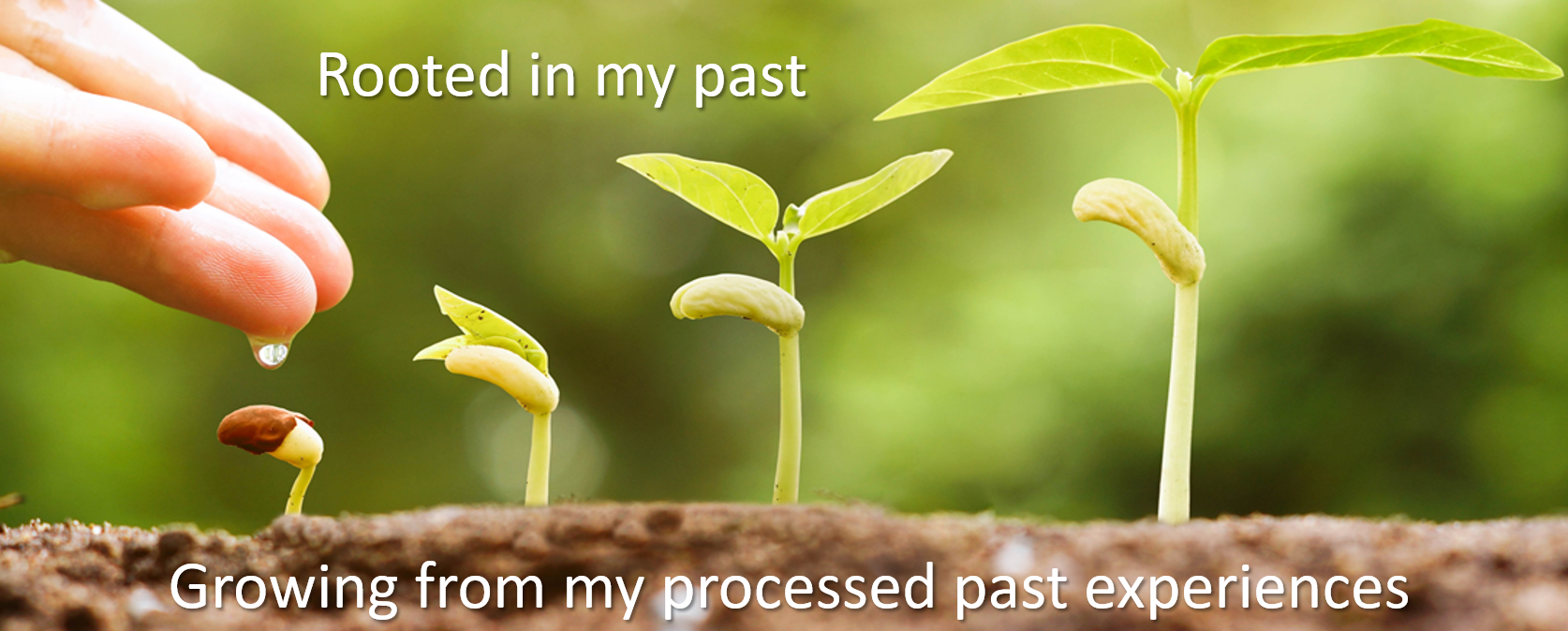
In her book Rooted in Love Margaret Blackie sketches her life as a plant rooted in rich soil. The plant symbolizes her life, flourishing. The roots seek security and nourishment in the fertile soil. The ground, enriched by the processed plant matter, represents reflected past experiences.  Together, this image powerfully portrays how our lives flourish when anchored and nourished by our awareness of God’s presence and purpose with our everyday lives.  Therefore, closing a life chapter aims to root us securely in the rich soil of the previous season, ready to bloom in the next season.

We close the chapter on 2020 by making a memory and find its meaning in the light of our life’s trajectory as a whole.  First, we look back to review the highs and lows of the year.  Second, we look up to recognize and give thanks for God’s goodness in the past season.  Third, we reflect on the losses, hurts and disappointments by look inward; we own our share in the pain and release those who caused us harm.  Lastly, we look forward as we revision the next leg our of our journey with hope.  We will work through each of these points in subsequent blog posts.

So what do you expect to take with you out of 2020? You might be surprised at the insights and hopeful energy gained from such a reflection.

Guarding the Gates

Where can we find the virtuous, honorable man?

Proverbs 31 describes in detail the characteristics of a virtuous woman – a truly inspirational picture of a person who with wisdom, selflessness and skills pours out her life to benefit her family and community. The description begs the reader to ask “If she does all this, but what does her husband do?” The answer: “Her husband is known in the gates, when he sits among the elders of the land.” (Proverbs 31:23)

At first glance, it might seem that, while this woman works effortlessly to provide for her family, her husband is relaxing with his peers in the public square. This thin reading has lead many to despise the absent husband of the virtuous wife. However, a contextual reading of this text in the Middle-Eastern culture of its day sketches the opposite picture.

The Gates. City Gates were significant to preserve a peaceful and prosperous community. It was a barrier to the dangers on the outside as it completed the city walls, but it also formed the insiders into a closed community, allowing for common customs and regulations which typified its culture. Within the city gates one was safe.

These gates were the most vulnerable part of a city’s structural defense. As such, city gates were built as a strategic stronghold, often with watch towers, a moat with drawbridge and sharp spikes to fortify the city’s access point.

As one enters the city gate, one would generally walk onto the city square – an open plain used for town gatherings such as communal threshing floor, the village market, court room, and civic center for both administration and celebrations.

Whoever possessed the gates of the city had rule of the city.

That is where the man in Proverbs 31:23 sat. What did he do at the gate all day long?

The Elders at the Gates. Elders were chosen from among the people groups within the city as wise, honorable representatives to govern and administer the city. They were called out of the hustle of everyday life to be concerned with the wellness of their community. They ensured fair commercial practices, judged civil disputes, administration, ensured the cultural celebration and the safety of the city. Whoever sat in the city gates guarded the culture of the city.

In short, the Bible reveals that city elders were tasked to cultivate and preserve an atmosphere of justice, peace, and joy for all its inhabitants (by wise rule). What the Bible calls Shalom.

At the city gates, priests would address moral issues according to the Law, prophets would call for justice and the fear of God, and the decrees of the reigning king would be read. These teachings, prophesies and decrees were entrusted to the elders for implementation, for the good of the whole community.

In short, elders controlled access to and the atmosphere of the city.

“This is interesting, but what does this have to do with me?” you might ask. If you are a follower of Jesus, then everything!

When Paul addressed the church, for instance in 1 Corinthians, he names them “ekklesia (the Church) tou theo (of God) en korintho (in Corinth),” specifying that they are ones sanctified and called to this place by the Lord Jesus Christ. The word ekklesia in its context refers to the elders called out of the hustle of everyday life, summoned to meet the God, the Great King, about His rightful reign in this city.

The church are the chosen ones, called to sit as elders in the gates of the city, to ensure the reign of God in their community.

When we gather, we represent our community, bearing its current concerns, gain wisdom from the Rule of God, listen to His call justice, and how to bring about righteousness, peace and joy to our people. Male and female, young and old, educated or not – we are all ekklesia, called out ones summoned to serve the Kingdom of God in this city. We are called to be ambassadors of the Great King in the gates of our cities.

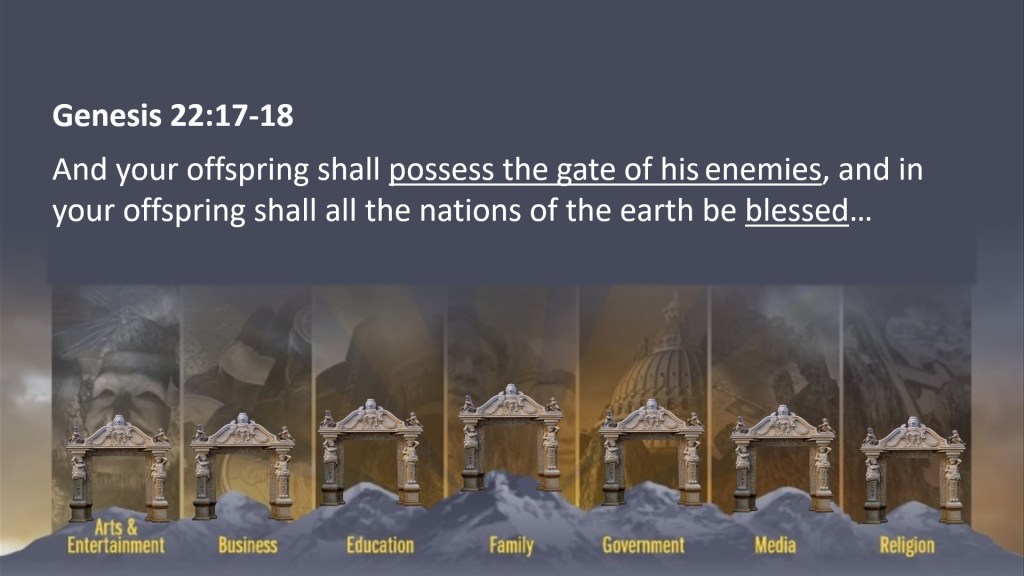
When we consider this call to guard the gates, we should also consider the blessing God promised to us as Abraham’s decedents through faith: “I will surely bless you, and I will surely multiply your offspring as the stars of heaven and as the sand that is on the seashore. And your offspring shall possess the gate of his enemies, and in your offspring shall all the nations of the earth be blessed, because you have obeyed my voice.” Genesis 22:17-18

When we rightly possess the gates, our communities enjoy God’s peace (blessing). But our modern cities generally don’t have gates. If we are called to sit and govern, where do we yield our influence?

The 7 Mountains Mandate. In 1975, in the heyday of the Jesus Movement that awakened a youth missions movement across the globe, Loren Cunningham (of YWAM) and Bill Bright (of Campus Crusade for Christ) met for lunch. Each received a revelation from the Lord they had to share with the other about what it takes to “disciple a nation” and “win a nation for Christ.” They were so shocked that their Revelations that day were exactly the same: to “disciple a nation” and “win a nation for Christ” involves more than individual conversions: one would have to transform the culture by “conquering seven cultural mountains” (Cunningham) or “possess seven gates of culture” (Bright). See the short embedded video of Loren Cunningham’s account below.

Loren Cunningham recounts the original Seven Mountain Mandate moment.

The seven gates of culture (or seven mountains), pertain to Media, Government, Education, Economy, Religion, Family and Celebration/Arts, with Science and Technology frequently added to the list. These spheres of influence into a community orient the dominant culture of the day either towards God’s Kingdom or another value system.

These revelations by Cunningham and Bright are in line with God’s Old Testament Template for society in the Law of Moses, as Landa Cope unpacks in her book. In these first five books of the Bible God gives the blueprint for a society – his Kingdom Law of shalom – prescribing the wholesome (“blessed”) life in each of these domains.

To subject a nation to God’s Kingdom and receive his blessing, the church are called to possess these gates in society to bring about justice, peace and joy.

If you are part of the church of God, called to represent and reinforce his good reign in your community – in which gate do you sit? How has He gifted you to bring his rich culture of peace to your city? What are the concerns that press on your heart? Be bold to step out and act for God’s sake – Christ promised the grace to conquer and the reward for your faith.

Not Alone – preparing to live with power and prosperity

Which word best describes your year? Let me guess:

a. Uncertain | b. Disastrous | c. Painful | d. Wasted | e. All of the above.

Yet deep in our hearts we have this hope that this rough ride is in some way purposeful, that perhaps this perilous path is preparation for power. Such expectation for good is not vain imagination – it is the substance of the Biblical message.

As pastor I am often confronted with questions about the purpose of pain. If God is all powerful and has good plans for us, why do we find ourselves walking through dark valleys like many do during this year? Why not just skip the bad times and move straight to the good times ahead? We would all love that!

Moses answers this question in the re-giving of the Law to the Jews about to enter the Promised Land. Deuteronomy 8 is one of the most moving chapters in the Bible, where we sense God’s vulnerability and loving concern for his people. We also see God’s desire to bless his children, to do them good and to prosper them. Verses 3 and 18 serve as a good summary.

Deuteronomy 8:3

Deuteronomy 8:18

In this emotive text God reveals that he is the one who had lead them through this season of hardship in the wilderness. He was the one who opened the Red sea so they entered the wilderness, and he is the one who will again open the Jordan river so they could exit this hostile terrain. This season of hardship was his design, “to do you good in the end.” (Deut. 8:16) In some way, this hardship was for Israel’s benefit – a season of preparation to live with power and prosperity. A season of character building, if you will.

In particular, the Lord mentions two purposes with this season of preparation: to humble and to test. First, the dessert-dwelling was meant to instill in the ethos of Israel a character of humility, a healthy awareness of their insufficiency to do life by themselves. The forty years of daily provision was meant to teach them that what they have is a gift from God, and that when they don’t have God is still their provider. As I wrote before, “not by bread alone but by every word from the Lord” refers to the provision from God, reminding them that they are eternally dependent on the Lord. We are never self-sufficient.

Secondly, the journey through the harsh wilderness was a time of testing, revealing what was in their heart, “whether you would keep his commandment or not” (v2). Moses’ account of Israel’s encounters in the dessert is indeed revealing of their unthankful, flaky and rebellious character. Tough times tend to show us for who we are. In life as in a harbour, times of plenty means sailing is smooth, but during low tide the rocks at the base of our character causes dangerous and embarrassing moments. Low tide is not the problem; low tide only reveals the problems that were there all along.

The Lord’s purpose – for Israel and for us – is not only to show us what is in our heart, but also to correct and train us as a loving Father (v5). His purpose, as revealed in this chapter, is to heal our hearts so that we may live well with the prosperity and power he plans to entrust us with, in fulfillment of his covenant (v7-10, 17-18).

This is both the great promise and stern warning in this moving chapter: that indeed God had led Israel through this long period of testing and shaping in the wilderness, because of the great prosperity and power they were about to inherit. Indeed, God had promised them wealth and success, “to eat and be full and bless the Lord” (v10).

All they were called to do was remember the Lord, remember the way he led them to this place of prosperity and power. This blessing is a gift from God, in fulfilment of his promise, to reveal his covenant (v18; compare Psalm 25:12-14). Israel’s journey, from being powerless, poor slaves in Egypt to their prosperity in Palestine, was a witness of God’s character, power and purpose in the world. Their position of power and prosperity was meant to portray God’s nature and partner with his purpose of redemption and restoration of his creation. It’s all about the Lord and his covenant.

Therefore the stern warning that sets the tone of this beautiful chapter: do not forget from where you come, and the way the Lord had brought you here. If you forget the Lord and think that your prosperity is the product of your own power, “you will perish” (v19-20). God is bound to his purpose and jealous of his glory.

In some sense this chapter paints Israel’s entry into the Promised Land as a return Eden: the Lord having redeemed his people from slavery, bringing through the wilderness into a garden of plenty. And therefore the great warning: “do not fall for the temptation to sin as your ancestors Adam and Eve did by enjoying My gifts and thinking you don’t need Me anymore”, says the Lord. “God opposes the proud but gives grace to the humble.” (1 Peter 5:5-6; James 4:6)

Metaphorically, do you find yourself in the wilderness on the way to the promise of God for your life? Or can you acknowledge that you already enjoy much power and prosperity from God? Regardless of where you see yourself in relation to the hope in your heart, a year such as 2020 brings much shaking, inviting us to note our response to hardship.

As when this message was first preached to the wilderness-dwelling Israelites en route to their promised destination, it reminds us during tough times of God’s promise to not abandoned us and fulfill the good plans prepared for us. This message also reminds us that God always provides during tough times, calling us to receive both the humble daily manna or the plenty with thanks as gifts from God. This chapter reassures us that these hard times hold purpose for our good, urging us to allow the season of testing to purify and prepare us for what lies ahead. Lastly, Moses’ message moves us to soberly assess the pitfall of prosperity and power: the temptation to presume independence from God when all is well. Such pride progressively permeates our mindset, gradually moving from an indifference towards God and God’s people / Word / mission to the tragic ignorance of God’s presence where Samson “did not notice that the Lord had left him” (Judges 16:20). Because God loves us, he will save us from each gift we turn into an idol, and return us to retrain us in the wilderness (Hosea 2:14).

Our invitation in these tumultuous times is to note our emotional responses towards the hardships, to remember the Lord who has shown us his goodness by recalling the particular saving moments which brought us to where we are today. We are invited to remember and re-imagine the promise of his goodness he holds before us, as it is the basis of his covenant to restore all things! We are urged to re-evaluate our relationship with the blessings he has gifted to us, whether health, plenty, prestige or power, rendering all we are and all we have in service to him. This is indeed a time to remind ourselves that “in him we live, we move and we have our being” (Acts 17:28)

Marching on – joining God’s restoration

If there was ever a time to “rebuild, restore, repair” (Isaiah 61:4) a nation, the time is now. Covid-19 hit South Africa hard in a time during which it was reeling from the blows of post-Apartheid tensions, wide-spread corruption, a series of droughts and ongoing political instability.  Today, unemployment is at an all-time high and our economy has shrunk by 50%.  Racial and socio-economic polarization is ever widening and social unrest is a common occurance.  The education system is struggling to meet the need.  Infrastructure is deteriorating.  The social fibre of families and communities are fractured, resulting in lower morals, violence and a general sense of hopelessness.  The “rainbow nation” dream we embarked on 25 years ago seems as evasive as the pot of gold grounding this colourful symbol of hope to our land.

In this dire situation, there is a call for the courageous ones to lead the charge.  But rather than courage I see even faith-filled people disengaged from God’s invitation to “rebuild up the ancient ruins; raise the former devastations; repair the ruined cities”.  The waves of devastation persuade many to defect from God’s Kingdom quest to renew all things.[1]  Others seem distracted from the call to rebuild by their pursuits of security and comfort.[2]  Many will admit that they are dismayed – pacified from terror by scale decay and destruction. Sadly, the majority of faithful, courageous Kingdom veterans seem disheartened, weary from the repeated efforts to reconcile, rebuild and restore a nation in pain; They have lost confidence in their ability to make a lasting impact and are tired of trying. 

Can you identify with one of these groups?  Because if you can, the historical account of Jonathan and his armour bearer will speak not just into our contemporary context, but also into your heart.

1 Samuel 13 opens with the newly crowned King Saul and his son Jonathan leading the oppressed tribes of Israel in combat against the Philistines strongholds in Gibeah.  By God’s grace, they had success in these two battles, and 30’000 men joined King Saul’s army.  However, the Philistines responded by marching an innumerable mass of foot soldiers, 30’000 chariots and 6’000 horseback riders. The Israelites were terrified, knowing that they were not only outnumbered but also outclassed by Philistines technology – they had no blacksmiths who could produce iron weapons like their enemies.

These overwhelming odds left Saul’s army intimidated.  After one week 24’000 defectors, dismayed, and distracted soldiers abandoned the quest to liberate Israel from its oppressors. And the 600 who were left were dismayed, hiding out in a spot where the Benjamites also fortified themselves for four months a few years earlier.[3]  However, 1 Samuel 14 shows how two men’s faith in God not only brought about a great victory but revived the hearts of the soldiers to trust in God and fight for the restoration of Israel again.  

This account was recorded as an encouragement and example for God’s people facing similar overwhelming odds.[4]  What can we, facing equally devastating challenges, learn from this inspiring story?

Lessons from Jonathan’s quest

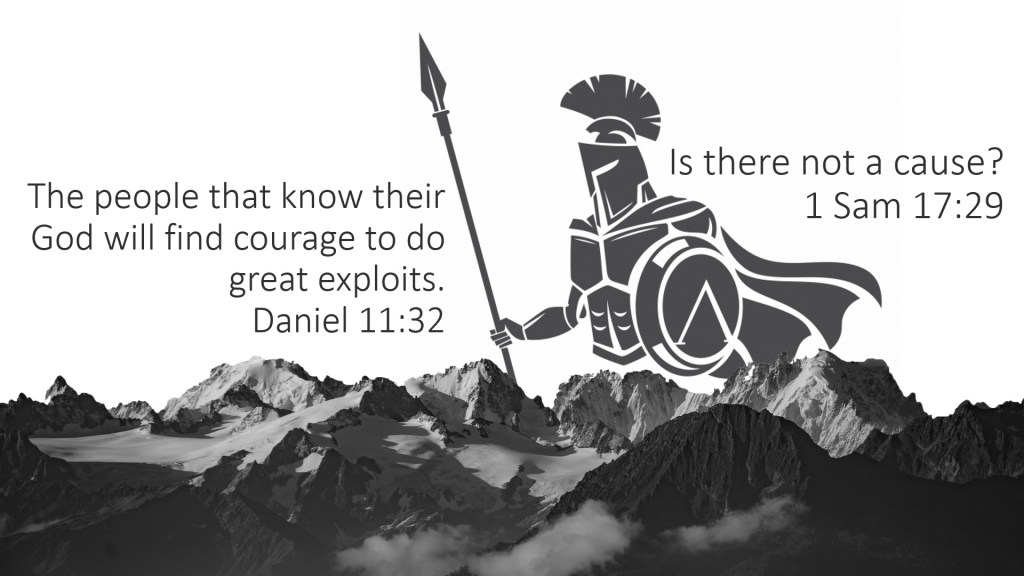
The contrast between King Saul and his son Jonathan is striking: while the king and his army were “taking it easy” (14:2 MSG) in their hideout, Jonathan remembered that there is a cause. Yes, he could play it safe and enjoy his status and comfort, but Jonathan’s conviction persuaded him the crisis called him to act in courage.  In a similar situation, three chapters later, his future friend David challenged the cowering soldiers’ passivity: “Is there not a cause?”[5]  Jonathan was compelled to act on his conviction.  Yes, it is safer and more comfortable to secure yourself, to stay away from the destructive forces and maintain the status quo, but there is a cause that calls for courage.

Jonathan’s courage would make Brene Brown very proud: he planned to be vulnerable and show up in the face of fear, and trust in God.  Outnumbered, with only one sword, in an exposed, defenceless position at the bottom of the ravine, he tested his conviction to check whether indeed was with him in this endeavour.  He acted in humble faith, not arrogant presumption.  Jonathan knew that Israel’s covenant God had delivered his people from even greater dangers in the past and that He was faithful and able to save them from this situation.  But he did not pressure that his plan was indeed Israel’s plan, and therefore he checked with God before climbing the cliff face into combat.

Once his check confirmed his conviction that God is indeed calling him into this conflict, Jonathan was confident to climb into combat.  But he was not alone – the prince was comforted by the companionship of his dedicated armour bearer’s vow “I’m with you all the way.” And where two of more agrees about anything, there the Lord is present, commanding a blessing.   The Lord’s cooperation in their fight was more than their strength in combat: the Lord himself was fighting for the liberation of his people from oppression, “the ground itself quaking”.  He did not send Jonathan into battle on his behalf – he was inviting Jonathan to join him in the liberation of his people.

The chaos of combat attracted the attention of the look-outs above king Saul’s hideout. Learning that the cries came from his son’s charge against the Philistine garrison, Saul called the priest closer to inquire the will of God (through some ritual).  But the noise of combat became so loud that he got the army to combat.  God was in the move, calling Israel to join the deliverance! 

Courage is contagious, as we see in this account. The disheartened regained strength, the defectors returned to Israel’s army, the dismayed reemerged from their hideouts, and the distracted rejoined the quest to rid the land of evil.  And therein is the hope for our day: one believer who responds to God’s invitation to join him or her in his quest to rebuild, repair and restore will instil the courage to those disengaged from God’s Kingdom mission to renew the land.

A call for our day

It is tempting to flee from the devastation that is sweeping over the country.  It is comforting to gather with God’s people for safety and avoid the dangers and oppression in the world around us.  It is easier to focus on personal security and comfort of our homes.  But ignoring the pain and destructive forces will only embed the ruin for coming generations. Like Jonathan, the Lord of Liberty and Life is calling him to join him as he tackles the evils that enslave the nation. 

Landa Cope writes of research into “the most Christian city in America” where Dallas, Texas boasts the most active Christian Church attendance and giving in the nation.  The sobering outcome of the study reveals that mere devotion to God and church activities has seemly no impact on the wellbeing (peace) of the city.  If the charge on the church could be summed in the phrase “Let God’s Kingdom Come”, or “seek the peace of the city”[6], then this research suggests that mere church attendance and ministry among the members utterly fails the mandate of the church.  We are called to get out of the safe spaces and engage the enemies of God’s kingdom with the Lord of Hosts.

And like Jonathan learned, this text shows us that God is on the march with those who dare, and all barriers bow in his presence among his people.    

“What ails you, O sea, that you flee?
    O Jordan, that you turn back?
O mountains, that you skip like rams?
    O hills, like lambs?

Tremble, O earth, at the presence of the Lord,
    at the presence of the God of Jacob”

Psalm 114

This account is both comforting and inspirational to me. An oppressed and divided nation, led by a cowardice ruler and self-preserving security force was captured by a hoard of coordinated, brutal plunderers. One man had it in his heart to risk his comfort for the cause, confident of God’s power and faithfulness.  He did more than recapture that piece of land; his charge inspired the confidence of Israel’s fighting men.   Imitating Jonathan’s trust in God will be rewarded by God’s cooperation, as well as the spreading of contagious courage. 

This text calls me to quiet down and consider where God calls me to join him in his work of restoration and reconciliation.  Which “garrison” of evil we would love to see demolished first.  What cause is close to us, always in our mind and on our heart?  Which companion will join us in this charge?  But before we move, we need to check whether this is charge is something the Lord is inviting you into, at this time.


[1] Revelation 21:5; Matthew 19:28-30

[2] “A soldier refrains from entangling himself with the affairs of this world” (2 Timothy 2:4)

[3] Compare 1 Samuel 14:1-4 with Judges 20:47.

[4] Romans 15:4

[5] 1 Samuel 17:29

[6] Jeremiah 29:7

Casting Chariots | preparing to possess the promise

A video recording of this post can be found in the link below (starting at 21min).

When last have you woken from a dream where you defend yourself, but you find you have no power? Or you dreamt that you arrive at work in your pyjamas or underwear?

naked_at_work
A widespread nightmare.

Dreams such as these are commonly associated with subconscious feelings of vulnerability, insufficiency and the fear of failure – the sense that you don’t have what it takes to do what I want to or what is expected of me.  Such feelings can leave one frustrated and hopeless – especially if the dream or promise you pursue is genuinely significant.

As believers, such a sense of powerlessness often leads to self-doubt and even shakes our faith in the Bible and God as we try to make sense of failures and the apparent lack of help from God.

The introduction to the book of Judges records such a situation in Israel’s history (1:1-19).  The book opens with the account of Israel’s failure to fully occupy their Promised Land, leading to the repeated cycle of apostasy, then oppression, repentance and God’s deliverance through a judge (2:11-16).

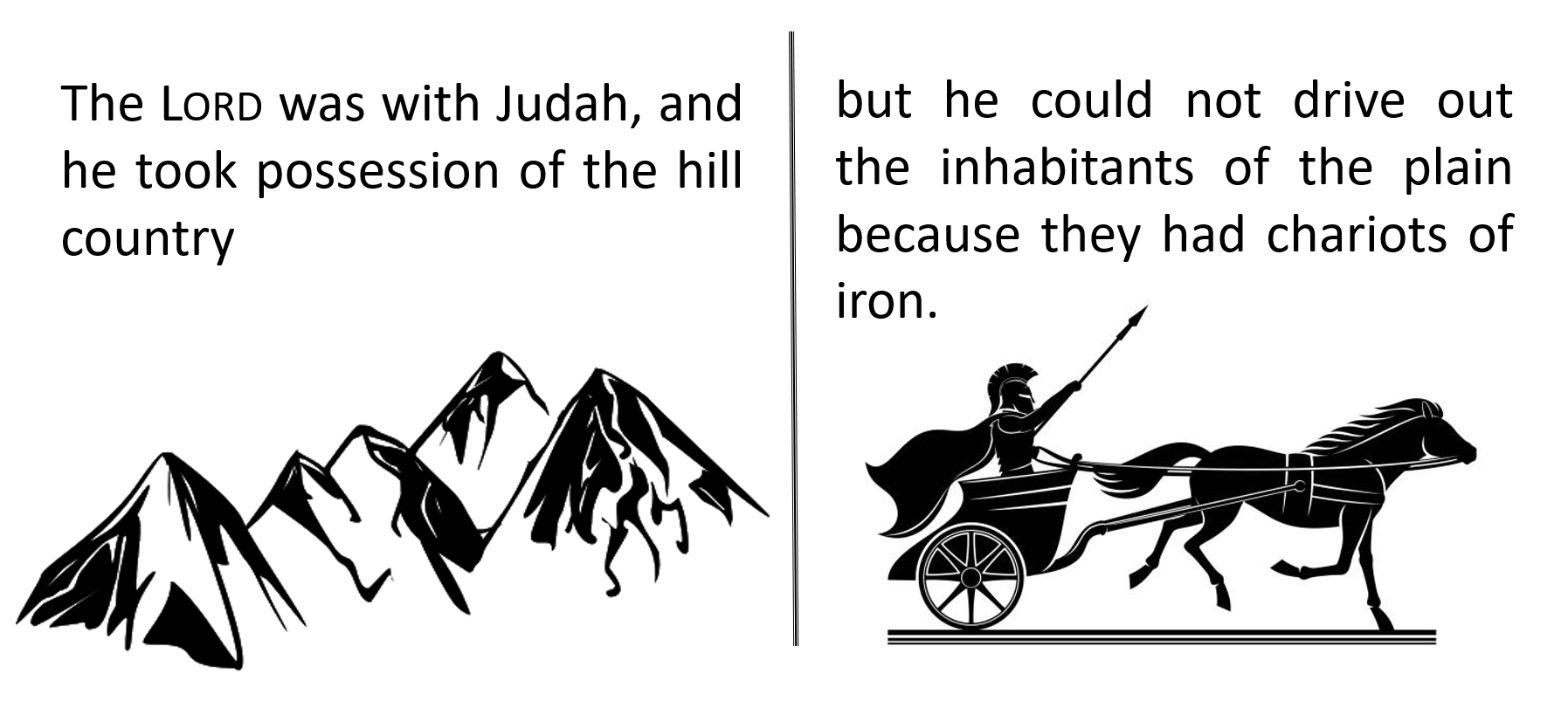
In this introduction, we find one of the greatest paradoxes Bible: the Almighty covenant-God of Israel “was with [the tribe of] Judah” and they tasted success in the highlands, but they could not conquer the plains because of the Canaanite’s iron chariots (1:19).

Failure_to_possess
Judges 1:19 – the great paradox.

The promise, the paradox and the plain problem

The Lord promised Israel the land (Joshua 1:13) as well as a victory by the hand of Judah (Judges 1:2).  The tribe of Judah had tasted significant successes in the quest for their allotted Promised Land (1:17-18). Still, their conquest came to an end at the plains: they did not have what it takes to conquer the Canaanites in the lowlands because their enemy had iron chariots.  While having the Lord’s promise and presence, they did not have the power to possess their promise.

What was the issue with iron chariots?  Simply stated: the Canaanites had them while the Israelites did not have them.  The chariots present superior military technology and can be likened to a modern-day battle where riflemen are confronted with tanks in the open field. The outcome of this battle is decided before it begins because of superior speed, armour and firing power. Likewise, the iron chariots had superior speed, strength (armour) and height over footmen, giving the Canaanites advantage in combat.

Why bother with the plains?  Why not just live around them?  While the conquered mountain fortresses gave strategic defensive power to the Judeans, the plains offered the (essential) potential of food cultivation, access to water, trade routes and nation-building.
The open plains are ideal for pasturelands, plating grains and vineyards etc.  The plains connected the cities through routes allowing for trade and other cultural connections.  Without the plains, there would be limited agriculture, limited market economy, limited tribal (and national) coherence.  The plains were where life really happened.  Without the plains, Judah was confined to an isolated, crippling existence in the hills, cut off from the rest of society.  Without the plains, the Promised Land “flowing with milk and honey” would never be realised.  This was Judah’s big frustration.

Can you identify with Judah’s frustration?

Looking intently at this historic account one can easily identify with the disillusioned Judeans.  They grew up in the wilderness with the promise of possessing “a land flowing with milk and honey”.  The had seen God’s presence and power as they passed through the Jordan River, conquered Jericho, allotted the land to the tribes and taken the mountain fortresses.  Evidently, the Lord was with them!  But now Judah could not gain victory over the Canaanites in the lowlands, because their enemies had superior technology.

I imagine they felt frustrated at an unfulfilled promise they hoped and lived for; they have come so far!  Their defeat and inability to conquer their foes left them ashamed and vulnerable, fearful of a superior opponent.  They felt powerless and hopeless.  A sense of confusion and bewilderment would cause them to question every decision that led them here: the reason for their past successes, their identity as God’s chosen ones, the Promise of inheritance and even the One who made the Promise.  Their failure to fulfil their journey was no small thing – this defeat shook the nation.

One can easily see why the author sets this “iron chariot” dilemma as background to the cycle of apostasy-oppression-deliverance in the book of Judges. Judah’s inability to drive out the Canaanites caused Israel to lose faith in their Lord and turn to other idols, leading to their oppression and need for deliverance.  Disappointment can breed disillusionment, doubt and defection.

We have all tasted this disappointment as a dream disappeared like a promising rain cloud before the sun.  We have all felt the shame of failure, the frustration of powerlessness, the loss of confidence and conviction.  Some acknowledged a sense of abandonment when you needed God most.  We have all been plagued by the incessant doubt in one’s ability, one’s course of action, even the miracles we’ve tasted and promises we lived by.  We can all identify with Juda’s failure and the vulnerability it flings you into.

What are the iron chariots that possess your plains?  What is your unfulfilled promise? Make no mistake – to give up on this promise will haunt you all your life as it did Israel.

An unfulfilled promise: a missed stake

Running into a brick wall quickly loses its appeal.  After a few failed attempts, it might seem easier to reframe our goals or promises to try and live around the plains possessed by Canaanite charioteers.   Like the Judeans, we can try to make our living in the hills as secure and comfortable as possible, or alternatively make peace with the Canaanites, allowing some sense of freedom.  But these peace treaties with the enemy lead to the degenerative cycle of apostasy, oppression, and God’s faithful deliverance.

For Judah, giving up on their promise led to their apostasy.  Their defeat bred disillusionment, tempting them to not only reframe their purpose (possessing the Promised Land) but also alter their identity.  Judah forgot that they were God’s chosen people, saved from slavery and oppression, made into a new nation – a kingdom of priests.  They were called to inherit the promised land, live under his law to reveal his benevolent character and purpose for creation.  Judah’s Promised Land was not only meant for their own peace and prosperity – possessing their promise meant participating in God’s redemption of creation.  Israel was saved and called to be “a light to the nations” (Isaiah 42:6; 49:6; 60:3) – a sign of God’s redemption available to all the nations of the world. For this reason, we see throughout the book of Judges the Lord urging Israel to not live a life of compromise, but rather to “possess the land.” (2:6; 18:19)

If God makes you a promise, you can bet that it forms part of his redemptive plan for all creation; the promise is your invitation to partner with him.  That is why you will repeatedly hear the Spirit urging you to “Go on, possess your promise! Don’t give up!” When last did you hear this prompting of the Spirit?  Can you see how your unfulfilled dreams and promises fit into Christ’s “renewal of all things” (Matthew 28:19)?

A simple step of faith: reposition, restore

“The Lord was with Judah… but he could not drive out the inhabitants of the plain because they had chariots of iron.”   This verse speaks of the error of presumption: the forwardness of thinking that approval alone by God guarantees success.  But here we see that Judah indeed had God’s favour and company, yet lacked the proper strategy and technology to secure their victory.  The Canaanites advantage in the plain was iron chariots; the strategic equivalence of iron chariots (or something similar) would have secured their conquest of the plains.  Judah’s sin was passive presumption, the neglect of preparing to possess the plains.

The Bible teaches us that God honours passion and productivity, but that he despises passivity.  An honest reflection of our own lives would reveal that sinful humanity are prone to inaction and procrastination;  we would rather do nothing and wait on God (or anyone else) to fix our problems or fulfil our purposes on our behalf.  This account, like the rest of Biblical history, reminds us that God created mankind as a co-worker in his creation and redemption of this world.

Throughout Scripture, God calls for practical preparation as he invites us to participate in his promised redemption.  Noah had to build the ark as God directed (Genesis 6:13), and his family was saved.  Elisha commanded the widow to gather as many jars as he could to receive the miracle of the multiplying oil (2 Kings 4:1-7), and God provided in proportion to her preparation.  

For Israel, mastering the skills of ironwork and horsemanship would secure their conquest of the Promised Land.  What would secure your promise?  What practical preparation would position you to possess your promise?

On two occasions in my life, I heard the Lord say to me “reposition yourself.”  Both times I understood that the Lord prompted me to grow in a specific way, which required studying and learning from others so that I may become the person who has the competence, character and perspective to walk deeper into the purpose the Lord promised me.  What would “reposition and prepare to possess your promise” mean to you?  What is the practical response the Lord is inviting you to walk into at this time?

Judah found themselves wholly unprepared and disempowered to possess the Promised Land the Lord had allotted to them, for his purpose.   This left them disillusioned, frustrated and oppressed by the Canaanites.   May you never find yourself unprepared to possess your allotted promise, for God’s sake.

mountains1


The End? The new beginning

With this last chapter of Revelation, John focuses again on Jesus and his centrality to all of God’s creation and redemption. A recording of this post is available on the Shofar Durbanville YouTube channel.

The Bible begins and ends with the description of a paradise garden in which there is a tree of life and a life-giving river. In this last chapter of John’s Apocalypse, John shows how God’s restoration and renewal of all things are brought to completion. In this final vision of the Revelation of Jesus Christ (1:1), we see the Gospel of God beautifully painted.

Jesus is life (22:1-5).  Continuing with the scene of the New Jerusalem (Revelation 21), John describes the River of Life flowing from the throne room of God and the Lamb.  The picture of the life-giving river alludes to Eden (Genesis 2:7-10) and Ezekiel’s vision (Ezekiel 47:1-12).  This River of Life flows in the middle of the street of this Holy City.   On its banks is the Tree of Life, bearing fruit all year long, with “its leaves for the healing of nations” (22:2; Ezekiel 47:7,12).

tree-of-life3_1

After Adam and Eve rebelled and ate of the tree of the knowledge of good and evil, God removed them from the Garden “lest [they] stretch out [their] hand, and take also from the tree of life, and eat, and live forever” in their fallen state (Genesis 3:22-24).  But access to the Tree of Life is a sign that there is no more sin, no more darkness, “for the Lord God will be their light” (22:5), and those who dwell therein will forever reign.  This garden image is a compelling picture of Christ’s full redemption and restoration of mankind, where mankind will live in communion with God, share in his life, and reign over his creation with goodness (Genesis 1:26-27).  Here, life is as it always should have been.

The symbolism is beautiful and meant to be both hope-giving and instructive to the readers. Christ is the source of all light and life (John 1:4-5; 11:25; 14:6).  The Life-giving River “which make glad the city of our God” (Psalm 36:8; 46:4) depicts the nature and work of the Holy Spirit – the “Spirit of Life” (Romans 8:2, 11) who satisfy believers to “never thirst again” (John 4:13; Isaiah 55:1), even to overflow with “rivers of living water” (John 7:38-39).  The street in the Holy City is “the Highway of Holiness” (Isaiah 35:8), “the Way” of life Jesus taught of and made possible by his blood (Acts 24:14,22, Hebrews 10:19-20).  The Tree of Life is the church, God’s redeemed creation, who in turn is God’s redemptive gift to the world.  It is the tree that grows from the Gospel seed (Matthew 13:31-32), that is planted next to the River of Life and therefore “yields its fruit in its season, and its leaf does not wither” (Psalm 1:3; Jeremiah 17:7-8).  Through the reigning of the Lamb and the nourishing of his Spirit, the church now and forever reign (Revelation 5:9-10; Romans 5:17).

Put together, the church is those renewed and sustained by the Spirit of God, who walks in the Way of Holiness as they submit to the reign of God and the Lamb.  By drawing from the water of the Spirit, the church bears fruit that gives life and healing to the nations, displacing evil.  This is as much a picture of the church today as it points to Christ’s coming kingdom.    

judge_Jesus1_1

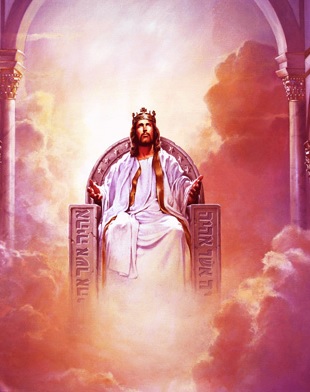
Jesus is the judge (22:12).  Four times in this chapter, John records the words that Jesus’ return is “soon”, and hears Christ’s admonition to “hear the words of this prophesy and keep it.” (22:7). The angelic warning about the end on the river-bank pictures a strong allusion to Daniel 12.  But in contrast to Daniel, who was told to “seal up” and “shut up” the prophecy “until the last days”, John is now instructed to “not seal up the prophecy, for the time is near” – implying the Day of the Lord, the Day of Judgment is near (22:10; Daniel 12:4, 9).  Alluding to Daniel’s vision (22:10; Daniel 12:10) the angel says:

“Let the evildoer still do evil, and the filthy still be filthy, 

[let] the righteous still do right, and the holy still be holy.”

This does not imply that the time of grace is over.  John writes that doing proceeds from being.  In keeping with the rest of the prophecy to the seven churches, John urges believers, if indeed they have been redeemed and sanctified by the Blood of the Lamb (5:9-10), that they then act in accordance with their standing.  Since you are holy, do righteous deeds!  Do not live in the filthy ways of Babylon because Jesus is coming soon as the judge “to repay each one for what he has done” (22:12; Isaiah 40:10).

Jesus is the goal (22:13).  [Read the full commentary of Revelation in Faithful to the End]


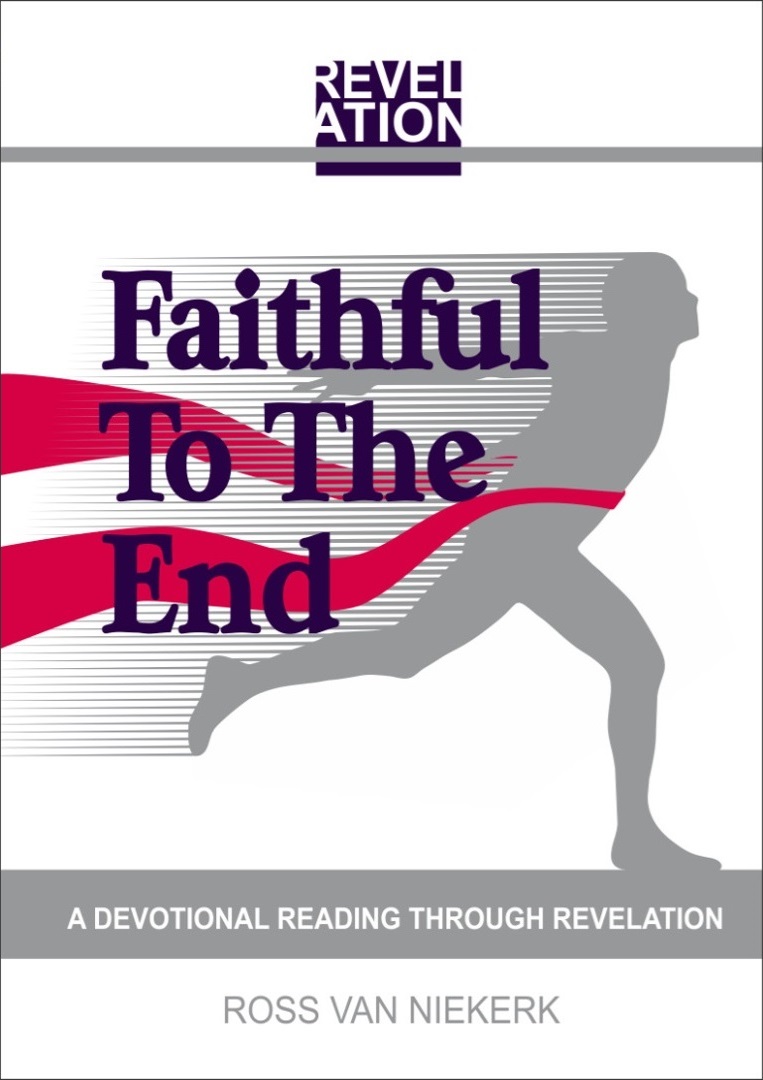
Faithful to the End is a simple commentary that helps make sense of the encouraging message of Revelation.

Quick links to full THE END Revelation Series posts

1  2  3  4  5  6  7  8  9  10  11  12  13  14  15  16  17  18  19  20  21  22  23  24  25  26

The End? All things new

The renewal of all things: this is the message of Revelation 21, our 25th study in the encouraging book.  A recording of this study is available on the Shofar Youtube channel.

What do you deeply desire for the future, your future?  What is your ultimate hope?  If every problem is fixed, every desire is met, and once all things are restored again, what will your reality be like?  How confident are you that this will happen?

This hope for God’s renewal of all things is the focus of John’s vision Revelation 21.  His only invitation to the reader is to “behold”, to picture the beauty of God’s renewed creation.

A physical future.  We are often tempted to think of life after this as only spiritual, eternally living a disembodied existence.  We imagine floating on the clouds, enjoying the bliss of an unending spa while singing praises with the angels.  We think that when Jesus returns, we will once and for all be rid of our sensual bodies and the earth, as though this material world is the root of the problem.

The idea that matter is inherently corrupted or “lesser than spiritual” comes from Greek philosophy.  Yet the  Bible teaches that God is the creator of our material world and that everything he made “was good”.  Mankind he made with body and soul, breathing His very spirit into them, and affirmed them as “very good”.  Then came the fall and the corruption of sin.  Still, we are called to “glorify God in our bodies”, even in the most mundane things like “eating or drinking” (1 Corinthians 6:20, 10:31).  God is the one who gives us these material things to enjoy (1 Timothy 6:17).  Our material world is not inherently the problem – the corruption of sin is, and that affects both our earthly and heavenly realms.

new_heaven_earth3

The first thing John notices of God’s great renewal is the continuity of our lives as we know it – that our eternal existence will be both physical and spiritual, lived out in “a new heaven and a new earth” (21:1; compare Isaiah 65:17-25).  God’s promise is the renewal of our physical and spiritual existence.  So Paul’s cry for deliverance “from this [wretched] body of death?” (Romans 7:24-25) is not answered by being eternally free of a body.  No, “when we see [Christ], we’ll be like him” – having the same resurrected body as he has.  We don’t know much, just that our resurrected bodies will be “imperishable”, “glorious” and “powerful” (1 Corinthians 15:42-43).  Eternally free of corruption and at peace – as it was in the Garden.

Free of fear and flaw.  The next thing John notices of this renewed creation is that “the sea was no more” (21:1).  In this apocalyptic genre, John is not trying to say that the new earth will be one big continent without oceans.  (Do I hear the surfers and divers sighing in relief?)  As mentioned in a previous post, the sea in ancient literature represents everything mysterious and dangerous, all the hidden forces of evil.  In stating that the “sea was no more,” John sees a world where there is no more evil, and therefore, there is no need to fear.  It speaks of a life without terror, loss, and lack.  John clarifies this by writing, “Death shall be no more, neither shall there be mourning, nor crying, nor pain anymore, for the former things have passed away.” (21:4)  O, what peace awaits us!

NewJerusalem

A glorious city.   [Read the full commentary of Revelation in Faithful to the End]


Faithful to the End is a simple commentary that helps make sense of the encouraging message of Revelation.

Quick links to full THE END Revelation Series posts

1  2  3  4  5  6  7  8  9  10  11  12  13  14  15  16  17  18  19  20  21  22  23  24  25  26

The End? The reign of peace

This 24th post looks into the 20th chapter of Revelation.  A recording of this study is available on Shofar Durbanville’s Youtube channel.

What is wrong with the world?  And what will make everything right again?  How you answer these questions defines your religion and your approach to and expectation of life itself.  This is the focal point of Revelation 20.  John describes the end of Satan, sin and death, ushering in 1000 years of peace.  This 1000 years of peace,  called the millennium (Latin for thousand), is the cause of much debate in Christian circles.  

If you are new to Christianity, the millennium debate might seem strange.  However, six times in this chapter, 1000 years are mentioned, which is central to the meaning of this chapter.  Moreover, this reign of peace is central to the message of Revelation: the destruction of Satan’s earthly forces (Babylon, the Beast and the False Prophet) in the previous chapters and here the end of Satan, sin and death, signifying the culmination of Christ’s work of redemption – making the 1000 years of peace possible.  From John’s perspective, the millennial reign of peace is central to God’s plan to redeem creation and, therefore, significant for you and me. It is what the church – and all mankind – longs for.  How we make sense of this chapter will impact your view and expectations of life.

What is John’s vision of 1000 years of peace, then? When is it? John’s Millennium can be read in three primary ways.

millennial-views

Premillennialism expects Jesus to return and end the tribulation, reign in peace for 1000 years, and then make an end to Satan, sin and death. This is the most prominent view among Christians in the West today.

Postmillennialism expects the church, through the Gospel, to usher in God’s peaceful reign for 1000 years before Christ returns to judge the world.

Amillennialism reads the 1000 years as symbolic, having been initiated by Christ’s death, resurrection and ascension.  From this perspective, we are now in this thousand years of peace.

All three of these views are held by very learned people who have given much thought to these views.  Sadly, some beautiful truths in Revelation remain unnoticed in all the dust kicked up by the debates about when the millennium will or has commenced (d).  Let’s walk through the chapter and ask ourselves, “What did John see, and what could this have meant to him?”

The end of Satan (20:1-3, 7-10).  An angel descends from heaven and binds Satan in the Abyss, sealing the pit. Satan is tied up not by God, not by Christ, not by a known archangel like Michael or Gabriel. Instead, Satan is bound by some ordinary angel who “came down from heaven.”  This reassured  John that Satan is not God’s equal and never a threat to God’s authority or purposes.  Although Satan persecuted the church on earth and gave power to the empires of the Beast, the Sovereign Lord allowed Satan to roam loose in service of his redemptive plan. Once the Devil had served his purpose, God commissioned an angel to bind him up.  At an appointed time, Satan will be released briefly again to serve God’s redemptive purpose in bringing judgment on the wicked nations.  After that, he will be thrown into the lake of fire forever, joining his servants, the Beast and the False Prophet.

The thousand years (20:2-7). One thousand years” is mentioned six times in these six verses – the only place in the Bible explicitly naming the thousand years of peace.  How do we read it?  For one, we know that we cannot read this as literal ten centuries in the apocalyptic genre. This genre calls for a symbolical interpretation, just as we read the seven horns and seven eyes of the Lamb of God to convey a particular truth about Christ.  We also note this symbolism elsewhere in the Bible.  When we read that God “owns the cattle on a thousand hills” (Psalm 50:10), we don’t ask, “On which thousand hills do God’s cattle roam?”  When reading “with the Lord, a day is like a thousand years” (2 Peter 3:8), we don’t start calculating our age in God-years; instead, we understand that the Ever-living One is not bound by time as we are…

 [Read the full commentary of Revelation in Faithful to the End]

Faithful to the End is a simple commentary that helps make sense of the encouraging message of Revelation.

Quick links to full THE END Revelation Series posts

1  2  3  4  5  6  7  8  9  10  11  12  13  14  15  16  17  18  19  20  21  22  23  24  25  26

The End? Reasons to rejoice

The contrasting conclusions in this 19th chapter of Revelation bring much hope to suffering believers.  A recording of this 23rd study in our series through Revelation will be available on the Shofar Durbanville Youtube channel.

As Christians, we want to believe that God will (and should) protect us from hardships.  Even though our news feeds are filled with the reality of hardships today and our Bibles are stories of suffering saints, we are often stunned at the sting of suffering.  The early believers were warned by Peter to “not be surprised at the fiery trial when it comes upon you to test you, as though something strange were happening to you. But rejoice…” (1 Peter 4:13; compare Romans 5:3-5).  What contrast!  Yet this verse is such a good summary of the message Revelation conveyed to its first readers/hearers.

What is there to rejoice in when you suffer?  Paul wrote that believers should “rejoice in hope, be patient in tribulation, be constant in prayer” (Romans 12:12).   Along with patience and prayer, rejoicing in hope carries believers through times of trouble (compare Hebrews 12:1-3)

Hope_offspring_Abraham
God’s promise to Abraham – a picture of hope.

Images of hope.  Hope is the confidence that things will end well, an image that depicts a desired outcome. It is more than a target – these images move us deeply as they invite us to envision the promise as a fulfilled reality.  These images of hope give a reason to go on – the assurance that my endurance will be rewarded.  To Abraham, it was the stars above and the sand in his toes that symbolized his offspring.  To Joseph, it was the dreams of his reign that kept him faithful to God through enslavement and imprisonment.  

Revelation 19 paints three pictures of hope meant to spur on the suffering saints: Babylon’s destruction, the marriage of the Lamb, and victory over the Beast and his False Prophet. Seeing these images will stir the same joyful hope in us today.

Babylon_destroyed2

Babylon’s destruction (9:1-8). Chapter 18 depicts the fall of Babylon, representing the destruction of each and every worldly system that sets itself up against God and His rightful reign. The saints are called to “rejoice” over her destruction (18:20); chapter 19 opens with this rejoicing.

John hears four “hallelujah” cries, with four reasons to rejoice over the end of this evil empire.  The first shout celebrates God’s justice that had been served against Babylon’s cruelty and injustice (19:1-3). The saints were redeemed from oppression, and their enemies were destroyed.

The second shout John hears celebrates Babylon’s destruction as final and eternal – perversion had been destroyed once and for all (19:3-4).  Creation had been fully rid of lust, greed and pride, to never seduce the world again.

The third set of shouts celebrates the end of evil’s reign on earth; God’s reign had come, having triumphed over his enemies (19:6).  Righteousness, peace and joy will govern the earth forever (Romans 14:7)!

Happily ever after (19:7-8)…  [Read the full commentary of Revelation in Faithful to the End]

Faithful to the End is a simple commentary that helps make sense of the encouraging message of Revelation.

Quick links to full THE END Revelation Series posts

1  2  3  4  5  6  7  8  9  10  11  12  13  14  15  16  17  18  19  20  21  22  23  24  25  26