
In 21st post in our study of Revelation we look at the Fall of Babylon (chapter 17). A recording of this post is available on the Shofar Durbanville Youtube channel.
We are easily tempted to heroify the struggle for faith in the early church and downplay our own challenges to remain faithful to Christ. In doing so we diminish our battles and remain ignorant of the dangerous evil forces waging war against us (Ephesians 6:12; 2 Corinthians 10:3-5). The spiritual forces opposing us within our own culture are real and could be life-threatening to our faith. (Do you have friends or family who have drifted away from Jesus?) Therefore, we should not be ignorant of the schemes of Satan (2 Corinthians 2:11). Revelation 17 unveils the satanic forces within the 1st century Roman culture, Christ’s judgment on it, and how to overcome it. A careful look at their struggle within their own seductive culture will unmask our struggle within our culture – so this message becomes personal.
This chapter unveils three seductive lies which is potentially lethal to faith in God, as well as three truths to overcome Satan’s scheme in these lies.
Absolute autonomy. John sees Babylon, the Great Harlot, riding on the Beast, superior over many nations and people groups on many waters (nations and people groups) (17:1,3,5,15). All the rulers on earth are said to be seduced and subjected to her (17:2, 18). She is the one responsible for the death of God’s saints through the ages, as well as witnesses of Jesus, as she resists their message of the reign of God in Christ (17:6).

In John’s day this clearly pointed to Rome, the ancient city surrounded by seven mountains from which the empire was ruled (17:9; 18). But Rome was not the first or the last city to be named Babylon (17:9-10): the Old Testament prophets also referred to Nineveh, Tyre, and Greece as “Babylon”. ) Original Babylon was named after Babel (Genesis 11:4), the first city that revolted against God’s rule. Afterwards, Babylon became synonymous throughout the Scriptures with humanity’s claim for self-rule, self-sufficiency, and self-seeking. This is an extension of mankind’s original sin in the Garden – succumbing to the temptation to decide what is good and right so that I may satisfy my needs all by myself. As such, Babylon represents all of mankind who choose to live in sin, to live apart from God and his rule.
Why then the name Babylon the “Mother of all harlots” (17:5)? Scripturally, spiritual idolatry is likened to sexual immorality in that every single man and woman is created by God: “from him and through him and for him are all things” (Romans 11:36; refer Hosea; Ezekiel 16; Isaiah 3). Each person belongs to God, as a husband or wife belongs to his/her spouse. Therefore, denying him and living as though we do not belong to another to live for our own pleasures is the spiritual equivalent of sexual infidelity in a marriage. And this is the seductive heresy of Babylon: “I belong to no-one; I will decide what is right and wrong and give answer to no-one. I am my own master!”
Do you see this lie at work in our culture, in the undertones of films, music, advertisements and career pursuits? Do you hear this voice in your head when you are tempted to deny God and serve yourself – like most people in society?
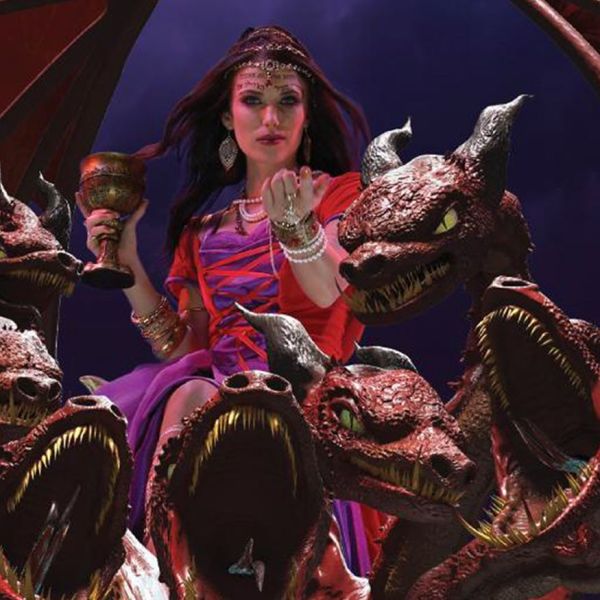
Luxurious living. John is mesmerized, almost hypnotized by the image of the seductive Babylon – in spite of her brutality (17:6-7). She is displayed in great power (over the nations, mastering the beast (17:2-3, 15), arrayed in opulence and glamour (17:3-4), and oozing sexual seduction (17:2). She is the epitome of John’s description of sin: “the lust of the flesh, lust of the eyes, the pride of life” (1 John 2:16)
The picture John sees is the promise of the fulfilment of all our desires. Hedonism is calling to us: “Look at me: I can fulfil all your desires!” All she asks is to stop resisting, to give in and enjoy her. She will give you life! Can you hear her call in our sensual, self-seeking culture? Do you believe her?
It’s beautiful to see here how God is not rebuking believers for their sensual desires. Rather, he makes the readers aware that resisting sensual temptations in this self-gratifying culture amounts to waging spiritual war. We are taking our thoughts captive, breaking down strongholds, battling principalities and powers (2 Corinthians 10:1-5; Ephesians 6:12). Christ helps believers to see the true nature of this Beauty and her Beast: Her beauty is skin-deep; she is vulgar, blood-thirsty and downright evil (17:3). The message to believers is clear: resist her and live, or succumb to her temptation and die (compare with the seductress of Proverbs 5:3-6 and 7:6-27).
The futile fight. [Read the full commentary of Revelation in Faithful to the End]

Quick links to full THE END Revelation Series posts
1 2 3 4 5 6 7 8 9 10 11 12 13 14 15 16 17 18 19 20 21 22 23 24 25 26
 walklikejesus
25 thoughts on “The End? The struggle is real”