Expecting the miracle in your marriage – hope for tomorrow

What do you do when your relationship is lifeless, communication is strained, interaction is difficult? Your partner feels like an estranged friend, someone you once shared life with, but now there is nothing left to share. There has been too many disappointments, too much pain.  Hearts have become hardened and the passion is long gone.  In fact, the affections are directed elsewhere. The marriage is on the rocks. All the signs are there: there is no coming back from this; it is THE END.  You are beyond hope.

Really?

What is hope? And why bother? 

Hope, simply put, is the anticipation of good. Hope, or vision, or a dream, is something desirable that you believe to be possible for you – those “plans to prosper… a good future” (Jeremiah 29:11).  It is best captured by the imagination, illustrated in a picture, or envisioned in a story.  It is an end-state that draws your affections and invites you to dream with.  We have seen the power of phrases such as “offspring as many as the stars above you and sand below you” and “a land flowing with milk and honey” (Genesis 15:1; Exodus 33:3).  Hope is powerful.

Hope is the attitude that looks up and dares to believe that this journey I am on is leading to something beautiful, something desirable, something worthwhile. That the best is yet to come!

Hope is like the architects drawing of the beautiful house in which you will have your kids and the two of you can grow old together, sitting on the veranda as the sun sets peacefully.  Although the house is not built yet, these lines on the paper is the catalyst of desire which will make you build the house.  But more, this picture (hope) is also the reason and clear direction for every inch of effort that will go into making that drawing into your dream home. (Refer to Hebrews 11:1). Indeed, hope is very powerful.

Why is hope powerful?

Hope makes hard times bearable, because as you hold onto the belief in a good future you understand these troubles are temporal, and the hope you long for gives meaning to the things you suffer on the way there.  A lack of confidence of a good future (or hope) is the cause for companies to close their doors, marathon athletes exit the race and couples end up in divorce court. We give up when we loose hope.  Conversely, hope gives athletes strength to endure pain in order to gain the reward, what makes the soldier survive his wounds to see his wife again, and what causes the mother with cancer to keep on fighting and see her children grow up.  Hope, the confident expectation of a beautiful future together, is the reason to endure hard times and helps to see meaning in the daily grind. (See Romans 8:28).

Secondly this hope (a clear vision of a good future) helps us to navigate life’s challenges because it sets priorities in our activities and the direction of our efforts – in both good times and in bad.  We know that the Christian hope of eternal life builds resistance to temptation, is the standard for our relational growth and gives strength to push through endure hard times. Similarly the marital hope of our beautiful and meaningful life together keeps us faithful, helps us grow closer and helps us overcome obstacles together.

Why can I have hope?

If everything in your relationship point to failure and hopelessness, why could you trust that all will be well soon? How could you be persuaded of a joyful, meaningful future together?  Indeed a fair question.  If one has tried everything to keep the relationship alive and nothing seemed to work, you have come to the end of yourself, allowing a sense of hopelessness to set in.

But for the Christian, the end of oneself is not the end of a matter. With God there is always hope: our success or failure does not depend on our efforts alone, but we hope in God (or “trust in God”) as the Psalmists frequently sing (eg Psalm 39:7; 62:5; see Ephesians 2:13-14). When nothing seems to help we are confident of a good outcome because of God’s character, his love for us and his ability. To say “I hope in God” means to trust that God is indeed merciful, trustworthy and powerful enough to help me, and that he is certain to hear my pleas and help me from this seemingly hopeless situation.  We further hope in God because of the hope intrinsic in the resurrection of Jesus Christ, showing that no situation is every truly hopeless to God who brings even the dead to lifer. No situation is ever too late, too hopeless, because “What is impossible with man is possible with God” (Luke 18:27)

How does hope work in practice?

Hope works best in pictures and stories – something you can look at or recall in your imagination. Something that best illustrates the good future you desire.

So find or draw a picture like the stars above Abraham and the sand beneath his feet which reminded him daily of God’s promise that “so will your offspring be.”  What he saw reassured him that his will have offspring – and many.  These visual depictions of God’s promise motivated him to be intimate with his wife, reminded him daily that God was at work in his daily actions, and comforted them both every month Sarah discovered she was not pregnant. It also intended to prevent them from giving up altogether from the hope of a child together by finding other women to provide offspring.   You need a picture like this – it can even be a picture of your wedding day or honeymoon when you were happy together.

Stories are also powerful sources of hope – the Bible is filled with those for a reason!  If you marriage is in a tough spot, then consider finding the story of a couple who were about to give up and God turned it all around beautifully.  Stories are very potent because you can identify with their suffering, and wish to share in their success.  Look for these people, talk or write to them.  Read their blogs and buy their books.  Go to their seminars and workshops where you can listen to their stories, cry about their pain, celebrate their restoration and gain hope!  Ask them to encourage you and pray for you.  Because what God has done for the he will do for you. These stories are filled with hope because these people live the dreams you have – these people embody the hope you need.

These images and stories stir our imagination, and our God “is able to do immeasurably more than all we ask or imagine” (Ephesians 3:20). So, like Abraham was invited to picture his offspring as numerous as the stars in the sky and the dessert sand between his sandals – so image your marriage in it’s prime. Imagine the greatest marital bliss, joy filled home, carefree moments of intimate pleasure, sweet companionship and potent partnership.  Imagine what God can make of your marriage – with all his wisdom and all his might – what could God do in and through the two of you.  What type of marital relationship between you and your spouse would bring God glory, would showcase his loving goodness to the world? Picture that!

I encourage you to “write out the vision and make it clear” as God told Habakkuk (2:2). Talk to your spouse about it, pray about it.  Tell your friends what you dream about. The challenge is to allow the hope (confidence of your good future) to overpower your anxieties (fearful expectation of failure and pain).  Deliberately dwell on the good of your spouse and what you have in your marriage, while you also pray about what makes you anxious or sad, “casting your cares on the Lord, for he cares for you” (Philippians 4:6-8; 1 Peter 5:7).

If you really cannot see a future because you are so aware of the challenges and pain, do what Elisha did when his servant was only aware of the Syrian army surrounding them. ’Don’t be afraid,’ the prophet answered. ’Those who are with us are more than those who are with them.’ And Elisha prayed, ‘Open his eyes, Lord, so that he may see.’ the Lord opened the servant’s eyes, and he looked and saw the hills full of horses and chariots of fire all around Elisha (2 Kings 6:14-17). Then the servant was not intimidated by the challenge they faced, because he was aware of The Lord of Heavens Armies who was right there with them.

You are never walk alone – God is right here with you in your marital crisis. And he is in the business of saving!

Let this be a reminder today that although your relational journey might be laden with disappointments, miscommunication and frustration that left you both hurt and hopeless, with God there is always hope. Nothing is too hard for him (Jeremiah 32:17)! He is close to all who call on him, and look – picture it – he makes all things new! (Revelation 21:5)

So what is the most ideal picture of your marriage? What could your story be? What is your hope?


When intimacy hurts

Recent studies show an alarming increase in “sexless marriages” – in fact, The Times reported that more than 21’000 people search help on this monthly via Google, outnumbering searches such as “unhappy marriage” and “loveless marriage”. The phrase “sexless marriage” refers to couples having sex less than once a month.

But who cares?  A survey by psychotherapist Abby Rodman says 75% of those couples do! They had healthy sexual relationships, but claim that having children(!), stress and fatigue, health reasons or simply time had dried up all the romantic passion.  In fact, this matter so much that half the respondents stated they would not have married their spouses had they known their married life would be sexless. (Although 75% said that they would not end the marriage because of the lack of sexual intimacy).

(Not making) love hurts

Why do they feel so strong?  Because constant sexual rejection in a marriage hurts. A lot.  Reading through articles, blogs, and recalling phrases I have listened to during counselling sessions, the following statements best capture the pain of spouses in sexless marriages.

  • I feel unloved, unwanted.
  • I feel unattractive, ugly.
  • I feel hurt. I sometimes hide in the bathroom and cry.
  • I feel so ashamed – what about me is so despicable?
  • I feel angry and cheated because I explained my desires, yet he/she ignores my pleas.
  • I feel ignored, my needs and desires are simply not important to my spouse.
  • I feel so worthless because he/she has time and energy for everything else but not me.
  • I feel so alone. I lie next to him/her in bed and yet feel so far away.

Sexual rejection by a spouse hurts much because it denies the means and expression of intimacy reserved exclusively for each other.  Especially in relationships where there was at some point much sexual arousal, the onset of habitual sexual rejection communicates not just “I don’t want sex” but rather “I don’t want you.”  Simply put, long-term sexual denial feels like rejection of the person.

Something’s gotta give

Marriage by definition is companionship, a means to obtain intimacy.  When sexual relations within marriage is rejected over a long period it not only impedes the relationship but also has devastating effects on the identity and emotional health of the rejected partner.  The following statements give good insight into the effects of such long-term sexual rejection.

  • I feel so disconnected from with my spouse. We live like house-mates, nothing more.
  • I find myself to be very irritable; small things make me act out in anger.
  • I have lost confidence – not just at home. I am not the strong man/ woman I used to be.
  • I feel resentful; my heart is really hard towards my spouse.
  • I feel attracted to the attention of others; the rejection has made me vulnerable to emotional and physical affairs.
  • I have grown tired of being rejected so I have stopped making efforts for the relationship.
  • I am very suspicious – I hate admitting this but I think my spouse is interested or in relationship with someone else. 
  • I am so depressed; the one person that I love does not want me.
  • I have suppressed every sexual desire, because not feeling anything is less painful than being rejected.
  • I am addicted to porn and masturbation. I know it is wrong but I can’t stop it (and I honestly don’t care anymore).
  • I don’t have hope for our marriage anymore. Things will always be this cold between us.

These phrases capture much pain. Looking at the two lists of statements above I feel so much sympathy for anyone in a sexless marriage. And I understand why Paul would write so strongly about not denying your spouse sexually intimacy (1 Corinthians 7:3-7).  Yet every marriage goes through ups and downs, and therefore the challenge of married life is to continue “cleaving to your [spouse]” to remain “one flesh” (Genesis 2:24). Never stop pursuing intimacy with your spouse!

couple-not-talking

Helpful, hurting and hopeful

Over the years I have noticed three general responses of people suffering from long-term sexual rejection.  The first group harbors anger, visible in hostility and frustration – typically accusation.  It is as though these people subconsciously want to hurt their spouses to share in their pain of rejection.  This is not helpful.  Yet anger and hostility hinders any form of intimacy, which requires safe space to open up.  So this response pushes the couple further apart.

The second group has become passive, apathetic.  Escaping the torment of perpetual rejection, they have given up on any hope for intimacy and suffocated their own desires for intimacy.  Marriage has become a cold, platonic friendship.  This is indeed a very lonely place – especially within marriage. This is not necessary: there is hope!

The third group has embraced vulnerability to allow for intimacy, enduring the hurtful rejection towards the other’s heart. It simply means to forgive the other in order not to close one’s heart.  They strive for connection beyond fear. These spouses talk about their hurts – but with open hearts – and intentionally create an environment of affection, warmth and encouragement.  They never lose hope that they will regain the romance and intimacy which they once enjoyed.  And they see the fruit.  Love never fails. (1 Corinthians 13:8)

To the rejecting spouse I don’t think I need to write any further advice, except to ask your partner whether he or she feels the same as the statements recorded above, and strive to understand his/her needs for intimacy.  Then share your feelings to identify the barriers to intimacy, whatever they may be, and seek help as a couple. Do it today!

My counsel to you, the rejected spouse, is take courage, and embrace vulnerability to graciously and patiently explain your feelings to your spouse, but do so in gentleness and love, not angry, and not nagging.  Express your love and attraction for him/her.  Affirm your affections and approval of him/her.  And with of without your spouse, seek help – your journey need not be so lonely.  But never lose hope!

You might not be able to fix this, but nothing is impossible with God. (Luke 1:37) Ask him to make a garden in your wilderness! (Isaiah 51:3)

couple-talking-in-bed

Connection Beyond Fear

Post by guest writer Joanne Eksteen.

I was recently reminded of someone that had lost a child and a parent in a short time. I was deeply struck by it and carefully wondered how something so tragic is processed by the psyche. Perhaps I could unpack it somehow. Instead I ended up asking God “why?’. That age old question. Why are we able to deeply connect with people if that connection can be lost so easily? It hurts and can be devastating. What’s the point? Why bother? The prospect of connection suddenly scared me. I have often seen how that fear prevents people from connecting vulnerably with others. How even in marriage, individuals are hurt and withdraw into simple friendships with their spouses.

A couple of days later I came across this photo on Facebook.

brother_holding_sister

I felt God saying: “This is why…” I heard in my heart that without human connection, without relationship, life would be a fearful endeavour harder than what we would be able to imagine. It is a gift not only to enjoy but also to comfort us. It can be seen as an extension of God’s relationship with us and in many ways His hand at times. The process of connecting is so enriching, rewarding and supportive that it also creates in us, I believe, resilience. The ability to ‘bounce back’ after a challenge or hard time as an individual and as a couple. As a married person this is what one should hope for.

Because connecting with another human being puts us at risk of being hurt, pain from previous relationships in the form of loss, rejection, death, divorce or really anything else, can often stand in the way of deeply connecting with your spouse. It can stand in the way of trust and being able to give of yourself fully. Unresolved anger towards an ‘ex-partner’ or even parent or colleague may make you defensive and unable to be vulnerable with your spouse. Unforgiveness may have made your heart hard and therefore unable to connect. Shame may make you feel like you are unworthy and you may withdraw into a friendship with your spouse (a place where you may feel safe but where you miss out on the resilience, support and reward described above).

Often the answer is simple: forgiveness. In fact in most cases it is forgiveness. It is understanding that human beings including yourself are fallible but that God can heal and restore anything. Christ’s blood was shed for that very purpose. It is putting our faith in Him and not in her. It is a decision and then a process. You can learn to trust again. It may take time. It starts with an open discussion about that which you may have buried. It will probably be hard and uncomfortable but it WILL BE WORTH IT!

For reflection 

To help you grow in deeper connection with your spouse, discuss the following questions 

  1. Discuss the win your groups how previous relationships may be hindering the process of connecting with your spouse.
  2. Have you ‘shut’ anyone one out in your life promising yourself to never let that person or anyone else hurt you again? What do you feel towards that person? Have you forgiven them? Can you forgive them?
  3. Do you see yourself as worthy enough for your partner? Are you ashamed of anything?
  4. What do you think about self-forgiveness?  Is there anything you struggle to forgive yourself for?

*Bold words are themes to be discussed in this session (you don’t have to ask these exact questions)

Post and reflection questions by Joanne Eksteen.  Joanne is wife, a mother and a clinical psychologist with a passion to help people grow in healthy identity and relationships.

Barriers to Intimacy: Questionnaire

Maintaining an intimate relationship is often more difficult than we’d hope for.  Preserving vibrant connectedness in a world filled with responsibilities and distractions requires disciplined effort and gentle responsiveness. We must be aware of the things that alienate affections and counteract closeness, and eradicate these relational threats.

Today’s post contains a short questionnaire aimed at identifying the big stumbling blocks that frequently hinder intimacy in marital relationships. The goal is to first look in the mirror before you look across the room. I hope this reflective exercise helps in increasing intimacy within your home!

A. To what degree do each of the following areas affect sexual intimacy with your spouse?

1.     Stress at work Much Some None
2.    Stress at home Much Some None
3.     Overworked and tired Much Some None
4.     Preoccupation with TV / phone / computer Much Some None
5.      Preoccupation with kids / hobbies / etc Much Some None
6.      Frequent conflict Much Some None
7.      Not feeling valued Much Some None
8.      Not feeling attractive / attracted Much Some None
9.     Lack of affection in home Much Some None
10.   Lack of initiative to engage Much Some None
11.   Lack of responsiveness to spouse Much Some None
12.   Lack of sexual desire (ie lowered libido) Much Some None
13.   Fear of inadequacy in bed Much Some None
14.   Fear of being laughed at/ mocked Much Some None
15.   Unforgiveness or anger in relationship Much Some None
16.   Past hurt in intimate / sexual relationship Much Some None
17.   Sexual intimacy not pleasurable Much Some None
18.   Porn tainted the intimate relationship Much Some None
19.   Physiological / medical reasons Much Some None
20.   Guilt of past prevents intimate enjoyment Much Some None

B. Use your answers above as prompting to discuss your feelings with your spouse, a counselor or within a safe group therapy environment. Seek to discover why you feel this way.

C. Confess your part in the problem. Is there something that you could do to remedy the problem? What could change the situation for the good?

D. Ask God to forgive you for your wrongs, to heal your relationship and restore joy again.

Are there other barriers to intimacy that you are aware of, and that i have not included here?


Growing in Spiritual Intimacy

“Some say they have been married for 20 years, but truthfully they have been married twenty times the same year.” This statement by pastoral psychologist Jannie Botha has been ringing in my head ever since I have heard him say it few years ago.  It’s true: just because we have been together for long does not mean we have grown together strong.  Growth requires deliberate discipline (1 Timothy 4:7).

From the offset of our relationship my wife and I had a good spiritual partnership.  We went to church together, did Bible School together, served in a student ministry together and even planted a church together before we got married.  But although we shared some amazing times of worship together over the years, and although we pray together daily, we have not found a model for frequent devotional time together that worked well for the two of us. She has her way of spending time with God and I have mine.

Yes, we occasionally share what we read in the Bible and what God says to us, but we have always desired to grow spiritually together through a structured couples devotional time.  Especially now that we have kids we longed some format of a family devotional time that they may grow into more and more as they grow older.  And after more than a decade’s marriage I think we found something which works for us!

A Devotional Model for Couples

In his series Creating and Intimate Marriage Jim Burns shares that he and his wife Cathy also have their own devotional time, but that once a week they would come together and have a devotional time where share on spiritually with each other and spend time in prayer together, especially regarding their marriage and family.

They would begin their devotional time together by sharing from their Bibles and journals the most significant thing(s) that that God revealed to them personally, and discuss this with each other.  They would share what they have read, why it touched them and what it made them think and feel, and possibly how it would impact their current or future attitudes and actions.  This is a time of spiritual discussion and reflection.

Thereafter they share their greatest joy, greatest struggle, and greatest desire of the past week.  This can be a simple as “my greatest desire of the week is a weekend away from everything” or as deep and honest as “my greatest struggle of this week was you, Jim!”

This is followed by a time of affirmation – where they would encourage one another by stating how they positively perceived one another during the week.  Because they are committed to create an atmosphere of A.W.E. (affection, warmth and encouragement) in their home, they schedule these times of affirmation. This would lead to a time of accountability for physical goals they set for one another, and I think any form of accountability is healthy in such a session.  And eventually these sharing with one another would lead to a time of prayer for one another, their relationship and their family.

growing_spirtually

Overcoming spiritual barriers to intimacy

It is important to note that the biggest barriers to intimacy include a lack of priority to meet together in such deliberate and disciplined ways – which these devotional times in themselves will overcome.  But furthermore relational issues such as unforgiveness, anger, and guilt, are all spiritual conditions which these times of sharing and praying should address.  These are the things that couples need to pray about together, asking God for love and grace to grow beyond.

The aim of this devotional time is to deliberately and systematically grow together spiritually as “draw near to God and he will draw near to you” (James 4:8) and so doing to  grow in deeper intimacy.

This couples devotional method works for me – perhaps you and your spouse can try this and see if it works for you?


Growing intimately

By Joanne Eksteen.

Intimacy is a gift from God to be enjoyed and to connect two people that have entered into the covenant of marriage. What does it mean then to connect intimately and why do so many of us miss this incredible gift?

To connect means to be completely vulnerable and open in the giving of oneself physically, emotionally and spiritually. For most this is difficult.  Often, when I put this thought to people, they report uncertainty regarding whether they can trust the other person to receive what they give in an accepting and graceful manner.

While this is important, it is really not about the other person. It is about that thing you think you need to trust the other person with. Do you accept that thing you think you need acceptance of? Do you believe that although you are not perfect, that God thinks of you as worthy? Whether you can trust the other person is really irrelevant. If what you give is not received in trust and acceptance – will you still be whole?

When you get to a place where you accept yourself and see yourself as God sees you, you are able to release the fear of being rejected. You no longer need to trust someone else. You can trust yourself. Shame is no longer an issue.

Only once we can give freely and without reservation, that which we consider worthy, are we open to receive. In turn your sense of self-worth will most likely be reinforced as you are able to receive and accept love in return. From this vantage point the view is spectacular!

Perhaps I can simplify this further? We all have a ‘sense of self’- the summation of an image we hold of ourselves. It is what we think of ourselves consciously and unconsciously. I was ‘top’ of my Maths class in High School. After a particularly hard test (or at least that was my perception), I walked out of the class huffing and puffing. My teacher asked me how it went and I replied: “terrible”.

She reflected: “…it is because you always focus on that which you think you got wrong and not on the 99 others that you got right…”. In life I have often struggled with this. Why is it that we are so afraid to let others see that 1 percent that is ‘wrong’, not perfect or bad?

I later realised that I needed to control everything to be ‘perfect’ in order to not let others see my shadowy or negative parts.  The reality is that we all have shady parts. The Bible tells us that we’re born in sin.

We also all have good parts I believe. In a real intimate relationship we need to be honest and vulnerable to the extent that you allow your partner into those shadowy parts. Only when we can give freely can we freely receive (the love and acceptance that should be returned). As partners we should be sensitive to our spouses’ vulnerability and never use it to hurt them. We should carefully choose the words we use to receive their vulnerability and care for them in that moment. And then…it’s your turn!

One of the largest barriers to intimacy is what I have described here i.e. poor self-acceptance, low self-esteem or shame. It feeds many of the other barriers that we often hear about. Take pornography for example. I believe porn to be an addiction and habit once it starts (an entire different story for another day) but how does it start? Porn starts when one tries to sooth the longing for intimacy but one is fearful of engaging in real intimacy as it would mean entering and sharing the shadowy waters of yourself. Instead porn in easily accessed and controlled (at least the first couple of times) and doesn’t ask any questions. It is not hard, takes little emotional effort, can’t reject you and you don’t need to fear it or trust it. You also don’t have to return the favour. Despite this, it doesn’t fulfill one’s real need and forces one to return time and time again.

Consider the barriers you experience to intimacy. Can you relate it to anything I have said above?

intimacy_collage2

Joanne Eskteen is wife, a mother and a clinical psychologist with a passion for identity and relational therapy.  

On a Journey of Intimacy

Craving intimacy

Humans crave connectedness. We are creatures characterized by a desire for companionship, with a yearning to be known, a longing to be loved.  This is a primal need; even in paradise “it [was] not for man good to be alone” (Genesis 2:18).  Indeed much of our conscious and subconscious decisions are driven by this aching to “become one flesh” (Genesis 2:24).

In paradise, our ancestors were “naked and not ashamed” (Genesis 2:25), being fully satisfied in intimacy.  But now we no longer live in paradise, making connectedness and companionship so much more complex.  Although the desire for intimacy still burns fervently inside of us mankind’s fall has stained our spirits with shame – the knowledge of our imperfection, the nagging voice that there is something wrong with us.  The awareness of our flaws deceives us into believing we are unlovable, so like our parents in the Garden (Genesis 3:7-8) we try to “cover our nakedness” with futile fig leaves or hide to avoid closeness with others altogether in the shadows of our loneliness.  Thus, shame – this sense of unworthiness – brings a deep fear of rejection and closes one up, making intimacy impossible.

Therefore, to have and maintain intimate relationships one has to firstly believe that you are worthy to be loved and secondly embrace vulnerability, knowing that closeness with others will expose the true you in all your glory and imperfections.

An atmosphere of AWE

So one of the easiest ways of cultivating intimacy is to create a safe relational atmosphere that affirms worth and encouragement.  In Creating and Intimate Marriage Jim Burns writes about creating an atmosphere of A.W.E. (Affection, Warmth and Encouragement):

  • Affection says “You are loved!”  It speaks to the basic need to feel loved through a gentle touch,  a hug a kiss and the loving tone in words of endearment affirms the worth of the other and strengthens the relational bond.
  • Warmth says “You are valued!”  by creating a friendly, welcoming and positive atmosphere within the home or relationship.  It is communicated by the attention we listen with, the attitude we respond with, and the air we speak with. It is strengthened through a culture of honour and celebration, creating an environment to which people would want to return.
  • Encouragement says “You are doing great!” It refers to a healthy habit of affirmation, praising both the worth and accomplishments of the other, and constantly recognizing the efforts and contributions of the other with giving thanks.  Encouragement aims to build the other up.

This Atmosphere of AWE affirms the worth of the other and creates a safe milieu conducive for vulnerability, allowing hearts to gently grow closer together. Even during difficult relationships seasons, creating a positive atmosphere through affection, warms and encouragement will result in increased joy and intimacy – even if just one in the couple keep to it.

Greater capacity for intimacy

intimacy_collage1
Our pursuit of intimacy proves difficult at times, but these moments of loving closeness brings delightful joy!

Over the next seven weeks we will embark on a journey of intimacy, specifically designed to help you grow in your personal capacity to be intimate within marriage.

  • Firstly we will consider our view of intimacy, including spiritual, emotional and physical (sexual) intimacy.  While we evaluate our view of intimacy we will also consider the nature of shame at work in our relationships and see how we can recognize and limit this destructive dynamic in our interactions.
  • Secondly we will recognize other barriers to intimacy, considering general stress as well as relational tension caused by unresolved conflict leading to anger, unforgivess and bitterness. Other major barriers to intimacy include self-centeredness, laziness, pornography, and physiological issues.
  • Thirdly we will consider how to enhance our capacity for intimacy by growing in courage for vulnerability, a stronger sense of worth and identity, as well as embracing the attitude of a servant lover.  We will also focus on the importance of consistently securing a safe space (through our actions and communications) within our relationships in which both we and the others can entrust themselves.
  • Lastly we will devote time in which we will deal with sexual intimacy, considering the the different ways with which men and women generally approach lovemaking, and how to prioritize physical intimacy in our busy lives and homes.

We all can grow in our capacity to love and feel loved.  Come join us on this journey of intimacy!

Slow down – you need to fast!

The medical benefits of fasting is astounding, ranging from a stronger immune system, better hormonal balance, increased longevity, lowered heart risk and even to healing of various cysts and some cancerous growths.  For these and other reasons fasting clinics have been popular throughout Europe for over 60 years.

But fasting is not only prescribed for its health benefits; it is rightfully still thought of as a spiritual exercise or discipline.  Yet in our high-paced consumerist society this ancient discipline is not frequently practiced.  So why should Christians fast?  What is the promise behind this self-denying practice?

The 69th Psalm of the shepherd-king gives us unique insight into the purpose and power of fasting.  In its opening lines David cries Save me, O God! For the waters have come up to my soul.  I sink in deep mire, where there is no foothold… mighty are those who would destroy me, those who attack me with lies” (verse 1-2, 4).  Two verses later he writes “O God, you know my folly; the sins I have done are not hidden from you.” (verse 5).

These opening phrases sketch the mindset of a troubled man in a hopeless situation: his soul is in anguish because of enemies much more powerful than himself, and to top of it his conscience is troubling him with the weight of guilt. Then David finds comfort in these words, the central thought of the Psalm: “I humbled my soul with fasting” (Psalm 69:10)

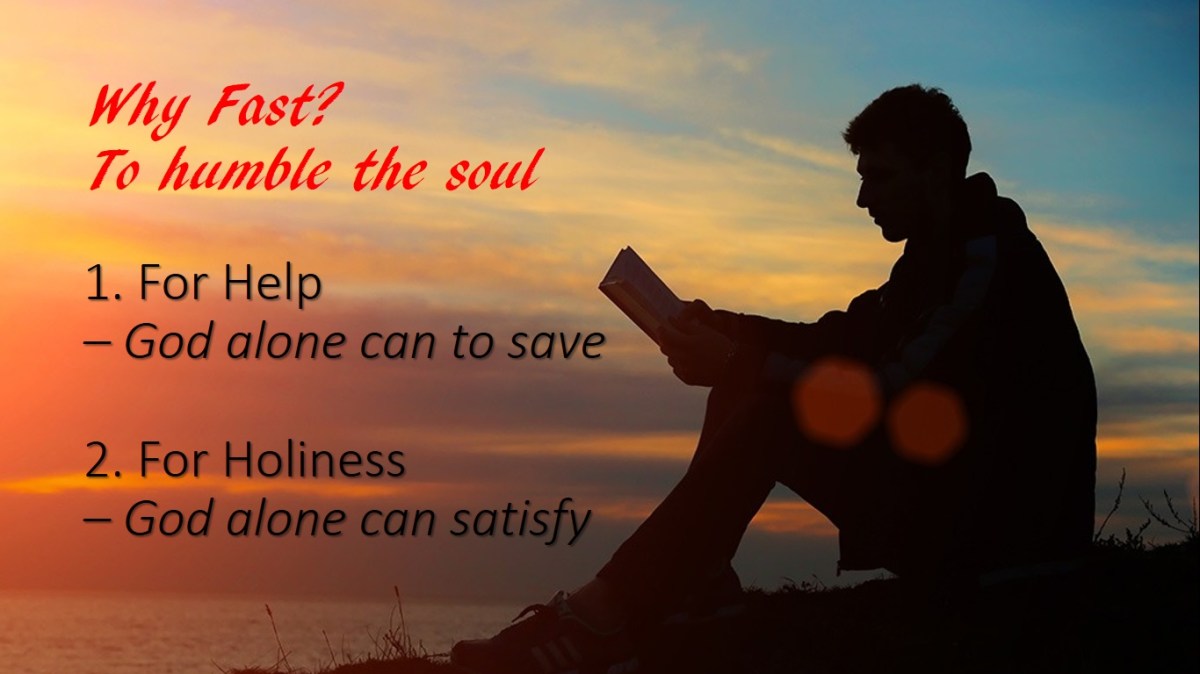
humbled_soul

God alone can save

Why fast?  Firstly, David “humbled his soul with fasting” to appeal for help: his fasting was a clear statement that all his strength, all his knowledge, all his resources was insufficient to save himself from this troubling situation.  This great shepherd-king who killed the lion, the bear and great Goliath, who lead an army of mighty men that put fear in the hearts of his greatest enemies, this great David abstained from food and wine to shamelessly declare “I cannot save myself” – “my prayer is to you, O Lord!”, “Save me!”, “Deliver me!” (Verses 13, 1, 14). In his fasting he displayed his trust in God, saying “God alone can save!”

Years later his great-grandson King Jehoshaphat received troubling news that three great armies were marching against Jerusalem, greatly outnumbering the inhabitants of small Judah.  His first response was to do what he learned from David: Jehoshaphat was afraid and set his face to seek the LORD, and proclaimed a fast throughout all Judah” (2 Chronicles 20:3). Rather than rallying the troops, forming allegiance, gathering supplies and fortifying the cities Jehoshaphat humbled himself with fasting to appeal for help from God. The closing line of his prayer captures the motive of their fast: “For we are powerless against this great horde that is coming against us. We do not know what to do, but our eyes are on you” (2 Chronicles 20:12).  And as they weakened themselves through abstaining from food and stood before the Lord helpless, the Lord answered “Do not be afraid and do not be dismayed at this great horde, for the battle is not yours but God’s” (verse 15). God responded with a great deliverance that day!

Still years later Ezra the priest was returning from exile, leading a group of elders and officials to rebuild Jerusalem and its temple.  Although Ezra had special favour from King Darius carrying letters of his support, Ezra refused to ask for a royal guard for protection through hostile territory because he ensured the King “The hand of our God is for good on all who seek him” (Ezra 8:22).  So what did Ezra and his company do before their dangerous journey?  “I proclaimed a fast there, at the river Ahava, that we might humble ourselves before our God, to seek from him a safe journey for ourselves, our children, and all our goods” (Ezra 8:21). The wise priest and his companions humbled themselves with fasting to appeal for help from God.  And the hand of the Lord was upon them for good!

God alone can satisfy

The second reason David states in Psalm 69 why he humbles his soul with fasting is to facilitate holiness as he confesses and shows remorse for his sins (verse 5-7).  After being confronted by the prophet Nathan for his adultery with Bathsheba and staged murder of her husband Uriah, the king fell on the floor in remorse and fasted for seven days (2 Samuel 12:15-18).  From this time of fasting comes these words:

Have mercy on me, O God, according to your steadfast love; according to your abundant mercy blot out my transgressions.

Wash me thoroughly from my iniquity, and cleanse me from my sin!

For I know my transgressions, and my sin is ever before me.

Against you, you only, have I sinned and done what is evil in your sight, so that you may be justified in your words and blameless in your judgment…

Create in me a clean heart, O God, and renew a right spirit within me.

Cast me not away from your presence, and take not your Holy Spirit from me.

Restore to me the joy of your salvation, and uphold me with a willing spirit.”

(Psalm 51:1-4, 10-12)

David did not invent fasting as a means of repentance and holiness; as a Jew David grew up and annually kept The Day of Atonement – the special Holy Day during which all Israelites fasted (“afflicted their souls”) and confessed their sins to God as a nation.  On this special Sabbath the High Priest offered a Lamb for atonement of sins (Leviticus 23:27-28). Thus the nation annually humbled themselves in fasting as a sign of remorse to facilitate their holiness to God – as prescribed in God’s Law.

But fasting for holiness not only has to do with confession of sins – the key focus is to humble the soul by denying its carnal cravings.  During a fast one shuts down all other impulses that tug at the heart and deny all the cravings of the flesh. This time of consecration therefore serves as both a reminder that God alone satisfies the desires of the soul, and an opportunity to grow in holiness and love for God.    During a fast one can pray with the Psalmist “As a deer pants for flowing streams, so pants my soul for you, O God… Deep calls to deep at the roar of your waterfalls” (Psalm 42:1,7).

So Psalm 69 teaches us to humble the soul by fasting, firstly to obtain help, because God alone can to save, and secondly to grow in holiness, because God alone can satisfy.

why_fast

When fasting is not selfish

But we ought to fast to obtain help for others, as the Lord instructed Israel in Isaiah 58:6 “Is not this the fast that I choose: to loose the bonds of wickedness, to undo the straps of the yoke, to let the oppressed go free, and to break every yoke?”  And Nehemiah and Daniel showed us that even righteous men humble themselves by fasting to show remorse for the sins of their nation, and to appeal for God’s mercy. (See Daniel 9 and Nehemiah 1)

Is there any situation in your life too big or difficult for you? Is your soul too cluttered, too worried, too demanding or overburdened with guilt?  And do you crave intimacy with God, to share in his holiness?  Then it’s time to slow down, and fast.

You never walk alone

“In the beginning God created the heavens and the earth.”  – Genesis 1:1, The Bible

God Created

This powerful opening line of the Bible brings such comfort, assuring the reader, with the fundamental assurance that “GOD IS” and that “GOD CREATED.”  These records of creation do not intend to prove the existence of God but rather assumes God’s existence, his power and design in the creation of the World.  He was there in the beginning, and he has been there from the beginning – he is eternal, enduring, unchanging.  God exists, he lives and he is the source of all that exists and lives.  He predates creation and he is the cause and creator of all things.

These opening words of the Bible changes your outlook on and experience of life dramatically.

“GOD IS”

alone_beach

Because “God is” you are never alone.  Wherever you go God is there. This truth moved David to sing Where shall I go from your Spirit? Or where shall I flee from your presence?” [i]  In the “highest heavens [or] deepest ocean”, even in death[ii] (Hebrews “Sheol”).  David knew God is present.  Even in his moments of “great darkness”[iii] David knew God is present and ready to help.

Elsewhere David wrote that “The Lord is near to the brokenhearted”[iv] meaning the Lord relates to and supports those who suffers emotional pain. Often one hurting feels alone even in among friends because he or she feels   David knew you never suffer alone because the Lord is compassionate[v]he identifies and feels with you.  That’s a primary reason why Jesus came to earth, why he “became flesh and walked among us”[vi]: to be tested and to suffer in every possible way in which you could suffer.[vii]

Because GOD IS, you are never without help, never without hope.  There is a God who exists and is “near to all who call upon him”.[viii]  In the beginning there was nothing, but there was God, and He created beautiful and vibrant life out of nothing.  Where God is there is hope.  David sang “If it had not been the LORD who was on our side… then they would have swallowed us up alive… the flood would have swept us away… [But] our help is in the name of the LORD, who made heaven and earth![ix]

And because GOD IS – the Almighty, All-Knowing, Omnipresent, Unchanging Godyou will never face anything too big, too powerful, or too difficult. There is never anything insurmountable, because he us the God who he created everything, including “all things in heaven and on earth, visible and invisible, whether thrones or dominions or principalities or powers… And He ranks before all things, and in Him all things consist.” [x]  He created all these things[xi]  – nothing is out of his control nothing is beyond his reach.  God said to Jeremiah “Look, I’m the LORD, the God of all flesh; is there anything too difficult for me?”[xii]

Because God is near, you never need to be intimidated by any person, group or situation, as David sang “Though an army may encamp against me, My heart shall not fear.”[xiii] and elsewhere “For by you I can run against a troop, and by my God I can leap over a wall.”[xiv] The security of God’s presence brings peace in a fallen world filled with violence and terrorism, infested with disease and sickness, characterized brokenness and uncertainty.[xv]  With God I am never intimidated, never on the back-foot, never caught off guard. With the Psalmist we can confidently declare The LORD is on my side; I will not fear. What can man do to me?”[xvi] Therefore you are you are never outplayed, never outweighed, never outwitted and never outnumbered.

“GOD CREATED”

choices_1

This opening line of the Bible also reminds you that God created you and therefore you are never without direction, never without a purpose and never without a future.  God, your Father, knew you and consecrated you for his purpose and pleasure even before he “knit [you] together in [your] mother’s womb”.[xvii]  Regardless of how you might have missed God’s purpose, regardless where you might have derailed from His path – still He has “plans of peace and not of evil, to give you a future and a hope[xviii] for you. With God, your journey has not ended!

Because God created you, you are not left to your own plans for the future and you are never abandoned to solve your own problems.  Your preservation or prosperity does not depend on your own powers, plans or possessions.   Even if your own foolishness or sinfulness left you stuck in mud, you can like David cry for help and be delivered and restored to His praise.[xix] God, your creator, knows your purpose, knows your circumstance, and still knows the way to the “future and hope” he planned for you!  So “trust in the LORD with all your heart… and he will make straight your paths.”[xx]  Our God has made “a road in the sea… and a way in the wilderness” [xxi] before – he will make a way for you where there seems to be no way.

God created you in his image.[xxii] You are not a misfit, not a mistake. You are never insignificant, never unnoticed.    It is not your [supposed] success that makes you significant to God, and neither does you lack of performance make you insignificant to him.  Your significance rests in your image: “indeed, we are His offspring” [xxiii] and therefore bear his image.  That is what David marveled of in his song O LORD, our Lord, how majestic is your name in all the earth! You have set your glory above the heavens… what is man that you are mindful of him, and the son of man that you care for him?” [xxiv]  You are significant because you are related to God: created in God’s image for relationship with him and reigning with him.[xxv]  You are invaluable and precious to God, uniquely crafted in his image. He has not forgotten you nor forsaken you; He cannot because “your name is engraved in the palms of his hands” and like breastfeeding mother has her baby continually in her thoughts, God has you in his heart and mind.[xxvi]

How does Genesis 1:1 arm the believer in the face of uncertain and difficult times?  This opening line of the Bible brings hope: GOD IS – the transcended God who is almighty, all-knowing, ever-present, everlasting and unchanging.  Nothing that you face will be too big for him – you are safe in his presence!  But not just his transcendence (God’s unfathomable bigness), also his immanence (God’s nearness and relatedness) brings great comfort: GOD CREATED you in his presence to relate to him and reign with him.  Thus he also relates to you and has compassion on you; he is near and ready to grant mercy and grace on all who approach him boldly.[xxvii]  You are never alone, never without help, never without hope.

Spring weather May 7th
A man look up at a starry night at Kielder Water, Northumberland. PRESS ASSOCIATION Photo. Picture date: Tuesday May 7, 2013. Photo credit should read: Tom White/PA Wire

[i] Psalm 139:7

[ii] Psalm 139:8

[iii] Psalm 139:12

[iv] Psalm 34:18

[v] Psalm 145:8, compare Exodus 22:27

[vi] John 1:14

[vii] Hebrews 2:17-18; 4:15-16

[viii] Psalm 145:18

[ix] Psalm 124:1-8

[x] Colossians 1:16-17

[xi] John 1:3

[xii] Jeremiah 32:27

[xiii] Psalm 27:1,3

[xiv] Psalm 18:29

[xv] Psalm 91:3-9

[xvi] Psalm 118:6

[xvii] Jeremiah 1:5; Psalm 139:13

[xviii] Jeremiah 29:11

[xix] Psalm 40:1-4; compare Romans 10:13

[xx] Proverbs 3:5-6

[xxi] Isaiah 43:16-19

[xxii] Genesis 1:26-28

[xxiii] Acts 17:28

[xxiv] Psalm 8:1,4

[xxv] See Genesis 1:26-28; Psalm 8:3-6; Psalm 115:16; Romans 5:17 and 2 Timothy 2:12

[xxvi] Isaiah 49:15

[xxvii] Hebrews 4:15-16

A Passion for God’s House

“For zeal for your house has consumed me.”   (King David, Psalm 69:9)

St-Patricks-Cathedral

I love this image of the St Patrick’s Cathedral standing between tall sky-scrapers in New York City:  a sanctuary for God in a busy, godless city.  Here the broken-hearted can find their Comforter and the oppressed their Deliverer.  Here the lonely can meet their Friend, the sinner can find Mercy and the troubled can find Peace. Here New Yorkers can escape the business and noise of the city and hear the still voice of God. And here the Creator of the universe can meet his beloved creatures and receive his rightful worship.  This is a church – the House of God.  And this image reminds me of a sermon I heard in 2002 by Fred May – a message that has not left my heart.[i]

The House of God had such a prominent place in the heart of king David amidst the business of his demanding life.  This beloved shepherd-king of Israel was a general of an active army, the ruler of a vastly expanding kingdom, a husband of several wives and a father of many children.  David was a brilliant architect, a skilful musician, songwriter and poet, as well as a prophet.  David’s life was not free from disappointment and pain: his childhood was marked by paternal negligence and sibling rivalry; his youth was celebrated by heroism which caused him to be hunted down and exiled by a jealous monarch; he buried (at least) three of his own children; and he experienced severe betrayal during the revolt lead by his own son Absalom who sought the crown.  But David was not without fault either: the Scriptures clearly record moments of rage and pride, an adulterous affair with Bathsheba and the murder of her husband Uriah, as well as David’s passive fatherhood which lead to violent incest, murder and eventually the revolt lead by his son Absalom.

But amidst these moral and ethical failures David was “a man after [God’s] own heart” (Acts 13:22) – why?  This phrase from the famous Shepherd-psalm reveals why: “Even though I walk through the valley of the shadow of death, I will fear no evil… Surely goodness and mercy shall follow me all the days of my life, and I shall dwell in the house of the LORD forever (Psalm 23:4-6).   Although this iconic king had the affection and even heroic worship of the people, the respect of both his army and his enemies, all the wealth and pleasures he could dream of, David had a zealous passion for the House of God more than anything this world could offer (Psalm 69:9; compare John 2:17).  Especially during times of hardship, during his days of exile from Israel, David would long for the comfort and security he experienced alongside other worshipers in the House of God.  And that was the key to David’s enduring legacy.

St-Patricks-Cathedral1

David really experienced the house of God as a special place where he met with God – alongside other believers.  What do the Psalms reveal of his experience in God’s house?

First, we read that David experienced something special in the House of God (although it was a tent in his days!) –  he experienced favour (a benevolent attitude) before God and mercy (undeserved goodness) from God towards him.  [Psalm 5:7]

Secondly, David experienced real security and strength in God’s House [Psalm 27:4-6]. While hiding in the wilderness, in caves from King Saul David longed to be in God’s House – because there in God’s presence he felt safe and secure.

Thirdly David associated the House of God with abundance of provision [Psalm 36:7-8].  In the presence of God there is no lack, and in the House of God there is always enough for the one who is hungry.  The house of God was – and is – always a place where the poor get helped with practical provision, displaying the gracious generosity of God.

Fourthly, for David the House of God was a place of fellowship and friendship – a place where deep bonds were formed in the presence of God [Psalm 55:12-14].  In Psalm 55 David laments in anguish how he had been betrayed by Ahithophel, his friend and wise advisor who had defected to Absalom’s insurgence.  But we read that the worse part of the betrayal for David was that they “used to take sweet counsel together; within God’s house [they] walked in the throng.” (verse 14).

The fifth thing we learn about David’s observation of those who love the House of God is how they live a long, healthy and productive life as recorded in Psalm 92:12-15:

The righteous flourish like the palm tree and grow like a cedar in Lebanon. They are planted in the house of the LORD; they flourish in the courts of our God. They still bear fruit in old age; they are ever full of sap and green, to declare that the LORD is upright; he is my rock, and there is no unrighteousness in him.”

I know several old people who love God and His House, and although they grow old but their spirits remain young.  They remain joyful and friendly, full of life and faith.  Truly, God renews their youth!

The sixth thing we note in Psalm 122 is that David and his decedents remained faithful to the House of God for the goodwill of the nation; i.e. their worship of God in the House of God resulted in God’s blessing on their kingdom.  The same remains true today: to see the Kingdom of God come and extend in our nation, our devotion should be to the House of God.

Lastly we read how David loved the house of God because it was God’s Home – a resting place for God [Psalm 132] – a place where His name was revered, where He could receive the worship due to Him.  A place where people could meet him away from the business of everyday life.  David knew that “the earth is the Lord’s and the fullness thereof” (Psalm 24:1), and that God fills the whole expanse with His presence.  But although God is omnipresent, His House is the one place that is set aside for Him – a place that is sanctified for Him and his worship.  “God’s name is blasphemed among the nations” (Romans 2:24), yet in his House, among His people, he is revered.  It is His “resting place.”

inside2

This passion for God’s house kept the shepherd-king up at night, especially once his wars had ceased, his enemies were conquered and he was crowned king over Israel, ruling from his beautiful palace in Jerusalem.  One night he called Nathan the prophet to share his burden and dream to build God a Temple – a structure which will host and display the greatness and glory of God: Now when [David] lived in his house and the LORD had given him rest from all his surrounding enemies, he said to Nathan the prophet, ‘See now, I dwell in a house of cedar, but the ark of God dwells in a tent…’” (2 Samuel 7:1-2)  The Lord’s reply was so telling of his honor for David’s love for the House of God; God said that because David had it in his heart to build Him a house, he will reward him with the following (2 Samuel 7:9-16):

  • A great name for David.
  • Rest from his enemies.
  • God will build David a house (legacy).
  • David’s children will reign.
  • God will instruct David’s children and take care of them.
  • Goodness towards David’s offspring.
  • An eternal kingship (fulfilled in his descendent Jesus the Christ).

And the Scriptures reveal that these all came to pass; although God did not permit David to build God’s temple because of his reputation of war and bloodshed, God clearly honoured and rewarded David’s passion for his House, amidst all his business and success.

But God is no respecter of persons – how he honoured David because of his love for God’s house, so he has honoured countless others who “had it in their heart to build God a house”.

basilique-notredamedemontrex301al-montreal-quebec-canada_main

Amidst the business of life, the terrors of our times and the delights this world offers, what priority does God’s house – the assembly of his people – have in your heart?  When you go through hardships or when you can’t fall asleep at night, does your flights of fantasy take you into the house of God where God’s presence meets God’s people in worship? Can you pray with this psalmist?

“How lovely is your dwelling place, O LORD of hosts!  My soul longs, yes, faints for the courts of the LORD; my heart and flesh sing for joy to the living God.  Even the sparrow finds a home, and the swallow a nest for herself, where she may lay her young, at your altars, O LORD of hosts, my King and my God.  Blessed are those who dwell in your house, ever singing your praise! For a day in your courts is better than a thousand elsewhere. I would rather be a doorkeeper in the house of my God than dwell in the tents of wickedness.”

[Sons of Korah, Psalm 84:1-4,10]

[i] Fred May of the principle pastor of Shofar Christian Church in Stellenbosch, South Africa – www.shofaronline.org