Living free from Burn-Out

You probably know someone who isn’t coping well with the demands of our high-paced life. That person might be you!  Take heart, you’re not alone.

Employee burnout is on the rise globally, with the World Health Organization predicting a global pandemic within the next decade.[1] Competing for market share in our global economy requires more hours of harder work (with the same pay).  What makes it worse is that our smart-phones and communication devices have opened the door for work (and the associated stress) to follow us home, taking hostage what once was our place of rest and refreshing.

Burn-out_collage
Persistent pressure on many fronts can lead to emotional and spiritual burnout.

Early on in my working life I experienced the reality of emotional and spiritual burnout after juggling a career, a church plant and studies, being newly married with a medical student.  For the first three years I coped well with the pressure, but as my responsibilities increased, emotional and spiritual fatigue set in.   Through a melt-down in my office I learned the hard way that one’s output cannot exceed one’s input indefinitely; we have to live a balanced life to ensure healthy sustainability.

Last year I was deeply inspired by Trevor Hudson and Jerry Haas’s book The Cycle of Grace, Living in Sacred Balance.”  This powerful lesson from the rhythms of Jesus was first discovered and published by Dr Frank Lake.

As Psychiatrist Lake worked closely with the British Missionary Society to India and was disturbed by the number of well-trained, well-supported missionaries who sailed off with clear sense of purpose to India, only to return within a few months, showing signs of emotional and spiritual burn-out in depression, cynicism and disillusionment.

Dr Lake connected with Prof Emil Bunner, a renowned Swiss theologian, and together they studied the Gospels asking the question: why did Jesus of Nazareth not show signs of emotional and spiritual burnout during his intense mission?  What Lake and Brunner discovered together was that Jesus lived a life of dynamic balance of receiving grace and giving grace – which Hudson calls The Cycle of Grace.

The Cycle of Grace

Cycle_Grace

ACCEPTANCE. Lake and Brunner accentuated the fact that Jesus only started his ministry after receiving the acceptance and affirmation of his identity from his Father (Mark 1:11).  His life was lived from the secure platform of being God’s Beloved Son, one who pleased his Divine Father.  Jesus started his work as one who was at peace, free from the enslavement of striving to please anyone.  He was secure in that his identity and approval was a gift of grace from his Father who loved him.

The authors for the New Testament frequently celebrate the truth that every believer share this platform of grace with Jesus our Lord: we too “are God’s chosen ones, holy and beloved…” (Colossians 3:12).  In which way have you embraced your identity as God’s chosen, holy and beloved one?  

SUSTENANCE. The gospels reveal in Jesus’ life habitual practices in which he sustained his identity as being “God’s Beloved Son”.  Jesus would regularly withdraw to spend time alone in prayer with his Father.  He would regularly worship with other believers in local synagogues and the temple.  He surrounded himself with close friends where he could be vulnerable – the disciples and people like Mary, Martha and Lazarus.  He had a very social life, being at home with whoever invited him over for dinner parties so that he was labelled “a glutton and wine-bibber!” (Luke 7:34).  Whenever Jesus opened his mouth he spoke truths from Scripture and Kingdom observations from nature, showing that Jesus studied both these to see his life in light of God’s providential care and direction.

As Trevor Hudson notes, I too find it extremely comforting that my Lord Jesus also needed to order his life in such a way to receive sustaining grace from God his Father. How do you order your life to receive grace from God to sustain your pace of living?

SIGNIFICANCE. Jesus understood his significance in God’s purpose. Before he sought to do the Father’s will, he accepted what he was meant to be in the Father’s will.  Jesus’ favourite title for himself, is “the Son of Man” – an Old Testament reference to the coming Messiah who would receive universal, everlasting dominion (ref: Daniel 7:13-14).  Jesus knew what he was meant to be in this world, not just what he was meant to do.  He understood that more than doing things for God, he himself was a sign of God’s grace to this world – in a unique sense.  Other names by which Jesus described his role in this world was with his “I am”-statements in John[2], describing his way of relating and giving grace.

Each of us has a God-given desire for significance.  A friend of mine pictures her unique way of being as a chandelier, creating space under and around her for the Light of God to bring clarity, comfort, peace and hope.  My way is being like a water-bearer, bringing God’s encouragement and strength where I go.  Hudson describes his significance of being a healing conversationist.  You too have a unique way of being. Can you articulate in which way are you a sign of God’s grace to this world?

FRUITFULNESS. Lake and Brunner called this phase in the Cycle of Grace “achievement”, but Hudson prefers fruitfulness to highlight the work of God’s grace in producing results. How did Jesus produce fruit?  His highly productive ministry was characterised by announcing God’s reign, demonstrating it with miracles and healings, and teaching about the Kingdom of God.  He was always accepting of the women, children, foreigners and all “sinners” that were culturally ostracized.  His ministry was highly transformational of individuals (eg. Zacchaeus, the Samaritan Women and the “Legion” the Gadarene) and communities, but most of his time and attention was in discipleship or mentorship of his chosen disciples.

We too are called and graced to be fruitful. In which ways do you distribute the grace of God given to you?

The Cycle of Works
Cycle_Works

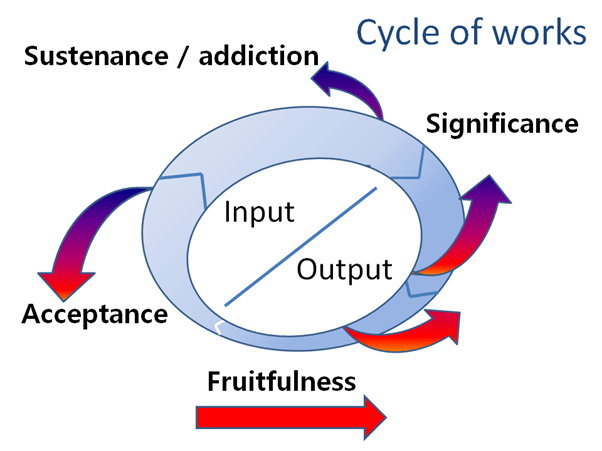
After discovering Jesus’ balanced life in the Cycle of Grace, Lake and Brunner understood the reason for the burn-out of the British missionaries to India: they burned out because they operated in the cycle of works.    After obeying their call to foreign mission, preparing well in seminary, these passionate ministers worked tirelessly, compelled to achieve tangible results that proved their significance in God’s mission, working hard to sustain the fruit of their labour in the hope of being affirmed and accepted as real missionaries, true believers and worthy sons and daughters of God.  And their striving for results that validate caused burn-out.  It always does.

The Cycle of Works will forever enslave one to work harder for approval and acceptance.  The Cycle of Grace will always empower one to confidently work, and even take risks, knowing that one’s worth and identity is secure.

Are you ready to step deeper into the Cycle of Grace, following in the footsteps of Jesus our Lord?  Accept Jesus’ invitation to follow his way of life, the rhythms he set in place to ensure his input and output stay in balance.

Matthew 11:28-30  “Come to me, all of you who are weary and carry heavy burdens, and I will give you rest.  Take my yoke upon you. Let me teach you, because I am humble and gentle at heart, and you will find rest for your souls.  For my yoke is easy to bear, and the burden I give you is light.”

Notes:

[1] Sarah Tottle, Dropping like flies: the rise of workplace burnout and how to tackle it, The Conversation, 28 October 2016. http://theconversation.com/dropping-like-flies-the-rise-of-workplace-burnout-and-how-to-tackle-it-67494

[2] The Bread of Life | The Light of the World | The Door | The Good Shepherd | The Way, the Truth, the Life | The Resurrection and Life | The True Vine


Growing all the way

When last did you feel utterly unprepared? Was it this morning when your boss asked for an update on your project? Or last night when you tried to resolve conflict with the love of your life? A recent (or memorable!) exam that blew you out of the water?  Or perhaps when your three-year threw herself down in a tantrum at your local shopping mall?

Grow_up
Don’t be found unprepared!

Being unprepared for any given situation causes one to feel humbled and helpless, yet in some instances the consequences are much costlier.  Thankfully the life of Jesus models how one could avoid the shame and resentment of failure in those key areas of one’s life.

Ready to launch

Luke records the launch of Jesus’s ministry at John’s baptism,[1] when God the Father affirmed and released Jesus with the empowerment of His Spirit.  Luke notes that Jesus was 30 years of age at this time.  The previous chapter in this Gospel recalls Jesus’ birth – announcing his identity and purpose as Saviour, Messiah and Lord[2] – and his early years, culminating in his words in the temple “I must be about my Father’s business[3].  Clearly, the 12-year old Jesus knew who he was, what his purpose was and where he should be.

Then the chapter ends with the words “And Jesus grew in wisdom and stature, and in favour with God and men.”  And that’s all Luke accounts for these 18 years of Jesus growing into adulthood: Jesus spent nearly two decades growing in wisdom, in physical strength and health, in spiritual vitality and emotional intelligence in preparation for the prophesies over his life.  Talk about a purpose-driven life!

Grow all the way – on purpose

Grow on purpose
Grow all the way – on purpose!

There is much similarity between Luke 2:40 and Luke 2:52 (and the story in-between explains the difference!).  But the English hides one important difference between these two statements in the similar translation of the words grow.  When Luke records that Jesus, aged 12 returned from Jerusalem to Nazareth with his parents and “grew” intellectually, physically, spiritually and emotionally, he uses the Greek prokoptõ meaning “to drive forward” as a herdsman drove cattle with purpose and urgency in a specific direction.  Luke states that after his realization of his identity and purpose, Jesus “drove forward” and intentionally, passionately advanced in preparation for his purpose as Messiah, Ruler and Saviour of Israel (and the world).

Today many Christians emphasize the supernatural empowerment of the Holy Spirit in the life of Jesus (which is clear and true![4]) but neglect to note the deliberate preparation Jesus went through for this purpose.  It shows that Jesus knew that God has entrusted a very important part of His redemptive plan to him, and therefore he took ownership of that call through urgent and disciplined growth in wisdom, health and strength, intimacy with the Father and emotional/ relational skill with a wide range of people.

Grow all the way – even in Nazareth[5]

The way in which Luke gives account of how Jesus answered his parents who came to fetch him in the temple suggests that Jesus really wanted to remain behind in Jerusalem, to be trained in the Scriptures by the teachers in the temple – as Paul was taught by the renowned Gamaliel.[6]  After all, it was customary for a boy of his age, after receiving basic education by tutors, to be prepared for a specific vocation by either their fathers or someone who specialized in such a vocation. Jesus knew the temple was the right place to be and said so to his parents, but still “he submitted and went with them to Nazareth”.[7]

Nazareth was a very small, very simple village. An insignificant place, where “nothing good comes from.”[8]  Yet here, in this nowhere little town, Jesus determined to grow in preparation for his purpose.  It as here that Our Lord spent 18 years intentionally preparing for his role as Messiah, Lord and Saviour.  There were better places, with more opportunities and wiser scholars, but his parents and later his circumstances kept him in Nazareth.

But Jesus alone was responsible for his purpose – no one else would give account on his behalf.  Therefore, Jesus took every opportunity to “drive forward” and prepare himself for his purpose.  What an inspiration to many who feel frustrated and boxed in by people or circumstances! Grow forward non the less!

Grow all the way intellectually

poor_learner
Grow all the way intellectually!

Throughout the Gospels (and the epistles), the wisdom of Jesus is highlighted and applauded.[9] His wisdom is often displayed as superior to that of the scribes, lawyers and teachers of Israel.

Luke records that Jesus grew wisdom – not only in knowledge.  Wisdom speaks of the right application of knowledge, especially in complex situations.   “Wisdom is fear of the Lord.”[10]  To fear the Lord means to speak and act with the knowledge that one must give account to God; wisdom acts with that reality in mind, over against immediate gratification.  Thus, wisdom sees the big picture and discerns the weightier matters.

Moreover, Luke notes that Jesus grew in wisdom – he did not get it supernaturally.  A quick scan through the Gospels shows that Jesus used about 50 Old Testament scriptures in teachings, to withstand temptations, and to prove himself during testing.  Wisdom is gained as one study the works of God, the words of God and the ways of God in the Scriptures, and prayerfully reflecting on it.

Jesus made an effort to grow in knowledge and wisdom to prepare and position himself for purpose, so that he would not be unprepared when God released him into his call. To prepare for our purpose, we should do the same!

Grow all the way physically

grow_taller
Grow all the way physically!

Jesus also grew physically healthy and strong for his purpose – and he needed to!  His ministry period of three years was wide and intense.  Conservative sources suggest that Jesus walked more than 5000 kilometres during these three years, while doing intense teaching, preaching, healing and deliverance almost daily.  His travels were over rough terrains and in harsh weather conditions.  With this in mind Jesus trained for strength and endurance; he grew in stature.

But nowhere during the life of Jesus is his strength and endurance clearer than the 24 hours of his arrest, trials, torture and crucifixion.  That Jesus was alive and alert on the cross is an amazing feat in itself!  His brutal beatings and whipping would have left him weak, stripped of his skin and tissue from his back, having lost much blood.  Yet Jesus somehow found strength to walk to his crucifixion, carry his cross part of the way, and, having finished his task, “bowed his head and gave up his spirit.”[11]    Would he have fainted before the cross, his redemptive work would have been incomplete.  But Jesus grew strong enough beforehand in order to finish his task.

Let this be our example. Don’t let your body grow weak and let you down before it is your time!  Our culture is obsessed about looking pretty, bulky or skinny – looks are superficial.  Rather, grow strong and healthy.  Determine to grow all the way to see your purpose through.

Grow all the way spiritually

child praying
Grow all the way spiritually!

Jesus deliberately cultivated an intimate relationship with God his Abba, his Daddy, through prayer. We see this in his habitual evening retreats for prayer and solitude.  This intimate relationship with God provided for Jesus a source of strength and refreshing, his security in identity and purpose, as well as direction for what he should say and do.  Bluntly: without this vital spiritual link Jesus would not have had any way to fulfil his purpose, seeing as his purpose was derived, directed and sustained by his relationship with the Father.  Therefore, Jesus intentionally grew in relationship with God through a well-developed prayer life before his release into his purpose.

Likewise, your purpose is also derived, directed and sustained by your relationship with God your Father.  And therefore, determine to cultivate a healthy prayer life to grow in the same intimacy with God your Father.

Grow all the way emotionally

grow_friends
Grow all the way emotionally!

Jesus’ emotional capacity is astounding!  He could maintain meaningful relationships with such a diverse group of people – a skill essential for his ministry!  His disciples were such a diverse group (as I wrote about in Known by your Love), resulting in constant tension and frequent conflict.  Yet he could patiently lead, teach and love them all!  He was able to identify and show kindness to the various groups of Jews (Pharisees, Sadducees, Zealots, scribes, lawyers, tax collectors and sinners, etc) and even many groups of outsiders (Greeks, Romans, Samaritans, etc).  Jesus was able to maintain love and peace amidst conflict day in and day out.  He displayed remarkable emotional maturity indeed!

Luke records that Jesus intentionally grew in his emotional and relational capacity – where he was.  Without this development Jesus would have short-ended his own ministry.  I suggest that you and I also need to intentionally grow our emotional and relational capacity to fulfil our purpose – preferably before we are released into it!  How?  Start by intentionally widening our relationships to include people very different from us, and practice speaking the truth in love, not shying away from conflict.

Although Jesus stuck in the nowhere town of Nazareth, he was ready to be released on the day the father chose.  From a young age Jesus demonstrated intentionality in his attitude to “be about my Father’s business”[12], and made it his daily activity to “purposefully grow intellectually, physically, spiritually and emotionally”[13] until the day of his activation when “the Holy Spirit descended on Him.”[14]

So make it your aim to daily grow wiser, fitter, closer to God and closer to people – that you too may be ready to be released, and not be found unprepared for your purpose!

[1] Luke 3:21-23

[2] Luke 2:11

[3] Luke 2:49

[4] Acts 10:38

[5] I must give credit to John Andrews who highlighted this significant point in Jesus’ development to me.

[6] Acts 22:3; cf 5:34.

[7] Luke 2:50

[8] John 1:46

[9] Mark 6:4 and John 7:15 as examples.

[10] Proverbs 9:10

[11] John 19:30

[12] Luke 2:49

[13] Luke 2:52

[14] Luke 3:22

Kindness leads to life

Have you heard of the BELLS challenge?  Michael Frost, Australian missiologist, wrote a simple book entitled “The Five Habits of Highly Missional People” (a free copy here) to help followers of Jesus grow in habits, simple everyday activities, to grow more proficient in witnessing God’s Kingdom to the people we interact with.  The habits are:

  • Blessing others – showing acts of kindness, to cultivate a heart of generosity.
  • Eating together – sharing meals with those I interact with, to grow in hospitality.
  • Learning Christ – intentional study of Jesus’s works, words and person, to grow Christlike.
  • Listening to the Spirit – intentional waiting on God, to grow in discernment of God.
  • (Being) Sent – daily reflecting how I recognize my participation in God’s mission.

The reality that each of us have to face is this: if I live like I lived yesterday, I will have the same witnessing power that I had yesterday.  And for me – I assume for many of us – this is a sobering thought.

Our habits reveal our faith, but conversely, our faith is also shaped by our habits.  That’s why Frost identified these simple, everyday, easily doable habits which increases our witness of Christ and His Kingdom.

People long for Kindness

kindness_relationships

Our world is a harsh place, and humanity is a vulnerable condition. Because of our imperfections we lack, we suffer, we cause harm.  We are in need of care, of help; we are in need of kindness.

Sadly, modern man strives for independence; especially Western society aspires to not elf-sufficiency, to be strong and not need anything or anyone.  But humans are flawed, and when we fail, we have lack, we hurt or cause harm.   We rely on the kindness of others: to receive what is undeserved.

Relationships flourish in kindness

What makes human relationships flourish?  This was what Drs. John Gottman and Robert Levenson have studied in their “Love Lab” for the past four decades.  In the process of observing how newlyweds interact with one another, and again recalling them six years later, they grouped these couples into two groups based on their interaction

The disasters showed patterns of aggression and criticism in their relational dynamics. Their relationships deteriorated quickly over time and was characterized by contempt, criticism, and hostility.  In contrast, the mastersdemeanor towards one another was characteristically warm and inviting – even during conflict.  The masters learned to create an atmosphere of trust and intimacy that made the relationship safer and more comfortable.

Based on these findings and follow-up studies Gottman deduced that the key indicators in marital success (with about 94% certainty!) come down to two characteristics: kindness and generosity.  Indeed, “love is kind” (1 Corinthians 13:4), and “love is the bond of perfection” (Colossians 3:17).

In an environment of kindness people thrive, because in the care and compassion cultivates true connection and cooperation in trust.  In contrast, the absence of kindness breeds distrust, fear and shame, causing the other to withdraw and withhold him-/herself – the very opposite of thriving.

Our God is kind-hearted

Humankind is like the rebellious son who foolishly packs his bag and walks out the door, believing he can enjoy living life all on his own.  Our sin-infested world is harsh, and we were never meant to be independent – we will lack, we will fail.  But, as the tale of prodigal son so beautifully illustrates, it is the knowledge of “the kindness of God that leads us to repentance” (Romans 2:4).

We are – and will always be – in need of God’s kindness, as the Psalmist rightly sings:

Psalm 145:8-9, 14-16 (CEV)

You are merciful, Lord!
You are kind and patient
and always loving.
You are good to everyone,
and you take care
of all your creation…

When someone stumbles or falls,
you give a helping hand.
Everyone depends on you…

Jesus also taught us to rely on God’s kindness, to freely and shamelessly be dependent on Him: “Give us this day our daily bread, and forgive us our debts, as we also have forgiven our debtors. And lead us not into temptation but deliver us from evil.” (Matthew 6:11-13)

Our God is kind, moved with compassion, to console and care for his creatures.

Jesus is kindness personified

The greatest sign of God’s kindness is the sending of His son Jesus.  Paul refers to the incarnation of Christ as the time “when the goodness and loving kindness of God our Saviour appeared” (Titus 3:4).  Indeed, Jesus embodies and personifies the kindness of God!  He “went about doing good, healing all who were oppressed” (Luke 10:38).  Like his Father, Jesus healed “the ungrateful and the wicked” (Luke 6:36), without expecting anything in return as we see in his healing of the 10 lepers (Luke 17:11-19).

kindness_man_gives_sandals2

But the apex of God’s kindness is the substitutionary suffering and death of Christ on the cross, who although “He was despised and rejected by men… He has borne our griefs And carried our sorrows… He was wounded for our transgressions, He was bruised for our iniquities; The punishment for our peace was upon Him, And by His stripes we are healed…” (Isaiah 53:3-5).  Indeed, God so loved the world: He had compassion on us, His enemies, and showed kindness in the sending His only Son to forgive our debts and deliver us of oppression!

Marked by kindness

The kindness which Jesus Himself modelled to us, He also commanded us to do emulate.  And in showing kindness to all – even our enemies! – we will be identified as “Sons of the Most High, who is kind to the ungrateful and the wicked” (Luke 6:35).  Like our Master, our kindness is a mark of the Father.  Our acts of kindness therefore are a witness to our God, and a witness to our allegiance to Him.

source_goal_love

You might ask “Almost every religion inspires kindness to others.  How does a Christian’s good deeds point to God?”  This is a thoughtful question one should consider.

Firstly, we recognize that the source of our loving-kindness is not of ourselves. As Christians we recognize that we are fallen, that our capacity to care and show love is limited.  That is why Jesus taught his disciples to “abide in Me, for apart from Me you can do nothing” (John 15:5).  In Paul’s words, kindness is a fruit of Christ’s Spirit (Galatians 5:22) – we become kind persons who naturally do kind deeds through intentional fellowship with our kind Saviour.  “As we behold him, we become like him” (2 Corinthians 3:18).

Secondly, the goal of our kindness is to point to God’s kindness.  Jesus taught his followers to “not sound the trumpet in the street” when showing kindness (Matthew 6:2); the goal of giving is not to receive praise, not to make us feel good, but to point to God.  Likewise, the motive for forgiveness is “as God in Christ forgave” (Ephesians 4:32) – again pointing to God’s kindness in Christ.  As we give and forgive, we look for opportunities and ways to point to God, “that men may see your good deeds and glorify your Father in Heaven” (Matthew 5:16).

Kindness brings us home

Our world is a harsh place, at times even hostile.  The lie of self-sufficiency causes isolation, the reality of insufficiency causes fear and shame.  But God is kind, who generously gives to those in need, eager to guide the lost and restore the fallen, graciously forgiving the sinner.  To this end Jesus invites us to show the same kindness to even our enemies, that we may be known as children of God. That even our enemies may come to know the kindness of God which leads us to repentance (Romans 2:4)


Let’s eat! Building community though hospitality

Eating together in the life of Jesus

Jesus’ enemies once accused him of being “a glutton and a winebibber, a friend of tax collectors and sinners!”[1]  And this should not surprise us, since a great part of Jesus’ missional life was occupied by eating and drinking – with everyone, all of the time!

Reading through Luke’s account of the works and words of Jesus, one cannot ignore the focus on our Lord’s table fellowship as he seems to move from house to house, from party to party, from meal to meal.  The bulk of the teachings and miracles Luke records happens as Jesus sat down to eat and drink with whoever invited him.  Indeed, the ethics of the Kingdom of God was first imparted over a meal.

Luke Meals in the Gospel of Luke
5:27-32 Banquet at Levi’s House
7:36-50 Dinner at Simon’s House
9:10-17 Feeding the 5,000 at Bethany
10:38-42 Hospitality at the home of Mary and Martha
11:37-52 Dinner at a Pharisee’s House
14:1-24 Sabbath meal at a Pharisee’s House
19:1-10 Hospitality at the home of Zacchaeus
22:14-38 The Last Supper in Jerusalem
24:28-32 Breaking Bread with disciples at Emmaus
24:36-43 Jesus eats a meal in presence of Disciples

In addition, meals were often the central theme of his messages – in itself a metaphor for God’s relationship with man.[2]

Eating together in the early church

Luke continues with this theme as he records the history of the early church.  The early believers multiplied and were strengthened in faith as they moved “from house to house” and “broke bread”.[3]  Early church historians notes two distinct meals that were habitually practiced: communion meals (The Lord’s Supper) and love feasts (fellowship meals).  This makes sense, because the way in which Jesus wanted his disciples to remember his works and words was through the communion meal[4] (not only a small piece of wafer and sip of juice!), mainly because this was how the Lord had taught them through example and instruction.

Not only was the church edified through the practice of hospitality, but through table fellowship it was also extended.  Disciples were instructed to preach the Kingdom of God from town to town just as Jesus modelled: speak peace, receive its hospitality as you eat and drink with them, heal the sick and announce the Kingdom has come![5]  Just as Jesus modelled with Zacchaeus, the disciples would discover “communion first, conversion second.”[6] Relationship leads to repentance.

More than mere extension enlargement (geographic growth), table fellowship was also the Lord’s means through which expansion growth (ethnic diversification) happened in the early church. Luke records how sharing a meal with gentiles resulted in a new conviction,[7] conversion[8] and charter[9] for the early church.  Acts 10 records three acts of hospitality that facilitated the conversion and inclusion of the Gentiles into the church: while Simon the Tanner hosted and prepared a meal for Peter, God (in a vision) prepared a meal for Peter, teaching the apostle that what he declares clean is clean – and then Cornelius’ messengers arrived.  Peter hosted and shared a meal with these gentile messengers, and accepted Cornelius’ invitation based on God’s prompting.  At Cornelius’ place, Peter and his friends enjoyed Cornelius’ hospitality, and shared a meal and the Gospel, which caused resulted in the sharing of God’s Spirit and their conversion.  Luke’s record shows that the focus is not only on the message, but the hospitable reception into fellowship signified by table fellowship.  “Communion first, conversion second.”[10]

Outdoor_feast_Table1

Our take-away

We eat our way into people’s hearts and lives.  Whether with fellow-believers, seekers or people opposing our faith, sharing a meal is the means to find common ground, show sincere love and allow for real relationships to be formed.  Sitting at the same table breaks downs walls of suspicion, scepticism and superiority.  Sharing a meal has for eons been the chosen ritual to seal a pack of friendship and communicate acceptance and trust.  Inviting someone to the table indicates interest and mutual identification.  And lastly, but most importantly, hosting a meal for another is a sign of honour and favour.

If we eat together more, we will be enlarged.  Eating together (1) edifies the believer, (2) extends your influence, and (3) expands your relationships.

When believers share a meal together, we are edified. Table fellowship strengthens fellow believers because sharing of our everyday life in Christ encourages one another, educate one another in everyday faith, exhort one another to put faith in practice and especially to establish (ground) our faith in relationship and everyday life. Faith that remains an individual’s ideas without manifesting in actions and relationships, is meaningless.  Therefore, sharing in our life with Christ with fellow believers over meal strengthens our experience and expectations of life with Christ, in community.

Secondly, sharing meals with seekers and non-believers extends our influence as we open our homes, and effectively hearts and lives to them.  And when you open your heart and life to another, your guest will encounter Christ in you. As mentioned above, Jesus’ instruction to preach the gospel focussed on hospitality: the Kingdom is extended as we share meals and open our hearts to those on the other side of the table.

Thirdly, just as the early church was diversified through hospitality, so eating together expands our relationships to include people outside or our normal sphere of influence.  I recall an early church plant in Pretoria: in spite of all our evangelistic outreach in the heart of cosmopolitan city, we remained mono-ethnic.  I could never understand it: people responded to us, accepted Christ, but never joined our faith community.  Years later in prayer and reflection it dawned on me: people not feel they belong because you greet them friendly in church – they feel they at home when you invite them for supper at your home.   Sharing a meal is an invitation to share life.  This is why Jesus would gladly enter the homes of “tax collectors and sinners” because accepting an invitation for dinner would lead to their inclusion into the Kingdom of God.

Indeed, eating together enlarges us and expands the Kingdom of God.  Jesus demonstrated it, the early church applied it, and wise missionaries it today.  Do you feel like practicing it?  Who will be first to share a meal with you, to edify your faith, extend your influence or expand your relationship for Christ’s sake?

hospitality_feast_1

[1] Luke 7:34-35

[2] Consider the parables of Jesus Luke recorded: the unexpected guest (11:5-10), of humility vs pride (14:8-11), of the great wedding feast (14:15-24), the lost coin, sheep and son (14:15-24) as well as the rich young man and Lazarus (16:15-31) – all have table fellowship at the heart of its teaching.

[3] Acts 2:42, 46

[4] Luke 22:14-18

[5] Luke 10:1-12

[6] Ben Meyer – Quote?

[7] Acts 10:15;

[8] Acts 10:44-48

[9] Galatians 2:10-16

[10] Meyer B.F., The Aims of Jesus (London: SCM Press, 1979), p. 161

Living in the Blessing of the Lord

Humanity is a vulnerable condition.  Every now and then life has the tendency to throw us a curve ball – some unexpected crisis or hardship one could not prepare (enough) for.  Retrenchment. Cancer. Depression. Divorce. Death of a loved one. Others times it’s not one big thing, but the perpetual business of life that leaves one with a sense of being overwhelmed, feeling faint.  And God knows that we need strength, need courage put into the heart.  Humans have a constant need for encouragement.

For the wilderness-wandering Israelites, roaming through nothingness, forever vulnerable to what the warm winds of the day blow their way, God instituted a daily encouragement that would shape their self-understanding.  During their forty years of wandering, and the generations of believers that would follow, worshipers would daily hear the blessing of Yahweh and be reminded of Who He is, and how He relates to them, to us.

Numbers 6:22-27  “The LORD spoke to Moses, saying, “Speak to Aaron and his sons, saying, Thus you shall bless the people of Israel: you shall say to them, ‘The LORD bless you and keep you; the LORD make his face to shine upon you and be gracious to you; the LORD lift up his countenance upon you and give you peace.’ So shall they put my name upon the people of Israel, and I will bless them.””

Every day, at the conclusion of the daily offering, the priests pronounced this blessing over Israel as a daily reminder of the reality of their life with God.  And this is what got engrained in their corporate identity through this practice of daily encouragement.

generous

Our God is a blessing God – a generous God. Because their wilderness wandering warned them of the harshness of our fallen world, the people of God were regularly reassured that God is generous in giving, uninhibited in his kindness towards them.  “He opens his hand and satisfies the desire of every living thing.”[1]  It is marvellous to note that the words “the Lord bless (Heb. bârak) you” implies God bowing down to serve one’s need.  It is almost unbelievable, but we see this servant-disposition of God manifest in Jesus bending the knees to serve his disciples.[2] He is the one who invites you to “cast all your cares on the Lord, for he cares for you!”[3]  We can be assured that “He who did not spare his own son for us… who much more will he not also freely give us all things?”[4]  Surely, our God is a generous God!

protective

Our God is a keeping God – a protecting God. Meandering through the desert with families and livestock, dwelling in tents, the Israelites felt the vulnerability of our earthly existence: defenceless against the storms and winds, the wild animals and barbaric tribes.  Therefore the priests reassured Israel daily that they need not fear: God watches over them.

“Indeed, he who watches Israel neither slumbers nor sleep.

The LORD is your keeper; the LORD is your shade on your right hand.

The sun shall not strike you by day, nor the moon by night.

The LORD will keep you from all evil; he will keep your life.

The LORD will keep your going out and your coming in from this time forth and forevermore.”[5]

Years later, when a small group of exiled Israelites returned to a devastated Jerusalem without the security of city walls, surrounded by hostile nations, the Lord again reassured them that “I will be a wall of fire all around.”[6]  Today we too can find rest in that our God is our protector!

friendly

Our God is a smiling God – a friendly God. Every day as they gathered, the nation heard “Israel, your God is not an angry God! His face is beaming as he looks at you!” Indeed, God delights in his people,[7] is pleased with all his children.  Especially during this time of testing in the wilderness[8] Israel needed reassurance that God loves them and is pleased with them, that difficulty does not imply displeasure. God is friendly and accepting, his face is beaming with delight over them.  Our God is friendly!

forgiving

Our God is a gracious God – a forgiving God. Daily Israel would gather at the tabernacle of the Holy God who dwelt among them, bringing daily offerings to atone for their failure to live up to His covenant with them.  In the presence of a holy God, and in the hearing of his law, our sinfulness is striking. Therefore, God instructed this daily reminder that He is indeed “merciful and gracious, slow to anger and abounding in steadfast love”[9] and that “he does not deal with us according to our sins, nor repay us according to our iniquities.”[10]  Our God is gracious, “His mercies are new every morning – great is his faithfulness!” [11]

So we too are invited to not hide in guilt or shy away because of shame as our ancestors in the Garden[12] but rather to “confess our sins – he is faithful and just[13] to forgive us our sins and to cleanse us from all unrighteousness.”[14]

interested

Our God lifts up his face – He is an interested God.  To a people who used to be poor slaves, foreigners, nobody’s, it could be easily feel that God (also) has no concern for them, does not notice them, and is not interested in them.  Therefore the Lord said:

“For you are a holy people to the LORD your God; the LORD your God has chosen you to be a people for His own possession out of all the peoples who are on the face of the earth.”[15]

“and you shall be to me a kingdom of priests and a holy nation.”[16]

Indeed, God is interested, emotionally invested, attentive and engaged.  When one of his children approach him, God drops all in his hands, lifts up his face and gives his attention on you, because he delights in you.[17]

life-giving

Our God desires our peace – he is a life-giving God. The Hebrew word Shalom here means welfare, prosperity, wholeness, fullness of life.  And for people who used to live in terror and oppression of slavery, this was almost unbelievable!  Prolonged hardship dampens hope and can drop a man in depression and despair, therefore the Lord instructed a daily promise of his desire and intention to prosper his people – to give them “overflowing life”![18]  They needed to hear that God “delights in the well-being of his servants”[19]  and therefore fosters “plans for welfare and not for evil, to give you a future and a hope.”[20] Years later, at the time of Israel’s exile, the Lord again reminded them of his promise of peace:

“Though the mountains be shaken and the hills be removed, My steadfast love will not be shaken and my covenant of peace shall not be removed from you… all your children will be taught by the Lord and I will give the my peace”[21]

By this repeated blessing, the priests “put the Lord’s name on them” (verse 27), meaning to immerse them in the Lord’s nature or character.  These blessings firstly intended Israel to know what God is like and how they relate to him, and secondly, as the know him the become like Him.[22]  Israel would increasingly embody the nature of God and imitate him in his behaviour to become a generous people, protecting the vulnerable, being friendly, interested in and generous to all, creating environments where peace reigns for all.  As Israel live in the Kingdom of God, so Israel would model and manifest the Kingdom of God to all.  This is God’s design and desire for his people.     

The instruction of blessing ends with he promise “I shall bless them” (verse 27).  This gave the priests of Israel confidence to freely speak of the nature and desire of God, because the Lord Himself guarantees to be faithful to his character, saying “You speak it, I will perform it”.

Do you believe this?  You can – God is faithful and powerful enough to perform this blessing for you!

[1] Psalm 145:16

[2] John 13:3-14.  See also Philippians 2:4-8.

[3] 1 Peter 5:7.

[4] Romans 8:32

[5] Psalm 121:5-8

[6] Zechariah 2:5

[7] Psalm 36:8

[8] Deuteronomy 8:2

[9] Psalm 86:15

[10] Psalm 103:10

[11] Lamentation 3:23

[12] Genesis 3:8

[13] God is faithful – always ready to forgive

[14] 1 John 1:9

[15] Deuteronomy 7:6

[16] Exodus 19:6

[17] Psalm 147:11

[18] John 10:10

[19] Psalm 35:27

[20] Jeremiah 29:11

[21] Isaiah 54:10, 13

[22] Refer to Philippians 3:10

A walk of faith – life with God

Indeed, we live in a very spiritual world!  We sing songs, write poems and make movies about faith.  George Michael urges “you gotta have faith”, Bon Jovi calls us to “keep the faith”, Shrek’s donkey confesses “I’m a believer!” and no doubt many of his swamp-friends are Beliebers too!  We live in a faith-filled world!

Images_Faith

But as often happens with the overuse of a word, the meaning goes missing.  Faith becomes some mysterious wishing power that gives is a warm feeling of hope on the inside and keeps us bearing forward.

But that is not Biblical faith.  And if you read the Bible thinking faith is this, you will miss the bliss of its promise.

What does it mean to have faith?

On June 30 1859 Charles Blondin “the Great” became the first person to cross over the 340m wide Niagara Falls Gorge tightrope, expended 50 meter above the river where about 1million cubic meters of raging waters rushed by every second. To gt a feel for the risk he took, watch this stunt as Nik Wallanda crossed over these falls in June 2012.

Blondin repeated this stunt several times with variation: he crossed over the rope (8cm in diameter) on stilts; he did it blindfolded; he did it in a sack; he pushed a wheelbarrow over; he carried a chair, stopping half-way to stand with one leg of the chair balancing on the rope.  Once he even sat down in the middle and cooked an omelette, enjoyed his breakfast, and only then walked on!

One of his most memorable moments was when, after another crossing on September 15 1860, he asked the crowd whether they believed he could cross the falls again.  “Yes!” was the confident cheer.  “Do you believe I could cross the falls carrying a man on my back?”  After witnessing his previous stunts, they cheered expectantly “Yes!” Blondin leaned in, asking “Who will volunteer?”  Silence.  After a moment Blondin pointed to an onlooker “Will you trust me?”  “No!  I can’t risk my life like that!”  No one would volunteered, so Blondin turned to his manager Harry Colcord.  “Harry, do you believe I can carry you across?”  “Yes”, said Harry, “I know you can.”  “Then climb on!”  And Harry became the only man who was ever carried across the raging Niagara falls by his friend since he was the only man with real faith in Blondin.

Charles_blondin

This is a good example of what real faith is – to entrust your life without reserve in something or someone.

So in who or what do you put your faith?

To simply say “I have faith” is meaningless. Faith in what, or faith in who?  A google search on faith reveals various religions, some more plausible than others, and others totally bizarre.  But the most common themes are “belief in science”, “belief in yourself” and “I belief in God.”

I-Believe-COMPOLATION2

If you say you have faith in God and put your future confidently in His providence and justice, you are in a great company: 5.8 billion people still believe in (a) god (84% of the world population), a third of these are Christian. Do we all believe in the same god, worshiping him with different names?  Or what distinguishes Christians from these believers in God?

The God Christians believe in is the triune God: the Father, the Son and the Holy Spirit. One God in three persons. He is the living God, and his nature is holy and loving.   The doctrine of the Trinity is sometimes regarded as obscure, at times disregarded as unimportant or unnecessarily stumbling block to faith.  But this truth is what originally distinguished Christianity from Judaism, something that was only revealed in the incarnation, when Jesus was born and started declaring that he is the Son of God.  To be more accurate, the doctrine of the Trinity is grounded in the crucifixion and resurrection of Jesus Christ – the foundation of the Christian faith.

We know God to be triune because of his redemptive mission of the world in the giving of his Son and Spirit – and in that we know is true nature.  It is because of Jesus’ birth, ministry, death and the resurrection that we have come to know the 3-person nature of God. Migliori (Faith seeking Understanding, 2014) writes that the trinitarian nature reveals God as “self-expending, other-regarding, community-forming love.”  It is primarily in the giving of himself in Jesus and the Spirit that we know God’s nature is self-expending love.  In the life example of Christ and the deferring relationship of the Godhead we know God as other-regarding.  It is in the giving of the Son and Spirit that we come to know God’s heart for community, and that his love is always community-forming.  The Christian God is Trinitarian and his nature is loving.

And that is the foundation of our Christian Faith – a living, everyday reliance upon the triune God, and not merely a belief in a distant creator-God who might grant an eternal life of bliss when all this is over.  Faith is for today.

Why am I so confident to trust this triune God?

Christian ethics and morality is not so much different from many other religions; the description of a “good or godly person” in the New Testament is not altogether different from other codes of ethics. And the Greco-Roman world in which the church was birthed was a whirlpool of such religious ideas and ideals!  Why then was the gospel of the early church so compelling and urgent, and why did the Christian faith grow with so much vigour then, and ever since?

Because the Christian gospel is not good advice on morality, but good news of a life that is possible!  For the first time ever the ideals of ethics and morality was not only preached as necessity for a blessed human life – but news that the the proof of the resurrection of Jesus Christ and outpouring of his Spirit showed that the teachings of God’s Kingdom Life was indeed possible for individuals and communities at large!  Yes, the resurrection shows that death was not the end of life anymore, but more! The eternal life of God was now available to recreate what was dead and decaying in this life.

The problems that plagued humanity since the fall, known pride, envy, wrath, fear, deceit and divisiveness, sensuality and covetousness, could for the first time not only be identified and managed, but overcome!  Paul gloried in this truth in his letter to the Romans 8:11: “If the Spirit of him who raised Jesus from the dead dwells in you, he who raised Christ Jesus from the dead will also give life to your mortal bodies through his Spirit who dwells in you.” (read Romans 8:9-11 for context).  A life of peace and goodness was now are reality, visible in the communities of the early church.

The verse in its context shows that having faith in the triune God is lifegiving:

  • We can confidently believe in and trust GOD THE FATHER because he is good and loving, generously giving the Son and the Spirit to accomplish the redemption and reconciliation of fallen man. He is indeed the Creator and gracious Sustainer who cares for all his creatures (see Matthew 5:45 and 6:26).
  • We can confidently believe in and trust JESUS, THE SON OF GOD who is the Saviour and Lord of all. He left his heavenly throne to become man, to show God’s love, vicariously pay the price for sin and death, resurrecting as sign that sin and death no longer have hold on all those who trust in Him.  By dealing with rebellion and sin he rightly became legitimate Lord of all the earth. Now we can confidently trust in him as Mediator between man and God, because he knows human temptations and struggles, freely distributing grace for everyday life (Hebrews 2:18 and 4:14-16).
  • We can confidently believe and trust in GOD THE HOLY SPIRIT, the Wisdom, Power and Communion of God. Through the indwelling Spirit we enjoy the living fellowship with Father and Son (John 14:20-23 and 17:20-23), sharing in his eternal life today. Through the indwelling Spirit we are made new (2 Corinthians 5:17) through the life-transforming power of God who gives life that actually transforms our sinful natures, giving us the grace to share in the life of God (Romans 8:11), guiding us in his will.

I find it very easy to believe in, to confidently trust in this God!

Faith for today

Yes, for life in this earth “you gotta have faith!”  Faith in God who transforms our sinful nature, breathes life in decaying relationships, recreates hopes that are dead and makes possible that which seems impossible.  But this life with God requires faith – a living trust in God’s character and ability to do that which is impossible for me (Romans 4:21).

What does this promise of the God of the resurrection mean for you today?  What transformation in your nature, in your body, in your relationships, in your business or in your community is possible?  If indeed the triune God lives with you through his indwelling Spirit, what is too big to face?  What could be possible through faith?

walk_by_faith3


A Cry for Justice

“Most of my life was spent living as a privileged person in an unjust society. Last time I did nothing to help change. At 76, I am not about to repeat the mistake. This time I march. I shout. I scream.” Robin Binckles, author, historian, columnist.

The words above penned by Robin Binkles above capture much of our collective sentiment towards the current political situation in South Africa.  Following the news this morning my heart again is heavy – not because of the nationwide protests, but because of the blatant presidential corruption and political injustice which provokes the marches. My heart breaks for the poor and the vulnerable in our nation who keep on suffering because of this persistent corruption and prevailing apathy.  God save us!

Over the last few weeks I have become increasingly aware of the suffering within our beautiful nation, more specifically the poverty within Cape Town.  As the info-graphic below could explain, privileged people are not commonly confronted with the pervasiveness of poverty, because that is how our social tapestry is woven. We generally work, live and move within our own economic spheres. One can only appreciate the impact of poverty when one crosses over into the world of the poor – even if it is only 5km away.

inequality_CT2011
Mapping diversity in Cape Town – obtained from 2011 SA National Census data (STATS SA online report available at http://www.statssa.gov.za/?p=7678)

Looking at this map one can’t ignore the fact that 25 years after Apartheid was abolished a city like Cape Town still lives in racial segregation – primarily due to economic inequality cultivated by a racist regime: according to the latest figures from Statistics SA the average annual household income for white South Africans are still five times more than that of black households.[1] We are still segregated by the sins of our past.

poor_man_rich_world

Secondly, we might be unaware of the suffering and poverty around us because our generation is fixated on fun.  People preoccupied with pleasure train themselves to preserve happiness by overlooking pain.  Suffering steals our serenity, so we have mastered mindless indifference – we have become blinded to the surrounding suffering.  Indeed, ignorance is bliss.

What does justice demand in this unjust society?

Essentially, Biblical justice demands three things:[2] firstly, that each person is created in the image of God[3] and therefore all people should be treated equal[4], allowing for equal opportunity.  In this case, the abolishment of Apartheid was a celebration of justice in South Africa, but as the map above shows, economic equality is not a reality and therefore justice has not yet been established.  Secondly, Biblical justice calls for special care of the vulnerable in society – those most severely affected by fallen creation (the “orphan, the widow and the foreigner”[5]). This “care” for the weak and poor requires charity to provide in needs[6], but also necessitates advocacy to call for an end injustice[7] and intervention and liberation to free from oppression[8]. Thirdly, justice demands a generous sharing of livelihood with those in need[9]. The motive for this neighborly kindness is rooted in compassion – the compelling love that emanates from a deep sense of identification with another suffering individual.[10]

more_important_matters

God frequently dismissed corporate worship whenever social justice was not practiced in Israel.[11]  The care for the weak, poor and marginalized is essential for a living relationship with God because God personally identifies with the lowly, weak and oppressed.[12]

Injustice and oppression in society therefore require deliberate social intervention programs to ensure justice for the weak and the marginalized.[13] Since injustice is the result of the inherent corruption of man (i.e. sin), true and lasting social reformation requires the renewal of the human heart. And that is exactly what the gospel of justification by grace does, as Yale theologian Miroslav Volf discovered when he reflected while walked through the dispirited inner city of Baltimore.

“Could the hope for inner cities lie in part in the retrieval of the doctrine of justification by grace? How could the dead streets receive life from a dead doctrine? Imagine that you have no job, no money; you live cut off from the rest of society in a world ruled by poverty and violence; you are pre-judged for the color of your skin—and you have no hope that any of this will change.

Around you is a society governed by the iron law of achievement. Its gilded goods are flaunted before your eyes on TV screens, and in a thousand ways society tells you every day that you are worthless because you have no achievement… But the gospel tells us that we are not defined by outside forces. It tells us that we count; even more, that we are loved unconditionally and infinitely, irrespective of anything you have achieved or failed to achieve. Imagine now this gospel not simply proclaimed, but embodied in a community. Justified by sheer grace, the community seeks to “justify” by grace those declared “unjust” by a society’s implacable law of achievement…. A dead doctrine? Hardly!”[14]

poor_man_by_zfazly

Thus the Biblical justice happens when God’s Kingdom manifests to liberate individuals and a community at large from the corruption of sin[15] resulting in societal regeneration and reconciliation as he “make(s) all things new.”[16]

What does justice for the poor demand from me?

It is important to note that Biblical justice demands the care for the poor, weak and marginalized not primarily from the state or the temple, but from the neighbors. This is evident in the legislated Year of Jubilee[17] and its principled application in the early church.[18]  Jesus made that exact point with his parables of the Good Samaritan[19] and the King’s rewards to the righteous.[20] Yes God does command justice in the judicial system and government[21] but primarily God expects it from his people to ensure justice for their neighbors.

poor-man2

The overwhelming need and violence within our country is intimidating, but justice simply asks “how shall you love your neighbor as yourself.”[22] So how could you respond?

Firstly, open your eyes and your heart to see the need and meet the needy. It is often lamented that the biggest accusation against the church in the West is not that we don’t care for the poor, but rather that we do not know the poor. And this is certainly true for our economically divided society. We honestly do not see the needs of the needy nor do we hear their cries, therefore we don’t feel or respond.  Therefore, make a friend who is vulnerable and poor – and listen in order to hear and understand their struggle.  Don’t give from a distance – build a lasting relationship first.

Secondly, don’t be pacified by the enormity of the need out there. “Do not withhold good from those who deserve it when it’s in your power to help them.”[23]  Do what you can, share what you have.  But “do not be hard-hearted or tight-fisted toward them. Rather, be openhanded and freely lend them whatever they need.”[23]  Work towards dignifying a person and his or her legacy by empowering him or her out of oppression. And remember, “as you did it to one of the least of these my brothers, you did it to me.”[24]

Lastly, don’t become cynical, thinking that this is the way it will always be on earth.  The Gospel truly changes societies and nations for the good – not just secure people for eternity. For that reason trust in God as you keep on praying “let Your Kingdom come, let Your will be done! On earth as it is in heaven!”[25] Imagine what could your city look like when the Kingdom of God manifests, and pray for that! Strive to let heaven invade earth.

Like Robin Binkles I must admit that most of my life was spent living as a privileged person in an unjust society… [and] I did nothing to help change… [but] I am not about to repeat the mistake.”  So Lord, let your Kingdom come! In me and through me.

kingdom_comeCT

[1] Pitjeng, R., 28 January 2017, Stats SA: Black households continue to be excluded from the economy, Eye Witness News online: Johannesburg. Available at http://ewn.co.za/2017/01/28/stats-sa-black-households-continue-to-be-excluded-from-the-economy. Last viewed 18 March 2017.

[2] Keller, T. 2012, What is Biblical Justice? Relevant Magazine, 23 August.

[3] Genesis 1:27; cf Acts 17:29.

[4] Exodus 22:1; cf James 2:1.

[5] Deuteronomy 10:18.

[6] Deuteronomy 14:19, 24:19-20; James 1:27.

[7] Isaiah 1:17; Proverbs 31:8-9.

[8] Psalm 82:3-4.

[9] Deuteronomy 15:1-14; 1 John 3:17-19.

[10] Luke 10:26-37; cf 1 Corinthians 13:3.

[11] Amos 5:23-24; Isaiah 58:1-14; Micah 6:8; Matthew 23:23.

[12] Matthew 25:34-40.

[13] e.g. Acts 6:1-6.

[14] Volf, M. 1997. Shopkeeper’s Gold, The Christian Century, 12 November, p. 1045.

[15] Psalm 76:9; Romans 8:20-22; 3:23.

[16]1 Corinthians 5:17-20; Revelations 21:5; cf Colossians 1:20.

[17] Deuteronomy 15:1-14.

[18] Acts 4:34-35.

[19] Luke 10:26-37.

[20] Matthew 25:34-40.

[21] Proverbs 16:11-14.

[22] Matthew 22:39.

[23] Proverbs 3:25, Deuteronomy 15:4-5; cf. 1 John 3:17-18.

[24] Matthew 25:40.

[25] Matthew 6:10.

The marks by which we are known

The growth rings of a tree trunk intrigue me. These contours compile the life story of the tree in the lines left by nature’s faithful seasons of wet and dry.  Years of plenty leave thick lines, years of lack leave thin lines. Yet more than mere rainfall history is recorded in these contours: forest competition leave elliptical lines of asymmetrical growth, while the trauma of forest fires, animal damage, pests or sickness leave permanent stains or scars in the tree trunks.  These lines, scars, stains and blotches portray the life of the tree: it is the record of events the tree witnessed, what it encountered and what it survived.  Just like our fingerprints these contours distinguish one tree from another – what a tree lives through lends it its distinguishing marks; its experience lends it its beauty and character.  As these pictures show[i], each tree is known and valued by its marks.

tree_trunks_small
The tales trees trunks tell. [image credits below]
But note that the lines and marks in a tree are the trees response to its environment – not the environment itself.  We don’t see the rains, droughts, fires, bugs or animals.  The contours only record the tree’s growth because of a wet season, and its hardening because of a dry season.  We only see the elliptical contours because of the tree’s self-adjusting growth for a few years in its fight for better sunlight. We only see the darkening as it healed from the heat and flames, the recovery scars left from animal damage and the discolouration caused by other environmental conditions.  In essence, the trunk of the tree is a witness to how the tree coped with its experience, how well it adjusted to survive in its environment and how it was strengthened through it.  Indeed, these contours are aptly called the “growth rings of a tree”.

If your character could be dissected as a tree trunk, it might reveal similarly distinguishing “growth rings” – the marks that show how each season has impacted you.

tree-rings-0023_web

As I reflect on the past year I am struck by how deeply it influenced me – both for the good and the bad.  A few family traumas of people within our church community has left a heightened appreciation for my family and my health, with a deliberate response to cherish the precious time with those I love and make the best use of my health and fitness.  Frequent reports of leadership failure have heightened my awareness of my own fallibility and the traumatic impact it has on many; this sparked renewed study and intentional growth in Christian leadership practice as well as intentional accountability as I see the need to allow others to speak into my life.  The development and facilitation of a marriage intimacy course has made a lasting impact in my attention to and intention for growth in marital intimacy.  A demanding season has highlighted the dangers of isolation resulting in purposeful pursuit of healthy friendships for me and my family.  But the business has also caused me to reevaluate my life, reconsider my efforts and remind myself where I should be heading, so I can readjust my course now.

Sadly I am also aware of some less noble responses to events in the past year: I recognise a mounting degree of cynicism due to frequent disappointment by certain people, coupled by latent anger and even bitterness in my heart.  I notice a resistance to spontaneous generosity because of perceived entitlement and misspending of some with whom I have supported.  I note the signs of compassion fatigue because of seasons of overextending myself.  And sadly I am aware that I laugh and play less because of the impact of the serious things that I deal with. These responses are not good for my soul, my family and my relationships.

Thus the events of the past season has touched me personally and impacted my character.  I have grown grateful and humble, more relational and accountable, vulnerable and intimate, and more purposeful.  Yet I have to acknowledge that I have grown more cynical, less innocent and less generous, less compassionate and less joyful.  My growth through the last season has been both good and bad; in some ways I have grown to resemble Christ my Lord better and in some ways I have grown to represent him less.

Although the memories of our experiences remain with us, it is our own responses to those experiences that ultimately impact us and those around us greatly, because how we respond shapes us for the long run.  Our responses to life’s significant moments and seasons lay the contours that make up our character – and our character shapes both our consciousness (how we view life) and our course (where we end up in life).

That is why we need to “guard our heart above all things, for from it flows the issues of life.”[ii]  We cannot control or undo what life’s seasons throw at us, but we can and should control our response to those moments.

The Bible teaches that one is “blessed” (or better off) when in spite of injustice one remains kind and merciful; when in the midst of cruelty and betrayal one remains pure in heart; when in the midst of conflict one pursues reconciliation and peace; when in the midst of hardship one remains faithful and true to God.[iii] In fact, the Bible shows that regardless of what life throws at us, a godly response always leaves one blessed – in this life and the life to come.[iv]  And that although everything seems hopeless, there is a very real reason to be optimistic, because God can and will bring beauty out of every situation.[v]  Although there are things that challenge us in every season of life, God’s grace in that season is enough to carry us through.[vi]

It’s a new year.  Another year is over and it left its marks on your life.  Was it a year of plenty or of want?  A season of vigorous growth or a tough season of hardening?  A festive time or fiery trial that left its stains?  Regardless of what the year brought you, its impact on your life will prove significant in the shaping of your heart.

How will you allow your experiences to impact your character for good or bad?  Consider it carefully, because your response to this season will determine your consciousness in the next season and ultimately your course in life.

tree_rings_3a

[i] Images from online article in Mizzou Magazine https://mizzoumag.missouri.edu/2013/05/if-trees-could-talk/

[ii] Proverbs 4:23

[iii] Matthew 5:7-9; James 1:12

[iv] Romans 8:28

[v] Jeremiah 29:11; Revelations 20:5

[vi] 2 Corinthians 12:9

​Going somewhere?

This post by guest author Joanne Eksteen

In the last couple of weeks we have looked at couple intimacy. After hearing yet another story from a couple that felt that their intimate life is in shambles I wondered about what they really wanted? I got the sense she wanted him to say that he loves and wants her desperately and that he wanted her to say that he is everything that she has ever wanted and more. Instead there they sat saying: “he said/she said”. 
I must be honest in situations like this my own heart often aches for the couple but I also find myself wanting to scream: “what do you want?” It is therefore this question I pose to you as we reach the end of our journey of intimacy. 

If you were miraculously touched by an angel in the middle of the night and didn’t realise that a miracle had happened (i.e. you marriage/intimate life was ‘perfect’) the next morning when you woke, what would be different? How would it be? What would others notice in your behaviour that would tell them something had happened? What would your children see? What would the fly on the wall in your bedroom see? How would you speak to each other? What would your non-verbal communication be like? How would you love each other? How would you romance one another? How and how often would you have sex? Please be specific in the detail in answering these questions. 

Many of us are stuck in problem-focussed arenas. We simply fight to survive. The truth is we are not slaves and should be dreaming of more than survival. The questions posed above are not rhetorical. Please ask/answer everyone in detail. Facilitators please pay careful attention to the body language and non-verbal communication of each member while answering these questions. In most you will see emotion as they are forced to break negative brain schemas and thinking patterns. Please comment on the emotion. As people move towards more solution-focussed thinking they often begin to smile and become more relaxed. You can comment on this and ask them why they are smiling. Please reinforce this. The exercise is frustrating for most and they will continue to drift towards problem-talk using words like but/won’t/can’t. Kindly stop them and ask the question again. They must answer strictly to the point. Remember a miracle has happened and there are no limits with miracles. 

You may want to break into small groups for this. Please choose the groups wisely.  Please explore romance in more depth if possible (to continue next week). 

Dreaming of a life together

Post by guest author Joanne Eksteen.

Every so often it happens that I meet someone whose presence lingers in my thought processes for a while. The time afforded to them depends on the impact that they had on my mind and emotions to start off with. When they inspire me they usually stay for some time.

One such an individual in particular has stood her ground. She inspires me as someone that is able to deeply connect with others on all levels but also practices supreme boundaries and ambition. I imagine her as a competitive corporate giant and a most attentive and loving wife and mother. On paper she is brilliant and in life her personality brings out the best in those around her. She is successful on multiple levels. She inspires me. She is my pedestal person (well at least one of them).

A little while ago I mentioned to her that I would be travelling abroad. She was excited and explained (obviously having seen the entire world herself!) that the people of the country I would be visiting and their manner of being, still lingers in her mind to this day. She talked further of contentment and how very different her own life experience has been. Her experience in life articulated that regardless of what one does, one should be able to do it better. Her mind was still reaching, contentment a foreigner in another country.

I felt many things in that moment, mostly confused, a deep sense of sadness and then relief. How could she not see herself?? My pedestal person was a human being much like myself.

My mind wandered to hers. I wondered about her thoughts, emotions and behaviour. If she had felt that she had never been good enough, why continually strive? Why not give up? If what we assess is not up to standard, how then can we still move on successfully? Or maybe that is exactly what has always driven her?

Yet there in that moment my pedestal person had revealed a tender and vulnerable part of herself that overflowed with honesty and insight. Her revelation, although shockingly new to me, was not new to her. Her identity was right there in the midst of our conversation and she was quite aware of it.

It led me to consider sonship, the term we often hear in church but one I wonder whether we fully understand. It means that we will as sons of God, understand in oneness with Our Father, who we are and where we are going. To me, understanding who we are with all of our good parts, bad parts and in spirit opens up the doors to enlighten us to the paths He created for us.

As married couples we are one. We have spent four weeks looking at what God says our marriages should be and do, barriers to intimacy and finally we started to vulnerably explore our identities as individuals and how it impacts on what our marriages are at present. Not only did this process create an opportunity for greater intimacy with our spouses but it should also mean that in exploring our identities we can have hope. Hope that we are going somewhere. Hope in our purpose as an individual and as a couple. Surety that we are not married to wear a bling ring, have a housemate, be a Mrs or expect a plate of cooked food every evening, but surety that our marriages are meant to mean something to this broken world. Surety that there hope to reach contentment and joy in finding our purpose as a married couple.

My pedestal person is not free from struggles. She is a person just like me and she knows this. Her understanding of herself allows her to move onto the path created for her, her life is evidence of this and I realised in that moment, this is why she does not lose hope and continues on.

With the idea in mind that we want to pursue our purpose and destiny as a couple in order to honour God, continue to explore the identity of each individual in the group. Look at shame, selfishness, fear, self-esteem, self-doubt and in general, identity. May we all become pedestal couples!

Reflection question: how does selfishness, shame, poor self-esteem, or fear affect your marriage and you as an individual?

Post and reflection questions by Joanne Eksteen.  Joanne is wife, a mother and a clinical psychologist with a passion to help people grow in healthy identity and relationships.