I am a husband of a loving wife, a father of two delightful children, a pastor of a beautiful Christian community, and a sincere follower of Jesus who wishes to know him and represent him well.
In the early years of Shofar Pretoria the church grew almost exclusively through salvation of new believers. The first adult who salvation in church was Danie Ferreira – a heart-broken young man who were referred by a mutual friend to visit us. That day Danie met Jesus his Saviour and his life was radically transformed. He became a pillar in the church, was ordained and today Danie and Jacomin Ferreira pastor Shofar Christian Church in Secunda.
Evangelical outreach
Because we had a burning passion for the lost to meet Jesus, we did many outreaches in the city. At times we did attractional style outreaches with dances and music in the parks; we would do do two-by-two outreaches, or make hot dogs and give free hand-outs to start conversations and witness to everyone who would listen. In addition, Shofar in Stellenbosch would send outreach teams every six months to come help edify the church, also doing outreaches in the city. Although many people prayed the sinner’s prayer during those three years of frequent outreaches, only three of those converts became members of our congregation (in spite of very deliberate follow-up and invitations).
Relational growth
So how did the church grow in Pretoria intially? The church primarily grew through relational influence as each member impacted the environment in which he or she lived. It was very visible through the groups of people that made up the early church, for instance there was a big component of Air Force engineers, because I was an Air Force engineer, and my friends brought some more. Magriet, who later became my wife, was a medical student, and therefore from the very start we had several medical students in the church – which is still the case today.
My brother Conrad came because I invited him, and he brought a big group of Military Medical students. I was with him when he invited the first students one Friday afternoon very early on in the church plant. We were having coffee in his cafeteria at work when a few young nursing students were giggling in the corner. My brother, their superior, got up and sternly rebuked them for their immaturity, then promptly told them they must be ready at 8:30 on Sunday – he will pick them up for church. That Sunday they reported for church on time, but he sent them up again to dress more appropriately. They obeyed their lieutenant, and that Sunday they became part of the church plant. And because these initial military students were young girls, we soon had young military men who came to church for the girls, met Jesus and stayed on for other more noble motives.
Ester Venter was part of the church plant right from the offset and brought friends whom she stayed with and some who studied with at the dancing academy. Some of the graduated engineers like Braam Visser, Thinus van As, Jaco Wagenaar and Jaco Kirstein invited their friends and collogues. Thinus Olivier connected with the church via family friends in Shofar Stellenbosch and recommitted his life to the Lord. He worked at Mugg & Bean in Centurion, and invited all his colleagues; a group of them stayed on.
Charné Bloem started with a student ministry, deliberately connecting with students on the Pretoria University campus. When Phillip Boshoff joined the church as youth pastor the campus ministry took off and brought great momentum to our church – but mainly because the students brought their friends to small group and church.
Later, when Annerie Logan (formally Strohfeldt) joined the church via her sister in Shofar Cape Town, a big part of her Performing Arts class at the Tswane University of Technology joined because of her influence. Today she is part of the staff and ministry team at Shofar Cape Town.
The church also grew through members from Shofar Stellenbosch who relocated to Gauteng after their studies and subsequently invited their friends, families and colleagues to church.
The names mentioned above are just a few to give an example of how each member in our church plant had the power to bring a whole sector in their community into church where they would meet Jesus and grow in godliness.
Pale hearts
It is interesting to note that, in spite of the location of the church and in spite of all the outreaches the church did in the inner city of Pretoria, that the congregation consisted of primarily white, higher educated people. This, in spite of the services that were deliberately conducted in English, and the many, many black people who prayed the sinners’ prayer and accepted Christ as Lord. Our conclusion was simple: we had no black friends, and therefore our church had no black members (apart from Robert Ramwisa mentioned in an earlier post). Only later, when our members (and notably the students on campus first) had friends across cultural and racial boundaries, did it reflect in our congregation. As our hearts grew wider to welcome different people in our lives and homes, so the church grew bigger and more diverse. Hospitality flows from generous hearts.
So Shofar Pretoria grew via relational influence, in sincerity and love. The church grew as members witnessed to and invited their friends where they were. As our friendships grew more diverse so did our congregation. The people who felt comfortable and stayed on in our church were the people we felt comfortable with and invited to our homes. After all – church lives in our relationships, and church is family.
In the next two posts we will consider the blessing of an anointed and humble worship leader in a church plant, and the blessing of having a mother church supporting a church plant.
I will always cherish the first 3½ years of planting and pastoring Shofar Pretoria – the time when I was still working as engineer in the Air Force. It was a busy time for me – I worked during the day, studied post-graduate engineering part time, and also pursued relationship with Magriet whom I later married. So my ministry in the church was really “part-time”: leading prayer meetings on Monday evening, teaching in Bible School on Tuesdays, attending small group meetings on Wednesday evenings, regular outreaches or discipleship courses on Saturdays, ending with Sunday services. The reason why I cherished this memory is for two reasons: firstly I did not get paid to do for a long time; I did it because I loved God and his church. And secondly this “part-time” ministry inspired everyone in church to value and participate in our times together. Since I did not “work for the church” everyone “worked in the church” – we all pulled together and shared responsibility. There was such a joyful, selfless spirit of serving in the church!
Also, the pastor who worked – as everyone else – meant there was no elitism, no class difference between the “spiritual” and the “secular” people. It made not just “volunteering” and “activities” in church normative – it made every type of ministry in church normative.
So the fact that the pastor worked inspired unreserved partnership in and ownership of the congregation – each pulled their weight joyfully. And this high degree of involvement and service set the tone for a growing, learning church. There were no passive, stagnant church members – every member was minister.
A warm environment
One of the key characteristics in Shofar Pretoria right from the offset was the warm and authentic relationships. It usually takes a while to cultivate such an accepting, loving relational environment, but this was true form the offset in the church.
Very early in the church plant I boldly approached six of my very close Air Force engineering friends (who served God and studied with me in Stellenbosch) to help us in the church plant. One by one they agreed and came in to help with the church plant.
A photo taken during our studies. here you can see some of the legendary Air Force friends who had such a big influence on teh church plant. In this photo: myself, Hendrik Redelinghuys, Henno Kriel, Wim van der Merwe, and Corne Smith. Johan Appelgrein is not on this photo. SG Ferreira, Barry Drotche, Christo Versteeg also joined later.
Our friendship was cultivated over a period of six years by that time, having gone through Basic Military Training, Officers Course and engineering studies together. Our friendship was robust and sincere, having been forged in good times and hard times. By then we really knew each other well and loved each other sincerely. That meant there was no pretense among us; we were well aware of one another’s strengths and weaknesses and we had the habit of watching out for one another.
So when these young men joined the church they did so exclusively to help build the church – they “came not to be served, but to serve” (Matthew 20:28). When I asked them they were already attending other congregations, but they came over to help build a church in which a friend – whom they knew well, fully aware of all his flaws and mistakes – was pastoring. Their loyalty and devotion to a friend caused them one by one to prayerfully join the church to help build the church.
Another man is worth mentioning here: my brother Conrad van Niekerk. When we started with services in Pretoria Conrad served as Lieutenant in the Military Medical School in Pretoria. He was frustrated with his work, not really seeing a future career there, and not in a good space. He was on the point of leaving for greener fields in the UK when he made a vow to God to put his career and life on hold to serve and help me, his younger brother, to build the church.
I must mention that most of the initial church planting team also knew each other really well from our days in Shofar in Stellenbosch from years together in campus ministry and medium term outreaches. But when these men joined with their tight working relationships and the sole motive to help build, it added much momentum.
The coming of this “band of brothers” early in the church plant set the tone for the culture in the church: a warm relational culture of loyalty, service, transparency and accountability was formed. From the offset these Christian values were visible and normative in the relationships of the young congregation. And because they were a relatively large in the beginning the new members who joined the church were disciple in this warm, honest and selfless culture.
In the next post “the blessings of influence” I will reflect on my insights gained as I reflected on how the church grew, and it might challenge some people’s view of church-growth a little.
A street view of the Moonbox Theater, annexed to the bigger Breytenbach Theater in Sunnyside, Pretoria
Our first meeting place was a dark little boutique theatre in the heart of Sunnyside called the Moonbox Theatre. At times this quaint little theatre caused for some amusing and very embarrassing moments as the décor of the current production had to be left untouched. For instance, during Halloween there would be spider webs in the corners, witches on brooms hanging from the ceiling and smiling lit pumpkins all around; during Easter bunnies and bright eggs decorated the dark theatre; during valentine the lights would be red, hearts and balloons on the walls and a bright mouth-shaped couch filled the preaching place… Yet this never seemed to bother the early members of Shofar Pretoria who confessed they came back into this unsafe part of the city to a small, dark hall for times of intimate fellowship with God and one another.
Dependence on God
When we came together there was so much joy, excitement and hunger for God. Yet we were clueless – none of us had any idea how to do this thing called church planting. I had no experience in church-planting, pastoring or administering a church, but I had no need to fake it, since everyone else aslo knew I was clueless – but so were they! There was no pretense, no false confidence – we all knew that we needed God’s grace and leading. During this period I truly learned that “God gives grace to the humble” (James 4:5), and what grace did we walk in!
That sense of dependence lead us to pray a lot; since we had no education or experience in church-planting we needed hear everything from God. Even with sermon preparation: I remember praying every Saturday for hours on end to hear the Word of the Lord for the church meeting on Sunday, recording everything the Lord was saying to the church. (During the initial 3.5 years of the church plant I was employed in the Air Force). But it was not just me praying – the church prayed continually: before our services members would pray that everyone who entered would have a life-changing encounter with God – which they did. The whole church rocked up for our midweek prayer meetings and we also had regular weekends dedicated to prayer and fasting. We prayed so much because we were clueless and knew that “unless the Lord builds the house” our efforts would be in vain (Psalm 127:1).
A house of prayer for all nations
In the first year of the church-plant we noticed that we were a very white, educated group of people meeting in the inner city of Pretoria – not at all representing or reaching the community we worshipped in. In times of prayer we strongly felt God lead us to become “a house of prayer for all nations” (Isaiah 56:7). So I ministered on that one Sunday and we prayed sincerely throughout the week that God would add people from the inner city to our congregation. The very next Sunday, as I ministered, I noticed a tall, handsome black man walk into the small theatre where we met. He was clearly moved in the service but tried to slip away during the closing prayer. But Hendrik Redelinghuys quickly jumped up and greeted him and offered him coffee. He then told us that in the week he was alone in his room, frustrated with his life and betrayed by the people around him, praying with a rosary to God for help. Frustrated at his lifeless religion he grabbed the rosary, threw it in the corner, and when lightning did not strike him down he cried out to God to lead him to people who knew Him and could teach him. So this particular Sunday morning Robert Ramwisa, a student from Rwanda walked out of his flat and (miraculously) heard our singing as we worshipped from within our little theatre-church. He asked the guard at the gate to allow him inside, and although the man warned him “this is a white church”, Robert felt drawn inside. That day Bob was overwhelmed by the presence of God and felt His love in the congregation, and the next Sunday Robert met Jesus his Savior and became part of the family. With that we started to grow into God’s “house of prayer for all nations.” He was a pillar in the church-plant, later became a small group leader, and today he is back in Rwanda heading up a small group and church plant.
A recent photo of Robert Ramwisa in Kigali, Rwanda with a few mission team members from Shofar Johannesburg visiting him.
Power to transform
One of the major benefits of this dependent, prayer-driven congregation was the resulting prophetic ministry within the church – not by some “elect prophets” but by everyone. I do not recall one service that passed without someone sharing a word of knowledge to an individual, or a word of prophesy from the Lord to either the church or an individual. Because we waited on the Lord in prayer and worship God spoke faithfully, clearly, personally. Our gatherings were characterized by a liberating freedom and holiness in respectful fear in the presence of God. Each time we met, the Lord “sent forth his word and healed” (Psalm 107:20) and lives were forever transformed by the Lord.
One such an example is how Handré Verreyne became a member of our young congregation. That day he was not looking for spirituality or God, and he was not at all interested in attending church, even though he was brought up as a “Christian”. But Handré loved beautiful young women, and we had beautiful young women in our small congregation. So Handre came to church on that Sunday wanting to win the heart of Meson Osborn, but God had a meeting planned with him. That day God spoke into Handré’s heart and he became a member of the church. As an added extra Handré did win Meson over, got married, and today Handre is serving as assistant pastor in Shofar Pretoria.
Avoiding bloodshed in church
Living in prayerful dependence on God saved us from various disasters in those days – some more literal and some more spiritual. For instance, one evening as we prayed before the church service I heard the Lord instruct us to lock the doors. So I asked Danie Ferreira to lock the doors when the service started. Early in the sermon, I looked up and saw two men stand at the security gates trying to open the gate. I asked Danie to open the gate for them, supposing they were visitors who did not know what time services started. But as they entered my spirit felt very uneasy. The two “visitors” went to sit on the opposite sides of the hall, and immediately four or five of the men in church got up and went to pray in the foyer at the back – you could hear the deep rumbling as they prayed ardently. Several others bowed their heads and prayed softly in their chairs. Something was not right!
At some point the uneasiness was so great that I stopped preaching and asked the congregation to pray together. We continued the ministry, but as we closed the service in prayer and everyone stood up, the men who prayed at the back gently removed the two “visitors” form the congregation and confronted them in the foyer as to their motives for coming here. Their story was fickle and their demeanor evasive, but we discovered they had guns and asked them to leave. We suspected their motive was to rob the church during offering time (as was reported regularly in Pretoria Central during that time). The next day we heard that two other congregations up the street were robbed on that Sunday by two gunmen who “visited” the churches. Our prayerful dependence and sensitivity to God’s leading protected the church that day.
Birthing the purposes of God
In the months leading up to the church plant about 10 of us prayed fervently until we were convinced that God mandated a church plant in Pretoria. Moreover, as we prayed we understood that the church were to be characterized by a few things: the healing of sexually broken people, a “well of salvation” (Isaiah 45:8), to restore “peace in the city” (Zechariah 8:4-5), “a house of prayer for all nations” (Isaiah 56:7) and influence in government.
As I got underway in the pastoring and administration of the church I had forgotten to focus on these things the Lord had said about the church. So as time went on and the church grew with new people being added there was much ministry in the area of sexual brokenness, and the prevalence thereof really concerned me, until I recalled the mandate given to the church. From that moment on I cherished and celebrated the redemptive work the Lord was doing, to bring the sexually broken to the church for healing and restoration.
Today as I look at the photos of the people from those early days of Shofar Pretoria and I see their flourishing friendships, marriages and families, I cherish the fact that the Lord had birthed in Shofar Pretoria a well of salvation, a place where the broken can find Jesus their Healer.
Safety in the counsel of many
The last benefit I wish to mention regarding the blessing of being cluelessness was our experience of “safety in the counsel of many” (Proverbs 11:14). Since no one had experience in planting, pastoring or administrating a church – but all had some experience and ample passion for ministry – there was a great degree of praying and planning together. We were all learning, we were all praying, we were all working together. Although I was the leader and made the final call God spoke to us all and though us all. Looking back, I find this extremely necessary since I was much younger, much more gullible and much more emotionally lead. This was indeed safer for both the church and myself!
But there were other benefits: because everyone participated in the planning and discussions, people felt that their opinions were valued and therefore they were valuable, that their contributions mattered. It truly stirred the faith and passion of the young group who saw that they were part in building God a house, and that the Lord was working through them. This lead to tremendous buy-in and ownership of the church plant, resulting in a strong unity, crazy creativity, a freedom to minister and a willingness to serve, because God worked through us.
In the next post we will consider the benefits to the church when the pastor was still working.
“Now those who were scattered because of the persecution that arose over Stephen traveled as far as Phoenicia and Cyprus and Antioch, speaking the word to no one except Jews. But there were some of them… who on coming to Antioch spoke to the Greeks also, preaching the Lord Jesus. And the hand of the Lord was with them, and a great number who believed turned to the Lord.” Acts 11:19-21
This account by Luke is so simple and challenging at the same time: Christians fled Jerusalem due to persecution and suffering after Stephen the first martyr died at the hands of the Jews. As they fled, they gladly shared their new-found faith with the Jews in every city and town they went through. But in Antioch these Christians for the first time shared the gospel of Jesus with Greeks, “pagans”, and many believed. And thus the most influential church in the first century was birthed – the church in which Paul grew into the apostle we know, and the church from where he and Barnabas was sent as missionaries to the gentiles.
So fearful, fleeing, young Christians “accidentally” planted the most influential church in the first century.
This could have been me and you. Better still – it can be me and you.
When I think about the first church-plant I was involved in, this Scripture comes to mind, because on all accounts we were as clueless as the young Christians mentioned above. We were young, passionate, inexperienced and without formal theologically education. But like them, we knew Jesus and his Gospel.
The birth of Shofar Pretoria
In 2002 a hand-full of young working Christians who used to be part of Shofar Christian Church in Stellenbosch found themselves in Johannesburg and Pretoria, longing for the vibrant worship, tight-knit fellowship with honest accountability in which the Holy Spirit freely ministered. After a few months of prayer and a purposeful visits from the leaders in Stellenbosch there was agreement that the Holy Spirit mandated a church plant in Pretoria.
Today, more than thirteen years after the first service in the small, dark Moonbox Theatre in Sunny Side, Shofar Pretoria is a vibrant, multi-generation, missional church that has been key to the salvation, healing and discipleship of hundreds of individuals, as well as the planting of several other congregations in the North of South Africa.
I intend to tell the story in another blogpost, but in the next six posts I wish to share the lessons learned as we planted Shofar Christian Church in Pretoria.
The blessing of confident humility
Nothing will happen without someone taking initiative, without someone person taking the risk. If a church is going to be planted, somebody, or some group of people, needs to do it. This requires leadership, and leadership requires belief not just in the necessity and feasibility of the cause, but also in his/ her own ability to facilitate and coordinate the activities required for a life-giving church wherein people will forever be transformed through the powerful working of the Spirit and Word of God. You need to believe that your mortal activities will lead to the eternal, salvivic consequences of yourself and others. The proverb is true: “As a man thinks in his heart, so is he.” (Proverbs 23:7).
For me that shift to what I call “confident humility” happened when I was a student. I was studying for another re-write of some notoriously difficult engineering subject. On a coffee break, walking back to the study hall contemplated the quote “there is a God, and I am not him!” [see the inbedded clip below]. In that moment this truth settled in my heart and gave me such a freedom from the pressure of “making something happen” and delivered me from of the fear of failure! God exists – so not everything depends on my effort. Yet at the same time, this God lives in me and works through me.
In that moment a song was planted in my heart:
“I know who am I, and who I am not…
I know my Redeemer – the Almighty God
His Spirit will guide me in all of my days
Lord Jesus – it’s you that I praise!”
Confidence grounded in God – his omnipotent power, faithful and benevolent character. Humility founded in my limited abilities, dependability on God’s providence, always with a sober awareness of my fallibility. So liberating!
“I said you are the leader”
During my student years in Shofar Stellenbosch we had plenty of opportunities to grow into responsibility, allowing for character and skills development though ministry opportunities such as campus outreaches, small group leading, personal ministry facilitation such as emotional healing and deliverance, leading prayer meetings, and short term mission outreaches. All with oversight and coaching – each opportunity allowing for discipleship growth in a safe environment. In preparation of one of those summer mission trips myself and a friend Antoinette Woods (nee Bosch) were assigned to lead the 6-week GO!SA evangelism and ministry tour around the borders of South Africa. Upon hearing the news I was struck with the paralyzing feeling of utter incompetence, much like Gideon of old (Judges 6:14-15). While spilling my feelings to God in my room I remember the Lord clearly saying “Read Genesis 1”. As I read aloud I came to verse three and heard the Lord say to me “I said ‘Let there be light,’ and there was light. Now I say to you “You are the leader!” and that you are!” God assigns and creates capacity and provides grace with the appointment. That day something shifted in my heart – eradicating fear and insecurity pertaining to leadership and ministry. I was young and inexperienced, but I knew that when God sets one aside for leadership or another assignment, he provides grace to complete the task. You are never left to you yourself – His grace is sufficient for all he calls you to.
“The Lion and the Bear”
So when the principle pastor of Shofar Christian Church, Fred May, asked me in 2002 if I would lead the church plant in Pretoria I felt like David who said to King Saul before facing Goliath “Your servant has struck down both lions and bears, and this uncircumcised Philistine shall be like one of them” (1 Samuel 17:36). I had a reference for God’s grace at work in spite of my human inadequacies. I have gained confidence in seeing what I have accomplished, and grown inhumility as I have come to know “it was not I, but the grace of God that is with me” (1 Corinthians 15:10).
Confidence in the face of opposition
After the commissioning in Cape Town I returned to the prayer group in Pretoria and announced that I have been commissioned to lead the church plant. The news was met with mixed feelings, and some of the older members of the group resisted and outright rejected the decision, saying “you are too young” or “you have not been in the church long enough”. Some left the church plant initiative during that time. Amazingly, those conflicting moments and combative statements did not shake my heart the least, although I knew that the statements were true – I was young, I had limited experience in ministry, I studied engineering and not theology.
Yet, I knew what God had said to me previously. I knew I was not perfect, I was not God – but I knew God, and I knew he is for me and with me. I knew I was called to plant the church, and I knew that it did not all depend on me – I knew the “Christ in me, the hope of glory” (Colossians 1:27).
Today, after more than thirteen years the church in Pretoria is still flourishing and growing at the hands of Phillip Boshoff and the team. Truly I can witness that God gives grace to the humble, and that those who know their God will accomplish great things. So let your faith be in God, not your expertise, experience or effort. After all,
“Unless the Lord does not build the House, those who labor, labor in vain.” (Psalm 127:1)
In the next post we will consider the second lesson I learned – The blessing of being clueless.
“I love you”. Three simple words that – as the saying goes – makes the world go around. And quite literally so! This year the US Economy received a boost of $18.9 Billion with Valentines Day sales, less than 2014’s Christmas sales but more than 2014’s Mothers Day sales.
And the record industry literally turns year after year with songs singing these three words. From the time when Huey and the News felt “The power of love”, when Whitney promised her Bodyguard “I will always love you”, Elvis pleaded “Love me tender” or the Righteous brother lamented “You’ve lost that loving feeling” – the great songs written by people in love makes the record companies very rich. But I wish more people spent some time to wonder with Foreigner when he sang “I want to know what love is.”
Love does makes the world go around, and no-where is it on greater display than at a wedding, where two people make vows of love to each other. The essence of the familiar marriage vow is a promise “to love and to cherish, to have and to hold from this day forward, until death do us part”. The wedding vow is a promise of companionship in love.So frequently while conducting wedding ceremonies I have two questions I silently wonder “do you know what you are letting yourself into?” and “do you know what you are promising – do you know what love is?” Because marriage, as in every other relationship, only flourishes when love true.
Building blocks of love
The word love occurs in various forms in some 290 times in the New Testament, and is thus a major Biblical theme – for obvious reasons. We read that “God is love” and that he “so loved the world that he gave his Son” and we should emulate him so that we “walk in love”, meaning “love one another” and “love your enemies” – ultimately Christians should be “known by our love”. Yet many times our definition of love is informed by contemporary culture, powerfully influenced through music, movies and novels, and the power of love is missing from our lives.
This was also true in days of the early church, heavily influenced by the booming Roman culture (from where we get our word romantic), so the New Testament writers had to define what they meant with “love”. We get definitions in most of the New Testament letters (Paul’s definitions of Christian love in 1 Corinthians 13 and Galatians 5:22-23, as well as Peter’s definition in 2 Peter 1:5-7 come to mind). But one of the most helpful definitions of love if found in Colossians 3:12-14:
“Put on then, as God’s chosen ones, holy and beloved, compassionate hearts, kindness, humility, meekness, and patience, bearing with one another and, if one has a complaint against another, forgiving each other; as the Lord has forgiven you, so you also must forgive. And above all these put on love, which binds everything together in perfect harmony.”
Love begins with compassion in the heart
Paul teaches that love begins with compassion – a deep feeling of identification with the person and his or her circumstance. This is the place where real love starts, as you consider the other person, and value him or her enough to stop to think and identify with the his or her circumstance. Love starts with giving attention and time to someone, and that moves our hearts to act for the benefit of the one whom we love.
Looking at our example of love, we see Jesus being motivated by compassion. In fact, often before Jesus acted in kindness the Gospel writers would mention Jesus’ compassion as the motive for his benevolence. For example, Jesus was moved with compassion, therefore he taught those who gathered (Mark 6:34), healed the crowds (Matthew 14:14) and fed the multitudes (Matthew 15:32). The pleas of the two blind men (Matthew 20:34), the leper (Mark 1:41) and the demon-possessed boy’s father (Mark 9:22-23) filled Jesus’ heart with compassion before he healed them all. When he saw the mourning mother at Nain (Luke 7:13) and Lazarus’ sisters weeping (John 11:33) his heart was moved with compassion so that he resurrected the dead. As he looked at the crowds, the gospel writers recorded that Jesus was filled with compassion and was moved to pray for them (Luke 13:34), and at another time to time send out his disciples to heal the sick, cast out demons and preach the good news of God’s reign in the surrounding villages and towns (Matthew 9:36).
Some of Jesus best-known parables are also about compassion: the parable of the Forgiving Master (Matthew 18:22-35) tells us that the Master forgives debt because he has compassion, and we should do likewise. The parable of the Good Samaritan (Luke 10:30-37) teaches us that love for our neighbor starts with compassion for someone in need, regardless of political or racial preferences. The parable of the Prodigal Son (Luke 15:11-32) teaches us that the Father sees his returning son and has compassion, and forgives and restores him with great joy.
Love starts with compassion. Compassion is activated as you stop and look or reflect intently at the person and his or her circumstance, as Jesus taught Simon the judgmental Pharisee who was offended when Jesus allowed the immoral woman to touch him, wash his feet with her tears and pour fragrant perfume on his feet. Looking at the woman, Jesus taught him “Simon, do you SEE this woman…” (Luke 7:44). This is Jesus’ ultimate lesson on compassion: it’s easy to judge “sinners” because of their wrong, to stereotype “lazy beggars” because of their circumstance or be indifferent to the needs of strangers. But Jesus demonstrates here that love starts as we look and see the person, to reflect on this person’s pain and suffering and to see the human being whom God loves enough to send his Son to die for. And that is when God starts to stir his love in our hearts, when we identify with the image of God in this person.
“The Word became flesh and dwelt among us…”
The incarnation of Christ is the ultimate demonstration of the compassionate love of God. “And the Word became flesh and dwelt among us…” (John 1:14). God, the righteous Lawgiver and Judge left the holy heavens to walk with mankind and identify with the temptations and suffering of humanity, even experiencing the death and agony of separation with God his Father. In a sense Jesus answered the prayer of Moses in Psalm 90 “Lord… you are from everlasting… we are like grass that withers… come down Oh Lord, have compassion on your servants!” (vv2, 5, 13).And because Christ came to share in our humanity, we have a High Priest that can “sympathize with us in our weaknesses” so we can be confident of his forgiveness and help. (Hebrews 4:15-16). God took time to identify with us and has compassion with us – therefore he is merciful towards us. His love starts with compassion.
This example of God’s identification with us in our weakness is the model of our love: love starts as you take time to walk in another’s footsteps, feel their pain and suffer with them. Like Christ, love overlooks the wrongs done and first considers the one in need. Like Christ, love values the person before dismissing the sinner.
This is not only a model for working with the poor, the addict and the offender. This is the model of love for your conflicting spouse and difficult child, your rude coworker and racist service official. Lover starts with compassion gained through time, attention and reflection until you can identify with this person whom God has made in his image, and who joins suffers with you in this sin-infested, loveless world, and is also in need of God’s desperate need of loving grace – like yourself. Everyone needs compassion.
This short animation by Dr Brené Brown on empathy helps a lot to give practical guidelines to grow in compassion.
Before love is visible in acts of kindness, it starts in the heart and moves you to not do good deeds from a position of superiority but to do good because you identify with the suffering, the want, the pain of this person you love.
Compassion enables us to embrace even our enemies because we identify with their common humanity. Image credit: Hien Nguyen/Flickr
Often, as I stand at the end of a long flower-draped carpet, looking at the anxious bridegroom and nervous, beaming bride being ushered down the isle by her dad, I silently smile and wonder “do you have any idea what you are letting yourself into…?”
Because – honestly – I had no idea what I was saying “yes!” to when I enthusiastically promised forever love to my wife ten years ago. Yes I was repeatedly warned by older married people that married life is tough, that it requires work, that the romance is not all it is promised to be in the movies, that I should enjoy my time of freedom before I say “I do” to a life of “ball and chain” etc. At that time I was also aware that the divorce rate in my country was about 50%, being Christian or not. In short, from all over I got the message that married life is quite grim.
But I was never told what I discovered over the last decade, and what research is progressively revealing about married life. Today Iknow that “he who finds a wife finds a good thing and obtains favor from the Lord!” (Proverbs 18:21) and this “favor” or “blessing” is evident in at least the following verified benefits over non-married individuals: married people will statistically live longer, happier, healthier (physically and psychologically), wealthier and safer than non-married adults.
Married adults enjoy longer and healthier lives
It has been suggested that the longevity and health is closely related to wealth, education or even nationality. But contemporary research has discovered for you to live longer and healthier you don’t necessary have to earn more, study more or even emigrate – you simply need to get married! Married adults generally outlive their unmarried counterparts[i] – regardless of cultural background or nationality[ii]. Linda Waite, University of Chicago sociologist concluded after years of researching sociology “The evidence from four decades of research is surprisingly clear: a good marriage is both men’s and women’s best bet for living a long and healthy life.”[iii] In fact, saying “I do” has a similar impact on one’s health as that of a smoker quitting.[iv]
Married couples are more likely to enjoy better overall physical health: married persons have the lowest incidences of diseases such as diabetes, hypertension, and heart disease than adults from any other relational status.[v]“The protective influence of marriage applies not only to more minor illnesses like colds, flu, and migraine headaches but also to serious health issues like cancer, heart disease, and heart attacks – as well as the need for any kind of surgery.”[vi] In addition, married couples recover better from both minor and major illnesses[vii] and even boast stronger immune systems.[viii]
Married adults enjoy better emotional and mental health
Referring to a 2004 report from the (US) National Center for Health Statistics[ix] Bridget Maher from the Center for Marriage and Family Studies at the Family Research Council concludes that “married people are happier and healthier than widowed, divorced, separated, cohabiting or never-married people, regardless of race, age, sex, education, nationality, or income.”This same study revealed that the improved emotional health show that married adults have the lowest amount of serious psychological distress and exhibit less addictive behavior, while another reveal that married people live longer and are less likely to commit suicide that those who are unmarried.[x]
Marriage leads to higher incomes and greater wealth
Married people accumulate more wealth over time than unmarried people[xi] and tend to earn higher salaries as well – one study found the increase to be 22%![xii]
Marriage brings safety
Marriage is undeniably the safest relationship to be in – physically and emotionally. One study revealed that the occurrence of physical aggression in unmarried relationships to be three times higher than that in married relationships.[xiii]
Marriage brings the benefits, not simply living together
Interestingly, these benefits are not shared by adults who simply live together – only those who get married enjoy these health, wealth and safety benefits. Studies indicate that co-habitation (and singles with intimate relationships) experience less financial satisfaction and poorer psychological health than their married counterparts.[xiv]
Now you know what I wish every bride and groom knew before they got married, and what every fearful lover and struggling married couple knew: that married adults have a much higher likelihood of living longer, being healthier, happier, wealthier and safer than being single or divorced. Truly, “He who finds a wife finds a good thing and obtains favor from the Lord!” (Proverbs 18:21)
So it seems that you will be better off marrying the lonely girl in the office across from the passageway, or the person having coffee with you, or your neighbor (what’s his name again?) – even if you don’t like them.
[i] Robert M. Kaplan and Richard G. Kronick, “Marital status and longevity in the United States population,” Journal of Epidemiology and Com-munity Health 60 (2006): 763.
[ii] Yuaureng Hu and Noreen Goldman, “Mortality differentials by marital status: an international comparison.” Demography 27 (1990): 233-50.
[iii] Linda J. White and Maggie Gallagher. The Case for Marriage: Why Married People Are Happier, Healthier, and Better Off Financially (New York: Doubleday, 2000), 64.
[iv] Chris M. Wilson and Andrew J. Oswald, “How Does Marriage Affect Physical and Psychological Health? A Survey of the Longitudinal Evi-dence,” Institute for Study of Labor Study Paper 1619 (Bon, Germany: Institute for the Story of Labor, May 2005), 16.
[v] Amy Mehraban Pienta, “Health Consequences of Marriage for the Retirement Years,” Journal of Family
Issues 21 (July 2000): 559–586.
[vi] Janice K. Kiecolt-Glaser and Tamara L. Newton, “Marriage and Health: His and Hers,” Psychological Bulletin 127 (2001): 472-503.
[vii] Catherine E. Ross, John Mirowsky, and Karen Goldsteen, “The Impact of Family on Health: Decade in Review,” Journal of Marriage and the Family 52 (1990): 1064.
[viii] Sheldon Cohen, William J. Doyle, David P. Skoner, Bruce S. Rabin, Jack M. Gwaltney Jr., “Social Ties and Susceptivility to the Common Cold,” Journal of the American Medical Association 277 (1997): 1940-44.
[ix] Charlotte A. Schoenborn, “Marital Status and Health: United States, 1999-2002,” Advance Data from
Vital and Health Statistics, Centers for Disease Control and Prevention (Number 351, December 15,
2004).
[x] Linda J. Waite and Maggie Gallagher, The Case for Marriage: Why Married People Are Happier,
Healthier, and Better Off Financially (New York: Doubleday, 2000) 50–52.
The Apostle’s Creed starts with the words “I believe in God.” This is probably the boldest statement one can make, with the greatest consequence. It sets believers aside from non-believers, and distinguishes between those who live with God and hope, and those “without hope and without God in this world” (Ephesians 2:12). This statement makes all the difference – in this life and the next.
In the New Testament the church is called a “household of faith” (Galatians 6:1) comprised of “believers” (Acts 5:14) or more specifically “believers in God” (1 Peter 1:21), those who have been “justified by faith” (Romans 3:28). The writing of the apostles urge the church to “walk by faith, not by sight” (2 Corinthians 5:7), to “live by faith” (Habakkuk 2:4, quoted 5x in New Testament), to “have faith in God” (Mark 11:22), to “believe in God” (John 14:1) or “trust in the Lord” (Philippians 2:24, 8x in Psalms). Throughout the New Testament, we read the many promises of faith including “all things are possible to him who believes” (Mark 9:23) and also that every faith-filled decree will be accomplished and every faith-filled prayer will be answered (Mark 11:23-24).
The Gospel writers record a few unsuspecting individuals whom Jesus commended for having “great faith”: the Canaanite woman whose daughter were possessed (Matthew 15:28), the men who lowered their paralytic friend to Jesus through the roof (Matthew 9:2) as well as the Roman Centurion whose servant was ill (Matthew 8:10).
In contrast, the Gospels writers frequently emphasized the failures of the disciples due to their “little faith” (which became their nick-name of sorts). For instance, related to their fear of poverty (Matthew 6:30), when Jesus calmed the storm (Matthew 8:26), when the disciples could not drive out a demon from a young boy (Matthew 17:20), and when Peter started drowning after initially walking on water (Matthew 14:31).
What does it mean to “have faith in God”?
The term “faith” has very little to do with God in our contemporary world.
In our secular world, the word “faith” is used frequently in songs, writings and conversation, but it rarely has any reference to God. This creates confusion regarding the Biblical use of the term faith. So what is Biblical faith? And what is it not?
Faith is not mental ascent, or mere human knowledge. James challenged the church that mere agreement with the truth of is God is insufficient for saving faith – “even the demons believe that, and they shudder!” (James 2:19) That faith does not save, as it is merely mental ascent, just cognitive in nature (James 2:14). Similarly, to merely agree with the historical truth that Jesus lived, was crucified, died, resurrected and ascended to heaven is not salvific in nature either. The fact that you “know” and “agree” with truth does not save you, just like agreeing a parachute will save you from a certain death in a falling aircraft – you have to put it on yourself.
For faith to be saving faith, one needs to believe that Christ’s life, death and resurrection was a substitution for ours (or a “propitiation”, Romans 3:25, Hebrews 2:17, 1 John 1:2, 4:10). Saving faith requires you to trust that Christ became “sin for [me] so that [I] might become the righteousness for God in Christ Jesus” (2 Corinthians 5:21). Saving faith is personal. One receives the gift of salvation “by grace” (Ephesians 2:8-9) through personal trust in Christ – that his life, death and resurrection was enough for me. One trusts him so much that – if you are wrong or if he is not enough – you will perish without him. It means you bank on Christ only; there is nothing you can add or take away from the completed work of Christ. Your human effort is useless in this regard. Christ is your only hope (Colossians 1:27; cf Ephesians 2:12).
A good example of saving faith
Charles Blondin – French tightrope walker famous for crossing the Niagara Falls first on 30 June 1859.
On June 30 1859 Charles Blondin (born Jean François Gravelet) became the first person to cross over the Niagara Falls on a tightrope. The 340m walk was witnessed by 25’000 awestruck (paying) spectators. The stunt took 42 minutes, elevating him 49m above the raging waters where about 1million m3 rushed by every second.
To understand the risk he took, watch this short video of Nik Wallanda who crossed over the same falls in June 2012.
Over the next few months Blondin repeated the stunt several times with variation: he crossed over the rope (8cm in diameter) on stilts; he did it blindfolded; he did it in a sack; he pushed a wheelbarrow over; he carried a chair, stopping half-way to stand with one leg of the chair balancing on the rope. Once he even sat down in the middle and cooked an omelet, enjoyed his breakfast, and only then walked on!
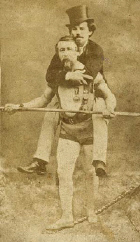
One of his most memorable moments was when, after another crossing on September 15 1860, he asked the crowd whether they believed he could cross the falls again. “Yes!” was the confident cheer. “Do you believe I could cross the falls carrying a man on my back?” After witnessing his previous stunts, they cheered expectantly “Yes!” Blondin leaned in, asking “Who will volunteer?” Silence. After a moment Blondin pointed to an onlooker “Will you trust me?” “No! I can’t risk my life like that!” No one would volunteered, so Blondin turned to his manager Harry Colcord. “Harry, do you believe I can carry you across?” “Yes”, said Harry, “I know you can.” “Then climb on!” And Harry became the only man who was ever carried across the raging Niagara falls by his friend since he was the only man with real faith in Blondin.
Charles Blondin carrying his manager Harry Colcord across the Niagara Falls on a tightrope. An image of real faith.
Faith in action
Our faith here on earth is not only effective to secure our eternal salvation, although that conversion is primary (John 11:26). The eleventh chapter of Hebrew recalls a few momentous instances of faith in Jewish history, and therein we learn of what faith can do on earth: it leads to our obedience by which we can escape dangers on earth (v7) or secure an inheritance (v8-9). Through faith we receive power to do the impossible (v10), we speak powerful blessings (v21) and future prophesies (v22). Faith prevents us from giving in to fear (v23) or temptation (v24), and gives protection from death and destruction (v28,31). Through faith we can to do the impossible (v29-30), “conquer kingdoms, enforce justice, obtain promises, stop the mouths of lions, quench the power of fire, escape the edge of the sword, [be] made strong out of weakness, [become] mighty in war, put foreign armies to flight… receive [children] back their dead by resurrection…” (v33-35). This list is a recording of what believers had accomplished in faith in the past – you can do the same, and more. Indeed, Jesus promised that “those who believe in [him] will do greater works” than what he had done (John 14:12).
How do we put our faith to work?
Firstly, our faith is in God, not in our faith. God is the object of our faith; we trust in him to do that which we cannot do. He has the Divine power to do what we cannot do, and the Fatherly goodness and generosity to do it for us. Thus our trust in not in our powerful faith or skillful prayer to conjure up appropriate faith for the need. No, the burden is off our shoulders – we trust in God, not our ability. When we say we “believe in God”, we mean to say that we trust God’spower to do what we cannot do, we trust in God’sperson (his benevolent, faithful character) to help us in our weakness, and we trust in God’s promises (the reliability of his word – both written and spoken to us) to be true and certain. That is the faith that Abraham had (Romans 4:18-22).
God’s promise to Abraham was very tangible: every day he felt the sand beneath his feet, and every night he saw the stars in the sky above. His hope was kept alive daily.
Secondly, faith in action requires a goal, or in the definition of the author of Hebrews “faith is the subject of things hoped for” (Hebrews 11:1). Elsewhere Paul writes that “our faith rests in the hope of eternal life…” (Titus 1:2). In other words, hope is the subject of our faith. Faith follows the hope we have, as Abraham’s tangible promise of “offspring as many as the stars in the sky and grains of sand beneath your feet” illustrate (see Genesis 15:5). For you to wield your faith, there must be some hope, some definable, clear, certain outcome. Something you can work towards and can hold onto. This can be a promise of God, a dream, a goal. And the more certain and more defined your hope, the stronger the faith which you work to make this hope a reality.
Faith is from the mouth.
Thirdly, our faith is from the heart, through the mouth. Luke records how Jesus’ disciples woke him in the night, afraid to drown in the stormy sea. “[Jesus] awoke and rebuked the wind and the raging waves, and they ceased, and there was a calm. He said to them, ‘Where is your faith?’” (Luke 8:22-25). By implication Jesus said “My faith has effect when I speak it – why did you not do it?” In another instance he taught the same principle, after cursing the fig tree (Mark 11:14). When Peter was amazed the following day by the effect of Jesus’ words, the Master replied “Have faith in God. Truly, I say to you, whoever says to this mountain, ‘Be taken up and thrown into the sea,’ and does not doubt in his heart, but believes that what he says will come to pass, it will be done for him. Therefore I tell you, whatever you ask in prayer, believe that you have received it, and it will be yours.” (Mark 11:23-24). The principle is clear: for faith to have effect, it has to be spoken. For the impossible obstacles (“mountains”) to be removed, or the unwanted things to die in our hearts and lives (“fig tree”) the words of faith must be decreed, or the prayer by faith must be prayed “not doubting” (James 1:6-8). After all, “The power of life and death in in the tongue” and those who live by it will profit from it (Proverbs 18:20-21).
Obedience is faith in action.
Lastly, our faith require action, or obedience. If hope is the house-plan we desire, faith is the progressive activities to realize that plan. Therefore James wrote “faith without works is dead” (James 2:26). Noah’s hope was being preserved from the flood, so in faith he chopped the wood, assembled the ark and loaded his family and animals and all the while warned the people of the coming flood. Joseph’s hope was the preservation from the great famine, so in faith he constructed silos to store the coming abundance. Moses’ hope was the deliverance of God’s people from slavery and secure in their Promised Land; his faith was standing before mighty Pharaoh saying “Let God’s people go!” and announcing the ten plagues, and later leading the people Home. David’s hope was deliverance from the Philistine oppression, specifically Goliath; his faith was picking up five stones and standing before the giant, announcing his immanent death and scattering of the Philistine army. Hope is the goal; faith is the (inadequate) effort we take while expecting God’s miraculous intervention.
We are believers, called to be a household of faith, those who live by faith and are called to walk by faith. We have Jesus’ promises that “nothing is impossible for those who believe”. So what do you believe? How do you exercise your faith? Write your hope today. Speak it today. Take certain steps towards it today – while you trust in God today.
It’s the beginning of a new year, and we are reminded often of the good plans God has for us – “plans to prosper and not to harm us, to give you a future and hope.” (Jeremiah 29:11). But what do we do when God’s plans include walking through the fire?
“I believe in God, the Father Almighty.” This first line of the Apostolic Creed is fundamental to the Christian faith (Hebrews 11:6): the belief in a God for whom nothing is impossible, and God who is a loving Father who has our best interests in heart. In this God we trust.
Yet this great truth is the problem for many devout believers who sincerely trust in God for something – healing, provision, breakthrough at work, peace in a relationship – but God does not come through. Over and over we affirm that God is almighty and good, and that he hears our cries and answers our prayers – but then a loved one dies, your company folds and finances dwindle or marriage ends in divorce court. Or your desires are unmet in spite of all the promises you received, and you start another year lonely, or childless, or frustrated at work. What do we make of these situations? How do we relate to a loving, Almighty Father that allows for the suffering of his children?
The cause of suffering
As mentioned in a previous post Suffer Well, suffering has two basic behavioral consequences in a believer.
“Introspection” – bronze statue by Frank Somma (2004)
Firstly, he/she may gravitate towards doubt of self, leading to unhealthy introspection, believing that the suffering is either a result of God’s punishment for sin or some “open door” through which Satan has access to hurt us. Job’s friends believed this and accused him of secret sin. (Yes, “sin leads to death” (James 1:15) and yes, our God “disciplines those he loves” (Proverbs 3:11-12; Hebrews 12:5-6), but like a good father he warns beforehand and makes it clear what you are being corrected of – his aim is correction)).
Accusing God.
Secondly, the one suffering may doubt God’s character or ability, leading to accusation, that either God is unjust (as Job did) or unable to save. This can escalate to agnosticism or even atheism.
However, the Bible contains a myriad of godly characters who has undergone suffering – neither because of their sin or God’s unfaithfulness. These accounts were recorded during times of hardship “for our learning… encouragement… [and] hope” (Romans 15:4) during similar circumstances. One such helpful recording is of Daniel’s three friends who refused to bow down and worship a statue which emperor Nebuchadnezzar erected (see Daniel 3:14-30). By their own declaration these godly men believed “our God is able to deliver us from the burning fiery furnace, and he will deliver us out of your hand…” (v17). Yet they ended up in the fire; God did not prevent them from suffering. What can we learn from this account of the three Jews in Babylonian exile 530BC? How does it encourage us or give us hope in our own suffering?
“The Three Men in the Fiery Furnace” – 3rd Century wall painting discovered in the Priscilla Catacomb, Rome
God is not the author of suffering and death
In Genesis and Revelation we see the nature of God in creation: no suffering, no death, no sickness, no enmity.
As illustrated in this account, God is not the one who initiates suffering and death – the pagan king was. God’s character and desire for his creation is clear in the Genesis creation account (Genesis 1 and 2) – there was no death, sickness or suffering until the fall. We see this also in the promised re-creation of the New Heaven and New Earth (Revelation 20 and 21) where again “death shall be no more, neither shall there be mourning, nor crying, nor pain anymore, for the former things have passed away.” (Revelations 21:4). God is the author of life; Satan is the author of death and destruction (John 10:10). Since the fall of creation sin in our hearts and our world will result in pain, suffering, sickness, and death. This is exactly why Jesus came – “to destroy the works of the devil” (1 John 3:8) so that mankind may again “have life more abundantly” (John 10:10). God is not the author of suffering, but he is drawn to our suffering to redeem mankind from it.
A good life does not save usfrom suffering.
As seen in our text, a good moral life does not prevent us from suffering. In fact, even a devout godly life does not protect us from all harm as we see in this account of Shadrach, Meshach, and Abednego who refused to worship idols, and yet were thrown in the fire. A casual glance at Biblical and church history will assure you that good people suffer – in spite of their godliness and often because of their devotion to God.
Consequently, suffering is not always the result of our sinfulness or imperfection. Our suffering many times is the result of other people’s cooperation with evil (as in this case – the idolatry and oppression of Nebuchadnezzar), or simply the result of the fallen world infested with genetic imperfections, diseases and natural disasters. Our righteousness does not always exclude us from these hardships.
God enters into our fire.
God enters our suffering. (Shadrach, Meshach, and Abednego in the Fiery Furnace by William Maughan, 1985)
Suffering believers often feel abandoned by God. The question asked many times “Where is God when it hurts?” is clearly answered in this account of Daniel’s friends: God enters the fire to be with his people in their suffering and strengthen them. This is clearly demonstrated by Christ’s incarnation: Jesus became man to identify with us in our suffering (Mark 8:31; Luke 9:22; Hebrews 4:15) and to ultimately bring an end to the suffering brought about by sin and Satan (Revelations 21:2-5).
And still today Jesus is “Emmanuel – God with us” (Isaiah 7:14) who will “never leave us or forsake us” (Hebrews 13:5). Especially during hardship the Psalmists sings “The Lord is near to the broken-hearted” (Psalm 34:18). No amount of suffering, pain, death or loss – “Nothing can separate us from the love of God in Christ” (Romans 8:38). God enters our fire – we never suffer alone.
Our suffering has purpose
Why does a loving God then allow suffering? If he is with us in our suffering, why does he not simply save us from it? The mocking Jewish elite asked this same question to Jesus hanging on the cross 2000 years ago (Matthew 27:41-44), but Jesus endured it because he knew there was purpose to his suffering (Hebrews 12:2) – the salvation of the world!
Our text shows us that the suffering of the three righteous men at the hands of Nebuchadnezzar also had purpose, and we find hope that our suffering has the same three benefits.
Firstly, we note that their suffering lead to their immediate promotion (Daniel 3:v30). This is a pattern in the Bible – the one who suffers well is promoted directly after his/her suffering. Think of Job who was double as wealthy after his loss (Job 42:10), Joseph who became ruler over Egypt after his imprisonment (Genesis 41:41-44), David who was crowned king after his persecution (2 Samuel 5:3), Peter who became leader of the early church after his “shaking” (Luke 22:31-32 and Acts 2:14), and Jesus who earned the title “King of kings, Lord of lords” through his obedient suffering (Philippians 2:8-11 and Revelations 19:6).
As mentioned in a previous post Suffering your good tutor we can rest in the truth that “Nothing irredeemable can happen to a Christian” – or as Paul said it “all things work together for the good…” (Romans 8:28). For the Christian who hold onto God in Christ, regardless of what you are going through, you are better off afterwards – both in this life and the life to come. Suffering well always lead to promotion. Nothing we encounter can put you back – God can turn every situation around for your good and his good.
Secondly, the suffering of the three friends of Daniel functions as an amplifier of their witness of and faith in God, so that everyone knew them and was attracted to them after the suffering to hear and investigate their story (Daniel 3:27; refer Philippians 1:13). Their faith in God and faithfulness to him drew the attention of the king and his governors. Furthermore, because of God’s preservation and presence in the fire, the king issued a decree that no one may “speak anything against the God of Shadrach, Meshach, and Abednego” (Daniel 3:29) for fear of their life. Effectively, their faithful, hopeful suffering lead to the honoring of Israel’s God throughout the vast Babylonian Empire, by the King’s decree. Because they suffered well, the name of God was known and held in honour throughout the fast Babylonian empire; in other words, their suffering was part of God’s plan of salvation of the world. Joseph discovered the same after his imprisonment and promotion – what his brothers intended for evil, God intended for the preservation of millions of souls from widespread famine (Genesis 45:5-8).
Throughout the ages, the blood of the saints has been the seed of the church. In other words, the faithful, hopeful suffering of God’s people has lead to the salvation of millions of souls throughout the ages. Likewise your suffering amplifies the witness of your faith in God and lends credence to your message of hope in God – if you suffer while trusting God and remaining faithful to him.
Thirdly, as in the case of the godly martyrs who endured Nebuchadnezzar’s fiery furnace, suffering helps one grow in the knowledge of both yourself and God. Trying times helps one discover the end of yourself and you realize how much you need the Lord’s grace to survive the fiery ordeal, as Paul realized (2 Corinthians 12:9). This produces a beautiful humility.
But suffering also helps one grow in intimacy with God like never before, as we see in this rich example of the three Jewish martyrs who experienced Jesus “walking in the midst of their fire” with them (Daniel 3:25). Suffering forces one to draw near to God with no pretense, and the result is an honest perception of who God is, as Job discovered (Job 42:5). This intimacy with God leads to uncharacterized confidence to pursue the impossible, because you have come to know the power and faithfulness of God through your hardships.
Taking it home
In closing, there are three take-home messages from this story in Daniel 3.
We find comfort in the truth that God will never forsake us – especially not during hardship! “I am with you when you go through the fire… you shall not be burned, the flame shall not consume you…” says the Lord (Isaiah 43:1-2). But don’t isolate yourself, don’t walk through the fire alone – “God is among His people” (Revelation 21:3).
We find hope that our suffering has meaning, it has purpose – God makes “all things work together for good, for those who are called according to his purpose.” (Romans 8:28) You will be better off after this suffering than you were before it!
Lastly, this story makes us consider and prepare our hearts: can we say with these three godly men “our God whom we serve is able to deliver us from the burning fiery furnace … but even if not… we will not serve your gods…” (Daniel 3:17-18). They knew God could save them, but God said no. Jesus pleaded his Father to make a way around the cross, but God said no (Matthew 26:39, 42). Paul pleaded the Lord to save him from his torment, but the Lord said no (2 Corinthians 12:8-10). David trusted his Shepherd to lead him “through the valley of the shadow of death” (Psalm 23:4) – will you? Will you serve God when the he says no and you must walk through the fire?
The WordPress.com stats helper monkeys prepared a 2014 annual report for my blog walklikejesus.net
Here’s an excerpt:
A New York City subway train holds 1,200 people. This blog was viewed about 7,500 times in 2014. If it were a NYC subway train, it would take about 6 trips to carry that many people.
Picture this: you have just spent six grueling weeks ascending the slopes of Mount Everest to reach the top. You have a head-ache and feel nauseous because of the thin air at an altitude of 8.5km. You and your two friends eventually reach the summit and fall down on in the snow – satisfied and thankful, yet feeling miserable. You only have a few minutes to drink in this moment in the light of the rising sun with the spectacular view of the Himalayan peaks, and you think: “this is the view God must have of the our world”. You know you will probably never have this experience again, but thankfully you brought your camera. Handing your camera to the Nepalese Sherpa (trekking guide) you and your friends strike a pose to capture this memory. After an awkward silence your smiles change into unbelief and frustration when the Sherpa announces in his flat, broken English “batteries dead!” You take the camera from the guide, fiddle with it for a few minutes but after a while you realize that the exercise is pointless – the batteries expired in the extreme weather conditions and now you will have nothing to capture the moment, no proof that you have climbed the highest peak in the world. You will have no transferable memory that you can show to your friends and family, nothing you can post on Facebook and no story you can leave for your children in your family album.
Throughout our lives time keeps on ticking away; nothing distinguishes once second from another. But in the course of our lives there are moments which are precious, others that are crucial, others moments are hilarious or awful. These events become the stories we cherish and retell; so that these moments become the memories that are transferred to coming generations – they become “the story of my life” and eventually “my life lesson”. These unique moments are the matter that folk tales or legends are made of. And there these the stories that make up the pages of the Bible – memories that “were written for our learning, that through the patience and comfort of the Scriptures we might have hope.” (Romans 15:4)
Memorial stones
Memorial stones on mountain top stating “I made it!” – a common sighting all over the world.
One way in which memories are made and transferred in the Bible is by setting up memorial stones or monuments. In one such instance (around 1150BC) the prophet Samuel called the whole nation together at Mizpah to sacrifice to God and worship because the Ark of God was brought back to Israel. The Philistines heard about it and wanted to take opportunity of the vulnerable worshipers, but the nation cried out to God. God intervened with thunder so loud that it confused the enemies and the Israelites had a great victory that day. Samuel set up a memorial stone there and then calling it Ebenezer saying “Thus far the Lord has brought us” (I Samuel 7:12). This monument was meant as a reminder to the nation and coming generations that the Lord had heard their cries and delivered them from annihilation that day. The life lesson transferred to those who see the stone and hear the story is “God hears and saves from impossible situations!” The story stirs hope and faith in God to whoever hears it.
Other such stone memorial is at Bethel where the Lord visited Jacob and made covenant with him (Genesis 28:18-19), as well as the heap of stones next to the Jordan river, where all of Israel had crossed over on dry foot (Joshua 4:1-7). As in Joshua’s account, the purpose of such memorial stones are both to provoke inquiry and to remind that “This is what the Lord has done – right here in this place!”
Merry-making
In life we make memories by stopping to celebrate success.
Another way in which memories are cherished in Israel’s history is by feasts. Most of Israel’s annual feasts were to serve as a reminder of an event where God intervened. For instance, every week the Sabbath is honored by not working, a day to celebrate and remember that the Israelites were slaves but the Lord delivered them from slavery (Deuteronomy 5:15). Likewise the Passover is celebrated annually to commemorate Israel’s deliverance from Egypt (Exodus 13: 3), and more specifically that the Lord spared their first-born children from the tenth plague – the night in which the angel of death “passed over”. Much later Queen Esther instituted the feast of Purim as a reminder that the Lord had saved the Jews from annihilation by Haman’s schemes (Esther 9:19-22).
Communion is celebrated in the same way – “in remembrance” (Luke 22:19). All of these feasts are meant to be merry-making – celebrated in memory of something the Lord has done. A time to retell the event and celebrate the goodness and might of God in joy-filled thanks.
Making Melody
Memories are made and transferred through songs and poems, painting or sculptures.
One several occasions the Bible records songs being written to celebrate (and propagate) some intervention or deliverance of the Lord. Moses and the Israelites composed and sang a song in celebration of their escape from the Egyptian army and their dry-footed passage through the Red Sea (Exodus 15:1-18), followed by another song by Miriam (Exodus 15:19-26).
The judge Deborah composed and sang a similar song after God granted them victory over Sisera, commander of the Canaanite army (Judges 5:1-31). The beloved King David composed several songs retelling the faithful deliverance of God from his enemies, of which Psalm 18 is a good example.
The Psalmists of Israel understood that songs were a good instruction and reminder of the faithfulness of God to successive generations, and composed psalms such as Psalm 78 and 136 as reminders of God’s faithfulness in the history of Israel, as they sang then at their feasts and in their local synagogues.
Paintings of memorable events work the same way to remind coming generations of God’s faithfulness. The church through the ages have decorated the insides of cathedrals, monasteries and churches with images of Biblical accounts and heroes of the faith as visual sermons to stir faith and inspire believers to emulate their examples.
Memoirs
We make memories by recording our precious and defining moments for others to follow in and build upon.
The Bible as book is delivered to us as a record of God’s relations and dealing with his covenant people. It is the compiled memories of what the Lord has done and said in the past, and it is skillfully recorded and graciously preserved so that we may learn of what God has done for others, so that we may trust in his faithfulness and love . The aim of such memoirs is that we may build on their lives and walk in their legacy, as Asaph recorded “Tell the coming generations the glorious deeds of the LORD, his might, the wonders that he has done… to set their hope in God… not forget his works; but keep his commandments; and that they should not be like their fathers, a stubborn and rebellious generation…” (Psalm 78:3-8)
Likewise, the memories we transfer to others shape their understanding and affection of God. Moreover, these memoirs will bring comfort and hope in hardship as the readers recall that the Lord has brought others through similar challenges (Romans 15:4).
Make memories
Pause your journey and reflect through thanksgiving and celebration. make some memories – you (and others) might need them later!
In this season for merry-making, gather friends and family around the fire or table and relive the great memories that brought you here. Celebrate it properly! Record it in pictures or in writing, in poetry or a song . Set these up somewhere as a “memorial stone” that it may provoke coming generations to ask “What is this?”. Then you can tell them “This is what the Lord has done – He can do the same for you!”





















 walklikejesus
