Have you felt stretched too thin lately? Worn out or burnt out? You are not alone. Our culture fights against limits and pushes against the boundaries that frame our lives. We don’t want to miss out. “More is better”, we believe, so we try harder to experience more to get more. Yet, there is always more. This leaves us unsatisfied, angry and exhausted.
Our marketing memes show our belief that “more is better.” Just add the word “unlimited,” and customers will buy whatever you sell. Because we believe the good life is found beyond our boundaries, we always strive for more. We war against the boundaries of our lives but end up fatigued, frustrated, fearful, and flat—in a word, lifeless. How is it that “more” leaves me feeling “empty”?
In a world where limitless is life, we fantasise about superheroes. Yet we are creatures, not gods. We are limited beings, blessed to thrive within our boundaries. Pete Scazzero lists some limits that we all can relate to. My life on this earth is a blessing, but it is brief; I can’t escape death. My mind has its limits, regardless of my learning. My personality or temperament has its strengths and weaknesses in every situation. My gifts are great, but it has their limits. My family or origin gifts me within a particular cultural, financial and social context; this is a blessing, but it holds its limits. Whether I am rich or poor, black or white, male or female – each attribute empowers and impedes me in life. Likewise, my own past (actions and experiences) holds great treasures, but with its limiting consequences. Each season of life has its gifts and limitations; we can’t change that – only embrace the season with its invitation and limitation.
The Apostle Paul also wrestled with his human limitations. In 2 Corinthians 12:7-10, he recounts a life-altering meeting with Jesus that changed his perspective on limits. “…I have received such wonderful revelations from God. So, to keep me from becoming proud, I was given a thorn in my flesh, a messenger from Satan to torment me and keep me from becoming proud. 8 Three different times I begged the Lord to take it away. 9 Each time he said, “My grace is all you need. My power works best in weakness.” So now I am glad to boast about my weaknesses so that the power of Christ can work through me. 10 That’s why I take pleasure in my weaknesses, and in the insults, hardships, persecutions, and troubles that I suffer for Christ. For when I am weak, then I am strong.”
Paul’s reference to “a thorn in the flesh” is often misunderstood as a slight pinch in the foot. But, Pete Scazzero explains that the original language referred to a pike-like military defensive barrier (see image below). Today, Paul might have used “a sharp palisade fences or barb-wire in my flesh.” Pressing against this barrier caused him anguishing pain and left him feeling frustrated (angry and powerless).
Many have speculated about this “thorn in the flesh” in Paul’s letter. Some read Paul’s “thorn in the flesh” as a painful or shameful bodily obstacle that inhibited his life or mission. It might have been a speech impediment, like Peter’s lisp (Matthew 26:72-73) or Moses’ stuttor (Exodus 4:10). Others think Paul lived with a painful and debilitating eye infection (see Galatians 4:13-15, 6:11). Some sceptics believed Paul suffered from episodes of epilepsy (because of his disabling visions, as in Acts 9:3-9 and 2 Corinthians 12:7. Yet, others argue that Paul used the phrase “thorn in flesh” metaphorically to refer to emotional pain caused by his loneliness or the ongoing opposition by the Judaizers who constantly discredited his message and character. A last group believed that Paul’s torment was only spiritual, caused by some demonic “messenger from Satan”.
Whatever it was, we know that this “thorn in the flesh” was painful and limiting. Paul suffered from it and could not fix the problem himself. His prayers were not answered either – the Lord did not relieve him of this burden either.
Our culture does not readily accept the limits of “no.” Our culture believes you can do anything and everything if you put your mind to it. Not accepting limits or “no” leaves us exhausted, angry, and inhibited. What can we learn from Paul’s message?
Flourishing within limits
The Bible includes examples of people who served God with tremendous freedom despite their limitations. These limits did not hamper the ministry or legacy of these faith heroes; instead, these faith heroes flourished within these limits, often because of these limits. Jesus taught that “blessed are the meek, for theirs is the kingdom of heaven.” Meekness means submission to restraints as a horse submits to the saddle and bridle of a rider. We are blessed (better off) when we learn to rest within our constraints and trust that God can and will give us goodness here where we find ourselves.
Moses’ life-long speech impediment did not prevent him from fulfilling his call. It seems ironic that, despite all the miracles performed through Moses, the Almighty did not heal him of his stutter. God chose to appoint a man with a speech impediment as his spokesman. In his weakness, God’s power was made known.
David was small, the youngest and most neglected member of his family. Yet God chose this insignificant shepherd boy to deliver his people from the Philistine giant and unite them in one glorious kingdom.
Daniel and his friends were enslaved, yet his God’s sovereignty was made known through these young Hebrews as they faithfully served their captors in the palace.
John the Apostle was a political prisoner on the Island of Patmos, far removed from the oppressed churches under his care. Yet here, God revealed powerful visions with messages of hope that have served the church for millennia.
Likewise, Paul’s most potent and lasting ministry was from within a Roman prison, as he learned to rely on God’s grace. He discovered that these impediments taught him not to become proud (happy, independent, or self-reliant) but rather to rely on God’s grace. “My grace is all you need. My power works best in weakness.”
Jesus Christ is God in the flesh, living as a poor Jewish boy raised in an insignificant rural village while the mighty Roman Empire ruled his people. This God suffered hunger, ridicule, shame, betrayal, torture and violent death. Through this, God restored his kingdom and delivered all who trusted in him from death.
My limitations as gifts
Paul discovered that the “thorn in his flesh” did not diminish his life; his life and legacy expanded as he embraced his limitations.
Paul’s limitation taught him humility – a life that relies on God’s grace, not his own strength and wisdom.
Resting in his limitation gives him a revelation of God’s nearness and grace.
His limits were the means to intimacy, the reason to draw near to God and trust him more.
Paul’s limiting imprisonment was the door to his most significant legacy — the letters that became the blueprint for every Christian church in history.
Paul’s message to the Corinthians invites me to see my limitations as gifts from God to keep me humble and dependent on Christ. It reminds me that these impediments drive me to draw daily strength from Christ. These limitations are the windows that witness the power of Christ in a world filled with weakness. Paul invites me to see my impediments not as limitations to my life, but as a door to my most significant legacy.
We are limited beings invited to live flourishing lives under the care of our compassionate creator. We will do well to learn the secret of being content in every situation (Phil. 4:11-13). Then, our weakness will become our strength.
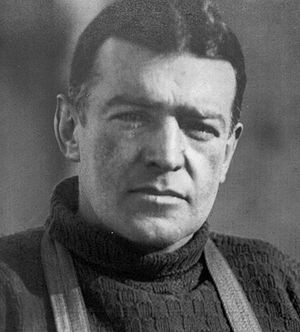
“Men wanted: for hazardous journey. Small wages, bitter cold, long months of complete darkness, constant danger. Safe return doubtful. Honour and recognition in case of success. Sir Ernest Shackleton.” 5000 men responded to this blunt advertisement posted in London newspapers January 13 1914, applying for the Imperial Trans- Antarctic Expedition. Shackleton selected a crew of 28 who proved to be optimistic, patient and courageous – the minimum requirements he sought for in a man who boarded a ship with him. They set sail from London in the ship aptly named “Endurance” on the first day of August 1914 and stopped over at the whaling station on South Georgia for fresh supplies. After a month they departed for the Antarctic on December the 5th for one of the most grueling adventures undertaken by man, unaware that they would not touch land again for another 497 days. On return to England three years later Shackleton published the account in his book South in 1919, documenting the journey, events and experiences of their expedition, including the following five legendary survival accounts.
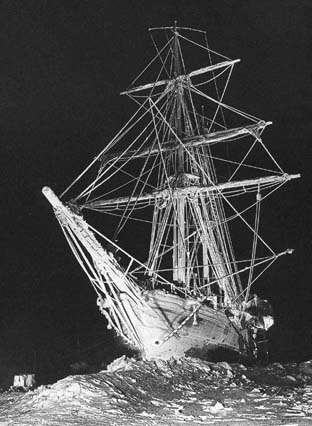
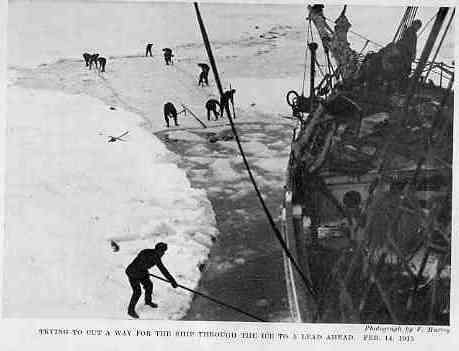
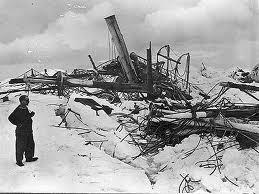
Due to an unusually cold winter the ship entered pack ice much sooner than expected. Just one day’s journey from the Antarctic the Endurance got stuck in pack-ice on 18 January 1915, drifting gradually away from the South Pole for ten months with the ice until the ship tipped and was crushed to pieces on October 27, 1915.
Endurance slowly breaking through pack iceEndurance stuck in polar iceEndurance crushed by pack ice
The men saved what they could and drifted for another five months on the ice until the ice started melting and the food became scarce. On 31 March 2016 Shackleton woke up from a soft crackling sound to find that the ice beneath him split in two; he instinctively reached his hand to grab the sleeping bag of the man sharing his tent just as he was slipping into that icy, black water. During the ice-splitting they were also separated from their life rafts for some time but they managed to retrieve it again. The next day he gave the command to board the three life boats.
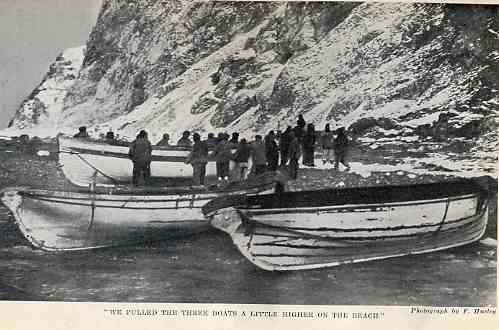
The life-saving achievement was the harrowing journey through the Weddell sea to a rock called Elephant Island, 100 miles in the three small life boats, navigating one of the roughest seas with 60 foot waves blown by gale-force winds. The three boats had to be dragged on top ice floes at night to rest. They managed to reach Elephant Island, and eventually found a suitable camping terrain.
Boats on Elephant Island
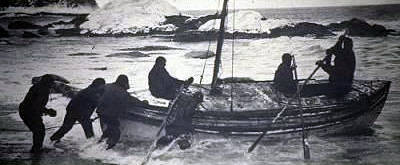
Their third legendary survival story started on 24 August when Shackleton and five others boarded the small 22ft life boat called the James Caird and made way for South George, from where they departed about 500 days earlier 800 miles away. (That is the distance between Cape Town and Johannesburg!) After a grueling 17 day journey in the stormiest sea, navigating by dead reckoning with a compass and sextant only with merely four sightings of the sun, the six men reached the island exhausted. This is still considered one of the greatest boating achievements ever.
Crew boards James Caird for South GeorgiaLanding on South Georgia
The next survival feat was equally impressive, born from necessity as the men landed on the wrong side of the island. To get to the whaling station for help and rescue of their friends Shackleton, captain Frank Worsley and second officer Tom Crean began to cross the ice-bound mountain tops of South Georgia – never before attempted, including the 9000ft Mount Paget. During their 36 hour ordeal without any rest they travelled across two snowfields, four glaciers and three mountain ranges: all of these unmapped and life threatening. The last bit of their journey, being severely fatigued, dehydrated and shivering, Shackleton lowered his two friends down a partially frozen waterfall before abseiling down himself and waking the harbor master at Stormness whaling station, asking for help.
Panoramic view of South Georgia
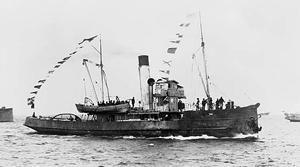
Lastly, the survival and rescue of the 22 men marooned on Elephant Island for more than 137 days is commendably in itself. They used the two life boats to construct a hut of sorts to stay warm. Due to the roughness of the sea it took four attempts by Shackleton and his men to rescue them, only managing to reach them with the steam boat Yelcho on 30 August 1917, two years and one month after their departure from England.
The Chillean steamer Yelcho
This story of endurance and courage is inspirational – in spite of the failure to cross the Antarctic – because Sir Earnest Shackleton succeed to bring all 28 the men home safely; they endured and survived the impossible together. Part of their survival had to do with what Shackleton took with them as their ship Endurance was crushed by the pack ice: in spite of the lack of space in the three life rafts he instructed that they take a rugby ball, the gramophone as well as the big Bible. He insisted that they daily laughed together, told stories and read the Bible together as encouragement in hope, daily played sports together, and daily sang together. For him, humour, story, song, playing and prayer was keys to endurance – and it proved true.
Football on iceGramophone for the penguins
Shackleton was a God-fearing man who lived and lead though this ordeal with Godly courage and persistence. Looking at his example of endurance, and comparing it with examples and teachings from the Bible, what can we apply to navigate through our own hardships with “Endurance”?
(1) Comfort of Scripture
As mentioned above, Shackleton ordered his men to rescue the ships’ big Bible and take it with them on their journey to safety, knowing that the Scriptures are in part a compilation of God’s miraculous deliverance and preservation of people in desperate circumstances, as were they. Their faith in God’s salvation from this seemingly hopeless situation would be stirred as they read they reflect on the accounts of God’s awesome deliverance of individuals and communities as recorded in the Bible.
New Testament Authors encouraged their suffering communities to look at Old Testament characters (as well as their leader’s examples of steadfastness) to find strength to press on in faithfulness to God. Paul reminded the persecuted church in Rome that “whatever things were written before were written for our learning, that we through the patience and comfort of the Scriptures might have hope” (Romans 15:4). James encouraged the poor, persecuted church in Jerusalem to “consider the blessed who remained steadfast” with special reference to Job and the Old Testament prophets (James 5:10-11). The author of Hebrews encouraged his suffering readers to “consider [Jesus] who endured such hostility from sinners against Himself, lest you become weary and discouraged in your souls” (Hebrews 12:3). Thus they all pointed to the exemplary lives recorded in Scriptures for encouragement during difficulty.
The history of God’s faithfulness in Scripture comforts us during hardships because we see that we are not alone in hardship – many have been there; and the Biblical accounts testify to us that God is present during suffering to strengthen and preserve, and that he is willing and able to save. Thus the Scriptures comfort us and stirs our hope and faith in God.
(2) Companionship in community
Shackleton knew that for the 28 men to survive this ordeal, they should not just live in community, but also practice community. That’s why he commanded that every one participate in four group activities daily: they eat together, play sports together, pray and reflect on Scripture together, as well as sing, tell stories and laugh together. These moments of togetherness brought great encouragement and camaraderie amidst the protracted stressful times. He understood and articulated that for the group to survive, each individual needed to survive. If no-one gives up, the group endures.
In relation to their survival and community, I find C.S. Lewis’ quote on friendship quite fitting: “Friendship is unnecessary, like philosophy, like art… It has no survival value; rather it is one of those things that gives value to survival.” For the crew stranded in Antarctic, their community was a reason to endure in itself; their companionship gave both motive for and meaning to their survival.
(3) Celebration of life
Shackleton wrote in his journal during their long winter drifting on the pack-ice “As we clustered round the blubber stove, with the acrid smoke blowing in our faces, we were quite a cheerful company…Life was not so bad. We ate our evening meal while the snow drifted down from the surface of the glacier and our chilled bodies grew warm.” They were thankful for what they had; their companionship, warm food and their survival was reason to laugh.
Going through life with the optimistic perception of “glass half full” makes endurance possible, and life so much more pleasant. Jesus put it this way (referring to money in the context of a financially oppressed Judea) “The eye is the lamp of the body. So, if your eye is healthy, your whole body will be full of light, but if your eye is bad, your whole body will be full of darkness. If then the light in you is darkness, how great is the darkness!” (Matthew 6:22-23). Shackleton lead his men on in “light-filled eyes”, celebrating what they had amidst a cold, seemingly hopeless situation.
Paul encouraged the persecuted church in Philippi to do the same, to emulate his discipline of focusing on the good and praiseworthy, so that “the peace of God will guard your hearts and minds” (Philippians 4:6-8). Instead of becoming anxious about trying circumstances he instructed them to pray about their situation, but “with thanksgiving”, helping them recognize and celebrate the goodness of God amidst difficult circumstances. This is a worthy lesson to learn for anyone, anywhere.
Thanksgiving and celebration makes hardship tolerable and gives one strength to carry on. These disciplines gives strength in trying times by focusing attention on that which causes joy and gladness – truly, “the joy of the Lord is your strength!” (Nehemiah 8:10). By focusing attention of the good it trains one’s perception to see what God is doing, recognizing that God is near, and “He will never is leave you, nor forsake you” (Hebrews 13:5).
(4) Continuing in hope
Shackleton never allowed his crew to give up. They were always moving forward, always planning and preparing for tomorrow. In his mind, and from his mouth, it was clear that they were going to get home to England. He never gave up on hope, and never allowed the crew to slide into hopelessness, because he knew that hope is necessary for endurance. If a person believes that nothing is going to change for the good, that person sinks in the mud of depression and hopelessness, and finds no reason to fight and or live on. But if one believes that pushing forward today will be rewarded in the end, it is worth it.
The author of Hebrews frequently motivate endurance with the promise of reward (hope), for example “you have need of endurance, so that after you have done the will of God, you may receive the promise” (Hebrews 10:36) and later encouraging the readers to “run the race with endurance, looking to Jesus… who for the joy that was set before Him endured the cross, despising the shame, and has sat down at the right hand of the throne of God.” (Hebrews 12:1-2, compare with 1 Thessalonians 1:3). Jesus found strength to continue through tremendous suffering, his eyes fixed on the joyfilled reward at the end.
Paul imitated Jesus’ example, as he was a man who experienced great difficulty, including “afflictions, hardships, calamities, beatings, imprisonments, riots, labors, sleepless nights, hunger, …slander, …being poor” (2 Corinthians 6:4-10). In another place he records “imprisonments, with countless beatings, and often near death. Five times I received at the hands of the Jews the forty lashes less one. Three times I was beaten with rods. Once I was stoned. Three times I was shipwrecked; a night and a day I was adrift at sea; on frequent journeys, in danger from rivers, danger from robbers, danger from my own people, danger from Gentiles, danger in the city, danger in the wilderness, danger at sea, danger from false brothers; in toil and hardship, through many a sleepless night, in hunger and thirst, often without food, in cold and exposure. And, apart from other things, there is the daily pressure on me of my anxiety for all the churches.” (2 Corinthians 11:23-28). How did he endure these hardships? He kept his eye on the reward, a “crown of righteousness” (2 Timothy 4:8) saying “I consider that the sufferings of this present time are not worth comparing with the glory that is to be revealed to us.” (Romans 8:18; see also 1 Corinthians 3:14, Colossians 3:23-24). Paul joyfully pushed one through suffering in hope of eternal rewards in the Lord. He reckoned that suffering briefly for eternal rewards was worth it, making these moments of pain bearable.
(5) Courage from God
Finally, God gives strength to press on in difficult times – to those who “wait on the Lord” (Isaiah 40:30-31). I have over the years learnt from David, who knew the Lord as “my strength” (Psalm 18:1, 118:14, 140:7), to “seek the Lord and his strength” (Psalm 105:4) when my I feel weak or ready to give up. I have learnt to “wait on the Lord [to] strengthen [my] heart” (Psalm 27:14), and also to “strengthen [myself] in the Lord [my] God” (1 Samuel 30:6) as David did in hopeless situations. With the Shepherd-king I can witness that “the Lord gives strength to his people” (Psalm 29:11) when I set time aside to pray to God for courage, strength and hope to continue doing what he calls met to do, although everything in me wants to walk an easier road.
Paul also testified that Christ Jesus has given him strength in trying times (1 Timothy 1:12), and could therefore pray for the Ephesian church that God would strengthen their hearts (Ephesians 3:14-16) amidst the persecution, encouraging them to “be strong in the Lord and in the strength of his might” (Ephesians 6:10). Thus we learn from Paul that one should find strength in God, but also that through encouragement and prayer from others one is strengthened by God. From his example we learn that we should encourage one another joyfully and hopefully press on, to “strengthen the weak hands and make firm the feeble knees” (Isaiah 35:3) of those facing hardship around us. Strength is found in God’s community.
Making it personal
If you are reading this as someone going through hardships now, I want to re-tweet the thrust of John’s message to the persecuted churches in Ephesus: “Here is a call for the endurance and faith of the saints.” (Revelations 13:10, 14:12). Although your suffering might not be religious oppression, you must know that your endurance is noticed and commended by Christ himself (Revelations 2:2, 19). He will put and end to your suffering One Day (Revelations 21:3-5) and if you endure in faith to the end, he will give you your reward from him (Revelations 22:12).
And in the words of Paul: “Run the race in such a way that you may revive the prize” (1 Corinthians 9:24). “Rejoice in hope, be patient in tribulation, be constant in prayer” (Romans 12:12), and may “the God of endurance and encouragement” (Romans 15:5) “strengthen you with all power, according to his glorious might, for all endurance and patience with joy” (Colossians 1:11). “Press on, that [you] may lay hold of that for which Christ Jesus has also laid hold of [you]” (Philippians 3:2).
It is appropriate to close this lesson on endurance from the exemplary life of Sir Ernest Shackleton with the words from Winston Churchill, since he was the man who sent the last telegram to the Endurance crew as they left the London harbor for their trans-Atlantic expedition on August the 1st, 1914. Later that day the war with Germany broke out, leaving the whole of Europe in turmoil for the next forty years. On October 29, 1941, Churchill then Prime Minister visited Harrow School to hear some of the traditional songs he grew up with and address the learners. Standing in the podium he stared at the youngsters long and hard, and then uttered the following short and urgent admonition: “Never give in – never, never, never, never, in nothing great or small, large or petty, never give in except to convictions of honor and good sense. Never yield to force; never yield to the apparently overwhelming might of the enemy.” [audio recording] During tough times let this phrase ring in your ears, as you remembering the enduring examples of Jesus, Shackleton, Paul, the prophets and the saints through the ages. Never give in!










 walklikejesus
