From surviving to THRIVING!

“My mission in life is not merely to survive, but to THRIVE; and to do so with some passion, some compassion, some humor, and some style” ― Maya Angelou (American poet, actress and activist in the American Civil Rights Movement).

Reading through the gospel John, one cannot escape the promise of LIFE, of flourishing and thriving, in Jesus.  Over and over Jesus promises that “I have come that you may have LIFE… and that you may have it in overflow” (eg John 10:10).  In fact, the over-arching identity and mission of Jesus (at least from John’ Gospel) is one of LIFE-GIVER.

Jesus is LIFE.  He said I am THE BREAD OF LIFE (John 6:35), “I am THE LIGHT OF LIFE (John 8:12), “I AM THE DOOR” for the preservation of life and access to life (John 10:9), “I am THE GOOD SHEPHERD” who lays down his life for the sheep, that they may have life (John 10:11), the “I am THE RESURRECTION AND THE LIFE that “whoever believes in me, though he die, yet he shall live(John 11:25), “I am THE WAY, AND THE TRUTH, AND THE LIFE (John 14:6) and lastly “I am THE VINE” though whom we have access to and power for life, for “apart from me you can do nothing.” (John 15:5)

I share Mark Hall’s philosophy on this video of Casting Crown’s album THRIVE:

THRIVE in spite of hardships

This promise of LIFE is not defined as an easy life, overflowing with worldly goods and void of suffering.  Jesus did not promise his followers a life void of pain, suffering and difficulty; rather, he promises “In this life you will have trouble” (John 16:33). 

thrive_on_bonsai

The apostles echoed his words when they wrote to the suffering churches “all who desire to live a godly life will be persecuted” (1 Timothy 3:12) and “do not be surprised at the fiery trial when it comes upon you to test you” (1 Peter 4:12).  In essence, the New Testament says “don’t just SURVIVE hardships – THRIVE in spite of it!”  The LIFE Jesus promised is not snuffed out through suffering.

This tree started growing from the remains of a burnt-down cottage.

THRIVE in spite of lack

It is difficult for us to think that it is possible to THRIVE in spite of financial difficulty. Yet it is true that most of the New Testament Church was really poor, being marginalized and persecuted because of their faith in Christ. Yet the church had power and grew rapidly; they knew to be true what Jesus taught: “life does not consist in the wealth of possessions.” (Luke 12:15)

thrive_not_money

Just like some plants flourish in the harsh conditions in a dessert, so a LIFE OF THRIVING is not dependent on abundance of wealth or material success.  In fact, neither Jesus nor Paul nor the other apostles had much possessions.

The dessert is full of life and beauty.

THRIVE in spite of imperfections

Just as a THRIVING plant may not be void of imperfections, so a THRIVING life is not a perfect, faultless life either.  Paul likened the full LIFE of Christ contained in human imperfections to a fire shining through the cracks of a clay pot that the excellence of the power may be of God and not of us.” (2 Corinthians 4:7)

Our imperfections shows God's glorious life.
Our imperfections shows God’s glorious life.

Thriving therefore is not dependent on worldly comfort, prosperity or perfection.  So, Biblically speaking, how does one move from a life of mere SURVIVING to THRIVING?

  1. A Place to Belong: LIFE flows through receiving and giving love

Using the metaphoric language of a tree, the Psalmist writes “They are planted in the house of the LORD; they flourish in the courts of our God. They still bear fruit in old age; they are ever full of sap and green, to declare that the LORD is upright; he is my rock, and there is no unrighteousness in him.”  To THRIVE, one needs to be “planted in the house of the Lord” – to find your space in church community which one calls “home”, a place of belonging.  To THRIVE one has to open your heart to people, and be received into theirs.

thrive_tree_1
“like a tree planted next to water…”

It’s common to not feel part of a community, to feel like an outside.  But Paul writes that – regardless of our background – Jesus has “made us accepted” into Christ’s beloved community through adoption (Ephesians 1:5-6).  If this remains “cognitive truth” at best we will SURVIVE; but once this adoption and acceptance becomes “realized or incarnated truth”, once we experience the blessedness of unconditional acceptance in the community of love we THRIVE in life.  We thrive in a community where love is evident both in our giving and receiving of one another.

Jesus refers to this THRIVING as the GLORY we share in wherever we living in unity, in harmonious, Christ-centered community. He said to his followers that THRIVING LIFE or GLORY will set us apart from the world, so that we will be recognized as Christ’s followers, sharing in his LIFE (John 17: 21-23).

Thriving in belonging.

Thriving happens in Christ’s community, in God’s family (Ephesians 3:14-19) within the security of unconditional love and acceptance, and space to grow and be yourself.  A place where there is no need for presence, where we can live in truth.

  1. Community of Truth: LIFE flows where the LIGHT shines

David observed that it is not financial prosperity that causes one to be blessed but rather by “delight in the law of the LORD” leading to a life devoted to its perpetual study and mediation.  He concludes this person “is like a tree planted by streams of water that yields its fruit in its season, and its leaf does not wither. In all that he does, he prospers” (Psalms 1:1-3).   As trees flourish and bear fruit next to a flowing stream, so humans THRIVE in a life devoted to the way God intended – a life directed by “the Law of the Lord”.  The “Law of God” or “Truth” is the manual for how God has ordained life, and the pursuit thereof promises a THRIVING LIFE (James 1:25), although not without opposition or difficulty.

One thing that the “Law of God” (or “Word of God”) does for the sincere reader is to search one’s heart and show what is true and what is false (Hebrews 4:12).  This shows what is dynamic and of God (truth), what is destructive and of the sinful self (selfish ambition), or deceptive and from Satan himself (a lie).  That which is from God causes eternal THRIVING LIFE in self and others; that which is from self or Satan causes death and destruction (James 1:13-17).  The Word of God brings to light the veracity of motives, thoughts and feelings.  It causes one to LIVE in Truth.

Thrive in the Light of Truth.

One prospers in the Truth: an environment of honesty without deception, of sincerity without pretense.  Such a community that embrace truth in love cultivates tremendous vigor – it leads to THRIVING LIFE.  Where there is freedom in unconditional acceptance to either confess faithlessness or failure, or to lovingly confront and correct destructive behavior or beliefs so that one’s life may be directed in Truth and be set free to THRIVE (Romans 8:32).

  1. Hope – a reason to LIVE on

As mentioned earlier, a THRIVING LIFE is not void of trials, tribulation or temptation, but rather this resilient life THRIVES in spite of hardships because of hope – the confident expectation that good will come.  Like the tree shoots out its roots, even splitting open solid rock because it follows the scent of water beyond it, so THRIVING in hard times requires the hope of reward.  There must be a reason to push on.  There must be a promise of THRIVING life beyond this hardship.

Press on in hope.
Press on in hope.

Paul was a man that endured much: “imprisoned frequently, in [danger of] death often… five times I received forty stripes minus one, three times I was beaten with rods; once I was stoned; three times I was shipwrecked; a night and a day I have been in the deep; in journeys often, in perils of waters, in perils of robbers, in perils of my own countrymen, in perils of the Gentiles, in perils in the city, in perils in the wilderness, in perils in the sea, in perils among false brethren; in weariness and toil, in sleeplessness often, in hunger and thirst, in fastings often, in cold and nakedness– besides the other things, what comes upon me daily: my deep concern for all the churches” (2 Corinthians 11:23-28).  But he did not give up, and he did not just settle to SURVIVE, but pressed on to THRIVE in spite of these hardships.  How?   Through hope!  He writes “we do not lose heart… For our light affliction, which is but for a moment, is working for us a far more exceeding and eternal weight of glory, while we do not look at the things which are seen, but at the things which are not seen. For the things which are seen are temporary, but the things which are not seen are eternal” (2 Corinthians 4:16-18).  Paul always kept his eye on the promise of ETERNAL LIFE, not being phased with temporal hardships.  Paul THRIVED on hope.

His life philosophy was that “all things work together for the good for those who love God” (Romans 8:28), and reasoned that “tribulation produces perseverance; and perseverance, character; and character, hope” (Romans 5:2-5). He stressed the fact that this hope is not an empty dream, because already the Holy Spirit is living in the believer as a guarantee of ETERNAL LIFE (Ephesians 1:14) and what he calls “the hope of glory” (Colossians 1:27) – the promise to share in the GLORIOUS LIFE in Christ.  Therefore Paul rejoices in these hardships, because it helps him produce godly character and reminds him long for a life without sin and suffering in Christ’s Kingdom.  He does not want to forfeit that prize by giving up now!

THRIVING amidst hardships means we push on in hardships in faithfulness to God, because we know “He who promised is faithful” (Hebrews 10:23) – our perseverance has promise of the prize.  Although itit is much more costly!  To hold on, to break through, to push forward in hope leads to a better LIFE.   THRIVING in hardships requires hope – a clear picture of what the reward for perseverance is.

David writes on hope: “I would have lost heart unless I had believed that I would see the goodness of the Lord in the land of the living” and concludes “wait in the Lord; be of good courage and he will give strength to your heart” (Psalm 27:13-14).

  1. Jesus – the source of LIFE

Earlier we wrote that Jesus us the SOURCE of ENDURING LIFE: He called Himself “THE BREAD OF LIFE” (John 6:35), “THE LIGHT OF LIFE” (John 8:12), “THE DOOR” to LIFE (John 10:9), “THE GOOD SHEPHERD” who preserves and leads us on in LIFE (John 10:11), ” THE RESURRECTION AND THE LIFE” (John 11:25),  ” THE WAY, AND THE TRUTH, AND THE LIFE” (John 14:6) and “THE [LIFE-GIVING] VINE” (John 15:5).

Jesus is the source of LIFE.  This thriving life is found in Him.  He told his followers to “Abide in me… for apart from me you could do nothing” (John 15:5).  How do we “live” and THRIVE in him?  Simple

Jesus said came that we “may have life abundantly” (John 10:10) – not just life to survive but LIFE in overflow, in excess: THRIVING LIFE.  This LIFE is found as we “abide” or live in Him (John 15:5) – in communion and prayer with Him; as we study his will and live in obedience to his Word (John 15:7); and as we participate and share in his loving community (John 15:12).


thriving_6

It took ten plagues…

It took ten plagues for God to deliver the Hebrews out of Egypt.  I remind myself of this truth often.  Imagine with me: Moses meets God at the burning bush, takes off his shoes and falls on his face in fear of this Great I Am.  God sends him to Pharaoh to command the release of his people (he tries to get out of the job, unsuccessfully).  (See Exodus 4, 7)

Moses walks into Pharaoh’s palace (where he grew up and from where he fled some 40 years earlier) and stands face to face with the ruler of Egypt who believes he is a god; Moses’ confidence is in Aaron his spokesperson and the two wondrous signs in his hands, given by God.  “Let God’s people go!” says Moses.  As a sign that he is sent by the One True Living God, he throws his shepherd-staff on the ground and it becomes a snake.  But then the court magicians did exactly the same with their sticks – what an unexpected surprise!  The magicians could do the same sign God gave as proof of His divinity and supremacy!

When Pharaoh did not let God’s people go to worship the Lord, Moses performed the first plague by turning all the water in Egypt to blood (Exodus 7:20-21).  Yet Pharaoh’s heart was hardened and unwilling to let God’s people go.

10plagues_cartoons

We know the history.  It took nine more signs before Pharaoh let the Hebrew slaves go.  The one sign was not enough.  Two plagues could not do the job either.  Did Moses miss God when he turned the water into blood and Pharaoh did not release the slaves?  No.  Did he do something wrong that caused the hardening of Pharaoh’s heart? No.  Moses had to go to Pharaoh ten time and instruct him to release the slaves ten times and call down ten plagues upon the Egyptians.  It simply took ten plagues for Israel to be delivered from Egypt – Moses needed to be persistent in obeying God.  There is a need for endurance.

This Biblical account is not unique in illustrating our need for persistence.  During Israel’s battle with the Amalekites they had the militant advantage for as long as Moses kept his hands in the air (Exodus 17:11).  Noah was persistent in obeying God to build an ark for 120 years and preach repentance to his generation, yet only his household was saved (Genesis 6:22; 2 Peter 2:5).    Abraham’s persistent faith for an heir is commended by God, so that he was called “friend of God” (Genesis 22:18; Romans 4:17).

More contemporary examples of persistence, its needs and rewards are captured in the memories and legacies of William Wilberforce who dedicated his life to the abolition of the British slave trade, and Thomas Edison for his persistence in the design of the light bulb.  Persistence pays off!

The Bible has much to teach us on a need for persistence.  It is fueled in prayer before God and results in faithful acts of obedience.

Persist in prayer

woman_kneeling_prayer

I have heard many people teach and encouraged demotivated individuals to pray once, believe and “leave it with God”?  Yet the Biblical text is full of examples and instructions regarding persistence prayer.  Jesus himself once prayed for a blind man, but afterward he could not see clearly.  So Jesus persisted in prayer and the man’s sight was fully restored (Mark 8:23-25).  He instructed and encouraged his disciples likewise to persist in prayer, saying that they always ought to pray and not lose heart” (Luke 18:1).  He taught them “ask, and it will be given to you; seek, and you will find; knock, and it will be opened to you” (Luke 11:9).  Although less clear in the English, this instruction in petitioning, acting and persevering for a desired outcome is given, implying persistence until the desired outcome is achieved.  His own life was one of persistent, passionate prayerfulness (Hebrews 5:7; ).  The disciples followed Jesus’ example of persistent prayer and modeled it to the early church (Acts 1:14; 2:42), also instructing them to “persevere in prayer” (Ephesians 6:18), “be steadfast in prayer” (Romans 12:12) and to “pray without ceasing” (1 Thessalonians 5:17).

Examples of persistent prayer also abound in the Old Testament.  Abraham persisted in prayer for Sodom and Gomorrah (Genesis 18:23-33).  Jacob’s persistence in wrestling with the Angel of the Lord secured him with the blessing of God and a changed identity (Genesis 32:24-31).  Moses persisted in prayer on behalf of God’s grumbling, unthankful people for forty days so that they were spared (Deuteronomy 9:25).  Hannah was shamelessly persistent in her petitions for a son, and Samuel was born (1 Samuel 1:10-12).  Likewise Zacharias’ and Elizabeth’s persistent prayers were heard, and John the Baptist was born (Luke 1:12).  Simeon persisted in prayer for Israel’s Savior and he was rewarded to lay his eyes on Jesus before his death (Luke 2:25-32).  Elijah persisted in prayer and the draught over Israel was broken (1 Kings 18:42-45).  Daniel had a disciplined prayer life (Daniel 6:10-11) and persisted in prayer for the restoration of his nation until he was heard (Daniel 9:1-3; 10:2-3, 11-12).

But persistent prayer must be accompanied by persistent faith in action.  In the Psalms and elsewhere in Scripture, “waiting on God” and “hoping in God” are typically used as synonyms for persistence in prayer and obedience while waiting for God’s intervention (e.g. Psalms 88 and 130; Isaiah 26:8 and 40:30-31).  There is a need for persisting in doing good as well.

Persist in doing good

Persistence in doing  the will of God
Persistence in doing the will of God

Jesus’ life is the perfect example of persistence in doing good (Acts 10:38), of doing the Father’s will (Matthew 26:36-45; Philippians 2:5-8).  His disciples followed his example and instructed the church to do the same, and “not grow weary of doing good” (Galatians 6:9; 2 Thessalonians 3:13) but remain “steadfast, unmoveable, always abounding in the work of the Lord” (1 Corinthians 15:58)

Joseph’s life is an example of someone who persisted in doing good, even though he was victim to much betrayal an suffering. (Genesis 41:43, 44)  Although he suffered unjustly at the hands of his brother and as slave to Potiphar and as prisoner in jail, he persisted in doing good, and God continued to bless him, until later he was appointed as ruler in Egypt. (Genesis 39:10, 12, 23).  Because of his persistence and faith God entrusted much to him.

Nehemiah’s life is one of persistence and faithful endurance.  Amidst great resistance from without and within (Nehemiah 2:19-20), even in the face of war (Nehemiah 4:7-9), he obeyed the burden of God to rebuild the walls of Jerusalem, to remove the shame of his people and to restore true worship in Israel (Nehemiah 8:1-3).  Likewise, the lives of the David, prophets like Isaiah, Jeremiah, Amos, and Hosea as well as the early church serve as inspiration to us of persistent faithfulness to God, suffering ridicule and rejection, imprisonment, beatings and even fatal martyrdom in faithful obedience to God.

Is there something you are “waiting” or “hoping” for in God?  Have you tried but failed, even though you did what God commanded you?  Then remember: it took ten plagues to deliver the slaves from Egypt.  Don’t give up!

So what are you trusting for?  Do you have unfulfilled dreams or unanswered prayers?  God has not forgotten you – he cannot (Isaiah 49:15).  He hears your prayers and is willing and able to intervene (Isaiah 59:1), but you have need for persistence, so pray and work until your bucket is full (Revelations 8:4-5).

Follow the example of our Biblical heroes.   Remain determined in your dream.  Do not wobble due to residence, do not yield to pressure.  Be not spineless in the face of the impossible nor waver when the wait is long.  Are you weak or battle-worn?  Then “Wait for the LORD; be strong, and let your heart take courage; wait for the Lord!” (Psalm 27:14; see Isaiah 40:31)

But be steadfast in your faith, tenacious in your pursuit, unshakeable on your course.  Be relentless in your prayers and unremitting in doing good.  God honors persistence!

Never give in!

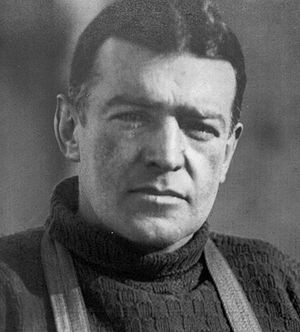
Sir Ernest Shackleton

Men wanted: for hazardous journey. Small wages, bitter cold, long months of complete darkness, constant danger. Safe return doubtful. Honour and recognition in case of success. Sir Ernest Shackleton.” 5000 men responded to this blunt advertisement posted in London newspapers January 13 1914, applying for the Imperial Trans- Antarctic Expedition. Shackleton selected a crew of 28 who proved to be optimistic, patient and courageous – the minimum requirements he sought for in a man who boarded a ship with him.  They set sail from London in the ship aptly named “Endurance” on the first day of August 1914 and stopped over at the whaling station on South Georgia for fresh supplies.  After a month they departed for the Antarctic on December the 5th for one of the most grueling adventures undertaken by man, unaware that they would not touch land again for another 497 days.  On return to England three years later Shackleton published the account in his book South in 1919, documenting the journey, events and experiences of their expedition, including the following five legendary survival accounts.

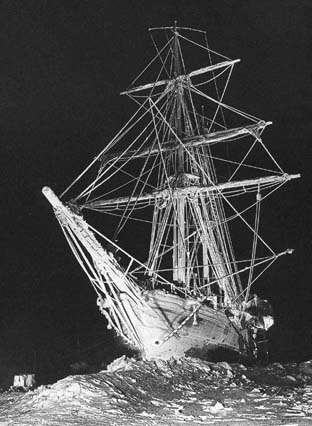
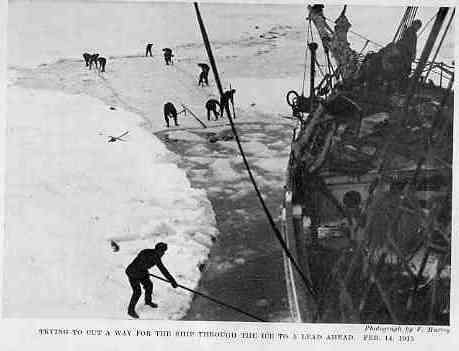
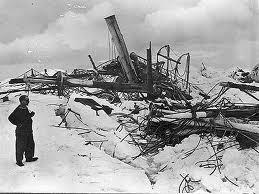
Due to an unusually cold winter the ship entered pack ice much sooner than expected.  Just one day’s journey from the Antarctic the Endurance got stuck in pack-ice on 18 January 1915, drifting gradually away from the South Pole for ten months with the ice until the ship tipped and was crushed to pieces on October 27, 1915.

Endurance slowly breaking through pack ice
Endurance stuck in polar ice
Endurance crushed by pack ice

The men saved what they could and drifted for another five months on the ice until the ice started melting and the food became scarce.  On 31 March 2016 Shackleton woke up from a soft crackling sound to find that the ice beneath him split in two; he instinctively reached his hand to grab the sleeping bag of the man sharing his tent just as he was slipping into that icy, black water. During the ice-splitting they were also separated from their life rafts for some time but they managed to retrieve it again.  The next day he gave the command to board the three life boats.

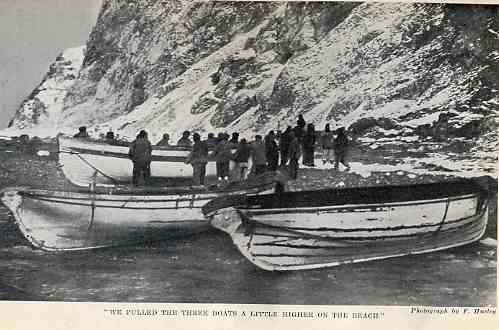
The life-saving achievement was the harrowing journey through the Weddell sea to a rock called Elephant Island, 100 miles in the three small life boats, navigating one of the roughest seas with 60 foot waves blown by gale-force winds.  The three boats had to be dragged on top ice floes at night to rest.  They managed to reach Elephant Island, and eventually found a suitable camping terrain.

Boats on Elephant Island

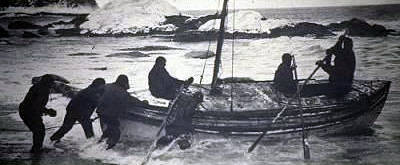
Their third legendary survival story started on 24 August when Shackleton and five others boarded the small 22ft life boat called the James Caird  and made way for South George, from where they departed about 500 days earlier 800 miles away. (That is the distance between Cape Town and Johannesburg!)  After a grueling 17 day journey in the stormiest sea, navigating by dead reckoning with a compass and sextant only with merely four sightings of the sun, the six men reached the island exhausted.  This is still considered one of the greatest boating achievements ever.

Crew boards James Caird for South Georgia
Landing on South Georgia

The next survival feat was equally impressive, born from necessity as the men landed on the wrong side of the island.  To get to the whaling station for help and rescue of their friends Shackleton, captain Frank Worsley and second officer Tom Crean began to cross the ice-bound mountain tops of South Georgia  – never before attempted, including the 9000ft Mount Paget.  During their 36 hour ordeal without any rest they travelled across two snowfields, four glaciers and three mountain ranges: all of these unmapped and life threatening.  The last bit of their journey, being severely fatigued, dehydrated and shivering, Shackleton lowered his two friends down a partially frozen waterfall before abseiling down himself and waking the harbor master at Stormness whaling station, asking for help.

Panoramic view of South Georgia

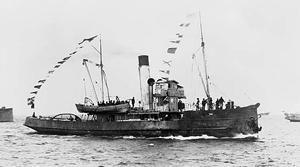
Lastly, the survival and rescue of the 22 men marooned on Elephant Island for more than 137 days is commendably in itself.  They used the two life boats to construct a hut of sorts  to stay warm. Due to the roughness of the sea it took four attempts by Shackleton and his men to rescue them, only managing to reach them with the steam boat Yelcho on 30 August 1917, two years and one month after their departure from England.

The Chillean steamer Yelcho


This story of endurance and courage is inspirational – in spite of the failure to cross the Antarctic – because Sir Earnest Shackleton succeed to bring all 28 the men home safely; they endured and survived the impossible together.  Part of their survival had to do with what Shackleton took with them as their ship Endurance was crushed by the pack ice: in spite of the lack of space in the three life rafts he instructed that they take a rugby ball, the gramophone as well as the big Bible.  He insisted that they daily laughed together, told stories and read the Bible together as encouragement in hope, daily played sports together, and daily sang together. For him, humour, story, song, playing and prayer was keys to endurance – and it proved true.

Football on ice
Football on ice
Gramophone for the penguins

Shackleton was a God-fearing man who lived and lead though this ordeal with Godly courage and persistence.  Looking at his example of endurance, and comparing it with examples and teachings from the Bible, what can we apply to navigate through our own hardships with “Endurance”?

(1) Comfort of Scripture

As mentioned above, Shackleton ordered his men to rescue the ships’ big Bible and take it with them on their journey to safety, knowing that the Scriptures are in part a compilation of God’s miraculous deliverance and preservation of people in desperate circumstances, as were they.  Their faith in God’s salvation from this seemingly hopeless situation would be stirred as they read they reflect on the accounts of God’s awesome deliverance of individuals and communities as recorded in the Bible.

New Testament Authors encouraged their suffering communities to look at Old Testament characters (as well as their leader’s examples of steadfastness) to find strength to press on in faithfulness to God.  Paul reminded the persecuted church in Rome that whatever things were written before were written for our learning, that we through the patience and comfort of the Scriptures might have hope” (Romans 15:4).  James encouraged the poor, persecuted church in Jerusalem to “consider the blessed who remained steadfast” with special reference to Job and the Old Testament prophets (James 5:10-11).  The author of Hebrews encouraged his suffering readers to “consider [Jesus] who endured such hostility from sinners against Himself, lest you become weary and discouraged in your souls” (Hebrews 12:3).  Thus they all pointed to the exemplary lives recorded in Scriptures for encouragement during difficulty.

The history of God’s faithfulness in Scripture comforts us during hardships because we see that we are not alone in hardship – many have been there; and the Biblical accounts testify to us that God is present during suffering to strengthen and preserve,  and that he is willing and able to save.   Thus the Scriptures comfort us and stirs our hope and faith in God.

(2) Companionship in community

Shackleton knew that for the 28 men to survive this ordeal, they should not just live in community, but also practice community.   That’s why he commanded that every one participate in four group activities daily: they eat together, play sports together, pray and reflect on Scripture together, as well as sing, tell stories and laugh together.  These moments of togetherness brought great encouragement and camaraderie amidst the protracted stressful times.  He understood and articulated that for the group to survive, each individual needed to survive.  If no-one gives up, the group endures.

In relation to their survival and community, I find C.S. Lewis’ quote on friendship quite fitting: “Friendship is unnecessary, like philosophy, like art… It has no survival value; rather it is one of those things that gives value to survival.”   For the crew stranded in Antarctic, their community was a reason to endure in itself; their companionship gave both motive for and meaning to their survival.

(3) Celebration of life

Shackleton wrote in his journal during their long winter drifting on the pack-ice “As we clustered round the blubber stove, with the acrid smoke blowing in our faces, we were quite a cheerful company…Life was not so bad. We ate our evening meal while the snow drifted down from the surface of the glacier and our chilled bodies grew warm.” They were thankful for what they had; their companionship, warm food and their survival was reason to laugh.

Going through life with the optimistic perception of “glass half full” makes endurance possible, and life so much more pleasant.  Jesus put it this way (referring to money in the context of a financially oppressed Judea) The eye is the lamp of the body. So, if your eye is healthy, your whole body will be full of light, but if your eye is bad, your whole body will be full of darkness. If then the light in you is darkness, how great is the darkness!”  (Matthew 6:22-23).  Shackleton lead his men on in “light-filled eyes”, celebrating what they had amidst a cold, seemingly hopeless situation.

Paul encouraged the persecuted church in Philippi to do the same, to emulate his discipline of focusing on the good and praiseworthy, so that “the peace of God will guard your hearts and minds” (Philippians 4:6-8). Instead of becoming anxious about trying circumstances he instructed them to pray about their situation, but “with thanksgiving”, helping them recognize and celebrate the goodness of God amidst difficult circumstances.  This is a worthy lesson to learn for anyone, anywhere.

Thanksgiving and celebration makes hardship tolerable and gives one strength to carry on. These disciplines gives strength in trying times by focusing attention on that which causes joy and gladness – truly, “the joy of the Lord is your strength!” (Nehemiah 8:10).  By focusing attention of the good it trains one’s perception to see what God is doing, recognizing that God is near, and “He will never is leave you, nor forsake you” (Hebrews 13:5).

(4) Continuing in hope

Shackleton never allowed his crew to give up.  They were always moving forward, always planning and preparing for tomorrow.  In his mind, and from his mouth, it was clear that they were going to get home to England.  He never gave up on hope, and never allowed the crew to slide into hopelessness, because he knew that hope is necessary for endurance.  If a person believes that nothing is going to change for the good, that person sinks in the mud of depression and hopelessness, and finds no reason to fight and or live on.  But if one believes that pushing forward today will be rewarded in the end, it is worth it.

The author of Hebrews frequently motivate endurance with the promise of reward (hope), for example you have need of endurance, so that after you have done the will of God, you may receive the promise” (Hebrews 10:36) and later encouraging the readers to “run the race with endurance, looking to Jesus… who for the joy that was set before Him endured the cross, despising the shame, and has sat down at the right hand of the throne of God.” (Hebrews 12:1-2, compare with 1 Thessalonians 1:3).  Jesus found strength to continue through tremendous suffering, his eyes fixed on the joyfilled reward at the end.

Paul imitated Jesus’ example, as he was a man who experienced great difficulty, including afflictions, hardships, calamities, beatings, imprisonments, riots, labors, sleepless nights, hunger, …slander, …being poor” (2 Corinthians 6:4-10).  In another place he records “imprisonments, with countless beatings, and often near death. Five times I received at the hands of the Jews the forty lashes less one. Three times I was beaten with rods. Once I was stoned. Three times I was shipwrecked; a night and a day I was adrift at sea; on frequent journeys, in danger from rivers, danger from robbers, danger from my own people, danger from Gentiles, danger in the city, danger in the wilderness, danger at sea, danger from false brothers; in toil and hardship, through many a sleepless night, in hunger and thirst, often without food, in cold and exposure. And, apart from other things, there is the daily pressure on me of my anxiety for all the churches.” (2 Corinthians 11:23-28).  How did he endure these hardships?  He kept his eye on the reward, a “crown of righteousness” (2 Timothy 4:8) saying “I consider that the sufferings of this present time are not worth comparing with the glory that is to be revealed to us.” (Romans 8:18; see also 1 Corinthians 3:14, Colossians 3:23-24).   Paul joyfully pushed one through suffering in hope of eternal rewards in the Lord.  He reckoned that suffering briefly for eternal rewards was worth it, making these moments of pain bearable.

(5) Courage from God

Finally, God gives strength to press on in difficult times – to those who “wait on the Lord” (Isaiah 40:30-31).  I have over the years learnt from David, who knew the Lord as “my strength” (Psalm 18:1, 118:14, 140:7), to “seek the Lord and his strength” (Psalm 105:4) when my I feel weak or ready to give up.  I have learnt to “wait on the Lord [to] strengthen [my] heart” (Psalm 27:14), and also to “strengthen [myself] in the Lord [my] God” (1 Samuel 30:6) as David did in hopeless situations.  With the Shepherd-king I can witness that “the Lord gives strength to his people” (Psalm 29:11) when I set time aside to pray to God for courage, strength and hope to continue doing what he calls met to do, although everything in me wants to walk an easier road.

Paul also testified that Christ Jesus has given him strength in trying times (1 Timothy 1:12), and could therefore pray for the Ephesian church that God would strengthen their hearts (Ephesians 3:14-16) amidst the persecution, encouraging them to “be strong in the Lord and in the strength of his might” (Ephesians 6:10).   Thus we learn from Paul that one should find strength in God, but also that through encouragement and prayer from others one is strengthened by God.  From his example we learn that we should encourage one another joyfully and hopefully press on, to “strengthen the weak hands and make firm the feeble knees” (Isaiah 35:3) of those facing hardship around us.  Strength is found in God’s community.

Making it personal

If you are reading this as someone going through hardships now, I want to re-tweet the thrust of John’s message to the persecuted churches in Ephesus: “Here is a call for the endurance and faith of the saints.” (Revelations 13:10, 14:12).  Although your suffering might not be religious oppression, you must know that your endurance is noticed and commended by Christ himself (Revelations 2:2, 19).  He will put and end to your suffering One Day (Revelations 21:3-5) and if you endure in faith to the end, he will give you your reward from him (Revelations 22:12).

And in the words of Paul: Run the race in such a way that you may revive the prize” (1 Corinthians 9:24).Rejoice in hope, be patient in tribulation, be constant in prayer” (Romans 12:12), and may “the God of endurance and encouragement” (Romans 15:5) strengthen you with all power, according to his glorious might, for all endurance and patience with joy” (Colossians 1:11).  “Press on, that [you] may lay hold of that for which Christ Jesus has also laid hold of [you]” (Philippians 3:2).

It is appropriate to close this lesson on endurance from the exemplary life of Sir Ernest Shackleton with the words from Winston Churchill, since he was the man who sent the last telegram to the Endurance crew as they left the London harbor for their trans-Atlantic expedition on August the 1st, 1914.  Later that day the war with Germany broke out, leaving the whole of Europe in turmoil for the next forty years.  On October 29, 1941, Churchill then Prime Minister visited Harrow School to hear some of the traditional songs he grew up with and address the learners.  Standing in the podium he stared at the youngsters long and hard, and then uttered the following short and urgent admonition: “Never give in – never, never, never, never, in nothing great or small, large or petty, never give in except to convictions of honor and good sense. Never yield to force; never yield to the apparently overwhelming might of the enemy.” [audio recording] During tough times let this phrase ring in your ears, as you remembering the enduring examples of Jesus, Shackleton, Paul, the prophets and the saints through the ages. Never give in!