What if the key to a flourishing life was as simple as staying put?
The chances are good that your neighbours are new to town—you might be too. We live in an uprooted world. I have written on the prevalence of nostalgia (homesickness) in our hyper-mobile culture. The effects of such a highly mobile culture include record-high levels of anxiety, depression, and a host of social ills that come from isolation and loneliness.

An (upwardly) mobile culture
More than 82 million people have been forcibly displaced from their homelands due to political upheavals, economic instability or natural disasters. We see these asylum seekers in every city or town. These minority groups have come here fleeing from disasters, hoping for a better life. Yet, a greater number of the people in your city or town have come here to pursue their desires. They, too, left home in pursuit of the good life.
Our world is driven by the lie that “the good life is out there,” running relentlessly towards the ever-evading pot of gold at the rainbow’s end. Our upwardly mobile culture always wants more, driven by billions of dollars in marketing campaigns.
In Christian circles, we won’t easily acknowledge greed as our motive for moving on. We say, “God has opened a door to bless me elsewhere.” But the underlying motive is the same: God’s blessing is over there, at that job, in that place, with those people. We don’t trust that God can or will bless us where we are now. So, to enjoy a better life, I must move on because the good life is not here.
Our culture is not unique in the history of the world. The 12th-century theologian Anselm of Canterbury wrote of restless people in his day. He compared these wanderers to trees that, when “frequently transplanted or often disturbed,” would not take root anywhere but wither and die.
“If he often moves from place to place at his own whim
– Anslem of Canterbury, 12th century AD.
(or remains agitated because of hatred for the place)”,
this unhappy person will “never achieve stability with roots of love.”
The Wisdom of Stability
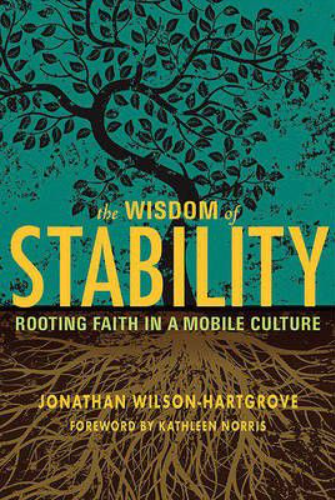
In his book, The Wisdom of Stability, Johnathan Wilson-Hartgrove describes the perils of our mobile culture. Without roots, we become:
- enslaved by our insatiable desires and ambitions, driven like uprooted bushed over a dry landscape.
- consumers of people and places, using my neighbours and neighbourhood to my advantage with no intention of genuine long-term relationships.
- ignorant of God, who is here and willing to bless us.
- disconnected from Christ, who loved the world and gave himself to these neighbours who live and work with me now.
In the book, Wilson-Hargrove describes how his life and mission was been transformed as he encountered a community in Europe living by the vow of St Benedict of Nursia. This Christian community, living and working in the city, lived by the Benedictine principles of stability, fidelity and obedience. The vow of stability grounds the monk or nun to a life of service within the monastery, receiving each member of this community as a gift from God. In doing this, the monk or nun trusts that God will bless him or her in this place, alongside and through the members of this community.
Stability is the opposite of the relentless seeking that drives our contemporary culture. Stability invites us to stop pursuing a better life elsewhere and rather settle down and seek the good life that God blesses us with here. Stability invites us to accept our limits as gifts, the boundaries that contain the goodness of God. Stability invites us to commit ourselves to a place and watch it change before our eyes. Practising stability means we have to unlearn the habits of culture that state that life is better elsewhere.
St Benedict’s vow of stability is grounded in Jacob’s encounters with the Lord.
A reason to run
In Genesis 28, we find Jacob on the run. His ambition and scheming have soured the already strained family relations. He deceived his father, Isaac, to steal his brother Esau’s inheritance. The fear of his brother and the shame of his betrayal prompted Jacob to leave home to pursue a better life elsewhere. The problem, Jacob would soon discover, is that he was trying to flee from himself – from his greedy and deceitful nature and the shame it caused. Running away from yourself is a futile task, as Thomas à Kempis wrote: “Wherever you go, you bear yourself, and always find yourself.” (“The Imitation of Christ”, Translated by Leo Sherley-Price, 1952).
The temptation to run away from relational troubles is common to all. The 5th century Ama Theodora of Alexandria recorded a conversation between two monks. As the one was putting on his sandals to leave the monastery for good, his roommate wisely remarked:
“Is it on my account that you are going away?
Because I go before you wherever you are going.”
An invitation to stay put
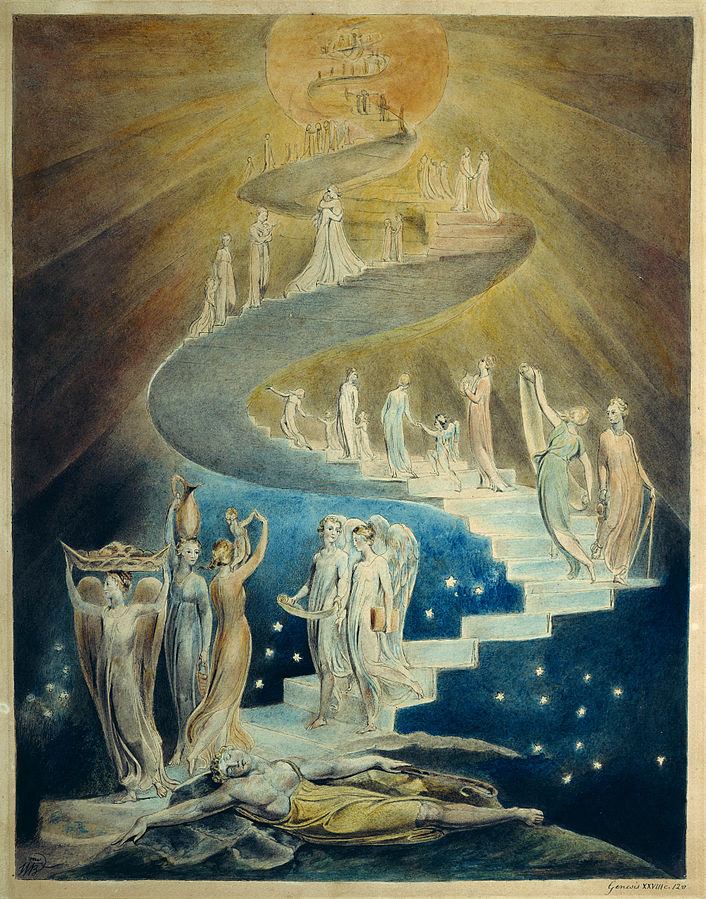
Yet, the very evening in which Jacob ran away, the Lord appeared to him in a dream, showing a ladder connecting heaven and earth, filled with angels ascending and descending. The Lord said to him:
“I am the Lord, the God of Abraham your father and the God of Isaac… [I’ll give you this land and legacy]… Behold, I am with you and will keep you wherever you go, and will bring you back to this land. For I will not leave you until I have done what I have promised you.”
Genesis 28:13-15, ESV
In the vision, the Lord assures this troubled young man that he is not responsible for his own prosperity. The Lord shows him that He is here and active in this very place he is fleeing from. Help from heaven is right here! The Lord promises Jacob:
- My blessing is a gift to you and your children;
- I will protect you and prosper you;
- Your prosperity is not dependant on your ability or effort but first on my goodness and character;
- I am aware you are running away. I am with you and for you – I will bless you still.
Despite his betrayal, deceit, and disbelief, the Lord assured him that He would prosper and protect him. Jacob’s blessing would come not from his efforts but from God’s provision and protection. In other words, Jacob does not need to seek prosperity elsewhere because the Lord of blessing is with him and for him.
Embracing Mission, here
Reading Jacob’s dream in the broader context of Biblical history helps us see that God’s generosity and companionship towards Jacob were for the sake of the world. God is on a mission to redeem and restore creation and chose Abraham and his descendants to partner with him. Jacob, the grandson of Abraham, was invited to embrace the legacy and engage in the Lord’s mission. The Lord would bless Jacob to bless those who surround him and those who would succeed him.
“Your place and community are for you a grace – a gift from God – and a mission.
Augustine Roberts
We are responsible for the growth of those with whom we live
and for the salvation of many persons.”
Stability breeds Shalom
Our culture pressures us to chase after opportunities, hoping it will leave us better off. But the wisdom of stability teaches us that God is here where we are, and he will bless us for the sake of his mission. The good life is not out there, somewhere. The good life comes from God, and He is with you.
Shalom depends on your awareness and response to the God of peace who is in this place. So stay put and see how God will bless you – and those around you – where you are.
























 walklikejesus