Encourage one another

Have you considered what your legacy will be?

What will you be known for one day?

What will your colleagues remember you by?

What will your kids imitate (either intentionally or unintentionally)? Or what are they learning from you now?

What is your influence right now? When you leave the office today, or the dinner party tonight or the Bible study group this evening, what do people say of you after you’re gone?  What are you known by?

I WANT TO BE A BARNABAS

St-Barnabas-cropped
St Barnabas “Son of Encouragement”

Imagine being known and remembered primarily for being an encourager.  I want to be that guy!  Joseph, a Levite of Cyprus, got the nick-name “Encourager” (“Barnabas”) by the apostles and the early church (Acts 4:36-37).    His ability to encourage was so influential that he is still remembered today by that name.  What a legacy!  This Encourager had much influence in the early days of the church and missions.  For instance after the zealous persecutor Saul of Tarsus had his life-altering encounter with the Lord Jesus and became Paul, the Encourager was the one who went to look for him, encouraged him and brought him to the Apostles in Jerusalem (Acts 9:26-28).  When the believers fled from Jerusalem after Stephen’s martyrdom and resulting authority, witnessing as they travelled, they “accidentally” established a big church in Antioch with Gentiles (Acts 11:19-24).  The Encourager was delegated by the Apostles to discover what was going on; he saw God was at work and encouraged them to continue what they were doing.  Afterwards he went to look for Paul, and encouraged him to join him in Antioch and to pursue the ministry he received from the Lord – the ministry among the Gentiles (Acts 11:25-26).   Years later, while the church was praying, the Holy Spirit set apart two people for missions to the Gentiles – Paul and the Encourager (Acts 13:1-3).  Again we read of the Encourager when he and Paul had an argument over John Mark (Acts 15:36-40); Paul considered him to be fickle and untrustworthy, but Barnabas could see God at work in and through him, so he encouraged him and took him along on his ministry trip. It seems whenever there was a new thing or a big change about to happen, God positioned the Encourager right there in the middle of the crisis, to put strength in the hearts of his people so they might press on amidst uncertainty and difficulty.

PUT STRENGTH IN THE HEART

To encourage literally means to PUT STRENGTH INTO THE HEART (en = into, courage = strength).  Fear does the opposite; it takes away the will to fight.  So in times of uncertainty or hardship with much opposition, people lose the will to press and as their hearts close up or cower away.  In times such as this people need to be strengthened in heart, they need to be encouraged to press one.

See how encouragement can produce strength and endurance in a very practical way in “Death Crawl Scene” from Facing the Giants: [https://www.youtube.com/watch?v=-sUKoKQlEC4]

Everyone needs encouragement at times.  And a need for encouragement is not a sign of weakness just a desire for water is not a sign of weakness.

SCRIPTURE AS ENCOURAGEMENT

It is helpful to keep in mind that the Old Testament history, poetry as well as prophesies were written during times of tremendous uncertainty and hardship.  The intent of the writings is to remind the reader of God’s promises, God’s power, God’s proximity and God’s personal commitment to his people.  Every book in the Old Testament is very encouraging.  That’s why Paul referred to it when he said “whatever was written in former days was written for our learning, that through endurance and through the encouragement of the Scriptures we might have hope.” (Romans 15:4)

Bible
The Bible: an encouraging record of God’s power, promises and proximity.

Likewise most of the New Testament was written during the three periods of most severe persecution of the first century (around AD 45, 60 and 92).  Many of these communities also suffered from internal conflict, so understandably the Apostles wrote with the intent to encourage the believers to remain faithful to Christ in their worship, witness and works.

Thus the New Testament is a great place to learn about this skill much-needed ministry skill of encourage.  So how do you encourage another?

  1. DELIBERATE INTENT IN MEETINGS
We come together to encourage on another.

When the author of Hebrews moves from orthodoxy (right belief) to orthopraxis (right practice) in the 10th chapter, he encourages the scattered, persecuted church to maintain “full assurance of faith” (10:22) in Christ while “holding on in hope” of eternal reward (10:23).  These instructions come as no surprise, but he goes on to instruct this fearful group to “not neglect to meet together” (10:25).  These believers may die when they meet together openly in their hostile environment!  Why should they risk the public association as Christians?  He writes says believers should meet together to “consider how to stir up one another to love and good works” (10:25).  He says “think about ways to encourage one another to greater love and more good works!”  Continue to come together so that you may effectively encourage one another!”

  1. VERBAL CULTURE OF UPLIFTMENT

We look for gold within the dust.

Such a deliberateness requires a disciplined community that – amidst personal hardship – have trained itself to only speak words that are encouraging and leads to the edification of another (Ephesians 4:29-31). Therefore there is no room for complaining, criticizing, slander or gossip in their communal verbal culture.  Rather, the tone of conversation is always one of affirmation, thanks, recognition, exhortation – always encouraging, even when correcting.

Our verbal culture is always uplifting.

Notice the way the apostles start and end their New Testament letters with affirmation, thanks and encouragement.  Jesus speaks the same way in Revelations to the seven churches around Ephesus, starting and ending each message to these congregations with affirmation and praise, and ending each letter with hope – a promise of reward.  What an example of verbal encouragement!

  1. ALWAYS LOOKING FOR THE GOOD

The verbal encouragement obviously stems from eyes that have been trained to be “light” and not “dark” as Jesus taught (Matthew 6:22-23), in other words they have trained themselves to recognize whatever is good and godly, and not to fixate on what is negative and evil.  As a pessimist sees the glass “half empty” an optimist sees the same glass “half full”, so one who has trained his eyes to see good can see goodness in great difficulty and thereby become an exceptional encourager when everyone else complains.

We look for gold within the dust.

Eugene Person’s paraphrase of Proverbs 11:27 (MSG) sums up this disciplined attitude well: “if anyone can find the dirt in someone, be the first to find the gold!”  An encourager always seeks what is good and Godly in someone, and when he finds it he praises it, drawing attention to it so others can also see and celebrate it.  Because, as Andy Stanley puts it, “whatever gets celebrated gets repeated!” 

  1. RELAYING GOD’S MESSAGE OF ENCOURAGEMENT THROUGH PROPHESY

New Testament Prophesy is exactly that – a message from the Lord that reveals and affirms what is good and even praiseworthy, meant for “upbuilding and encouragement and consolation” (1 Corinthians 14:4).  Prophetic words from the Lord – whatever the message – communicates to the receiver that “I, the Lord know who you are, what you are going through. I care and I am for you!”  Indeed very uplifting, encouraging and comforting! That’s why Paul encouraged this very charismatic but persecuted church in Corinth to earnestly desire the spiritual gifts, but especially that you may prophesy…” (14:1). Everyone needs encouragement, and the Lord wishes to encourage His church (also) through prophesy!

  1. LET NO-ONE SUFFER ALONE

One of the best ways of encouraging one who goes through hardship is by simply being with them in their times of hardship, and to encourage them to not give up.   Paul wrote to the Galatians that they ought to “bear one another’s burdens” (Galatians 6:2), or more literally to “stake yourself to” the one suffering, using the imagery of strengthening an injured leg, to prevent it from folding under the load.  Whatever the hardship, your presence with one suffering is encouraging and helps preserve the person’s spirit.

We encourage one another by our support.

The affirmation that “you are not alone, you are not forgotten” is an extremely powerful motivator to press on through hardship.  Community, love and a sense of belonging is in itself a reason to live and not give up.  Jesus knows that, and therefore, in various forms we find these words of comfort to persecuted congregations “Behold, I am with you! I will never leave you or forsake you.” (see Hebrews 13:5; Matthew 28:20 etc).   May times our presence and ministry to hard-pressed people reaffirm this encouraging truth: “God knows about you and He is near to you.” 

  1. ENCOURAGED TO PRESS ON THROUGH HOPE

One of the primary ways in which believers are encouraged within the New Testament writings is through hope – the certain promise of reward that give sense and meaning to the current suffering.  As for the athlete, the student, the pregnant mother and fighting soldier, anyone who undergoes suffering will hold on if they know that what they go through is rewarded in some way.  Like Paul says “these light afflictions do not compare with the glory that awaits us” (2 Corinthians 4:17).

Encourage through hope to press on.

The most common hopeful encouragement in the New Testament is the promise of rewards on “the Day of the Lord” – Judgment Day or the Return of Jesus, where the Lord will reward faithfulness and obedience amidst suffering, and judge the wicked. (See 1 Thessalonians 5:2-14 as example).  But even temporal hope is a strong encouragement, and the Bible abounds with examples of encouragement to push on with the promise of reward in this life, such as David’s prayer “I would have lost heart unless I had believed that I would see the goodness of the Lord in the land of the living.  Wait on the Lord; be of good courage, and He shall strengthen [encourage] your heart; wait, I say, on the Lord!” (Psalm 27:13-14) 

THE GOD OF ENCOURAGEMENT

Just as long-distance runners need water and cheers throughout the race, so the people around you need encouragement to go on.  God is “the God of Endurance and Encouragement” (Romans 15:5) who wishes to encourage his children, cheering them on as they do good, comforting them with his presence, promising that their efforts are worth it.

You and I have the privilege to imitate this loving, encouraging God who cheers his children on.  You and I have the privilege to put strength into the hearts of fatigued, faithless and fearful people.  And for that, you will also have your reward!

So look up.  Chances are the first person you meet now will need a cool cup of encouragement.  Be ready!


What is Church? God’s Special People

“This is a big old ship, Bill.  She creaks, she rocks, she rolls, and at times she makes you want to throw up.  But she gets where we’re going.  Always has, always will, until the end of time. With or without you.” [i]

If you’ve been in church long enough you would probably smile and nod at J.F. Power’s comment quoted above.  To say that the church is imperfect is a euphemism.  But to walk away from church is silly, if you understand the nature of church.  The church is made up by redeemed, but broken people.  And therein lies the tension between the expectation of Christ-like perfection and the reality of sinful, selfish people.  Church is messy, but church is glorious.

It is easy to get so busy with the activities, meetings and politics of church organization that one lose sight of the identity and nature of church.  When that happens, these necessary activities drain the life and joy out of church life, and we miss the beauty we once knew within Christ’ community.  So, what is church?

Simply put, church is GOD’S SPECIAL PEOPLE.

GOD’S people

Church begins with God: a community created and chosen, redeemed and reconciled by God and for God. It is in every respect God’s Church – a God-owned people.  Consequently, the church is and should be preoccupied with God and live God-conscious lives.  Thus we are people who live in the fear of God – we live in the knowledge that he exists, he sees all things and he will judge every person.  Moreover, because we are God-conscience we also live in hope because we know God hears every call and God saves everyone who cries out to him – we are not alone in this world!  The church is a God-worshipping community that live in thankful response to Christ’s work of redemption and in constant awareness of God’s gracious providence.  These thankful worshippers form a God-serving community who devote their lives on this earth to serve God’s His redemptive purpose, and a God-declaring people who preach the message of his coming kingdom. Most importantly, the church is God’s church because we are a God-abiding people, set aside by God to dwell in eternally.  As such the church community is a God-empowered and God-revealing people through whom the world knows the loving and righteous character of our God.

a SPECIAL people

The church is a special community, a people chosen by God.  We are God’s “ekklesia” – a posterity “called-out” by God, for God’s purposes.  We are separate, not part of this world; set apart by God, for his delight.  God has sanctified us for himself – we are holy to God, and unto God.  As such we are a counter-cultural community living differently because we do not values this world or the things of this world.  We are a special people because we are a people inhabited by God.  The God of creation, the God of the universe has made his dwelling place among us.  We have become an eternal community who live forever since the Eternal God has become our home, sharing his life with us.

no ordinary PEOPLE

The church is made up of people – humans who live ordinary lives here on earth.  A gathering of redeemed, but still imperfect, broken, mortal people.  But the church is God’s new race, God’s new humanity where there is no male or female, neither slave nor freeman, no distinction between Jew or Greek – a people who value life and identity in Christ more than economic, gender, race or education distinctions.  We are more than mere mortals – the church is God’s new creation, the restored Eden, the New Jerusalem where God is always in her midst and he is her perpetual light.  As Staney Grenz writes “the church is… a new humanity… who are seeking to point toward the future God has in store for creation.” [ii]  With his presence among us and his Spirit transforming us into his image, the church is God’s own representation as we have become partakers his divine nature.  Or as Grenz puts it [we are an] ‘eschatological people,’ a company who ‘pioneer’ in the present what the future will be like.”[iii]  The church is a foretaste of what the New Creation will be like when Christ returns.

But most importantly, the church is God’s own family – the privileged posterity who can rightly call him Dad as we have been born again of Him.  As such we are his favored offspring, his beloved children who bring joy to his face.  It is in the atmosphere of a local church that the loving nature and grace of God our Father is experienced and displayed.  It is through his family – imperfect as the humans therein – that God chooses to make himself and his mission known.  And that is the perpetual business of church: the gentle, purposeful redemption and restoration of individuals, families and society at large as God’s children go about representing the love of God our Father.  That is the privileged of being part of church.

[i] J.F. Powers, Wheat that Springeth Green, (NYRB Classics, 1988)

[ii] Stanley Grenz, Created for Community, (Baker Academic, 1998), p207

[iii] Stanley Grenz, Created for Community, (Baker Academic, 1998), p213

Church membership – who cares!?

“I’m attending this church (for now) – who cares about a name on a list?”

Formal church membership seem foreign and even impersonal to our current generation of passionate Christ-followers.  “To sign on the dotted line” seem so far removed from the deep spiritual relationships that our generation yearn for.  When conversation move away from passionate participation towards paper partnerships attendees become skeptical and scatter.  There is a general suspicion of anything formal or contractual.  And not without reason!

Off course we must note that the contemporary wariness of church membership is not only due to the fallible history of the Church; our generation holds a general resentment towards institutions and a skepticism in leadership at large.  It seems as though the bigger the institution, the more structured a partnership or the longer a commitment is, the greater our generation will stay clear of involvement.  This growing resentment towards institutions is also the reason for couples – even increasingly Christians – who do not see a need to get married formally.

So we dislike big, structured, impersonal and organized – we like small, intimate, personal, and organic.  We associate authentic spiritual life with small and intimate.  But a quick read of the New Testament reveals that the early church was big, very structured, and organized – yet very personal.  And it seems clear that membership in the early church was normative – in fact, the New Testament seem to associate Christianity with formal church membership.  Consider the following points.

  1. Accountability assumes membership

In the intimate setting where Paul greeted the elders of the Ephesian churches for good, he exhorted them to “pay careful attention to yourselves and to all the flock, in which the Holy Spirit has made you overseers, to care for the church of God, which he obtained with his own blood” (Acts 20:28).  Paul’s instruction to “care for the church of God” implied a very specific group of blood-bought believers whom the elders knew and had to protect against “savage wolves…with destructive heresies” (see verse 29).

Peter’s letter to a group of scattered congregations gave a similar instruction to elders who ought to “shepherd the flock of God that is among you… those in your charge” (1 Peter 5:2-3).  These elders had to oversee and lead by example “those in their charge” – a very specific group of people allotted to them by God.  Each elder had to watch over the members in his flock.  This was a clearly defined group of believers, i.e. members in a congregation.

The most sobering and challenging verse on this for me personally is Hebrews 13:17 where the apostle writes that leaders have to “keep watch over [their follower’s] souls, as those who will have to give an account.”  The elders of a local church must watch over and account for the members in that congregation before God, implying a relationship of accountability and entrustment – i.e. willing membership.

  1. Leadership assumes membership

Hebrews 13:17 also assumes that the congregation knows who their leaders are whom they ought to “obey” and “submit to” – the relationships were clearly defined.   So too Paul’s instruction to in 1 Thessalonians 5:12-13 shows that New Testament congregations had formal membership and leadership: there was something like a “those who labour among you and are over you in the Lord” who deserves respect.

  1. Church discipline and assumes membership

Jesus’ instruction to his disciples on how to regulate sensitive matters in church discipline (Matthew 18:15-17) assumes membership: if an offensive act from a fellow believer is not settled in loving confrontation with witnesses present, that person can be brought “to the church” – a clearly defined group of believers who knows this trespassing brother.  As in Jesus’ instruction, Paul instructs that the last resort of church discipline is for a congregation to excommunicate the sinning brother who now is “inside the church” to henceforth be with “those outside” (1 Corinthians 5:12-13) – from that moment he is regarded as “an unbeliever” (Matthew 8:17). This act of disassociation, writes John Piper, is not only a clear indication that membership was normative in the early church, but moreover it proves that church membership really means something.  It is a blood-bough, desirable and beneficial privilege for all believers.

  1. “One body” assumes membership

The term “member” for someone being part of a congregation was coined by Paul in 1 Corinthians 12:12-31 in his metaphorical description of the church as the living, interdepend body of Christ, where all the persons in this congregation are “members of the body” (v12).  He argues that a believer cannot say I do not belong to the body” (v15) – it is abnormal for the members to relate tangentially to the rest of the body; it is wrong and unhealthy for a person to not be built on or planted in a local congregation where life is received and given through the sharing of Christ Himself.  Membership was normative in the New Testament; every believer in the Early Church belonged to a local congregation.  Just like the Church globally is the Body of Christ, so too the local church is an expression of the Universal Church.

  1. “Known by your love” assumes membership

Ultimately, Jesus desires for the church to be known by your love for one another” (John 13:35) is only possible within the confines of a clearly defined congregation.  As this love is visibly discerned by outsiders, it reasons that relationships of church members must over time consistently witness acts of   generosity, forgiveness, affection, affirmation and shared life – not mere acts of kindness to passer-by’s.  The visible love among church members is the ultimate witness of our allegiance to Christ (John 13:34-35) and the reality of Christ among us (John 17:21).

Bringing it home

If you hear someone say “church membership – who cares?!” tell that person it is the most fitting question you can ask; membership is all about “who cares for you!”  Church membership is about entrusting someone appointed by God to watch over your soul and care for your needs – someone who must give an account to God for the health of your soul.  Church membership is about committing yourself to a community of believers for mutual accountability and edification – to discipline and be disciplined, to support and be supported, to encourage and be encouraged as you continue to grow in the character of Christ.  Church membership is the environment where we can securely live in vulnerability and mutual care, where love flows freely in generosity and forgiveness, affirmation and affection, radical acceptance and kind correction.  It is in church membership where the life and love of Christ flows and is displayed to the world.

So where do you belong?  Who should give an account for your soul?

From surviving to THRIVING!

“My mission in life is not merely to survive, but to THRIVE; and to do so with some passion, some compassion, some humor, and some style” ― Maya Angelou (American poet, actress and activist in the American Civil Rights Movement).

Reading through the gospel John, one cannot escape the promise of LIFE, of flourishing and thriving, in Jesus.  Over and over Jesus promises that “I have come that you may have LIFE… and that you may have it in overflow” (eg John 10:10).  In fact, the over-arching identity and mission of Jesus (at least from John’ Gospel) is one of LIFE-GIVER.

Jesus is LIFE.  He said I am THE BREAD OF LIFE (John 6:35), “I am THE LIGHT OF LIFE (John 8:12), “I AM THE DOOR” for the preservation of life and access to life (John 10:9), “I am THE GOOD SHEPHERD” who lays down his life for the sheep, that they may have life (John 10:11), the “I am THE RESURRECTION AND THE LIFE that “whoever believes in me, though he die, yet he shall live(John 11:25), “I am THE WAY, AND THE TRUTH, AND THE LIFE (John 14:6) and lastly “I am THE VINE” though whom we have access to and power for life, for “apart from me you can do nothing.” (John 15:5)

I share Mark Hall’s philosophy on this video of Casting Crown’s album THRIVE:

THRIVE in spite of hardships

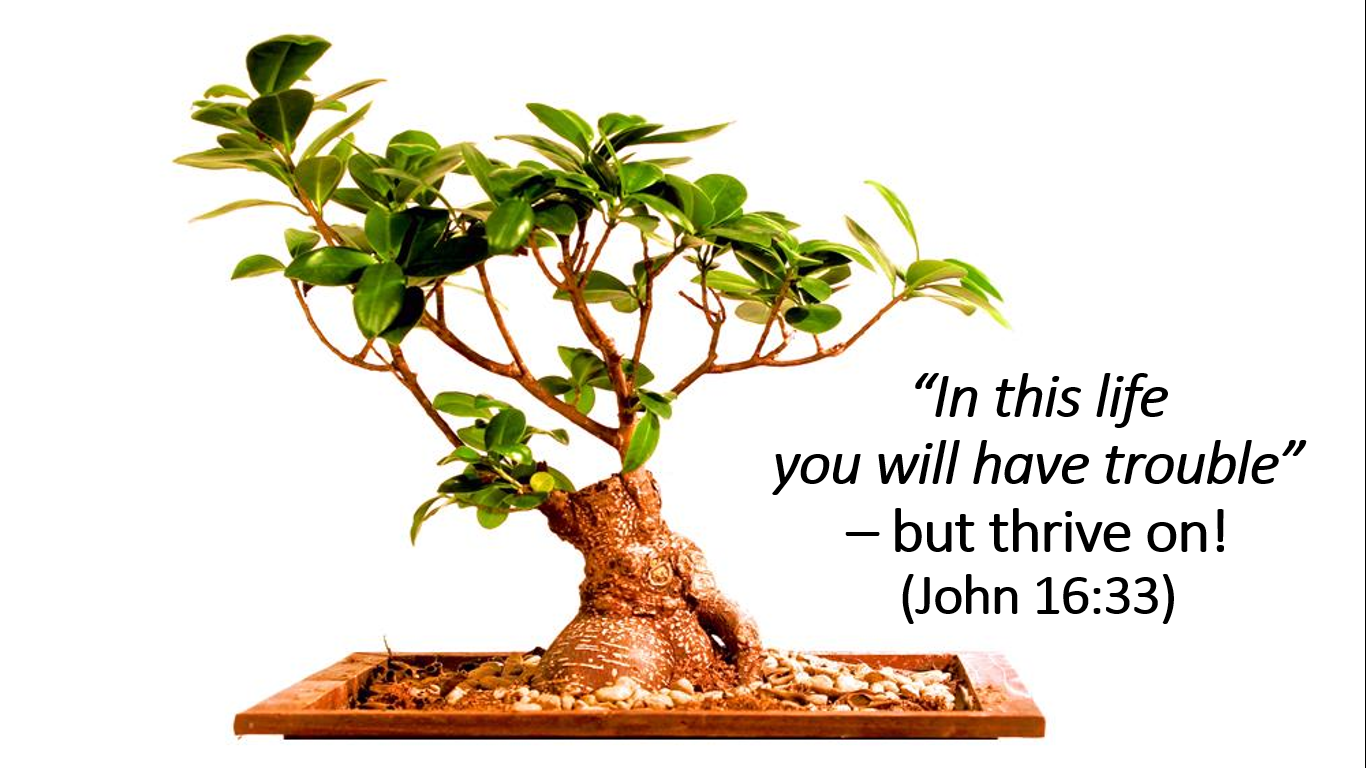
This promise of LIFE is not defined as an easy life, overflowing with worldly goods and void of suffering.  Jesus did not promise his followers a life void of pain, suffering and difficulty; rather, he promises “In this life you will have trouble” (John 16:33). 

thrive_on_bonsai

The apostles echoed his words when they wrote to the suffering churches “all who desire to live a godly life will be persecuted” (1 Timothy 3:12) and “do not be surprised at the fiery trial when it comes upon you to test you” (1 Peter 4:12).  In essence, the New Testament says “don’t just SURVIVE hardships – THRIVE in spite of it!”  The LIFE Jesus promised is not snuffed out through suffering.

This tree started growing from the remains of a burnt-down cottage.

THRIVE in spite of lack

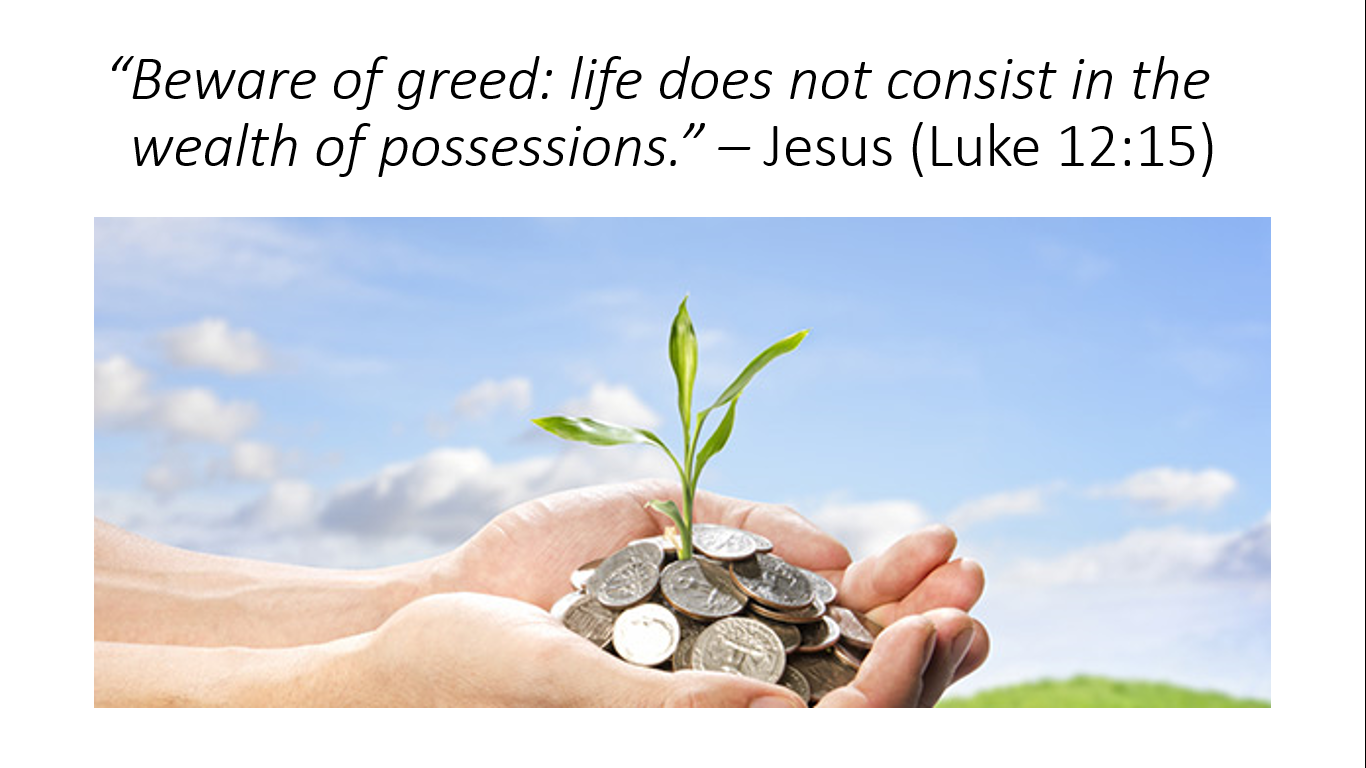
It is difficult for us to think that it is possible to THRIVE in spite of financial difficulty. Yet it is true that most of the New Testament Church was really poor, being marginalized and persecuted because of their faith in Christ. Yet the church had power and grew rapidly; they knew to be true what Jesus taught: “life does not consist in the wealth of possessions.” (Luke 12:15)

thrive_not_money

Just like some plants flourish in the harsh conditions in a dessert, so a LIFE OF THRIVING is not dependent on abundance of wealth or material success.  In fact, neither Jesus nor Paul nor the other apostles had much possessions.

The dessert is full of life and beauty.

THRIVE in spite of imperfections

Just as a THRIVING plant may not be void of imperfections, so a THRIVING life is not a perfect, faultless life either.  Paul likened the full LIFE of Christ contained in human imperfections to a fire shining through the cracks of a clay pot that the excellence of the power may be of God and not of us.” (2 Corinthians 4:7)

Our imperfections shows God's glorious life.
Our imperfections shows God’s glorious life.

Thriving therefore is not dependent on worldly comfort, prosperity or perfection.  So, Biblically speaking, how does one move from a life of mere SURVIVING to THRIVING?

  1. A Place to Belong: LIFE flows through receiving and giving love

Using the metaphoric language of a tree, the Psalmist writes “They are planted in the house of the LORD; they flourish in the courts of our God. They still bear fruit in old age; they are ever full of sap and green, to declare that the LORD is upright; he is my rock, and there is no unrighteousness in him.”  To THRIVE, one needs to be “planted in the house of the Lord” – to find your space in church community which one calls “home”, a place of belonging.  To THRIVE one has to open your heart to people, and be received into theirs.

thrive_tree_1
“like a tree planted next to water…”

It’s common to not feel part of a community, to feel like an outside.  But Paul writes that – regardless of our background – Jesus has “made us accepted” into Christ’s beloved community through adoption (Ephesians 1:5-6).  If this remains “cognitive truth” at best we will SURVIVE; but once this adoption and acceptance becomes “realized or incarnated truth”, once we experience the blessedness of unconditional acceptance in the community of love we THRIVE in life.  We thrive in a community where love is evident both in our giving and receiving of one another.

Jesus refers to this THRIVING as the GLORY we share in wherever we living in unity, in harmonious, Christ-centered community. He said to his followers that THRIVING LIFE or GLORY will set us apart from the world, so that we will be recognized as Christ’s followers, sharing in his LIFE (John 17: 21-23).

Thriving in belonging.

Thriving happens in Christ’s community, in God’s family (Ephesians 3:14-19) within the security of unconditional love and acceptance, and space to grow and be yourself.  A place where there is no need for presence, where we can live in truth.

  1. Community of Truth: LIFE flows where the LIGHT shines

David observed that it is not financial prosperity that causes one to be blessed but rather by “delight in the law of the LORD” leading to a life devoted to its perpetual study and mediation.  He concludes this person “is like a tree planted by streams of water that yields its fruit in its season, and its leaf does not wither. In all that he does, he prospers” (Psalms 1:1-3).   As trees flourish and bear fruit next to a flowing stream, so humans THRIVE in a life devoted to the way God intended – a life directed by “the Law of the Lord”.  The “Law of God” or “Truth” is the manual for how God has ordained life, and the pursuit thereof promises a THRIVING LIFE (James 1:25), although not without opposition or difficulty.

One thing that the “Law of God” (or “Word of God”) does for the sincere reader is to search one’s heart and show what is true and what is false (Hebrews 4:12).  This shows what is dynamic and of God (truth), what is destructive and of the sinful self (selfish ambition), or deceptive and from Satan himself (a lie).  That which is from God causes eternal THRIVING LIFE in self and others; that which is from self or Satan causes death and destruction (James 1:13-17).  The Word of God brings to light the veracity of motives, thoughts and feelings.  It causes one to LIVE in Truth.

Thrive in the Light of Truth.

One prospers in the Truth: an environment of honesty without deception, of sincerity without pretense.  Such a community that embrace truth in love cultivates tremendous vigor – it leads to THRIVING LIFE.  Where there is freedom in unconditional acceptance to either confess faithlessness or failure, or to lovingly confront and correct destructive behavior or beliefs so that one’s life may be directed in Truth and be set free to THRIVE (Romans 8:32).

  1. Hope – a reason to LIVE on

As mentioned earlier, a THRIVING LIFE is not void of trials, tribulation or temptation, but rather this resilient life THRIVES in spite of hardships because of hope – the confident expectation that good will come.  Like the tree shoots out its roots, even splitting open solid rock because it follows the scent of water beyond it, so THRIVING in hard times requires the hope of reward.  There must be a reason to push on.  There must be a promise of THRIVING life beyond this hardship.

Press on in hope.
Press on in hope.

Paul was a man that endured much: “imprisoned frequently, in [danger of] death often… five times I received forty stripes minus one, three times I was beaten with rods; once I was stoned; three times I was shipwrecked; a night and a day I have been in the deep; in journeys often, in perils of waters, in perils of robbers, in perils of my own countrymen, in perils of the Gentiles, in perils in the city, in perils in the wilderness, in perils in the sea, in perils among false brethren; in weariness and toil, in sleeplessness often, in hunger and thirst, in fastings often, in cold and nakedness– besides the other things, what comes upon me daily: my deep concern for all the churches” (2 Corinthians 11:23-28).  But he did not give up, and he did not just settle to SURVIVE, but pressed on to THRIVE in spite of these hardships.  How?   Through hope!  He writes “we do not lose heart… For our light affliction, which is but for a moment, is working for us a far more exceeding and eternal weight of glory, while we do not look at the things which are seen, but at the things which are not seen. For the things which are seen are temporary, but the things which are not seen are eternal” (2 Corinthians 4:16-18).  Paul always kept his eye on the promise of ETERNAL LIFE, not being phased with temporal hardships.  Paul THRIVED on hope.

His life philosophy was that “all things work together for the good for those who love God” (Romans 8:28), and reasoned that “tribulation produces perseverance; and perseverance, character; and character, hope” (Romans 5:2-5). He stressed the fact that this hope is not an empty dream, because already the Holy Spirit is living in the believer as a guarantee of ETERNAL LIFE (Ephesians 1:14) and what he calls “the hope of glory” (Colossians 1:27) – the promise to share in the GLORIOUS LIFE in Christ.  Therefore Paul rejoices in these hardships, because it helps him produce godly character and reminds him long for a life without sin and suffering in Christ’s Kingdom.  He does not want to forfeit that prize by giving up now!

THRIVING amidst hardships means we push on in hardships in faithfulness to God, because we know “He who promised is faithful” (Hebrews 10:23) – our perseverance has promise of the prize.  Although itit is much more costly!  To hold on, to break through, to push forward in hope leads to a better LIFE.   THRIVING in hardships requires hope – a clear picture of what the reward for perseverance is.

David writes on hope: “I would have lost heart unless I had believed that I would see the goodness of the Lord in the land of the living” and concludes “wait in the Lord; be of good courage and he will give strength to your heart” (Psalm 27:13-14).

  1. Jesus – the source of LIFE

Earlier we wrote that Jesus us the SOURCE of ENDURING LIFE: He called Himself “THE BREAD OF LIFE” (John 6:35), “THE LIGHT OF LIFE” (John 8:12), “THE DOOR” to LIFE (John 10:9), “THE GOOD SHEPHERD” who preserves and leads us on in LIFE (John 10:11), ” THE RESURRECTION AND THE LIFE” (John 11:25),  ” THE WAY, AND THE TRUTH, AND THE LIFE” (John 14:6) and “THE [LIFE-GIVING] VINE” (John 15:5).

Jesus is the source of LIFE.  This thriving life is found in Him.  He told his followers to “Abide in me… for apart from me you could do nothing” (John 15:5).  How do we “live” and THRIVE in him?  Simple

Jesus said came that we “may have life abundantly” (John 10:10) – not just life to survive but LIFE in overflow, in excess: THRIVING LIFE.  This LIFE is found as we “abide” or live in Him (John 15:5) – in communion and prayer with Him; as we study his will and live in obedience to his Word (John 15:7); and as we participate and share in his loving community (John 15:12).

thriving_6

How do I grow from here? – phases in discipleship

Building a tower

Chicago_Spire_pit
The famous “pit” of the incomplete Chicago Spire

I am always surprised at my impatience every time I pass a construction site where “nothing seems to happen” for weeks on end – sometime even for months. When the foundation is being laid it might easily look to the ignorant onlooker as if there is no work being done because – everything above ground looks the same!  We tend to think that because I can’t see any development on the surface, no progress is being made.  But that’s not the truth.  We all know that constructive growth happens in progressive phases.

Chicago_Spire_plan
An artists representation of the completed Chicago Spire tower.

So too with discipleship – our growth in Christ happens in phases.  And – like in our sky-scraper example – the strength and longevity of our spiritual health depends on the quality of its foundation.  When the necessary foundation phases are not laid down properly, the disciple will lack endurance and vitality in their spiritual life.

Phases in discipleship

One of the most helpful research studies on the various phases in discipleship was done by the Willow Creek Association in 2007.  After an extensive study of over 200 churches and 80’000 members, Greg Hawkins and Cally Parkinson identified a framework of four phases where church-attendees found themselves in their relationship with Christ.[1]  This framework ranges from those who have a basic belief in God, but seek surety regarding Christ’s person and role in their lives (exploring Christ), through attendees who are growing in relationship with Christ (grounded) and feeling close to Christ (maturity) in daily communion with him, to believers who see their relationship with Christ as the central most important aspect of their lives (leadership).  After identifying these phases, the researchers identified three “growth-movements” and sought to identify the spiritual catalysts that most likely caused spiritual growth to the next phase of a disciple’s relationship with Christ.  These catalysts were grouped as (i) spiritual beliefs and attitudes, (ii) organized church activities, (iii) personal spiritual practices and (iv) spiritual activities with others (i.e. activities not organized by local congregation).

Adapted from WillowcCreek REVEAL study 2007

The graph above is adapted from this REVEAL study, showing four phases in discipleship with the catalysts they found most likely to produce spiritual growth in a disciple within that phase. Below is a summery of the findings as illustrated in the graph above.

  1. After conversion, during the grounding phase in discipleship, the two agents that contribute the most to the disciple’s growth in Christ are Biblical Teaching (growing in knowledge and attitudes) and participation in church activities (like Foundation classes, Bible school, small group and weekend services); these two groups of activities causes the most spiritual growth within this phase of discipleship growth.
  2. During and after the initial grounding in Christ, the two factors contributing the most to the disciple’s growth in Christ are firstly personal devotional disciplines, and secondly a lifestyle of witnessing, where the disciple shares his/her faith with others. (It is important to note stress again that devotional disciplines must be demonstrated – the habits are best acquired through participation and demonstration; so also with witnessing). No further growth in Christ will occur without a lifestyle of devotional disciplines; the disciple must become a self-feeder to grow in spiritual maturity – just like a baby that needs to learn to feed itself.
  3. The last significant growth phase, where a disciple grows from maturity to leadership, happens as the disciple acts on his/her own conviction or initiative and takes responsibility for a church-related ministry or activity, or even the care of some younger disciples. Just as a boy grows from a baby dependent on others, through maturity as he cares for himself, into a the young man who cares for his own family, so the disciple must grow to become one who takes ownership and responsibility for the spiritual well-being of others in some form.  Without this step, mature believers tend to become discontent, frustrated and tend to disengage from faith or move to another ministry, because they are not “fed” in church any more.  If they do find a place to serve faithfully and see the impact it has on others, these members will continue to grow and inspire others to partner with the church in a similar manner. Along with this “initiative” the disciple also needs to grow in understanding and response to the Lordship of Jesus over his/her personal life.  The study shows that, in this stage of the disciple’s life, he/she needs little from the local church to grow apart from encouragement and opportunities of engagement in full participation in Christian service. [2]

Greg Hawkins comments’ on the results of the study is indeed noteworthy…increasing levels of participation in these sets of activities [read “church programs”] does NOT predict whether someone’s becoming more of a disciple of Christ. It does not predict whether they love God more or they love people more.” [3]  This is a very important conclusion: each disciple should be personally coached, given what he or she needs within their own walk with God.  One cannot give a one-size fits all program for every disciple – one must consider the phase of the disciple and coach them within in their current challenges.

There should be little surprise that the number one catalyst that provokes spiritual growth in a disciple is the Bible (studying, reflection, and the belief of its accuracy and authority). [4]  [I might add that helping people study it is the also the most neglected in contemporary church discipleship programs].

Bible
The Bible – still the most influential catalyst for spiritual growth.

Hybels refers to this as “the wake-up call of my adult life,”[5] since the church spent all their efforts and resources in developing programs to produce disciples, yet now he knows that that all they should have done was teach people “to take responsibility to become ‘self-feeders’… …how to read their bible between service, how to do the spiritual practices much more aggressively on their own.” [6]

This study has brought a new perspective to contemporary discipleship models: where in the past the commonly held notion was that greater participation in church activities (or discipleship activities) ensured spiritual growth (becoming like Christ), the result of this study indicates that church programs only initiate the discipleship process by grounding converts in their faith, but continuing in these programs will probably not lead to maturity in Christ.  The more mature a disciple grows, the less significant will a church program be on that person’s spiritual growth into Christ.[7]

Consider the maturity

Therefore, in summary, their reveal study concludes that the journey through discipleship has distinguishable phases: after conversion the young disciple needs to be grounded in the faith through instruction in doctrine and shown how to abide in Christ through the basic disciplines. During this phase instruction into basic truth and settling into a habitual life of personal devotion is important. Thereafter the disciple matures in character through training in the Christian lifestyle through observation and emulation of modeled behavior.  In this phase participation in fellowship and practices such as service and witnessing are important. In the last phase leaders are trained through delegation and participation in the discipleship process of others, and later through commissioning or deployment.  During this last phase mentorship and shared responsibility, with coaching in skills and character shaping is the focus.

Thus, to encourage growth towards maturity in Christ, a disciple should be helped firstly to be faithful in attending fellowship and bible study (such as church celebration, small groups, Bible School, etc).  Secondly, the apprentice needs to be coached in devotional disciplines in meeting with God faithfully.  Thirdly, as he/she grows in relationship with Christ, the disciple should grow in confidence in serving and taking initiative as the need arises or the Lord directs, so that his/her love for God may find expression in serving others.

So what should you do to grow in the grace and knowledge of our Lord and Saviour Jesus Christ” (2 Peter 3:18)?  What is your next goal?

Footnotes:

[1] Hawkins, Parkinson, REVEAL: Follow Me, p20-21.

[2] Ibid, p78.

[3] Hawkins G., from video results of study: http://revealnow.com/storyid=48 [Accessed 12 March 2011]

[4] Ibid, p105.

[5] Hybels B., from video response to results: http://revealnow.com/storyid=49 [Accessed 12 March 2011].

[6] Ibid.

[7] Spiritual Life Survey Results Revealed, Willow Magazine, Issue 3 2007, http://www.willicreek.com/wcanews/issue.asp?id=WNI32007  [Accessed 12 March 2011]

Don’t tell me, show me! – the process of discipleship

Ken Blanchard, who spent years developing his famous Situational Leadership Model[1] and devoted his life to advising secular leaders on how to lead and grow healthy organisations. The leadership model he developed draws focusses on the required leadership style and approach based on the maturity of the followers.

Ken Blanchard came to Christ late in his life and found it remarkable to see how church leaders fail at this, especially since his model of leadership agrees so much with Jesus’ model for discipleship. [2]

say-send

He notes that church leaders tend to instruct (“say”) their members on how to live and what must be done, and then commission them to do it (“send”).  But – as we see everywhere – the cognitive download in itself rarely leads to fruitful life transformation of these members, not even mentioning a lack of societal reform.  This class-room approach rarely ever works.  He explains that church leaders frequently make the mistake to assume that after instruction, a disciple has both the ability and confidence to execute what has been instructed.

Ken Blanchard illustrates how Jesus’ model of discipleship – which mirrors his own model – equips the disciple with the necessary knowledge, skill and experience to ensure that both the disciple and his leader are confident in the capacity and confident to do what is required.

Therefore, after instruction, a disciple needs to observe (“see”) in practice what he has been taught, then have the freedom to try what is being taught in a safe coaching (“support”) environment, before being commissioned (“send”) to live it out, as illustrated in the adapted model below.

say-show-support-send

Even a cursory reading of the Gospels reveal how Jesus discipled his followers along this model: a period of primarily instruction as in Luke 5-8 (“say”), where after His disciples were “with Him” (Mark 3:14) to see his life example and ministry (“show”).  After this Jesus sent out his disciples on short term mission outreaches, with coaching and feedback as in Luke 9-10 (“support”), and eventually he commissioning them in Matthew 28:18-20 and Mark 16:15-20 (“send”). The Great Commission only happened after the disciples had proper instruction, a period of observation, and ample time to gain confidence in participation under the guidance and coaching of Jesus.

This Great Commission of Christ also implies this model of discipleship when He said “make disciples” through conversion (“baptizing”), instruction (“teaching”) and training, as the command states (“teaching them [how] to obey my commands”); the focus is on training and coaching more than instruction. Leaders should not merely relay the commands of Christ, but rather teach them how to obey Jesus’ commands.

This model is extremely important. Whether you instruct a disciple in devotional disciplines (such as Bible study, prayer and fasting, witnessing and discipling), skills (such as teamwork, teaching and preaching, healing and deliverance, conflict resolution), or character (such as integrity, compassion, kindness, humility, self-control), the process of discipleship is the same.

To enable a disciple to fully grow in the imitation of Christ, the teacher needs to say what must be done, be shown what that looks like in practice, be supported in participation, and only then be sent to do it in confidence.

cycle_4

[1] Blanchard K., (Ed) Segil L., Goldsmith M., and Belasco J.A., Partnering: The New Face of Leadership, (New York: AMACOM, 2003), p59-71.

[2] Lecture relayed by Randy Pope during a “Discovery Bible School” of Perimeter Church, 2010 found online.

So what are we busy with? – the aim of discipleship

The Spaghetti-Marshmallow lesson

Sadly, lessons are better learnt though personal mistakes, so there is a certain group activity that I love to start with which teaches a very memorable lesson.  I’d hand each small group a big pack of marshmallows and uncooked spaghetti, give them 15 minutes and instruct them to build the highest, freestanding tower they can, and to add some pressure I throw in a prize for the winning team.

A recent group doing quite well with their spaghetti-marshmallow towers.

Without fail the teams jump in and start building by sticking marshmallows to the ends of spaghetti sticks.  The towers usually look very crooked and rarely stand by themselves.  What is the lesson they learn? Without a clearly communicated goal even our enthusiastic efforts fail – passion is not enough.

eiffel-tower

This is spaghetti tower lesson is quite a generic life principle, but I often use it to help us reconsider our thoughts and efforts regarding discipleship.  What are we busy with now, and why are we doing this?  This is exactly Bill Hull’s point when he writes believers “engage in the process with no regard or the product” – we are often busy with “discipleship activities” without considering what we ought to achieve through it.

The aim of discipleship

So what is the aim or goal of discipleship?  Jesus made it quite clear when he said “A disciple is not above his teacher, but when he is fully trained will be like his teacher(Mark 6:40).  The aim of discipleship is for the disciple to become like his master through teaching and training.

It is interesting to note that the word “disciple” occurs only in the four gospels and a few times in the book of acts – nowhere else is this word in the New Testament.  It is indeed interesting, since Jesus’ core message was that of discipleship in the Kingdom of God.  The apostles used the word “imitation” through instruction and copying of modelled behavior as in his letter to the Ephesians: “Therefore be imitators of God, as beloved children. And walk in love, as Christ loved us and gave himself up for us, a fragrant offering and sacrifice to God.” (Ephesians5:2).  [See also 1 Corinthians 4:17 and 1 Corinthians 4:17; 1Thessalonians 1:6-7; Philippians 4:9].

Both the concepts of discipleship and imitation therefore require deliberate effort to imitate someone’ life.  Thus the success of the disciple or imitator’s efforts rest on the clarity of the image or life they ought to copy.  The better you know the person you ought to imitate, the more likely you will resemble the master.

If discipleship is a life devoted to imitate Jesus, then the success of your discipleship activities rests on the clarity of your image of Jesus.

sandaled-feet3

Walk as Jesus Walked

The Apostles teach us that our conformity to the image of Jesus Christ our Lord is our past purpose (Romans 8:29), present process (2 Corinthians 3:18) and future promise (1 John 3:2).  This requires deliberate intent, as the apostle John writes “Whoever says he abides in [Jesus] ought to walk in the same way in which he walked.” (1 John 2:6).

But what is the image of Jesus we ought to imitate?  What does the New Testament reveal of the character of Jesus?  The authors of the New Testament explicitly instruct disciples to imitate Jesus’ humility and obedience (Philippians 2:5-7) and meekness or gentle self-control (Matthew 11:29), servitude (John 13:14-15), selfless love (Ephesians 5:1-2; John 13:34), patience or longsuffering (1 Peter 2:21),  kindness and forgiveness (Ephesians 4:32), as well as His missional intent (John 20:21) and ministry of reconciliation (2 Corinthians 5:18).  In less explicit imitation language the apostles instructed disciples of Jesus to grow godly characters that are compassionate (Colossians 3:12), confident (2 Timothy 1:6-7), hopeful and peaceful (Romans 15:13).

But the Gospel writes records that Jesus also deliberately taught the disciples skills, including teaching, preaching, healing and deliverance (Matthew 10:8), discipling others (Matthew 28:19; see also 2 Timothy 2:2 and Titus 2:3), pastoral care (Matthew 25:36), teamwork and cross-cultural ministry (Luke 10:1).  The New Testament writers also dictate that disciples need grow in witnessing to unbelievers (1 Peter 3:15) and skills ministry skills such as facilitating and use of spiritual gifts in a meeting.

The disciples are to shape their lives by the disciplines modelled in Jesus’ life, including a devotion to prayer and studying and memorizing Scripture, a life of thanks, praise and worship, a commitment to fellowship, selfless serving and giving (see especially Matthew 20:28), and witnessing.  Jesus also modelled the need for times of fasting, solitude, silence and rest (or sabbath).  [I don’t see a need to “proof-text” these habits visible in Jesus’ life].

In the New Testament the apostles also highlighted the need for the disciplines of accountability and confession (James 5:16 and 1 John 1:7-9).

Lastly, in pursuit as imitators of Jesus (and also in our efforts to make disciples) we need to ask what are the most essential truths and beliefs a disciple of Jesus must hold onto?  Obviously this question has been asked through the ages, even within the first century.  From that question the Apostle’s Creed was formed, which new converts had to confess as their “oath of allegiance to Jesus their Lord” (from where we get the word sacrament) at their baptism.  This creed is a mere 110 words, containing the most essential doctrines of the Christian faith. The central part (about 70 words) centers on our belief of the person and work of Christ.  Although the doctrines contained in the creed is global in scale, I suggest that there are four doctrines I find necessary to teach in discipling contemporary Christians: Church and mission, Stewardship, Identity in Christ and Biblical sexuality.  Depending on your immediate context these four doctrines might be adjusted, although I suspect these issues are universally challenged by our contemporary culture today.

Profile of a Mature Disciple of Jesus

This leaves us with the following summary of a Profile of a Mature Disciple – a clear goal of what a disciple of Jesus ought to know and believe (head), live like (habits), skills he/she must master (hands) and what his/her character should grow to (heart).

A PROFILE OF A MATURE DISCIPLE
HEAD HABITS HANDS HEART
I believe in God, the Father almighty,
creator of heaven and earth.
I believe in Jesus Christ, his only Son, our Lord.
He was conceived by the power of the Holy Spirit
and born of the Virgin Mary.
He suffered under Pontius Pilate,
was crucified, died, and was buried.
He descended to the dead.
On the third day he rose again.
He ascended into heaven,
and is seated at the right hand of the Father.
He will come again to judge the living and the dead.
I believe in the Holy Spirit,
one holy Church,
the communion of saints,
the forgiveness of sins,
the resurrection of the body,
and the life everlasting.
Church and mission | Stewardship | Identity in Christ | Biblical sexuality
Prayer Use Bible in ministry Compassion
Fasting Witnessing Kindness, mercy
Fellowship Healing, deliverance Humility, Selflessness
Bible study, mediation Use spiritual gifts Meekness, gentleness
Thanks, praise, worship Discern God’s voice Patience, faithfulness
Accountability, confession Teamwork, Delegation Confidence
Serving, giving Cross cultural ministry Joyfulness
Witnessing Pastoring others Hopefulness
Solitude, silence Discipling others Obedience
Sabbath (rest) Facilitation Peace

I find this profile very useful in my own pursuit of Christ-likeness, as well as the relationships with fellow believers with whom I walk a close road.  It helps me to “consider how we can stir one-another to love and good works” (Hebrews 10:24-25) as we meet to pursue Christ together.

On target
Discipleship requires a clear goal.

Deliberate effort and clear goal

Paul said that the culmination of his life efforts was to “present everyone mature in Christ” (Colossians 1:28-29).  This maturity thus comes with deliberate effort towards a clear goal.  Not as though we can earn our salvation!  We simply respond to the graceful promptings of God’s Spirit as he writes elsewhere “work out your own salvation with fear and trembling, for it is God who works in you, both to will and to work for his good pleasure.” (Philippians 2:12-13)

So, how have you grown into the image of God?  And where will you respond to His promptings to continue to continue to grow in the grace and knowledge of our Lord and Savior Jesus Christ”? (2 Peter 3:18)

A life of power – the need for discipleship

Power to win

The 1995 Rugby World Cup was in my matric year, which meant it was a good year for high school rugby.  I don’t know boys passed their exams during that season because all I can account for during that time was playing rugby with my friends, watching rugby highlights on the TV, listening to rugby commentary in the car and when there were no rugby broadcasts we’d play 1995 World Cup Rugby computer game.  It was an exhilarating few months from the build-up to the final, and what a final it was!  South Africa vs New Zealand, 80 minutes of extraordinary hard rugby turned to 100 minutes because by end of normal the teams were tied at 12 points each.  It seemed as though the the Webb Ellis Cup trophy would be shared by these two teams for the next four years until Joel Stransky received the ball from a scrum, and under tremendous pressured kicked a perfect drop goal from just outside New Zealand’s 22m line.  What a great victory he secured for South Africa! [see the video below]

But, oh! how this victory destroyed rugby in every school for the rest of the season…  Every match looked like a kicking competition.  I don’t think we even broke into a sweat in some games.  It doesn’t matter what position a player was supposed to play – every boy who got hold of the ball would attempt at a drop-goal.  Needless to say there were nearly no successful attempts.   Why could I or my school friends not execute a successful drop kick under pressure like Joel Stransky?  The answer is quite simple: we did not live the disciplined life he lived – on and off the rugby field.  We did not devote our lives to the hours of practice and mental preparation he did.  Those hours, amounting to years of preparation, paid off in those crucial seconds, because his gained power to perform when it was needed.

Power to break

On some Saturday mornings me and my brothers would watch a broadcast of Judo or Taekwon-Do championships where athletes scream and break bricks with their fists, kick through thick planks and smash concrete with their foreheads. [See example video below].

Carefully studying their methods and moves we’d get psyched and try it ourselves in our own back yard.  We’d find some bricks and planks, stand exactly like them, remind one another to “focus our energy”, scream and … crack our fists, sprain our toes and bruise our foreheads.  Although we copied their moves, screams and facial expressions as closely as possible we seemed to lack their power.

Why?  Because we did not live their lives.  We had their “form” but not their “power” – the power that stems from a disciplined, devoted life.

Power to survive

The best contemporary image for discipleship I have discovered is from the new movie Karate Kid .  In the 2010 version the young Dre (Jaden Smith) runs from some mean boys who know Kung Fu but is saved by Mr. Han (Jackie Chang), a master at Kun Fu.  [see the video below]

Afterwards Dre asks Mr. Han to teach him Kun Fu.  Mr. Han reluctantly agrees but instructs Dre to do seemingly meaningless exercises that has nothing to do with self-defense.  But seeing as the young Dre was only interested in learning to fight, he ignorantly rebels after hours of mundane exercises and starts walking out.  Mr Han calls him back and gives him the lesson of his life, showing him how the “pointless activities” of “jacket on / jacket off” and “pick the jacket up” was preparation for self-defense.  He concludes with the powerful life-lesson that “Kung Fu lives in everything you do… everything is Kung Fu.” [see the video below]

As a pastor I have had so many people over the years who come for counsel and prayer to gain power over something – smoking, pornography, anxiety, depression, obsessive thoughts.  Or to “fix a marriage”.    I’ve been at conferences where some big ministers invited people to “sow money now” that they may prosper.  Others invite people to come for impartation that they may gain a specific spiritual power.  These people sound like the ignorant, young Dre who simply wanted to be shown how to fight and overcome his enemies without living the life his King Fu master lived.  But like Mr. Hun I have come to understand that the power to reign in this life comes from the daily devotions and disciplined self-denial in everything we do, as we really live lives devoted to Jesus.  Everything we do is discipleship.

A need for deliberate discipleship

Have you ever met old Christians – genuine believers – who practically grew up in church, yet when you spend some time with them quickly discover they are staunch racists, or stingy and greedy, or habitually rude, bitter, or anxious?  And you think: how is it possible that a person can be a believer your whole life and after 60 years of going to church that person does not resemble the gracious, merciful, loving Jesus whom he or she follows?

Paul was referring to this hypocrisy when he wrote “In the last days there will be people… having the appearance of godliness, but denying its power” (2 Timothy 3:1,5).  In other words people who fake godliness – who act as though they are kind at heart when they are among believers, but in reality they are rude and demeaning, or act as though they are at peace with others but they harbor unforgiveness an bitterness in their hearts.

Spiritual growth does not happen automatically and does not stem from a “secret key” – it requires a deliberate intent (2 Peter 3:18) and disciplined effort (2 Peter 1:5-8) of spiritual practices through which we deny ourselves (1 Corinthians 9:27), transform our mind (Romans 12:2) and character as we come face-to-face with Christ (2 Corinthians 3:18), exercising ourselves unto godliness (1 Timothy 4:7), into the image of Christ Himself (Romans 8:29).

We need to remind ourselves every so often that the word disciple is derived from the word discipline; a disciple lives in the power of his master to the degree that he imitates the disciplines of his master.

In the next posts we will look more into the goals and means of discipleship.

On the nature of leadership

Who’s the boss?

A search for available resources at amazon.com yields a staggering 191’959 titles for “leadership” and 31’966 for ‘Christian leadership’.[i]  I think Crawford Loritts is stating it mildly when he writes “We’ve made too much of leadership”[ii] – I’d prefer to say “this generation idolizes leadership.” It is therefore hard to imagine that nearly fifty years ago Oswald Sanders opened his book on Spiritual Leadership with this statement: “Most Christians have reservations about aspiring to leadership; they are unsure about whether it is truly right for a person to want to be a leader.” [iii]  I think it’s safe to say we’ve moved on from that hesitation.

At the core of our leadership craze is the rebellion that certain individuals have the right to decide what everyone else must to do.  It’s not just democracy where each person has the right to make their opinion heard – rather, each person wants be their own little leader. This off course is not new: everyone who ever raised a toddler or a teenager has come face-to-face with the fight for self-governance.  In fact one whole book in the Bible was dedicated to show the destructive nature of a generation without wholesome leadership: “In those days there was no king in Israel. Everyone did what was right in his own eyes.”  (Judges 17:16).  History is a good teacher: nations do well when there is healthy governance, but simple observation of your immediate environment reveals the same conclusion when one considers good fathers and the health of the family, good headmasters and the health of the pupils and good bosses and the prosperity of the staff and company. Maxwell is right when he says “everything rises and falls on leadership.” [iv]

What makes someone a leader?

Leadership has been defined very widely, from “influencing others to most effectively achieve a defined mission together,”[v] “an invitation to greatness that we extend to others,”[vi] to “moving God’s people on to God’s agenda”[vii] and many more.  In spite of all these writings, not listing leadership schools and seminars, there seems to be confusion as to what makes for a successful leader[viii] and subsequently that the church is failing to produce much-needed leaders.[ix],[x],[xi]

Having so many opinions and definitions on the nature of leadership one has to ask “what is this author’s view of a leader?”

A few years ago I did a study one the nature of leadership, specifically focussing on Christian authors.  I will summarise those findings here and give my own brief conclusion at the end.

Four Approaches to Leadership

A study of leadership literature revealed four basic approaches to the topic of leadership: in pursuit of leadership one has to either do something, become someone, receive something or respond to something.

The first approach could be referred to as the skills approach.  This has been dominant in leadership literature (both secular and Christian) and essentially states that to be good at leadership you have to do the following… It primarily argues that people who were successful at leading had a common set of traits or skills which made them effective leaders.

A second common approach to leadership speaks to the character or identity of the person, arguing that skills alone does not make the leader. Leadership has to do with the core of your being – some characteristics and values that you embrace that set you apart and make you attractive and thus influential as a person.  This will be referred to as the character approach.

A third approach is that leadership is a spiritual gift supernaturally deposited to a select few individuals, entrusted to manage the Church on behalf of Jesus. This is often referred to as spiritual leadership.

A fourth distinguishable approach to leadership is the responsive approach, what some call battlefield leadership – a much more recent approach in literature.  This approach argues that although one can (and should) grow in both skills and character, no amount of training or maturing will make one a leader – responding to an instruction or stepping up in a situation sets the leader apart.  It is in taking the lead that you become the leader.

leadership_skills

The skills approach

This approach towards leadership is the most common approach of older, main-stream leadership literature, of which John C. Maxwell’s 21 Irrefutable Laws of Leadership[xii] is a pointing example.  In his book Maxwell calls these leadership laws “abilities” or skills which, he insists, anyone could acquire.

These well-known laws include seeking a genuine connection with followers to obtain more effective influence, while building a diverse team but ensuring unity in vision. It emphasises planning and timing, selfless serving and giving, earning and showing respect, adding value to your constituency and ensuring succession.  Although the crux of these laws is situated in skills and abilities, Maxwell does acknowledge that some leaders are more gifted than others and that leadership requires the character qualities of courage and loyalty.

In the research for his book 9 Things a Leader Must Do, Henry Cloud also found that great leaders (whom he calls déjá vu leaders) were successful not because of who they are, but because of what they do.[xiii]  They shared similar behavioural patterns that could be learned.[xiv]  These traits are self-discovery, departing from all negative stimuli, evaluating decisions in the light of it’s long-term effects, a mindset of continuous improvement, a step-by-step approach to realizing big dreams, developing the ability to hate the right things well, giving back more than you have received, projecting yourself in truth and to not make decisions based on other people’s perceptions or feelings.

Concerning these traits, Bill Hybels writes that “laws of leadership are really just descriptions of hard-learned lessons that, for hundreds of years, leaders have come to view as valuable guides towards mission achievement.”However, he warns that these principles we inherited from previous leaders are not divine or inerrant and should therefore only be used as guidelines towards effective leading.

Andy Stanley follows this approach to leadership when he writes on strategic leadership in 7 Practices of Effective Ministry,[xvi] and says that that persisting in these strategic leadership practices will ensure effective church ministry.  These practices include defining clear goals, planning incremental steps, focussing on those you intend to reach rather than those you intend to keep and succession planning.  However, he writes that his approach is “not so much about what to do as it is about what to ask.[xvii]  Still, he argues that it is a skill you require and a practice you apply to be a successful leader.

In reflecting on the teachings of Jesus for his disciples, David Bennett cautions against a skills-based leadership training program, stating that Jesus, in his purposeful training of the first Church leaders, never used the words ‘leader’ or ‘leadership’ (as recorded in the gospels) and taught very little about their impending roles as leaders.[xviii]  He therefore argues that leadership depends more on correct attitudes than skills, and relationships than on instruction or overseeing.  This brings us the next approach to leadership.

leadership_character

The character approach

Bruce Winston agrees with Bennett’s argument.  He writes that leadership does not originate in actions or skills, but rather that the “leader’s foundational values yield beliefs… beliefs yield intentions to behave… from intentions spring actual behaviour.”

Mark Sanborn also puts character before competence, stating that trustworthiness and humility must precede skills: people are drawn to you because of who you are, and then follow you because of your competence.[xx]

In Lorrits’ study of leaders in the Scriptures he found that “Biblical leaders have no common credentials” – God uses anyone. [xxi]  The only commonalities he could trace in these leaders were character traits that were developed through sacrifice and suffering.  To him, “the essence of leadership”[xxii] is brokenness (dependence on God because of a sense of inadequacy and fallibility), uncommon communion (a deep connection as the leader draws on God for resources, comfort and direction), servanthood and radical, immediate obedience to God.  These develop and shape the leader as he fulfils the task God entrusts to him.

In a recent book Maxwell acknowledges that character qualities distinguish successful leaders form unsuccessful leaders because “leadership truly develops from the inside out.”[xxiii]  Some character qualities he mentions include charisma, courage, generosity, passion, security, self-discipline and servanthood.

In Steve Miller’s biographical review of Dwight Moody’s leadership, he notes that Moody lacked skill, training and qualifications and was barely literate when he started ministering.[xxiv]  Yet he excelled in global evangelical ministry and even set up training schools because “he had the inner qualities that are absolutely essential in every Christian leader’s life.”[xxv]  Miller concludes that God uses the “right kind of person … not the right program, right methods or right techniques.”[xxvi]

leadership_gift

The gift approach

The leadership gift theory is the oldest one, and with good reason. Some people have the natural inclination to assume or receive the office of leadership.  We see this even the playgrounds of pre-primary children, where small kids with no developed skills or character run and reign as little leaders – even of the children older than themselves!

There are various opinions to the nature of the gift of leadership, but in Christian literature all agree that God is the source of the gift and relationship with Him is the key to the flourishing of this spiritual gift.  God’s pattern throughout the Old and New Testament Scriptures strongly supports this view of leaders who were called, appointed and anointed with God’s empowerment to lead.

Hybels’ search for common denominators that make churches flourish pointed to only one thing – leaders with the supernatural gift of leadership.[xxvii]  He believes that “people with the gift of leadership are uniquely equipped to come up with strategies and structures that provide opportunities for others to use their gifts most effectively.”[xxviii] These leadership gifts are entrusted to individuals for a purpose, and it must be developed and submitted in service to God.

Sanders identified three qualifiers for spiritual leadership, viz. sovereign appointing, suffering and empowering.  He recognizes that people have natural abilities commonly associated with leadership roles, but that those [xxix]abilities do not define the leader.  He states that “spiritual leaders are not elected, appointed or created by synods or church assemblies.  God alone makes them.”[xxx]

Henry and Richard Blackaby write that Jesus’ model for Christian leaders is not found in methodology but rather in his relationship with and obedience to his Father’s will.[xxxi]  Although leaders in both secular and spiritual spheres use similar methods (many of which are Scriptural principles), Blackaby and Blackaby state that “there are dimensions to spiritual leadership not present in secular leadership”[xxxii], implying that the dimension that Spiritual leaders have is the help that comes through relationship with God.

Other authors such as Bruce Winston use the phrase “leadership gift” differently, stating that not every ability is a spiritual gift – they may simply be “motivational gifts” or “functional gifts” as used in Romans 12:6-8.[xxxiii]  Therefore he defines ‘the gift of leadership’ as a motivational tendency to want to take charge; it does not imply a heightened ability such as charisma or wisdom.

 leadership_responsive

The responsive approach

A fourth approach to leadership is best illustrated in Leonard Sweet’s book Summoned to Lead.  He strongly disagrees with the common held notions that leaders are either born or trained up, or even that “anything that involves a goal (i.e. ‘vision’) requires a leader.” [xxxiv]  Says Sweet:

“To put it bluntly: the whole leadership thing is a demented concept.  Leaders are neither born nor made.  They are summoned.  They are called into existence by circumstances.  Those that rise to the occasion are leaders.” [xxxv]

This approach to leadership I therefore call the responsive approach to leadership, or battlefield leadership where in a crisis situation not rank nor status nor skills determines leadership – but the one who responds with decisive action.

Another fresh voice on this leadership approach is found in Mark Sanborn.  He puts it plainly,

“You don’t need a title to be a leader in life.  And the simple fact of having a title won’t make you a leader … everyone has the opportunity to lead, every day… anyone at any level can learn to be a leaders and help shape or influence the world around them.”[xxxvi]

He therefore defines leadership as neither mysterious nor elitist but sees it in the “daily response” of common people who choose to act for the betterment of others. [xxxvii]  George Barna agrees with this view of leadership, saying that it is the duty of each and every believer, “whether positioned as a leader or not”, to bring about Godly revolution in their own communities. [xxxviii]  This battlefield leadership style requires bold responses in every situation, based upon sheer conviction and obedience to God’s Spirit.  Every believer is a leader lead in this world as they are a follower of the Lord.

Comments and conclusion

Henry and Richard Blackaby believes that every organisation has the potential to be successful – “the key is effective leadership”.[xxxix]  That’s why Sanders calls church leadership “the most important work in the world” [xl] and Bill Hybels says “the hope of the world” hinges on effective church leadership.[xli]

The question is how to become effective in leadership, to which four approaches have been identified in this study, each focussing one truth of leadership success.  Firstly, the skills approach recognises that leaders through the ages had certain commonalities in practice – both public and private. Therefore, it assumes, to become a leader or improve leadership effectiveness, one has to do certain things.  The second approach, the character approach, discerns certain key characteristics of great leaders, and that to be a good leader one has to become like these leaders by embracing similar core values and characteristics.  The third approach to leadership, the gift approach, acknowledges the sovereignty and divine enabling of God and concludes that spiritual leaders are divinely ordained and empowered, and their union with God makes them effective in leading.   Lastly, in the responsive or battlefield approach, authors note that no skill, character or gift makes someone a leader; the leader is the one who responds to a call or rises within a situation and takes charge.  It is through taking initiative and responsibility that one becomes a leader.

Both the skills and character approaches assumes that anyone can become a leader by either practicing the right skills or embracing the right core values.  Authors that prefer the gift approach are not in agreement though.  Some believe that God has already assigned gifts in His wisdom and sovereignty.  Others suggest that devotion to God and supplication would increase leadership success, while some are of opinion that the leadership “gift” is merely an individual’s natural inclination in a situation (i.e. motivational gift).  The responsive approach to leadership states you can never make a leader – the leader sets himself or herself apart by deliberate acts, but a person can better position or prepare himself or herself for the act of leadership.

Although not every author believe anyone can become a leader, all agree that every person in leadership could and should develop in character and leadership skills. After each of these books and articles were written with the intent to increase a leaders’ impact, longevity or legacy; in other words the basic assumption prevails that anyone can increase their leadership impact by adjusting mindsets, actions, relationships, character or responsiveness.


Bibliography

Books

  1. Altrock C., Preaching to Pluralists (St. Louis: Chalise Press, 2004).
  2. Barna G., Revolution (Wheaton: Tyndale House Publishers, 2005).
  3. Bennett D.W., Metaphors of Ministry (Grand Rapids, Michigan: Baker Books, 1993).
  4. Blanchard K., Hodges P, Lead Like Jesus (Nashville: W Publishing Group, 2005).
  5. Blackaby H. & Blackaby R., Spiritual Leadership (Nashville: Broadman & Holmann, 2001).
  6. Cloud H., 9 Things a Leader Must Do (Franklin, T.N.: Integrity Publishers, 2006).
  7. Cordeiro W., Leading on Empty (Bloomington, Minnesota: Bethany House, 2009).
  8. Dever M., & Alexander P., The Deliberate Church (Wheaton, Illinois: Crossway Books, 2005).
  9. Driscoll M., A Book You’ll Actually Read on Church Leadership (Wheaton, Illinois: Crossway, 2008).
  10. Duin J., Quitting Church, Grand Rapids, Michigan: Baker Books, 2008).
  11. Hayford J., Sharpening your Leading Edge (Lake Mary: Charisma House, 2003).
  12. Horton D. (Gen. Ed), The Portable Seminary (Bloomington, Minnesota: Bethany House, 2008).
  13. Hybels B., Courageous Leadership (Grand Rapids, Michigan: Zondervan, 2002).
  14. Hybels B., When Leadership and Discipleship Collide (Grand Rapids, Michigan: Zondervan, 2007).
  15. Johnston G., Preaching to a Postmodern World (Grand Rapids: Baker Books, 2001).
  16. Kinnaman D., & Lyons G., unChristian (Grand Rapids: Baker Books, 2007).
  17. Loritts C.W., Leadership as an Identity (Chicago, Illinois: Moody Publishers, 2009).
  18. Lutzer E., Pastor to Pastor (Grand Rapids, Michigan: Kregel, 1998).
  19. Malphurs A., Mancini W., Building Leaders (Grand Rapids, Michigan: Baker Books, 2004).
  20. Maxwell, The 17 Indisputable Laws of Teamwork (Nashville, Tennessee: Nelson Business, 2001).
  21. Maxwell J.C., The 21 Indispensable Qualities of a Leader (Nashville: Thomas Nelson, 2009).
  22. Maxwell J.C., The 21 Irrefutable Laws of Leadership (Nashville: Thomas Nelson, 1998).
  23. Mickenna D.L., Leading With Significance (Kansas City: Beacon Hill Press, 2005).
  24. Miller D., Blue Like Jazz (Nashville: Thomas Nelson Publishing, 2003).
  25. Miller S., D.L. Moody on Spiritual Leadership (Chicago, Illinois: Moody Publishers, 2004).
  26. Newbigin L., The Open Secret, An Introduction to the Theology of Mission (Grand Rapids, Michigan: WMB. Eerdemans Publishing Company, 1978).
  27. Reeder H.L., Leadership Dynamics (Wheaton, Illinois: Crossway Books, 2008).
  28. Sanborn M., You Don’t Need a Title to be a Leader (Calorado Springs, Calorado: Waterbook Press, 2006).
  29. Sanders J.S., Spiritual Leadership (Chicago, Illinois: Moody Publishers, 1967).
  30. Searcy N., & Thomas K., Launch – Starting a New Church from Scratch (Ventura, California: Regal Books, 2006).
  31. Seybert J., Leadership Re:Vision (Carol Springs, Illinois: Tyndale House Publishers, 2009).
  32. Stanley A., Making Vision Stick (Grand Rapids, Michigan: Zondervan, 2007).
  33. Stanley A., 7 Practices of Effective Ministry (Colorado Springs, Colorado: Multnomah Books, 2004).
  34. Sweet L., Summoned to Lead (Grand Rapids, Michigan: Zondervan, 2004).
  35. Tucker R.A., Leadership Reconsidered (Grand Rapids, Michigan: Baker Books, 2008).
  36. Winston B.E., Be a Leader for God’s Sake (Cape Town, SA: G-Force Publishing, 2002).

Articles

  1. Hernez-Broome G, Hughes R.L., Leadership Development: Past, Present and Future, Human Resource Planning, Vol. 27, 2004.
  2. Yeo R.K., Developing tomorrows leaders: Why their worldviews of today matter?, Journal for Industrial and Commercial Training, 2006, Vol. 38; Number 2, pp. 63-69.
  3. Russell R.F., Stone G.A., A review of servant leadership attributes: developing  a practical model, Leadership & Organization Development Journal, Vol. 23 Issue 3, 2002.
  4. Smith R. II, Leadership: Not for the faint of heart, From Leadership Articles.net, www.leadershiparticles.net/Article/Leadership–Not-for-the-Faint-of-Heart/21550  [last accessed 26 April 2010]

[i] An amazon.com search on ‘Leadership’ yielded 191’959 titles; ‘Christian Leadership’ yielded 31’966. [Last accessed 21 July 2015].

[ii] C.W. Loritts, Leadership as an Identity (Chicago, Illinois: Moody Publishers, 2009), p. 22-23.

[iii] J.S. Sanders, Spiritual Leadership (Chicago, Illinois: Moody Publishers, 1967), p. 11.

[iv] JC Maxwell, The 21 Irrefutable Laws of Leadership (Nashville: Thomas Nelson, 1998)

[v] H.L. Reeder, Leadership Dynamics (Wheaton, Illinois: Crossway Books, 2008), p. 43.

[vi] M. Sanborn, You Don’t Need a Title to be a Leader (Calorado Springs, Calorado: Waterbook Press, 2006), p. 15.

[vii] H. Blackaby, R. Blackaby, Spiritual Leadership (Nashville: Broadman & Holmann, 2001), p. 20.

[viii] Blackaby and Blackaby, p. x.

[ix] Ibid, p. 9.

[x] T. Stanford, The Third Coming of George Barna, Christianity Today, August 5 2002, Vol 46 No 9.

[xi] A. Malphurs, W. Mancini, Building Leaders (Grand Rapids, Michigan: Baker Books, 2004), p. 10.

[xii] J.C. Maxwell, The 21 Irrefutable Laws of Leadership (Nashville: Thomas Nelson, 1998).

[xiii] H. Cloud, 9 Things a Leader Must Do (Franklin, TN: Integrity Publishers, 2006), p. 9.

[xiv] Ibid., p. 10.

[xv] B. Hybels, When Leadership and Discipleship Collide (Grand Rapids, Michigan: Zondervan, 2007), p. 45.

[xvi] A. Stanley, 7 Practices of Effective Ministry (Colorado Springs, Colorado: Multnomah Books, 2004).

[xvii] Stanley, p. ix.

[xviii] D.W. Bennett, Metaphors of Ministry (Grand Rapids, Michigan: Baker Books, 1993), p.11.

[xix] B.E. Winston, Be a Leader for God’s Sake (Cape Town, SA: G-Force Publishing, 2002), p. iv.

[xx] Sanborn, pp. 56-58.

[xxi] Loritts, pp. 11-12.

[xxii] Ibid, p. 9.

[xxiii] Maxwell, 21 Indispensable Qualities, p .ix.

[xxiv] S. Miller, D.L. Moody on Spiritual Leadership (Chicago, Illinois: Moody Publishers, 2004), p. 11.

[xxv] Miller, p. 13.

[xxvi] Ibid, p. 13.

[xxvii] Hybels, Courageous Leadership, p. 26.

[xxviii] Ibid.

[xxx] J.S. Sanders, Spiritual Leadership (Chicago, Illinois: Moody Publishers,1967), pp. 18-19.

[xxxi] Blackaby and Blackaby, pp. 24, 28.

[xxxii] Ibid, p. x.

[xxxiii] Winston, pp.167-169.

[xxxiv] Sweet, p. 12.

[xxxv] Ibid.

[xxxvi] Sanborn, p. xii.

[xxxvii] Ibid, p. 104.

[xxxviii] Barna, p. 83.

[xxxix] Blackaby and Blackaby, p. ix.

[xl] Sanders, p. 12.

[xli] Hybels, p.12.

Lessons learned from church planting 5 – the blessing of a planting church

I remember a specific Sunday in the first few months when we planted Shofar Pretoria.   The group was still very small, and on top of that it was holiday season, so on that particular Sunday morning we had only seven members in our small, dark theatre-church.  However, as always we were prepared for a big service – ready for when the masses of visitors would come to church.    It was a comical scene: Richard Wade and two others were leading worship on the small stage, Jaco Wagenaar was behind the sound desk, and I think Magriet was handling the flimsies on the rear view projector (old school style!), leaving two in the “congregation” to worship.  After that one would get up to lead and motivate us in giving an offering, two would take up the offering leaving four in the congregation… Then I would get up to preach while Magriet would work the projector, with Jaco still manning the sound desk, leaving four members in the congregation… There were always more people facilitating the service than those actually being served!  Looking back I think we were really silly doing small church like that, but that’s the way we did church, because that was the only way we knew how,

An example to follow after

Although copying the “big church” model was obviously unnecessary and impersonal within such a small congregation, it brought such a sense of security and stability since the young congregation and this inexperienced pastor had a model to follow – a model in which they were brought up and a model which brought them life back in their student days. In a strange way it made us feel at home and safe.

But it was not only in our services did we copy the planting church’s model – we copied the model of ministry from Shofar Stellenbosch in all our church activities. In our Sunday services, intercession meetings, mid-week small groups gatherings, discipleship courses, Bible School and even evangelistic outreaches we modeled everything we did on the content and manner of ministry of Shofar in Stellenbosch.  In the beginning I even copied the sermons of Pss Fred and Lucille May and Sias le Roux (with their knowledge off course) until I had confidence in pulpit ministry.  With no surprise we experienced the same life in our meetings and effectiveness in our discipleship of new members as we ourselves experienced while being members in Stellenbosch.

The benefits of having an example to follow after incorporates more than the security and comfort of “going in the right direction” – it actually sets the young ministry team on the right direction that has proven productive and good.  Although we did not initially understand the motive for all these church activities we reaped the benefits of a healthy, growing church because we copied the design of a healthy church model.

The blessing of a covenant relationship. The leadership team of Shofar Stellenbosch always saw Shofar Pretoria (as well as the other young congregations which were planted in the same time) as an extension of itself, which meant that they were as committed to the welfare of this church plant, its leaders and its members as they were of their own congregation (if not more).  Their devotion to me and the congregation were sincere and commendable, as you might see in the rest of the post.

Support, protect and care.  Being inexperienced in planting, leading and pastoring a church, the newly planted Shofar Pretoria benefited immensely from the frequent visits, phone calls and emails, visiting mission teams and regular prayer cover of the apostolic leadership team.  During those early days I had frequent and long phone calls with Pss Fred May and Sias le Roux as I bounced my thoughts and ideas with them, and as they checked in to see how I was coping with my work and ministry load.  Especially the frequent weekend ministry visits by the mature apostolic team members strengthened and comforted the young church.

But the support and care was always first to me, the pastor (and Magriet once we married), then to the church.  Although it might sound selfish and even ignoble at first, this wisdom ensured that the pastor never “lead on empty”.  I recall a particular Tuesday three and a half years into the church plant.  I was recently married, bought a house, just resigned from the Air Force.  The church grew well and the ministry program was very busy.  My wife Magriet was in her fourth year of medical studies and busy with clinical work.  I remember coming into the office that day feeling very empty and emotional; I closed the door to the office as started crying for no apparent reason, and hid in my office from sheer embarrassment.  At first I thought it was a deep spiritual thing that happened to me and started praying, but that just felt fake and made everything worse, so I called Ps Fred, the principle pastor. He walked out of a meeting, listened to me and said I must get on the first flight down so they could spend time ministering to me. (I negotiated to wait until the next morning since I reasoned that it’s good to first inform and consult with my wife – she was working a 24hr shift in the hospital and I have not seen her since the previous day). I flew down and was so blown away by the fact that Ps Fred and Lucille May as well as Ps Sias le Roux had cleared their schedules to spend the day with me – talking, listening, counselling, praying – a day devoted in support and care of me. (Apparently my emotional outburst as the result of burn-out because I never stopped to rest and refresh… Simple diagnoses with simple solution – a good lesson to learn early-on in life and ministry!)

Always held before the Lord.  During that time I had the sense that we, the young church, was always brought before the Lord in prayer.  I recall that almost on a weekly basis I received messages or phone calls with words of encouragement, often very accurate as to the current challenges I or we faced.  We knew that the church in Stellenbosch prayed for us, and it was tangible in the grace we experienced as we met and ministered.  We were so encouraged by the love we felt and the help we received!

Direction and structure. Shofar Christian Church is known for its well planned and documented administration and ministry support system; since we are a church planting movement, the apostolic team always thinks ahead, making sure everything is easily to duplicate and imitate at a church-plant level.  Even in those early days when we planted Shofar Pretoria we benefited from the “Church in a Box” concept – a compilation of administrative, ministerial and training templates with additional resources designed to free the hands of the church-planter, allowing all the possible help to focus on relationships and personal actual ministry – to build into the people.

Wisdom and support in handling difficult situations graciously.  A notable situation early in the church plant had the potential to snuff the passion and scatter the congregation when an assistant pastor with an extraordinary ministry gift fell into secret moral sin.  While being away on holiday in Namibia I was warned through disturbing dreams that there was “an outbreak” of sexual perversion in the church.  Upon returning home I was troubled at the news that things were as I dreamed, and our local leadership team started praying.  I first suspected that something impure was imparted when a mission team came to visit just before I left, but after enquiry with the team leader and prayer I felt at ease about them.  But then Ps Sias le Roux from Stellenbosch phoned with a word of knowledge regarding a particular sinful habit in the assistant pastor’s life, and after gentle confrontation he confessed everything to me.  This lead to the suspension and support towards restoration of the pastor and his marriage, but sadly his persistence in this destructive habit and the resulting shame lead to his estrangement from his wife, the church and his ministry.

During this difficult season for the young, intimate congregation, the confident and compassionate leadership of apostolic team in Stellenbosch proved very comforting and encouraging.  Rather than being a demoralizing experience, this episode proved to be a great teaching moment of the destructiveness of sin and graceful restoration of Christ in and through the church, leading to the fear of God and intimate accountability of one another.  Furthermore the church as a whole (and myself as pastor) felt really safe and cared for, knowing that the leadership of this young church was not left to themselves.

The blessing of inheritance.  As children inherit houses they did not build, money they have not earned, identity they have not established and traditions they have not started, so Shofar Pretoria received a big kick start in life simply by being planted by Shofar Pretoria.

One of the most cherished blessings we have inherited was the “DNA” of the Shofar Christian Church.  The initial planting group were all discipled and mentored in Stellenbosch through the apostolic leaders, as we attended and participated in all the ministry opportunities.  Through those relationships, the passions and values that lived in their leadership team’s hearts also lived in our hearts.  These passions and values include: a passion for the lost and unreached people; a sincere love for people leading to selfless service of people; a life devoted to worship Christ in everything we do; being sensitive to the leading and empowerment of the Holy Spirit; as well as living deliberately in pursuit of purpose God has for each one, with a willingness to be prepared for that life.

Because of the many personal ministry visits of the apostolic leaders as well as the visiting mission teams from Stellenbosch, these values and passions were transferred to the new members in a relatively short space of time.  And once these values were installed in our hearts, our culture and training courses merely needed to strengthen it so that it lived in every member and directed our thought, dreams and efforts of our congregation.

Discipleship courses and structures we did not build. Being part of Shofar Christian Church means that – as in other church groups – every member has the privileged of going through a well-structured discipleship course to lay foundations in your spiritual and relational life through carefully facilitated encounters with the Lord and His Truth – all in community.  Often in those early days I smiled at how blessed we are, the initial planting group, firstly because we have gone through these discipleship courses which set us on a true and proven path of life, and secondly because we had the experience and material and training to disciple others through this foundational course.  Every new member were invited and ministered to in relationship along a sure path.  We saw many, many new members burst with joy and freedom as they received healing and deliverance, or hear the voice of God for the first time.  And yet we never labored for these discipleship courses – we simply used it and the church grew healthy and steadily.

Moreover, very early on in the church plant we could start teaching and hosting a Shofar Bible School, both 1st and 2nd year.  We went through these rich courses ourselves while being students in Stellenbosch and it blessed us greatly.  Now we grow leaders in our church by presenting these courses because we had all the material an training tools given to us by Shofar in Stellenbosch, with some ministry experience gained in campus ministry and missions Now and had ample opportunity in facilitating and teaching and preaching in campus ministry and missions.

Other training material and guidelines inherited from the Shofar in Stellenbosch included the facilitation of small groups, church services and worship ministry.  These guidelines and policies also prevented some serious potential disasters within this young, vulnerable church as many schemers and false apostles and false prophets sought opportunity to minister or even take leadership in the church.  Good guidelines and policies really preserved the purity and directed the passion towards productive growth in the congregation.

Even the governance structures and policies – such as Eldership, Governance Board, Finance Board and Advisory Board and Human Resource policies were naturally inherited from Shofar Stellenbosch, allowing to follow established best practices and leaving us to focus on ministry.
In conclusion, I am convinced more than ever that one of the primary reasons why Shofar Pretoria survived and thrived in those early days was because of the living relationship with its planting church, the generous provision of its resources and ministry practices, with the unselfish devotion to care and support of Shofar Christian Church’s apostolic leaders in serving and protecting this young pastor and congregation.

I say to these men and women what the Lord said to me one, early in the church plant while I was praying or the church: The LORD will record, When He registers the peoples: “This one was born there.”” (Psalm 87:6) and you will receive your reward.