In Pursuit of Happiness – how to reap joy

I thoroughly enjoyed watching the 2006 film Poster-pursuithappynessIn Pursuit of Happyness based on the true story of how Chris Gardner (played by Will Smith) endured being homeless for nearly a year while pursuing his dream and caring for his
toddler son Christopher (played by eight-year-old Jaden Smith).  In the film Chris is a struggling salesman who invested all his life savings in new portable bone-density scanners. His wife leaves him due to mounting financial pressures and he is left alone to care for their five-year old son Christopher. His life reaches an all-time low when Chris loses his last bone-scanner, gets arrested for unpaid parking tickets, his bank account gets garnished by the revenue services for unpaid income tax and he gets evicted from his apartment.  Homeless and penniless Chris manages to land an unpaid internship at a brokerage firm, competing against 19 others to win the only paid position at the end of six months.  In the post-script we read how Chris continued to eventually own his multi-million-dollar brokerage.

This emotion-laden real-life drama each of us can identify with because it speaks about the sacrifices needed to realize one’s dreams, and the tremendous joy that comes from the fulfillment of the dream.  We were created to pursue the things that give us joy, and therefore joy is indeed one of man’s chief motivators especially in enduring difficult times.

An ancient Hebrew song dating around 400 BC has this same theme.

Psalm 126:1-6

1 When the Lord restored the fortunes of Zion,
we were like those who dream.
Then our mouth was filled with laughter,
and our tongue with shouts of joy;
then they said among the nations,
“The Lord has done great things for them.”
The Lord has done great things for us;
we are glad.

Restore our fortunes, O Lord,
like streams in the South!
Those who sow in tears
shall reap with shouts of joy!
He who continuously goes out weeping,
bearing the precious seed for sowing,
shall doubtless come home with shouts of joy, bringing his sheaves with him.

This psalm was sung against the dark backdrop of Jews who returned from exile, being oppressed and enslaved for seventy years first by the Babylonians and thereafter the Persians.  They were slaves who had no value or dignity, no sense of identity or value, with no rights or power to steer their own destinies.  They felt flawed, forgotten, worthless, powerless, and essentially hopeless.  Then suddenly Cyrus had an urge to send them back to rebuild their temple and their city, and these slaves were set free – a day of great rejoicing!

The first half of this psalm sings this prayer of gratitude, looking back at how God had graced these exiles to come home and rebuild the temple and its walls, and the people “were glad”.  The second half is a prayer for restoration of the nation that had been scattered and their land that had laid desolate for 70 years. Now that Zion (verse 1, pointing to the temple and its worship) had been restored, the psalmist prays the nation and its land be revitalized like the annual winter rains transform the arid dessert in the South of Judah (Hebrew “Negev” in verse 4) into a flowery garden bustling with life.

Restoring Joy like SOUTH
Rain transforms the arid desert into a flowery garden bustling with life.

Sowing in tears

Sowing is not a particularly sad or even hard job.  Why then would the psalmist write of “weeping” and sowing “precious seeds”?  The context of the Psalm is of Jews returning to a dilapidated Jerusalem and barren land, to a city and land that have been unoccupied and uncultivated for 70 years. They brought food with them what they were able to carry, but that would not last long.  So they would soon need to live off the land – they needed to sow.  And when you sow the food you want to eat, when you sow the seeds your children hunger for, your sowing is accompanied by tears of anguish.  These are costly seeds that mere money can’t buy – these are “precious seeds” that get its first watering by the tears of the sower

seed-sower-jeremysams
The sower by Jeremy Sams.

How to reap joy

This ancient song teaches us how to cultivate a life of joy amidst suffering – a valuable lesson for each of us.

Firstly, a life of gratitude makes for a glad heart even amidst hardships, as the psalmist teaches: The Lord has done great things for us [and] we are glad.”  In looking back, remembering the good things the Lord has done for you, the hard times in which God has preserved you and later from which he has delivered you, the anguished heart is refreshed with joy, hope and faith.  When you relive joyful times your heart relives the past joy and your faith is stirred by hope as you remember how God has delivered you from similar hardships in the past – he will do the same again.  Indeed, gratitude makes you cheerful, and the cheerful of heart has a continual feast” which no fire can quench (Proverbs 15:15).

Secondly the psalmist says that sowing needs to be continuously, not impulsively or sporadically.  You keep on sowing until you reap a harvest.  Considering the context then the psalmist probably had in mind how his people had been restored to joy from a life of slavery and exile through “sowing in tears” like recorded in the prayers of Daniel (Daniel 9), Nehemiah (Nehemiah 1), Jeremiah (Lamentations 1-4) and some of the Psalms (eg Psalm 137).  These prayers give us a view into the anguish of the exiled Jews, and how they lamented bitterly and continuously petitioned God for return and restoration – a true sowing in tears that resulted in the joy expressed in half of this psalm.

This is a great lesson to never give in to hardship, and never give up because of disappointments.   We continue to sow in tears because of the expected joy in the harvest.  In fact, the great anguish is the great motivator to continue sowing in tears as we long for the great joy.  So do not grow weary while doing good, for in due season we shall reap if we do not lose heart.” (Galatians 6:9).

Thirdly, the sowing of precious seed (KJV) especially results in “shouts of joy”.  And this is the main teaching in this psalm: sowing seeds which makes you weep will ensure a harvest accompanied by shouts of joy.  In other words, a life of selfless sacrifice results in joy.  The giving up of what you deem precious so that there is enough for others to share will result in joy.  This first generation of returned exiles made the big sacrifice to re-cultivate the farmlands from their own meagre food-packs to ensure that there is enough food for other returning exiles and their coming generations. Their sacrifice resulted in joy for all.  The joy is multiplied when the precious seeds you sow results in bundles of sheaves – enough for everyone.

Sowing_Angelus

When the sacrifice is rewarded with breakthrough and the effort was worthwhile – then there is great joy.  But without sacrifice – without the sowing of precious seed – there will be no reaping worthy of great joy. Playing it safe does not result in great joy.  Only sowing in tears results in a harvest of joy.

Lastly, although accompanied by anguish, the sowing is very hopeful.  The farmer knows that for every single seed he sows he is sure to reap thirty, sixty or even a hundred-fold (Matthew 13:8).  His tearful sowing can be done confidently and hopeful, because “he shall doubtless come home with shouts of joy, bringing his sheaves with him.”  And our confidence in sowing is not misplaced!  God himself oversees the principle and process of sowing and reaping: “God is not mocked; for whatever a man sows, that he will also reap.” (Galatians 6:8).  Sowing in tears is never in vain.

The psalmist teaches that persistent, sacrificial and hopeful sowing will result that results in a joyful harvest.

Bringing home the joy

Jump_baloon4

Each of us are in pursuit of happiness. We are all driven by a longing for joy: we run away from things that might cause us harm (fear) and we run towards the things that we belief will bring us pleasure (joy).  But many times we exert effort on what does not produce true delight or lasting joy (Isaiah 55:2).

The wisdom of this world says self-serving efforts (or selfishness) produces joy: “SPEND EFFORT FOR MORE COMFORT AND CARNAL PLEASURES TO INCREASES YOUR JOY.”  Self-serving pleasure is the chief motivator behind most of the marketing campaigns that dominate the media: “Buying [this] – it will give you joy.”  “Living [here] will give you joy.”  “More of [this] will increase your joy.”  “Doing [this] will give you joy.”  This philosophy is the heart behind every temptation that lures us into sin, yet it still leaves us unsatisfied and without lasting joy.

But over against this the psalmist says “Those who sow in tears you will reap with shouts of joy.” In other words, selflessness produces real joy: “THE GREATEST JOY IS FOUND IN THE GIVING OF YOURSELF FOR THE BENEFIT OF OTHERS.”  Just as the endurance athlete gets joy from completing the race, so the self-emptying mother of a disabled child reaps love and joy from any response the child may give. The couple who walked through their dark valley together reaps tremendous joy in their relationship at the end.  But for the one who quits or gives up or gets distracted during hardships, there is no reaping of joy.  If you wish to reap in joy, you need to sow the precious seed in tears.

The context of “sowing in tears” in this psalm as sketched above is to “restore [Judah]” (verses 4-6) – not only for yourself only.  “Shouts of joy” comes when your anguished efforts for another results in an end of their suffering, their hardship.  Ironically your joy overflows when you give of your precious time, share of your precious belongings, and give of your very life for the betterment of another.  It is truly “more blessed to give than to receive” (Acts 20:35; see also Hebrews 12:3).

Reflection

So consider your life, your pursuit, your prayers.

  • Can you recall what you have sacrificed a great deal to achieve or complete, and when it was fulfilled you were joyful, satisfied, ecstatic, and fulfilled?
  • Where are you currently “sowing in tears” – i.e. where are you sacrificing your own comfort for the benefit of another, so that joy may come?
  • Can you remember why?  What do you hope to achieve with this “sowing in tears”?

And as you go out again tomorrow, pouring out of what is precious to you, let this verse encourage you as it did the Jews who first sang when they rebuilt Jerusalem and their nation (400 BC):

He who continuously goes out weeping,
bearing the precious seed for sowing,
shall doubtless come home with shouts of joy, bringing his sheaves with him.”

Restoring joy

Ask a believer to describe what God is like and you are bound to hear characteristics like “good”, “righteous”, “loving” and “kind”.  Rarely will hear God being described as “joyful” or “happy”, which in itself explains why believers individually and the church as a whole are known for being “good” and even “kind” but rarely “joyful”.

But this is the reason why Old Testament Prophets declared Jesus came into the world: to restore righteousness and joy to the world!  Christ came to remove our sins which separates us from God, the source of Joy and Goodness, and restore our original blissful existence.  As it was in the Garden and Eden, so it will be in the New Creation: a place of rejoicing and gladness, with no more tears, no more suffering, no more death; a dispensation of joy and peace in the presence of God (Revelation 19:7; 21:1-5).  But that joy is not only a promise of our future state – joy is our inheritance even today.

Jesus said we should become like little children to inherit his kingdom.  What characterizes a child? Innocence, trust, and joy.  How can our joy be restored again like that of a little child?

1: GOD IS THE FOUNTAIN OF JOY

Firstly, we must remind ourselves that our God is called “the happy God” [1 Timothy 1:9-11, J.B. Phillips translation] in whose “presence there is fullness of joy [and] pleasures forevermore.” (Psalm 16:11; compare Matthew 25: 21).  His Kingdom is characterized by “righteousness, peace and joy” (Romans 14:7).  He sent his son Jesus to redeem creation from the perpetual “groaning” (Romans 8:32).  Therefore his coming reign was anticipated with rejoicing and gladness (Psalm 97:1), announced as “good news of great joy” (Luke 2:8-11) and he was anointed with the Spirit to “proclaim good news… bind up the broken-hearted… set the oppressed free… proclaim Jubilee… comfort the mourning… pour out the oil of joy instead of mourning, and a garment of praise of a spirit of despair.” (Isaiah 61:1-3).

harvest table1

Jesus first miracle was all about joy where the wine at a wedding ran out and the host feared that the festivity will end prematurely.  Jesus instructed six ceremonial pots (in excess of 750 liters in total) to be filled, which he turned into the best quality of wine. This sign was recorded by John (2:1-11) as a prophetic statement: the best joy this world can offer will run out, but the joy Christ brings is the best (superior quality) and will not run out (superior quantity).

And indeed it is so!  Jesus’s miracles resulted in joy-filled exclamations of praise to God.  His parables about repentance and conversion tells that both the man who happened to find the treasure in the field and the merchant who sought and found the pearl of greatest price in his joy he goes and sells all that he has and buys that…[field/ pearl].” (Matthew 13:44-46)  His motive for teaching his disciples was so “that My joy may remain in you, and that your joy may be full” (John 15:11) and likewise prayed “that they may have My joy made full in themselves” (John 17:13).

The early church was genuinely known for their joyfulness, in spite of physical, economic and social oppressing resulting from intense persecution.  Luke records that “the disciples were continually filled with joy and with the Holy Spirit.” (Acts 13:52)  How was it possible?  The reason is clear: fellowship with our joyful God lets us share in his joy.  That’s what Nehemiah meant to say to the mourning people gathered at the rebuilt temple: “The joy of the Lord is your strength.” (Nehemiah 8:10) – our strength to endure comes from drawing near to God and sharing in his joy.  As we abide in the Lord the fruit of joy is produced by his Spirit in us (John 15:4; Galatians 5:22; 1 Thessalonians 1:6).  It is “in His presence” that we share in his “fullness of joy”, and “at his right hand” that we enjoy his “eternal pleasures”. (Psalm 16:11)

2: JOY FLOWS FREELY FROM A LOVED HEART

old_people_bench
Joy is the natural response to feeling loved.

Secondly, joy is the natural response to loving affection and security. Just look at couples in affectionate embrace, or at children when they are playing with their loving parents. Joy flows freely from a heart that experiences loving attention and affection, that feels secure in loving acceptance and that is valued by loving appraisal.  That’s why a fresh revelation of the love of God makes a heart overflow in joy – even in spite of difficult times.  Look again at the prophet’s revelation of God’s love in Zephaniah 3:17  “The Lord your God is with you, the Mighty Warrior who saves.  He will take great delight in you; in his love he will no longer rebuke you, but will rejoice over you with singing.”  This “rejoicing over you” pictures our God dancing freely and wildly about us because of his abundant love for us.  The natural response to this generous and uninhibited love is joyfulness.

3: JOY FLOWS FREELY FROM A HEALTHY HEART

Kids_run_free

Thirdly, joy flows freely from a healthy heart – one that is care-free, generous and innocent. In the book of Proverbs there are so many cautions to the preservation against temporal temptations, of which Proverbs 4:23 is perhaps best known: “Guard your heart with all diligence, for from it flows the springs of life.

Some of the biggest enemies of joy in the human heart include cares and anxiety, bitterness and resentment, guilt and shame.  These things defile an innocent, pure heart and impedes its ability to feel deeply and rejoice freely.

  • A CARE-FREE HEART HAS NO WORRIES. Worries and anxieties is one of the surest ways to drain the joy and peace we experience in this life.  That’s why Jesus repeatedly cautioned the crowds to “not worry about tomorrow” (Matthew 6:34) and “worries… choke” the life produced in us by God (Mark 4:19).  Jesus’ answer is simple: don’t worry – know that God your Father loves you and cares for you; trust in his provision and protection (Matthew 6:32)!  So do as Peter instruct: “cast all your cares on the Lord, for he cares for you!” (1 Peter 5:7) and soon you will be able to testify with David “When anxiety was great within me, your consolation brought me joy.” (Psalm 94:19).
  • A GENEROUS HEART HOLDS NO GRUDGES. You only have one heart.  You cannot be a wellspring of joy and yet harbor unforgiveness in your heart; you cannot produce sweet joy from a heart with a “root of bitterness” in it (refer Hebrews 12:15). Unforgiveness leads to bitterness and resentment which defiles your whole life and poison’s every relationship. Forgive and see how joy from God and peace fills your whole heart and lifts the heaviness of your shoulders.
  • AN INNOCENT HEART HAS NO REGRETS. David hid his sin and avoided the Lord because of the guilt of bloodshed and shame of adultery which condemned his consciousness and impeded his confidence before God.  But when Nathan the prophet confronted him with a Word from the Lord, and the sickness of his baby drove him to seek the grace of God, David approached God to petition forgiveness and save his child.  He prayed “Create in me a pure heart, O God, and renew a steadfast spirit within me. Do not cast me from your presence or take your Holy Spirit from me. Restore to me the joy of your salvation and grant me a willing spirit, to sustain me.” (Psalm 51:10-12)  Don’t let the burden of failure and sin keep you from sharing in God and his joy.  That is why Christ died!

The other day as I prayed about regaining joy these words rolled off my cheek in a prayer.  It is so silly to become so serious, strong and independent.  May you never stop playing and laughing, and may God’s joy always overflow in your heart, flood your home and fill your world!

____________________________________________________________

dad_rugby_play

DADDY, WILL YOU PLAY WITH ME AGAIN?

I hid and you sought,

I jumped and you caught

We wrestled and fought for hours on end!

Daddy, will you play with me again?


We had cars and planes,

Built robots and cranes

We played with our trains until the Lego came.

Dad, will you play with me again?


You gave my first cycle

And taught me to swim

You couched me rugby and cheered my first win.

Father, can we play like that again?


I left home and became a man

The cares piled up as work began

As our playing stopped my joy ran out.

Lord, will you teach me how to play again?

Ross, April 2016

A call to courage

Our world is scared, and increasingly so. Anxiety disorders are the most common mental illness in the US today according to the National Institute of Mental Health affecting one third of the North American population, with a staggering 37% and 50% increase in occurrence among children (ages 4-10 and 11—19) over the last decade. It is estimated that anxiety disorders cost the U.S. more than $42 billion a year, nearly one third of the country’s total mental health bill.

But the cost of anxiety is not limited to medical bills.  The fear of terrorism has caused an arming 114 percent increase in the US defense budget in the last 13 years, which would total about $586.5 billion in 2016 (by far the greatest in the world). In addition the global security technology and services market which is expected to total $86 billion this year.

Our world is a scary place.  Our society is characterized by a sense of anxiety and vulnerability, daily fueled by images of terror and rumors of impending disaster. But we are not the first generation passing through these shadows of uncertainty, uproars and unrests. Like the generations before us we need to overcome the urge to panic.

This is a call to courage. It’s not the time to be anxious, to be intimidated, to succumb to terror. As we see the climate is changing, the shadows drawing longer, we need to look back and find courage from the accounts of others that have navigated similar moments in history. During Nero’s reign Paul urged the anxious, persecuted believers to look into the the Scriptures for “learning… encouragement… comfort… [and] hope” (Romans 15:4). And what examples of courage does the Scripture not have!

A Call to Courage

Abraham left all he knew for promise from God in his spirit.  Later he pursued five kings with their armies to save his nephew Lot from slavery. Noah, a preacher of righteousness had courage to confront a perverse generation and build the ark amidst their mockery for 120 years. Young David stood up to Goliath the giant.  Joshua and Caleb were not intimidated by the giants in walled cities and trained armies that occupied their Promised Land, patiently waited forty years and in their old age lead the nation to possess this land.  Daniel walked into a den of lions, and his three friends into the fiery oven because they would refused to bow to another god.  He did falter to fear but told Darius straight-up “God found you too light!” Moses confronted the terrifying Pharaoh demanding release of all his slaves, and then led the entire nation into.  Queen Ester risked her life when she approached the Persian king to save her generation from annihilation.  Nehemiah did the same to rebuild the holy city.  Gideon and his small army walked unarmed into a Midianite camp with 15’000 soldiers. Samson single-handedly took on 1’000 Philistine warriors. Jehoshaphat led the whole nation into the dessert against three massive armies. Elisha was besieged by the entire Syrian army but walked right up to them and led them into siege.  Elijah challenged all the Baal prophets to a public showdown asking “Who is the real God?!”  Jonah walked into the most violent city of his day as a foreigner, demanding repentance and submission to his God.  Prophets like Isaiah, Jeremiah, Malachi, Amos, Hosea, Nathan and John the Baptist willingly chose a life of mockery, poverty and pain as they confronted kings, rebuked hypocrisy, and exposed the injustice of the day.

Jesus, son of God, left the comfort of heaven, the honor of the throne, the worship of the angels and the power of divinity to enter a life of pain, poverty and persecution – ultimately to suffer brutally and die shamefully. All because “God so loved the world.”  And his courage set the pattern for his followers, as we see in the first beatings of Peter and John, the first martyr Stephen, the hardships of the Apostle Paul history of the church throughout the ages.

How do we grow in courage?

In Joshua 1:1-9 we see the Lord giving a pep-talk to the new leader called to lead the Hebrews to occupy their land inhabited by Giants in secure cities.  We learn much from this instruction about how to “take heart” when times are tough.[i]

Courage must rise in the face of fear.  There is no need for courage when everything is plain sailing, when all is as it should be.  But in the threat of pain of discomfort, loss or death, when the natural inclination is to hide or run away, that’s the que to take heart!  The Lord told Joshua to be courageous because the situation was terrifying.  A sense of fear must trigger the response to courage.

Courage has a cause.  When there is no need, no urgency, no mandate, there is no need for courage.  When one puts his hand into a lit furnace for no reason he is rightly labelled a fool.  But a woman who runs into a burning house to save her daughter is a hero.  Joshua had to be courageous to fulfill his mandate.  Bravery is called upon when the fight is worth it.  Courage is needed to uphold the righteous purposes of God.

Courage is gained in the knowledge of God.  Joshua was told to not forget “The Book of the Law” which Moses left Israel.  Today we have it as the first five books in our Bible. Why would that help Joshua to grow in courage?  Because it records – from Creation to Exodus – the accounts of God’s wisdom, power and loving faithfulness with his people. Joshua would be “encouraged” every time he reads how faithfully and powerfully God had preserved and delivered his people in desperate times past.  Thus courage is gained as we become convinced and get reminded of God’s power and might – that truly “nothing is impossible with God” (Luke 1:37).  Courage grows as we learn from these accounts who God is: that God is good, righteous, faithful and merciful.  This revelation of God’s power and character is preserved in Scripture as records of his interaction and decrees, so we get to know God and are encouraged as we read these accounts of divine intervention (Romans 15:4).  Indeed, but the people who know their God shall be strong, and carry out great exploits.” (Daniel 11:32)

Courage is gained in the assurance of God’s presence.  The Lord encouraged Joshua with the promises of his personal presence.  More specifically “as I was with Moses” – thus Joshua was promised the same intimacy with the Lord, the same faithfulness in preservation and the same powerful interventions which Moses experienced as he lead these people.  What an encouraging promise!  The Lord made that same promise of companionship his ascension (Matthew 28:20), and that companionship we experience in the empowering presence of His indwelling Spirit (Romans 8:11). We grow in courage as we grow in revelation of the Lord’s personal presence, declaring with David The LORD is on my side; I will not fear. What can man do to me?” (Psalm 118:6)

Courage is infectious. The Lord encouraged Joshua.  Before these words of encouragement Joshua was intimidated and anxious.  But the words of encouragement put the necessary strength into his heart to go on and fulfill his mission. That’s why we are repeatedly called to “encourage one another” (1 Thessalonians 5:11) – literally “put courage and strength into the heart of another”.  We get encouraged through deliberate effort to be built up, but also indirectly as we see others or hear their stories as they continue courageously amidst hardship, thinking “If another can do it, so can I.”  Courage is infectious, as we can see in this video

Read here how to Encourage One Another (https://walklikejesus.net/2015/09/10/encourage-one-another/)

Courage is a choice. The Lord’s repeated commands of courage implies a choice to succumb to fear and intimidation or to take heart and continue with his commission.  We either choose to allow fear to dictate our actions, or we choose to allow courage to reign in our hearts. So Jesus told his disciples – as he is saying to us today “Let not your heart be troubled…believe in me” because “In the world you will have trouble. But TAKE HEART; I have overcome the world.” (John 14:1; 16:33)  These exhortations from the Lord demand a response, a resolve to not allow fearful situations to “trouble your heart” and dictate your actions. So when there’s a choice to fight or flight, choose to fight and persevere.

Add courage to your faith

Life in the kingdom of God is not for the faint-hearted – it never was, it never will be. The kingdom suffers violence” said Jesus (Matthew 11:12). Our world is unfriendly and uncertain. But so it was in the days of Jesus and the Apostles. Their society was oppressed by the Roman army and heavily taxed by Caesar, plagued by perpetual civil unrest and terrorism, divided by extreme classism. For that reason Peter exhorted the church to add to your faith COURAGE (2 Peter 1:5). Mere saving faith does not make you fit or fruitful to fulfill your mandate. Our mandate is clear: peacemakers, Kingdom-bringers, heralds of the Good News.

So “don’t be anxious about tomorrow…” (Matt 6:34), don’t live a life pacified by fear or paralyzed by what can go wrong. Fear steals your joy and taps your strength.  Reflect on this truth: if God is for us, who can be against us!?  Then look up, shape up, sign up and step up. TAKE HEART, finish the job, then we can go Home.

[i] Note the incredible similarity in form of the appeals to courage to complete the divine mandate with assurance of the Lord’s power and presence in the following texts: Solomon’s charge to build the temple (1 Chronicles 28:20), Joshua’s command for conquest (Joshua 1:1-9), the disciple’s commission (Matthew 28:18-20), the angel’s warning about Paul’s shipwreck and appointment with Cesar (Acts 27:24-26) and the Corinthian’s church charge to not fear death but continue in their faith (1 Corinthians 15:57-8).


What man would I give my daughter to?

We’ve been blessed with two beautiful children: a boy and a girl.  So whenever I conduct a wedding I intently observe the father walk his daughters down the aisle knowing I will one day fulfill that role.  I try to put myself in his shoes: so many memories, so much emotion, such loving concern.  She’ll always be “Daddy’s little girl” but now she’s about to become someone’s bride.  In those moments I wonder: whom will I give my daughter to one day?  What type of man will I entrust her to?

little_girl_armour

I’ll entrust my daughter to a follower of Jesus. I don’t mean convert to Christianity in the broad sense; I mean deliberate disciple – one who lives to emulate Jesus, obey his teachings; one who lives in relationship with him. Such a man, although young and imperfect, will continue to grow in grace – the Lord Himself forever shaping and helping that man.  That young man is never alone as the Lord is always at hand.  With him my daughter is safe!

I’ll entrust my daughter to a faithful friend.  I don’t necessarily mean her friend although it would be nice.  But there will be enough time to grow deep friendship after their wedding as marriage is per definition a promise of companionship, friendship.  But I will easily entrust my daughter to a man who has a track record of good, lasting friendships.  Yes, I’ll look at his friends and consider his level of commitment, but in principle if this young man could show himself faithful in friendship to others for more than five years, he has proven his character to be devoted to my daughter. He has love for people that overflows in real relationships, and people respond and stick with him. God says if he was faithful with his friends he will be faithful with her. These solid friendships not only provide safety to their friend, but also to their spouse – there is accountability and support in those relationships.  In such a relationship my daughter is not vulnerable and alone; these friendships will provide security and support and will keep them on track.

I’ll entrust my daughter to a courageous, humble person.  I’ll gladly give my daughter to a man who lives not to please himself, but who considers and esteems others more than himself. A man who stands up for others even when it hurts himself.  But humility is more than servitude; humility also implies being teachable.  I’d entrust my daughter to someone who has this intellectually humility – someone who can acknowledge his wrong, who asks for help and takes the counsel of other people. God says he gives grace to the humble, and with such a man my daughter’s future will be secure.

little_girl_Kindness_1

I’ll entrust my daughter to someone kind.  A kind person gives generously and forgives easily.  A kind man responds to the needs of those around him by helping and blessing without obligation.  This man is selfless and generous, and with such a man my wife will always feel loved, always feel cherished.  With such a man her heart is safe.  And God says that a kind, generous man will receive kindness and generosity from him.

I’ll entrust my daughter to a gentle man.  Yes, it would be great if she marries a gentleman: a well-rounded, good-mannered person.  But I mean gentle as in self-controlled, or meek as in older English, someone who has learned to remain calm and resist outbursts and retaliation. A meek man is patient, has the ability to control himself when provoked, can also resists temptations, and can take a step back to make room for others to grow.  This gentle person is driven by principle and not by emotion; God promises to bless such a man with authority and entrustment.  So such a person I can entrust my daughter knowing that his strength will provide safety and bring no harm.

Although I desire the best for my little girl, these qualities are what I pray her husband should be.  A young man who fears and follows Jesus with his friendships.  A man who has a gentle, kind and humble heart. Such a man is blessed by God and will be good to my girl.  If she chooses such a man I’ll gladly hand her over at the end of the aisle.

But not yet… not for the next 20 years…


Enduring Nero’s fire

How to remain true to God amidst suffering.

Writing to a congregation of predominantly Jewish Christians in Rome during Nero’s reign, the author of Hebrews repeatedly exhorted believers to not renounce Christ in fear of the mounting persecution.  And that is necessary, because suffering moves one to re-evaluate what you believe.  At some point in life we all walk through the fire – but how do you remain faithful to God amidst suffering? How do you endure the fires of life.

Brief background to and outline of Hebrews

The letter to the Hebrews was written to Jewish believers (1:1 “spoken to our fathers”) probably in Rome (13:24 “those from Italy greet you”).  After hearing the gospel confirmed with signs and miracles (2:4), they were converted (3:16), were baptized and had partaken of the Holy Spirit (6:1-5).  This was a long-established church (5:12) whose members have lived exemplary lives of faith and good works (6:10), and have experienced persecution, imprisonment (13:3) and the loss of property (10:32-33), but have not yet suffered martyrdom (12:4).  The congregation were capable of charity and hospitality (13:2,16), and previously had great teachers and leaders (13:7) who grounded them in foundational Christian teaching in the Jewish Scriptures (6:1-2).

But their faith had been outlawed and these ostracized believers became discontent and discouraged and longed for earthly property and a sense of belonging in their society (13:5, 14).  So they started questioning their beliefs, considering other avenues to God so they could be reintegrated into society; they were on the verge of walking away from their Christian convictions.  In response the author of Hebrews wrote this “word of exhortation” (13:22) to bolster the faith and perseverance of this wavering Christian community, reminding them how to correctly “draw near…” (10:23) to God.

The recipients seems to have been influenced by the first-century philosopher Philo of Alexandria who mixed Judaism with Greek philosophy and wrote that there were several ways for sinful man to approach God.  He mentioned the Logos (elsewhere “the word or reason of God”), Sophia (elsewhere “the wisdom of God”), the angels, Moses, Melchizedek the high priest and the Jewish sacramental system were all avenues (or mediators) to bridge the divide between man and God.  Reading Hebrews, it appears that the first recipients of this letter were considering these alternative avenues to avoid persecution, yet still worship God.[1]  In response to their searching the author writes how Jesus Christ is better than Philo’s Logos and Sophia (1:1-3), better than the angels (1:4-2:18) and Moses (3:1-6), and better than the Aaronic priesthood (7:1-24), presenting a better offering (9:14) in better place (8:2).  Jesus has also secured a better, eternal covenant by his sacrifice “once for all” (10:14) that he can guarantee fulfillment on behalf of both man and God (7:22).  Our author shows this superiority to deter readers from turning to these “alternative mediators” to escape the pressures of persecution and to exhort readers to hold fast to their confession if faith in him amidst difficult times.

rome3

Faithful in the fire

How does this 2000 year old letter to Jewish believers suffering under Nero’s persecution help us today to “hold fast to your confession” (Hebrews 4:14; 10:23) in the midst of our own hardship and suffering? How can we be prepared to remain faithful in the fire and joyfully endure the suffering as these early believers who remained true to Christ through Nero’s fires?

The answer lies in the pivotal point of this letter, Hebrews 10:19, where the author moves from orthodoxy (or correct thinking) to orthopraxy (or correct living)Here the epistle shifts from theory to practice, with the transition Therefore” meaning “based on our argument up to here” and then follows with three powerful exhortations that appeal to the required response of the hearers.  These three exhortations contain the keys that will help the readers through the mounting persecution they feared.  The author encourages readers to “draw near… in faith” (v22), “hold fast to … hope” (v23) and “to stir one another in love” (v24-25).  Then he unpacks real faith in chapter 11, hope for endurance in chapter 12 and love in practice in chapter 13.  Like so many times in the letter he again reminds them that they need to remain faithful to Jesus, because of the coming judgment of Christ (v25-31).

These three exhortations to continue in faith, hope and love apply as much to us during times of hardships today.

rome5

Draw near in faith

These wavering believers were graciously encouraged to “draw near in full assurance of faith” (v22).  Even although they considered renouncing Christ they were encouraged to “have confidence to draw near to the throne of grace through the blood” (4:16; cf 10:19).  God has not written them off!  Amidst their suffering and wavering they can be assured that their confidence before God was not based on their track record, but based on Jesus’ shed blood (v19).  This also implies that their suffering was also not due to their failures.  Rather they were encouraged that Jesus, their perfect High Priest has also “suffered when tempted, [and is therefore] able to help those who are being tempted” (2:18). He “is able to sympathize with our weaknesses” (4:15-16) – so draw near to get help!

Hold on to hope

Poor and pushed aside, mocked and outlawed, their current circumstances were very uncomfortable.  And their immediate future looked even bleaker as the Roman persecution was escalating.  Therefore the author encouraged these fragile believers to hold onto their Lord who promises their share in his eternal inheritance! He is their “forerunner” (6:20) who went to announce their coming and the High Priest who secured their confidence before God (6:20). There is no room for doubt: Jesus secured their access and inheritance in Jesus’ eternal kingdom. And “this hope is the anchor of the soul” (6:19) – it settles the emotions and keeps the believer on course to, not swept away by the circumstance. So the believer is encouraged to endure suffering the way their Lord did – joyfully anticipating his reward (12:1-2).  This hope is the reason to remain faithful amidst the fire; their endurance will be rewarded!

Assemble to grow in love

Thirdly the author exhorts this congregation, fearful of being hurt or ostracized, to not neglect their assemblies (10:25). In effect he tells this fragile congregation “I know that you are afraid of being identified as a Christian, and I know that you will suffer and might even die when you are seen to gather with other believers – but do it!”  Why the urgency?  Why should they assemble?  Could they not practice their faith in private?

The author motivates that their primary purpose of assembly is to “stir one another to love and good works” – to grow in godly character and excel in good works (10:24).  More specifically, each congregant should make it their goal to think about how to help another excel in character and good works.  As he did earlier in the letter he encourages them to continue love and service for the saints (6:10-12).

Enduring the fire today

How do we endure suffering?  What was true for the Hebrew congregation in Rome suffering under Nero’s reign is true for me and you.  First, hold on to your faith: you are loved by God, approved by God, sanctified by God and preserved by God ford God.  Not the suffering nor your doubts or fears can separate you from God’s love in Christ Jesus (Romans 8:35-39).  So boldly approach of throne of grace to receive help in time of need! (Hebrews 4:16).

Second, let hope stir your joy and calm your fears, motivate you to continue in faith, work for your reward and find purpose in all you do.  God rewards faithfulness!

Thirdly, “never walk alone!” Join in the assembly to grow others “in love and good works” (Hebrews 10:24), and see how you are strengthen and encouraged yourself.  Indeed, “it is more blessed to give than to receive!” (Acts 10:35)

References for understanding the letter to the Hebrews

  1. Nash R.H., The Notion of Mediator in Alexandrian Judaism and the Epistle to the Hebrews, Westminster Theological Journal, Vol 40 (1977), p89-115.
  2. Barclay W., The Daily Study Bible, The Letter to the Hebrews (Edinburgh: The Saint Andrews Press, 1998).
  3. Gutrie D., Tyndale New Testament Commentaries Hebrews (Leicester: Inter-Varsity Press, 1993).
  4. Schenck K., Understanding The Book Of Hebrews (Louisville, Kentucky: Westminister John Knox Press, 2003)


5 Truths On Spiritual Growth

Too often the idea of spiritual growth is presented so disconnect from real life.  Not so in the Bible!

The Colossian church struggled with sensuality[i]  in a city renowned for its perversion.  Paul, writing from a Roman prison, was encouraging the Colossian church to grow in godliness amidst the immoral climate of the city in which they themselves once walked.[ii]  From within the congregation there were two theories as to who one overcomes these worldly lusts.  The first group argued that one inhibit and control the bodily desires through rigorous regulations and rituals (asceticism), and the second group reasoned that one cannot and need not overcome it – one simply needs to allow the earthly flesh to go its course since it has not importance or influence on your renewed spirit (Gnosticism).  Paul renounced the foolishness of both these arguments, stating that no bodily denial or imprisonment has power to overcome sinful urges[iii]  and that God will certainly judge sinfulness, so don’t fall back into that life.[iv] The answer is to deliberately grow in holiness and renounce sensuality. [v]

Although the whole letter to the Colossians leaves us with profoundly practical truths about spiritual growth, these three verses contain very helpful truths on Spiritual growth.

“To [the saints] God chose to make known how great among the Gentiles are the riches of the glory of this mystery, which is Christ in you, the hope of glory. Him we proclaim, warning everyone and teaching everyone with all wisdom, that we may present everyone mature in Christ. For this I labor, struggling with all his energy that he powerfully works within me.” (Colossians 1:27-29)

  1. Spiritual growth does not earn favor with God


Empire15

The gentiles in the Colossian church were saved and blessed with the indwelling Spirit of Christ because “God [has] chosen” them, because God “has qualified (them) to be partakers of the inheritance of the saints” (1:12).  God loved and favored these gentile Christians in spite of their struggle with sensuality.  Later, as he encourages them to grow in godliness, he reminds them that – even before they grow spiritually – they are already “God’s chosen, holy and beloved” (3:12).

This is true for you too: you have already been made “accepted in the beloved” [vi] regardless of their lack or level of spiritual growth.  No amount of spiritual growth or weakness will increase or decrease God’s loving favor on your life.  You are loved and favored because God had chosen you and qualified you.

  1. Spiritual growth has a clear goal

empire2

Paul’s ambition for the struggling Colossian church was clear: to “present everyone mature in Christ” (1:28). In the sister-letter Ephesians Paul phrased this truth bolder to mature manhood, to the measure of the stature of the fullness of Christ” (4:13). Every member ought to grow up into the image of Christ himself.  For that we have been predestined[vii]; and that is the purpose of our times in the presence of the Lord[viii].    Although Paul never used the word disciple in his writings, we are not surprised that he chooses another word conveying this truth as the overarching goal of the Christian life[ix].  So according to Paul, spiritual growth has a clear goal: the imitation of Christ himself: to emulate his lifestyle and represent his character.

This demystifies spiritual growth completely.  The goal of Spiritual growth is a person – to emulate and resemble Jesus Christ himself.  And this is a life-long process to “grow in the knowledge and grace of our Lord Jesus Christ”. [x]

  1. Spiritual growth requires deliberate effort

empire20

Paul did not assume that spiritual growth happens automatically, but rather through his “proclaim(ation)… warning… teaching… wisdom… labor… struggle(s)… energy” (1:28-29).  Spiritual growth requires deliberate effort – as everything else in life.  Later in this letter Paul instructs these Colossians to overcome their weaknesses to sensual temptations by deliberate actions: “set your heart on things above” (3:1), “set your mind on things above” (3:2), “put to death what is sensual” (3:5), “put off anger…” (3:8) and “put on… compassion” etc (3:12-14).   Peter likewise instructs the Roman church to “make every effort to add to your faith courage…” etc.[xi]  We grow as we “work out our salvation with fear and trembling”.[xii]

Real spiritual growth does not happen automatically.  It is not reserved for a select few.  It does not come by means of some special revelation nor academic learning alone, but by “exercising yourself in godliness” [xiii] – by deliberate acts of spiritual disciplines as we seek to know God, his will and seek to emulate him in a community of believers.

  1. Spiritual growth is God’s work

empire10

Christian spiritual growth is not another selfish self-help practice aimed to “be a better you!”  Spiritual growth happens by means of God’s renewal.  Even Paul’s labors are accredited to God’s as he works “with all his energy that he powerfully works” (1:29).  Even as he encourages the churches to “work out your salvation” he qualifies that “it is God who works in you, giving the desire and ability to fulfill his will.” [xiv]

Spiritual growth is God’s work.  We will do good to remind ourselves that when we were dead in our sin, God made us alive.  God revives and continues to renew us into the image of His Son.  And therefore every time “we behold him, we are being transformed into the image of his Son”[xv] – God does the work of renewal; we need to present ourselves to him and his grace.

  1. Spiritual growth is teamwork

empire9

Spiritual growth is not a solo mission.  God works through others to shape, encourage and renew us.  Paul boldly asserted his role in the renewal and regeneration of the Colossian congregation by means of his prayers (1:9-12), preaching, admonishing and teaching (1:28-29) and instructions (3:1-14, etc).  Elsewhere he encourages the church to follow his example in life and godliness as a means of spiritual growth,[xvi] “to encourage one another and build one another up” [xvii] and in another place he mentions that his spiritual warfare on their behalf enhances their growth in godliness. [xviii]  We grow up within caring and loving relationships.

Spiritual growth is teamwork; ironically our concern and effort for another’s spiritual growth makes us grow in godliness.  Therefore we ought to always consider how to stir up one another to love and good works, not neglecting to meet together.” [xix] In other words, the express reason for our assembly is to deliberately edify and encourage others to excel in godliness and good works.  We grow because of other Christians’ input.

Thus, Paul teaches spiritual growth is the quest to know and represent Jesus Christ our Savior, in response to God’s loving favor and powerful enablement, by means of deliberate effort within a community of believers.  It is something we desire, we respond to, we assist in and we celebrate, and something which only reaches its climax “we he appears”. [xx]

So, how have you grown? What’s next for you? And who is helping you?

empire5


[i] Colossians 2:22-23

[ii] Colossians 3:5-7

[iii] Colossians 2:23

[iv] Colossians 3:5-6

[v] Colossians 3:1-17

[vi] Ephesians 1:6

[vii] Romans 8:28

[viii] 2 Corinthians 3:18

[ix] 1 Thessalonians 1:6-7; Ephesians 5:1-2; 1 Corinthians 11:1; cf Philippians 4:9

[x] 2 Peter 3:18

[xi] 2 Peter 1:5-8

[xii] Philippians 2:12

[xiii] 1 Timothy 4:7

[xiv] Philippians 2:12-13

[xv] 2 Corinthians 3:18

[xvi] Philippians 4:9-121

[xvii] Thessalonians 5:11

[xviii] 2 Corinthians 10:1-6

[xix] Hebrews 10:24

[xx] 1 John 3:2

All Things New 2 – A New You!

God promises a new you.  The story of the Bible from beginning to end reveals God’s engagement with humanity to renew mankind in a very personal and profound way.  Throughout the Scriptures we read the promises and provision for receiving “a new heart”, “a new name [or identity]”, “a new creation”[i], collectively being “a new nation” inheriting “a new heaven and a new earth”.[ii]  Therefore we are encouraged to “be renewed in strength”, be renewed in spirit of your mind” and holistically “be transformed”[iii] by God’s grace; for “His mercies… are new every morning”[iv].

What God had purposed and promised in Christ is a complete transformation of your being; in short: A NEW YOU!  Not a superficial MAKE-OVER that focuses on outward appearance or behavioral modification but true transformation of your nature, character and destination.  And this is good news!  God had always in mind to forgive and remove the sins that cause decay and destruction.  Often the concept of sin is perceived as fuzzy and very “religious” – as though it is something wholly removed from the “real” world.  But the truth is that “sin” simply means “failure”, “shortcoming” or “imperfection”.  So God’s plan for our renewal and regeneration is to remove the cause and result of our inherent imperfections, shortcoming and failures. His plan is to remove all separation, suffering and sadness as he “make[s] all things new”.[v]

This process starts with being “born again”, a renewal of the spirit or heart – a core change of the person.[vi]  In Jesus’s substitutionary death he exchanged our sinful nature for his righteousness [vii]  – by this we are declared just before God and naturally long for goodness.

A new confidence: freed from your past

no_sjame_dirty_clothes

When God makes you new he restores your confidence before himself and the world.   One good illustration of this was when Joshua, who was high priest in Jerusalem around 500 BC, stood ashamed before the Lord with Satan accursing him (Zechariah 3:1-7).  The reason for the shame and accusation was “filthy garments”.  Joshua was in a predicament: he was the high priest, mediator and intercessor between God and man, but now his “garments [were] filthy”.   He was a man who has served God for a long time, has been appointed by God and honored by men.  But now after having served as an example of holiness and godliness for many years.  Yet this godly man no longer had confidence to minister before God and men because he felt ashamed about his sins or failures – which God knew, and possibly some people (“filthy garments” and “iniquity”).  So he lost his confidence as high priest.  Yet the Lord did not lose confidence in his servant Joshua, and moved powerfully to restore Joshua to serve the church powerfully.  Firstly the Lord quieted the voice of accusation to clear his conscience, and then instructed the change of clothes to remove his shame before God and people.  This is powerful illustration that our righteousness and holiness is graciously imparted by God, not from our goodness.  But then the Lord also reaffirmed Joshua’s office and ministry of high priest by issuing him a “new turban” – he had renewed confidence to not only stand before God with a clear conscience, but the Lord affirmed him in his authority and ministry.  After his failure Joshua felt guilty, ashamed and disqualified.  Yet his meeting with the Lord delivered him from the accusations, guilt and sense of disqualification.  The Lord removed his shame and restored his confidence before him and people.  Likewise we are encouraged “Don’t lose your confidence – it has great reward”.[viii]

A new identity: free from your failure

hopeless_shame

“A man is valued by what others say of him.” [ix]  How true!  Your self-view or reflective identity is shaped by how people relate to you – what they say to and of you, and how they treat or respond to you.   And in an imperfect society with broken people the identity derived from others is often hurtful and shameful.

However, our identities are mostly derived from how people experience us; we are named by our habitual behavior – whether good or bad.  We know people as either a sweetheart or brute, a workaholic or drunkard, a pervert or servant, a thief or a giver, a peacemaker or a fox; the list of labels go on and on.  Our habits shape characters which shape our identity.  But when God renews your nature he gives you “a new name”, a new identity.[x]  He not only renews your heart or your confidence, but also your character and identity.

One such example is Jacob.  His life was characterized by deceit and betrayal, and wherever he went he left a trail of broken relationship and angry people.  In fact, his name means “deceiver”, “liar”, “schemer”.  After cheating his brother out of his inheritance he fled for his life (Genesis 32ff).  But that night Jacob was met by the Lord who made a covenant of protection and prosperity.  Yet Jacob did not change deeply.  Yes, he was prospered by God in spite of being cheated for years, but Jacob’s relationships in his home and with his family was characterized by deceit, suspicion, manipulation – all lies.  Years after fleeing his father’s home Jacob again fled the home of his father-in-law.  By this time the Lord had prospered him tremendously, but he did not have peace.  He could not remain with his in-laws because of the damage of deceit.  Yet he could not return home to his own land which he cheated from his brother Esau, fearing the wrath of this skilled hunter.

As Jacob was nearing his home country the fear was mounting and Jacob did what he always did: he cowardly schemed to appease his brother.  But Jacob’s reality was screaming too loudly; the destruction of his character flaw was undeniable.  Jacob no longer wanted to be a known as a deceiver.  So that night Jacob went across the river to meet the Lord (Genesis 32:24-28).  He wrestled with the Lord all night, and would not let him go until the Lord changed his identity and his walk.  He persisted until he was truly a new man.  Jacob, “the deceiver”, was transformed into Israel, “prince of God”.  Jacob got a new name, a new identity.  His walk literally changed so that everyone who saw him could see that something happened, and that Jacob was a new person.  But also his legacy changed that night – his descendants are not known as Jacobites or “deceivers”, but rather Israelites or “princes of God”.  God made Jacob a new man with a new identity and new legacy.

A new you

new_you

Both Joshua the high priest and Jacob’s life examples are reserved in Scripture for our encouragement: God is on a mission to redeem lives, so that in Him we are not slaves of our past or slaves of our passions.

Joshua’s story reminds us that even when we fail and Satan accuses us we need not hide in shame.  The Lord forgives and restores us so we can confidently continue to serve and represent him to the world.  Failure does not imply finished.  Our confidence before the Lord and the world comes as a gift from the Lord, not our performance.  Does the memory of your failure fil your with guilt and shame?  Stand before the Lord in humility, and see how he stills your conscience, cleanses your heart and restores your confidence.  Your life is not over; “his mercies are new every morning”![xi]

Jacob’s story reminds is that is never too late to redeem your identity, your walk or your legacy.  The Lord makes all things new!  Does your life reveal cycles of destruction from a character weakness? Do you feel embarrassed by your habitual flaw?  Cross over to the Lord; come alone. Don’t let go until he blesses you; wrestle with him until he changes your walk, until he redeems your identity, until he renews your legacy. See how he makes you new!

flying_high


[i] Scripture references in order Ezekiel 11:19; 36:26; Revelations 2:17; 3:12; 1 Corinthians 5:17; 1 Peter 2:9-10;

[ii] Revelations 21:1

[iii] Isaiah 40:31; Ephesians 4:22-24; Romans 12:2

[iv] Lamentations 3:22-23

[v] Revelations 21:5

[vi] John 3:5; Ezekiel 36:26

[vii] 2 Peter 1:4; 1 Corinthians 5:21

[viii] Hebrews 10:35

[ix] Proverbs 27:21

[x] Revelations 2:17; 3:12

[xi] Lamentations 3:22-23

All Things New 1 – A new beginning

“Behold, I am making all things new” (Revelation 21:1-5)

It is quite fitting that we celebrate New Year’s Day.  In its nature these celebrations rejoice in the faithfulness of God who has preserved us another year, so we can exclaim “Thus far the Lord has brought us!” (I Samuel 7:12).  But more so it is a celebration of a fresh start, a clean slate, an unwritten book yet to be penned.  There is the anticipation of the unknown, the mystery of the unpredictable – what does this year hold for us?  How will things be at the end of this year?  How will it change me?

A Fresh Start

Open_Door1

It is necessary that we start this year with the reminder that our God is the God of a fresh start.  He is the God of the second chance who never grows tired of his children but is always “rich in mercy” (Ephesians 2:4).  Jeremiah wrote “The steadfast love of the LORD never ceases; his mercies never come to an end; they are new every morning; great is your faithfulness.” (Lamentations 3:22-23).  New mercies every day.  He is the One who lures the distant sinner closer by saying “Come now, let us reason together, says the LORD: though your sins are like scarlet, they shall be as white as snow; though they are red like crimson, they shall become like wool.” (Isaiah 1:18).  Indeed, our God is the God who wishes to put the past behind with the promise of a clean slate for a fresh start!  His invitation is clear: “forget what lies behind and strain forward to what lies ahead… press on toward the goal for the prize of the upward call of God in Christ Jesus.” (Philippians 3:13-14).
A New Beginning

thrive_tree-after-fire

Our God is the God of New Beginnings.  He is all-wise, all-mighty, and all-sufficient. Therefore over every situation we can confidently declare “nothing is impossible with God” (Luke 1:37; cf Jeremiah 32:27).  He is the One who promised “Forget the former things; do not dwell on the past. See, I am doing a new thing! Now it springs up; do you not perceive it? I am making a way in the desert and streams in the wasteland.” (Isaiah 43:18-19).  Our God springs life-giving water in a lifeless wilderness and creates a mighty army from dried bones (Ezekiel 37:1ff).  Nothing is ever too far gone or too hard for him. He has the power and the wisdom to redeem the hopeless or to make something out of nothing.  Even death does not mark the end since He himself rose from the dead and poured his resurrection spirit into our hearts (Romans 8:11).  He is the reason we hope and don’t despair, the reason we confidently wait and smile in the face of impossible odds.  Where there seems to be a dead end our God opens “a door of hope” (Hosea 2:15).  Our God reconciles the divided, rejuvenates the fatigued, restores the broken, and revives the dead.  He is the God of new beginnings!  With him life goes on, forever.

New Things

Butterfly-Transformation

Our God is the God of New Things. He is called Creator, the Beginning, and the Bright Morning Star announcing the coming new day.  He is the God of new inventions, new solutions, new answers, a new way of life.  As with the birth of a baby, new beginnings always starts with cries of pain and tears of desperation. These cries are not from a place of despair but in hopeful anticipation – joyful change is on the way.  As the birth a baby represents the promise of new life, a clean slate and new potential, so every oppressive or painful situation holds the promise of this newness of life. And when God is at work in these painful circumstances he promises that it is certainly not in vain (Isaiah 66:8-9).  This pattern we see repeated in the Scriptures.

The slaves cried out in Egypt – God’s answer for deliverance and a new way of life was in the birth of baby Moses; he embodied their answered prayer.  Years later, in their promised land, time and again the oppressed Israelites cried out to God for deliverance, his answer was the judges Gideon, Sampson, Jephthah, Deborah.  In a similar way the Bible talks of Samuel, David, Jeremiah, John the Baptist and, yes, Jesus our Redeemer.  God’s plan for new things, new life, enters our world during painful times through a person whom he empowers.  In a similar way, you are God’s answer for new things this year.

Your New Year

dont_look_back1
“Don’t Look Back” by Erik Johansson

This is a New Year.  The old is gone – it cannot be redone and it cannot be undone.  But it is a good time to turn the page and start with a clean slate.  Our God is the God of the Fresh Start.  He is the God of the Fresh Start in whom we can find peace for a plagued conscience and forgiveness for a life wasted.  Don’t despair – life is not over until he calls us home.  Come reason with him; unburden yourself and find new mercies for this New Year.  His steadfast love never ceases!  What do you want to close the book on this year?

He is the God of the New Beginning, who creates a garden in the wasteland, an army out of dead bones and makes a way where there seems to be no way.  Nothing is ever too hopeless for him to redeem. As long as your heart pumps he has good plans for you – plans of a glorious future.  He heals bleeding hearts, mends shattered dreams and restores broken relationships.  He truly makes all things new!  What can he do for you and in you this year?

He is the God of New Things, the all-wise, all-mighty creator of all things who knows the end from the beginning.  The Bible records how in the past he gave inspiration and plans for deliverance and warfare, for health, healing and sanitation, for designs and building of the ark, the tabernacle and temple, for arts, poetry and music, economic planning, supernatural providential sustenance and wise governance.    What can he do though you this year?
Sunrise3 - Mountaineers

Happy New Year! Make this one count for eternity.

RESPONDING TO A CRISIS

A crisis is due (time of arrival uncertain)

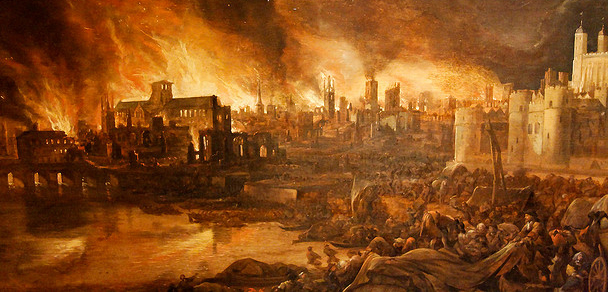
September 11, 2001 is a day that no New Yorker (or our generation) will ever forget.  It started off as another ordinary day as people hurried into the day.  Someone overslept, another had a fight with his wife, someone’s car broke down, one planned to get engaged that evening.  But for more than 5000 people in the Twin Towers it was the last day of their lives.

crisis

We never schedule a crisis in our dairy – no one knows when disasters is going to hit.  A sudden death of a loved one, news of cancer, robbers in your home or a letter of retrenchment.  These things happen to someone every day.  Jesus spoke the truth: “in this world you will have trouble” (John 16:33).  All we can do is “be watchful” and ready (1 Peter 5:8) and respond in a godly way.

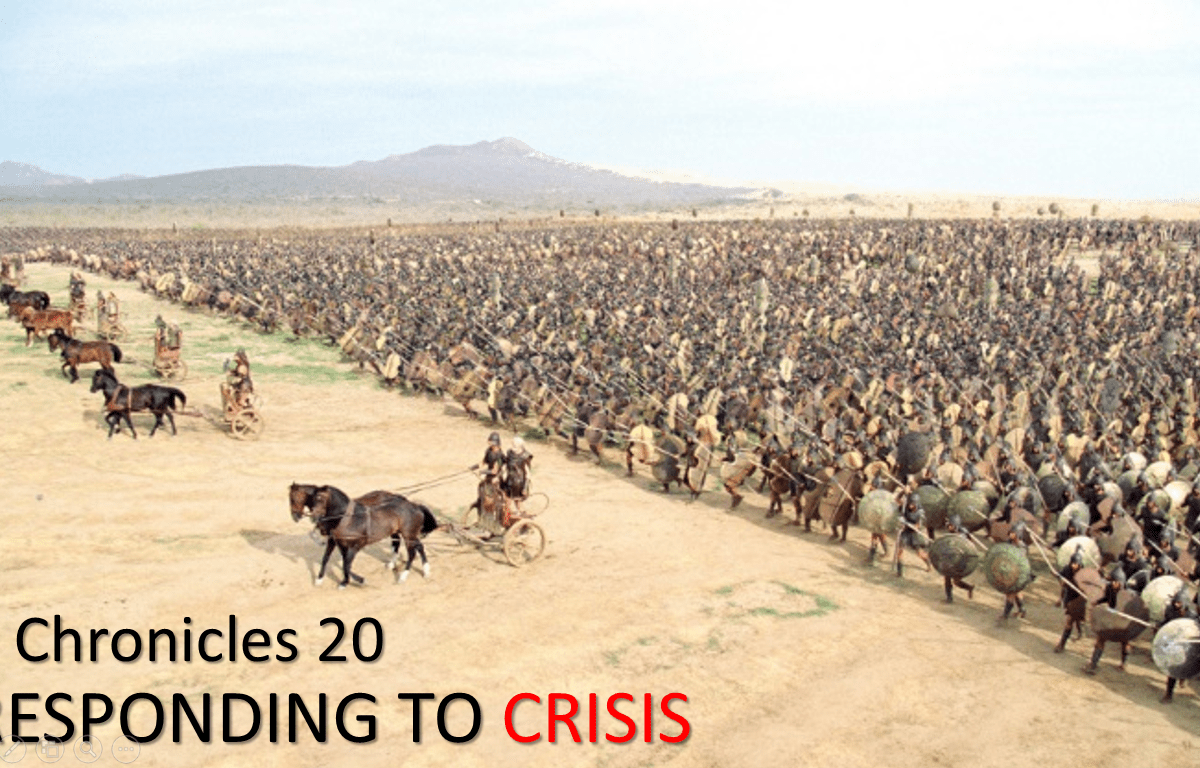
Judah’s king Jehoshaphat had such a day as three big armies crossed the sea from Syria to invade Judah.  Yet this Godly man did not panic or run away.  His response to this crisis is recorded for our comfort, encouragement and learning (Romans 15:4).

Comic_1
Photo-documentary of 2 Chronicles 20 (1 of 3)
Photo-documentary of 2 Chronicles 20 (2 of 3)
Photo-documentary of 2 Chronicles 20 (3 of 3)

What can we learn from this great historic account deliverance?

  1. DEVOTION: Live ready (v6-13)

1Devotion

Jehoshaphat is a king that served God with the devotion of king David, “walked in his commandments” (2 Chronicles 17:3-4) and had his “heart set on God” (19:3).  Not only did he serve God in the privacy of his heart and personal life, but this righteous ruler courageously brought about a great reformation in the nation of Israel by destroying Baal worship with its immoral public practices, and by further commissioning priests to teach the Law of God throughout Judah and later judges to bring about justice in his kingdom.

So when the news of this crisis came to his palace, Jehoshaphat did not fear but did what he did every day: he went into his inner room and prayed to the God whom he had faithfully served all his days.  I love the way the book of Daniel records how that godly prophet responded to the death threats of not worshipping the emperor: “and Daniel went to his house… and he kneeled on his knees three times a day and prayed, and gave thanks before his God, as was his custom since his youth.” (Daniel 6:11)

So what do we learn from this?  A crisis may hit any of us at any moment, and the best way to be prepared is to be securely rooted in a devoted relationship with God.  When war breaks out the soldiers should be disciplined and trained; when exam day comes the student should be prepared; when a fire rages the fireman should be trained.  When a crisis hits, the believer should be firmly established in the devotional disciplines and relationship with His God – just like Jehoshaphat was.

Secondly, Jehoshaphat was ready because he was forewarned about some impending doom (2 Chronicles 19:2).  Peter teaches us to “be watchful because the devil walks around like a prowling lion” (1 Peter 5:8) and Paul urges the believer should “not be ignorant if [Satan’s] plans” (2 Corinthians 2:11).  We are ready by staying close to God and watching in prayer, listening to what the Holy Spirit reveals to us.

  1. PRAYER: Run to God (v13-14)

2Prayer

As soon as the news of the approaching armies reached the king he proclaimed a fast, and everyone in this reformed nation ran to their God.  Jehoshaphat’s prayer is deliberately included as an example prayer for a crisis such as this.  This is how he prayed:

  • Praise: Even with the crisis looming Jehoshaphat starts by praises to God, allowing his (and the assembly) to consider Whom they are praying for: the Almighty God who Rules from Heaven and has power over every nation, and he is the God who made covenant with them!
  • Remind: The king reminds himself (and the assembly) of what God has done in the past, which immediately makes this present crisis seem less dooming since God has done many similar miracles for Israel in the past. Furthermore Jehoshaphat reminds himself (and the assembly) of the promises of God, stirring faith that God had already promised to do the thing he was about to ask. These two reminders stirred the assembly’s hope that God is at hand and for them, and therefore he is willing and able to deliver them from this disaster.
  • Confess: “You have not because you ask not”. Only after praising God for his attributes and faithfulness does the King confess his problem to God and asks for intervention, but he adds their helplessness in the situation and trust in God’s willingness and ability to help. He prays “For we have no power against this great multitude that is coming against us; nor do we know what to do, but our eyes are upon You.” (verse 12).   God promises “grace to the humble” – and that is exactly what the nation needs in this crisis!
  1. WAIT: Let God direct you (v13-15) 

3wait

After the prayer the whole nation “stood before the Lord” (verse 13) – just waited patiently, quietly for God’s direction or instruction. Each minute that they stood waiting they knew the army marched closer to Jerusalem.  But no-one did anything to prepare for war or flight – they abstained from all food and rest and entertainment because they knew that all their efforts will be futile – they literally looked and waited for God to save them.

Just like Habakkuk did years later, the Jews took their eyes off their enemies and looked towards God: I will take my stand at my watchpost and station myself on the tower, and look out to see what he will say to me” (Habakkuk 2:1). Then God answered through the prophet Jahaziel that he will destroy their enemies – they simply had to walk to the edge of the desert and see what He was going to do.  Juda was encouraged by God and worshipped God with relief and gladness.  God heard their prayers and would save them from certain destruction!

Because they waited, God answered the questions “Lord, what do you see?”, “Lord, what will You do to save us?” and “Lord, what must we do?”  In every crisis the Word of God is what changes the situation from trial to triumph.

  1. FAITH: the worship of faithful obedience (v16-21)

4faith

But as in almost every situation, God involves us in His salvation.  What did the Jews have to do?  In simple obedience walk head-on towards the enemy.  As Moses had to face Pharaoh, Joshua had to encircle Jericho, David had to walk up to Goliath, and Gideon had to walk into the Midianite camp, so Judah had to march in faith towards this massive army.  As Daniel’s friends discovered, God’s Great Plan sometimes requires us to walk through the fire. But as they obeyed in faith, they started singing the ancient Israeli song associated with God’s faithful deliverance of the Egyptian Army after their Exodus “Praise the LORD, for His mercy endures forever.” (2 Chronicles 20:20)

And this act of faithful obedience and praise resulted in God’s intervention into the situation: the three invading armies turned on each other and completely annihilated each other so that “No-one had escaped.” (v24)  All Judah had left to do was carry the spoils of war back – for three full days!  What a marvelous victory by the Lord!

  1. THANKS: Stop to give honour (v24-26)

5thanks

But the story does not end with the spoils and peace – Jehoshaphat had the wisdom to end where they began: at the House of God.  The whole nation returned to God’s Temple in Jerusalem to give thanks to God and make His praise glorious.  They returned to the place where they prayed, waited and received the Word and direction from God.

Just like one of the ten lepers who had received healing from Jesus returned to give thanks and “was made well (or whole)”, so Jehoshaphat and Judah was reward with “quite” and “rest all around” because of their gifts of thanks.

The other day the Lord said to me as something happened which was out of my control, “Don’t walk around defeated.”  I want to leave you with this phrase – when Crisis hits don’t walk around defeated, like heathen who live “having no hope and far from God in this world” (Ephesians 2:13).

Rather, like King Jehoshaphat, devote your life to seek and serve God.  When news of crisis comes, turn to Him in prayer, reminding yourself of Who He is and what He has done, present your problem to Him and confess your helplessness and trust in Him. Ask Him what He will do and what you should do. Then wait – let Him direct your response.  Act confidently – God is in control of your life, and you are precious to Him.  And once He has saved you, make His praise glorious!

LordForMe

Get up! Encourage yourself

“Wherever you go, there you are.”  Grin or laugh about the silly statement, but it is a truth with significant consequences.  The older we get the more we realize that we cannot run away from ourselves – the painful or shameful memories of past failures and disappointments with oneself, our emotions or our own shortcoming – because “wherever you go, there you are.”  Sadly we can’t outrun ourselves.  Where you go, these aspects of your life follow you.

wherever you go there you are

But we also realize that the people in our lives come and go because we move on, because we hurt or get hurt, or because inevitably our loved ones pass away.  So apart from the constancy of God in our lives, only “you are wherever you go” – no one else.  Good or bad – this truth requires some reflection and response.

Sooner or later in life you will find that you are left to face a big, troubling situation all by yourself.  With no-one else to spur you on, you will need to encourage yourself in God.

ENCOURAGE YOURSELF IN GOD

Although he did not live an isolated life, David had to face many critical situations alone with his God.  In 1 Samuel 30 we find David at a very vulnerable position in his life: he and his group of mercenaries (all refugees from Israel) just returned to their refugee-town of Ziklag after being rejected by the Philistines to participate in war on Israel.  As this agitated group of warriors returned to their hometown they found it plundered by a band of Amalekites who left with all their possessions and loved ones.  The historian records that David and the people who were with him wept until they had no more strength to weep… And David was greatly distressed, for the people spoke of stoning him, because all the people were bitter in soul, each for his sons and daughters.” (v3-5)

David was at the end of himself, and so were all the soldiers with him.  They have been living with the Philistines for the last 16 months as foreigners far away from family and familiarity.  They were tired and without income.  The last bit of comfort were their homes, family and community – now this too was taken away.  They worried what those savages would do to their loved ones.  The anguish was great and brought David to an all-time low – it seemed as though God had rejected him.

But our shepherd-king knew his God, and strengthened himself in the LORD his God.” (v6) David knew he needed courage to go on, and he knew where he would get it.  Better yet – he knew from WHOM he would get courage – “the God of Encouragement and Endurance.” (Romans 15:5)

How did David encourage himself in the Lord his God?

  1. THE DISCIPLINE OF PRAISE

worship_1I bet that this psalmist sang a song that he wrote just over a year earlier, after God had delivered him from Abimelech the Philistine King (Psalms 34).  In that song David vowed to “bless the LORD at all times (verse 1) – in all circumstances, good or bad.  Why? Because the Lord is always God, always good.  Then he vowed “his praise shall continually be in my mouth” (verse 1) – leaving no space for negativity, grumbling, complaining, fearful or hopeless confessions.  David’s mouth was dedicated to speaking of God’s power and goodness – he therefore his heart was encouraged to move on in faith.

  1. REMIND YOURSELF HOW BIG AND CLOSE GOD IS

who-is-god1

This discipline of praise lead David to magnify the LORD, and …exalt his name” (verse 3).  Is it possible (or even necessary?) to make God bigger than he is?  No.  God’s magnitude will not change with David’s praises – but when you tell God of his rehearse his great attributes and benevolent, righteous character, your perspective of our circumstances does change.   By making God bigger, you make your problems smaller.  You see life from God’s perspective, and that makes your troubles seem smaller.  When we praise God we remind ourselves that God can make a way where there seems to be no way – even in this hopeless situation we now face.  That reminder stirs hope, the confidence that this troubling situation will “work together for the good” (Romans 8:28) and that God “will make a way” where it seems impossible (Isaiah 43:19).  Hope stirs courage – it gives strength to the heart.

  1. REMIND YOURSELF OF WHAT GOD HAS DONE

Then, in the praises, David reminds himself of how God answered and delivered (verse 4) him in the past.  He probably recalled how the Lord saved him from the lion and the bear while he was watching his father’s sheep, and how the Lord gave him victory over the giant Goliath and later as captain in Israel’s army. He probably recalled how the Lord had delivered him many times from the hand of the jealous King Saul and the barbarians he fought as mercenary.  David truly experienced how the Lord is near to the brokenhearted and saves the crushed in spirit.” (verse 18)

This gave David strength to get up from the pit of despair, to get out of his raided house, face the angry mob of mighty men outside and encourage them to pursue their enemies!

  1. WAIT ON THE LORD FOR INSTRUCTION

wait_on_Lord

But David was wise enough to not act in presumption.  David knew how to wait on the Lord [to] strengthen your heart” (Psalm 27:14), and that it requires patience and discipline until God gives the go-ahead. The historian records that before David got up to pursue the band of Amalekites he inquired of the LORD, ‘Shall I pursue after this band? Shall I overtake them?’ [God] answered him, ‘Pursue, for you shall surely overtake and shall surely rescue’” (1 Samuel 30:8).  Only then did David encourage the men with this prophesy of success, turning their hopeless frustration into hopeful fortitude.

David and his men were so invigorated by this encouragement from God that they pursued the Amalekite army for two days and then engage them in combat from twilight until the evening of the next day” (verse 17).  A promise from God gives one strength to go on.

A NEED FOR ENCOURAGEMENT

Had David not leaned the discipline to encourage himself in God, his story might have ended in this chapter.  But he gained the necessary courage to press on in the presence of God.  Not only did David himself benefit from his self-encouragement: his army of mighty men got turned around from self-pity to strength, their wives and children got rescued, and everyone was prospered through this pursuit to such an extent that David even had wealth to share with the tribal leaders in Israel – the very thing that turned their hearts and attention to him and invite him to return from exile and receive his kingship.  All because David could encourage himself in the Lord his God.

Can you identify with David’s feelings of frustration, loss and despair?  Then follow his example: shut the door to all the noises and demands, praise God and remind yourself how powerful and close he is, and what he has done for you and others1 in the past. Then wait patiently on him for direction, and see how the Lord “encourages your heart and strengthen you in every good deed and word.” (2 Thessalonians 2:17)

You’ll be surprised to find that – like for David – self-encouragement not only changes your mood, but your circumstance and the lives and destinies of those around you.  After all, what else would you expect from a meeting with Allmighty God?


Footnote

  1. When one is in despair it is often difficult to remember good times and breakthroughs of the past. I find it helps to rehearse and reflect in prayer on what God had done for others as recorded in Scripture. I would recall Gods saving intervention in the lives of Abraham, Jacob, Joseph, Moses, Joshua, Samson, Gideon, David, Daniel etc… Their life stories as recorded in the Bible give me courage in my times of difficulty.  This is what Paul referred to when he wrote “whatever was written in former days was written for our instruction, that through endurance and through the encouragement of the Scriptures we might have hope.”  Try this.