Never give in!

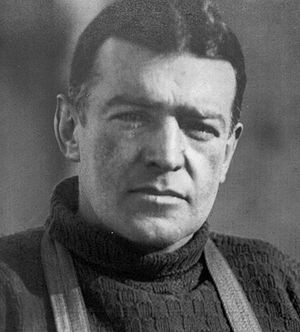
Sir Ernest Shackleton

Men wanted: for hazardous journey. Small wages, bitter cold, long months of complete darkness, constant danger. Safe return doubtful. Honour and recognition in case of success. Sir Ernest Shackleton.” 5000 men responded to this blunt advertisement posted in London newspapers January 13 1914, applying for the Imperial Trans- Antarctic Expedition. Shackleton selected a crew of 28 who proved to be optimistic, patient and courageous – the minimum requirements he sought for in a man who boarded a ship with him.  They set sail from London in the ship aptly named “Endurance” on the first day of August 1914 and stopped over at the whaling station on South Georgia for fresh supplies.  After a month they departed for the Antarctic on December the 5th for one of the most grueling adventures undertaken by man, unaware that they would not touch land again for another 497 days.  On return to England three years later Shackleton published the account in his book South in 1919, documenting the journey, events and experiences of their expedition, including the following five legendary survival accounts.

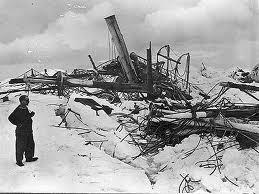
Due to an unusually cold winter the ship entered pack ice much sooner than expected.  Just one day’s journey from the Antarctic the Endurance got stuck in pack-ice on 18 January 1915, drifting gradually away from the South Pole for ten months with the ice until the ship tipped and was crushed to pieces on October 27, 1915.

Endurance slowly breaking through pack ice
Endurance stuck in polar ice
Endurance crushed by pack ice

The men saved what they could and drifted for another five months on the ice until the ice started melting and the food became scarce.  On 31 March 2016 Shackleton woke up from a soft crackling sound to find that the ice beneath him split in two; he instinctively reached his hand to grab the sleeping bag of the man sharing his tent just as he was slipping into that icy, black water. During the ice-splitting they were also separated from their life rafts for some time but they managed to retrieve it again.  The next day he gave the command to board the three life boats.

The life-saving achievement was the harrowing journey through the Weddell sea to a rock called Elephant Island, 100 miles in the three small life boats, navigating one of the roughest seas with 60 foot waves blown by gale-force winds.  The three boats had to be dragged on top ice floes at night to rest.  They managed to reach Elephant Island, and eventually found a suitable camping terrain.

Boats on Elephant Island

Their third legendary survival story started on 24 August when Shackleton and five others boarded the small 22ft life boat called the James Caird  and made way for South George, from where they departed about 500 days earlier 800 miles away. (That is the distance between Cape Town and Johannesburg!)  After a grueling 17 day journey in the stormiest sea, navigating by dead reckoning with a compass and sextant only with merely four sightings of the sun, the six men reached the island exhausted.  This is still considered one of the greatest boating achievements ever.
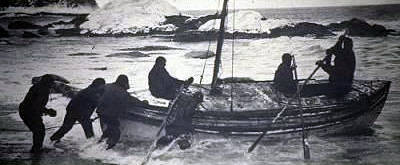
Crew boards James Caird for South Georgia
Landing on South Georgia

The next survival feat was equally impressive, born from necessity as the men landed on the wrong side of the island.  To get to the whaling station for help and rescue of their friends Shackleton, captain Frank Worsley and second officer Tom Crean began to cross the ice-bound mountain tops of South Georgia  – never before attempted, including the 9000ft Mount Paget.  During their 36 hour ordeal without any rest they travelled across two snowfields, four glaciers and three mountain ranges: all of these unmapped and life threatening.  The last bit of their journey, being severely fatigued, dehydrated and shivering, Shackleton lowered his two friends down a partially frozen waterfall before abseiling down himself and waking the harbor master at Stormness whaling station, asking for help.

Panoramic view of South Georgia

Lastly, the survival and rescue of the 22 men marooned on Elephant Island for more than 137 days is commendably in itself.  They used the two life boats to construct a hut of sorts  to stay warm. Due to the roughness of the sea it took four attempts by Shackleton and his men to rescue them, only managing to reach them with the steam boat Yelcho on 30 August 1917, two years and one month after their departure from England.

The Chillean steamer Yelcho


This story of endurance and courage is inspirational – in spite of the failure to cross the Antarctic – because Sir Earnest Shackleton succeed to bring all 28 the men home safely; they endured and survived the impossible together.  Part of their survival had to do with what Shackleton took with them as their ship Endurance was crushed by the pack ice: in spite of the lack of space in the three life rafts he instructed that they take a rugby ball, the gramophone as well as the big Bible.  He insisted that they daily laughed together, told stories and read the Bible together as encouragement in hope, daily played sports together, and daily sang together. For him, humour, story, song, playing and prayer was keys to endurance – and it proved true.

Football on ice
Football on ice
Gramophone for the penguins

Shackleton was a God-fearing man who lived and lead though this ordeal with Godly courage and persistence.  Looking at his example of endurance, and comparing it with examples and teachings from the Bible, what can we apply to navigate through our own hardships with “Endurance”?

(1) Comfort of Scripture

As mentioned above, Shackleton ordered his men to rescue the ships’ big Bible and take it with them on their journey to safety, knowing that the Scriptures are in part a compilation of God’s miraculous deliverance and preservation of people in desperate circumstances, as were they.  Their faith in God’s salvation from this seemingly hopeless situation would be stirred as they read they reflect on the accounts of God’s awesome deliverance of individuals and communities as recorded in the Bible.

New Testament Authors encouraged their suffering communities to look at Old Testament characters (as well as their leader’s examples of steadfastness) to find strength to press on in faithfulness to God.  Paul reminded the persecuted church in Rome that whatever things were written before were written for our learning, that we through the patience and comfort of the Scriptures might have hope” (Romans 15:4).  James encouraged the poor, persecuted church in Jerusalem to “consider the blessed who remained steadfast” with special reference to Job and the Old Testament prophets (James 5:10-11).  The author of Hebrews encouraged his suffering readers to “consider [Jesus] who endured such hostility from sinners against Himself, lest you become weary and discouraged in your souls” (Hebrews 12:3).  Thus they all pointed to the exemplary lives recorded in Scriptures for encouragement during difficulty.

The history of God’s faithfulness in Scripture comforts us during hardships because we see that we are not alone in hardship – many have been there; and the Biblical accounts testify to us that God is present during suffering to strengthen and preserve,  and that he is willing and able to save.   Thus the Scriptures comfort us and stirs our hope and faith in God.

(2) Companionship in community

Shackleton knew that for the 28 men to survive this ordeal, they should not just live in community, but also practice community.   That’s why he commanded that every one participate in four group activities daily: they eat together, play sports together, pray and reflect on Scripture together, as well as sing, tell stories and laugh together.  These moments of togetherness brought great encouragement and camaraderie amidst the protracted stressful times.  He understood and articulated that for the group to survive, each individual needed to survive.  If no-one gives up, the group endures.

In relation to their survival and community, I find C.S. Lewis’ quote on friendship quite fitting: “Friendship is unnecessary, like philosophy, like art… It has no survival value; rather it is one of those things that gives value to survival.”   For the crew stranded in Antarctic, their community was a reason to endure in itself; their companionship gave both motive for and meaning to their survival.

(3) Celebration of life

Shackleton wrote in his journal during their long winter drifting on the pack-ice “As we clustered round the blubber stove, with the acrid smoke blowing in our faces, we were quite a cheerful company…Life was not so bad. We ate our evening meal while the snow drifted down from the surface of the glacier and our chilled bodies grew warm.” They were thankful for what they had; their companionship, warm food and their survival was reason to laugh.

Going through life with the optimistic perception of “glass half full” makes endurance possible, and life so much more pleasant.  Jesus put it this way (referring to money in the context of a financially oppressed Judea) The eye is the lamp of the body. So, if your eye is healthy, your whole body will be full of light, but if your eye is bad, your whole body will be full of darkness. If then the light in you is darkness, how great is the darkness!”  (Matthew 6:22-23).  Shackleton lead his men on in “light-filled eyes”, celebrating what they had amidst a cold, seemingly hopeless situation.

Paul encouraged the persecuted church in Philippi to do the same, to emulate his discipline of focusing on the good and praiseworthy, so that “the peace of God will guard your hearts and minds” (Philippians 4:6-8). Instead of becoming anxious about trying circumstances he instructed them to pray about their situation, but “with thanksgiving”, helping them recognize and celebrate the goodness of God amidst difficult circumstances.  This is a worthy lesson to learn for anyone, anywhere.

Thanksgiving and celebration makes hardship tolerable and gives one strength to carry on. These disciplines gives strength in trying times by focusing attention on that which causes joy and gladness – truly, “the joy of the Lord is your strength!” (Nehemiah 8:10).  By focusing attention of the good it trains one’s perception to see what God is doing, recognizing that God is near, and “He will never is leave you, nor forsake you” (Hebrews 13:5).

(4) Continuing in hope

Shackleton never allowed his crew to give up.  They were always moving forward, always planning and preparing for tomorrow.  In his mind, and from his mouth, it was clear that they were going to get home to England.  He never gave up on hope, and never allowed the crew to slide into hopelessness, because he knew that hope is necessary for endurance.  If a person believes that nothing is going to change for the good, that person sinks in the mud of depression and hopelessness, and finds no reason to fight and or live on.  But if one believes that pushing forward today will be rewarded in the end, it is worth it.

The author of Hebrews frequently motivate endurance with the promise of reward (hope), for example you have need of endurance, so that after you have done the will of God, you may receive the promise” (Hebrews 10:36) and later encouraging the readers to “run the race with endurance, looking to Jesus… who for the joy that was set before Him endured the cross, despising the shame, and has sat down at the right hand of the throne of God.” (Hebrews 12:1-2, compare with 1 Thessalonians 1:3).  Jesus found strength to continue through tremendous suffering, his eyes fixed on the joyfilled reward at the end.

Paul imitated Jesus’ example, as he was a man who experienced great difficulty, including afflictions, hardships, calamities, beatings, imprisonments, riots, labors, sleepless nights, hunger, …slander, …being poor” (2 Corinthians 6:4-10).  In another place he records “imprisonments, with countless beatings, and often near death. Five times I received at the hands of the Jews the forty lashes less one. Three times I was beaten with rods. Once I was stoned. Three times I was shipwrecked; a night and a day I was adrift at sea; on frequent journeys, in danger from rivers, danger from robbers, danger from my own people, danger from Gentiles, danger in the city, danger in the wilderness, danger at sea, danger from false brothers; in toil and hardship, through many a sleepless night, in hunger and thirst, often without food, in cold and exposure. And, apart from other things, there is the daily pressure on me of my anxiety for all the churches.” (2 Corinthians 11:23-28).  How did he endure these hardships?  He kept his eye on the reward, a “crown of righteousness” (2 Timothy 4:8) saying “I consider that the sufferings of this present time are not worth comparing with the glory that is to be revealed to us.” (Romans 8:18; see also 1 Corinthians 3:14, Colossians 3:23-24).   Paul joyfully pushed one through suffering in hope of eternal rewards in the Lord.  He reckoned that suffering briefly for eternal rewards was worth it, making these moments of pain bearable.

(5) Courage from God

Finally, God gives strength to press on in difficult times – to those who “wait on the Lord” (Isaiah 40:30-31).  I have over the years learnt from David, who knew the Lord as “my strength” (Psalm 18:1, 118:14, 140:7), to “seek the Lord and his strength” (Psalm 105:4) when my I feel weak or ready to give up.  I have learnt to “wait on the Lord [to] strengthen [my] heart” (Psalm 27:14), and also to “strengthen [myself] in the Lord [my] God” (1 Samuel 30:6) as David did in hopeless situations.  With the Shepherd-king I can witness that “the Lord gives strength to his people” (Psalm 29:11) when I set time aside to pray to God for courage, strength and hope to continue doing what he calls met to do, although everything in me wants to walk an easier road.

Paul also testified that Christ Jesus has given him strength in trying times (1 Timothy 1:12), and could therefore pray for the Ephesian church that God would strengthen their hearts (Ephesians 3:14-16) amidst the persecution, encouraging them to “be strong in the Lord and in the strength of his might” (Ephesians 6:10).   Thus we learn from Paul that one should find strength in God, but also that through encouragement and prayer from others one is strengthened by God.  From his example we learn that we should encourage one another joyfully and hopefully press on, to “strengthen the weak hands and make firm the feeble knees” (Isaiah 35:3) of those facing hardship around us.  Strength is found in God’s community.

Making it personal

If you are reading this as someone going through hardships now, I want to re-tweet the thrust of John’s message to the persecuted churches in Ephesus: “Here is a call for the endurance and faith of the saints.” (Revelations 13:10, 14:12).  Although your suffering might not be religious oppression, you must know that your endurance is noticed and commended by Christ himself (Revelations 2:2, 19).  He will put and end to your suffering One Day (Revelations 21:3-5) and if you endure in faith to the end, he will give you your reward from him (Revelations 22:12).

And in the words of Paul: Run the race in such a way that you may revive the prize” (1 Corinthians 9:24).Rejoice in hope, be patient in tribulation, be constant in prayer” (Romans 12:12), and may “the God of endurance and encouragement” (Romans 15:5) strengthen you with all power, according to his glorious might, for all endurance and patience with joy” (Colossians 1:11).  “Press on, that [you] may lay hold of that for which Christ Jesus has also laid hold of [you]” (Philippians 3:2).

It is appropriate to close this lesson on endurance from the exemplary life of Sir Ernest Shackleton with the words from Winston Churchill, since he was the man who sent the last telegram to the Endurance crew as they left the London harbor for their trans-Atlantic expedition on August the 1st, 1914.  Later that day the war with Germany broke out, leaving the whole of Europe in turmoil for the next forty years.  On October 29, 1941, Churchill then Prime Minister visited Harrow School to hear some of the traditional songs he grew up with and address the learners.  Standing in the podium he stared at the youngsters long and hard, and then uttered the following short and urgent admonition: “Never give in – never, never, never, never, in nothing great or small, large or petty, never give in except to convictions of honor and good sense. Never yield to force; never yield to the apparently overwhelming might of the enemy.” [audio recording] During tough times let this phrase ring in your ears, as you remembering the enduring examples of Jesus, Shackleton, Paul, the prophets and the saints through the ages. Never give in!


Suffering, our good tutor

Writing this article, I am sitting in front of a casket of a faithful Christian minister who passed away un-expectantly, almost pre-maturely.  I am early for the funeral, and my heart is heavy for his children whom I know well.  Death brings grief, and the added shock of unexpected passing of a loved one leaves a sense of abandonment, and greater loss since there was no opportunity to say farewell.  Even more so if there was no time to reconcile hearts.  Furthermore, my mind and prayers keep going back to friends of ours who’s four-month old baby is in ICU again after heart surgery.  Things like these wear you down.

We suffer in many ways.  My wife and I have a list of people we pray for daily: beautiful single friends who long for a suitable mate to share life with, who suffer through loneliness and also some couples who long for a baby of their own to fill their arms.  I think of people in church who have been frustrated in the area of work, purpose and finances for quite some time – they wait, work and pray for some break-through.  There is the lady who has been battling leukemia for three years.  The friend who has been involved in a custody case for his son (who is in a very bad situation) for three years, but the case keeps on dragging out.  And yesterday I received a text message from a friend who let me know that her nanny and “second mother” to her three children has passed away after a serious heart attack; there will be tears in their house today.  No one escapes suffering. No amount of faith, no degree of devotion to God exempts us from suffering.

Over the past two decades much has been written on the detrimental effects of suffering, pain and trauma on the physical, psychological and spiritual well-being of a person.  Recently however, studies have been done on what is called “post-traumatic growth” or the positive growth effects of suffering, including gaining inner strength (resilience), become more appreciative of everyday things, growth in compassion and capacity for intimacy.  These findings do not surprise us since many of us can refer to some trying time in our lives as the turning point for positive personal or relational development.  Suffering is indeed a good school master.

The Bible has much to say on suffering and our approach to it.  Although God is not the author or origin of suffering the Bible teaches that God turns any situation for the good for his children (Romans 8:28-29) and that therefore one should approach suffering as an opportunity for God to complete a redemptive work in you or through it (see James 1:3-4; compare Hebrews 2:9-10).  In this article we will look at what the Bible says we benefit or learn from suffering.

(1) Allow suffering to tests your foundation

Charles H. Spurgeon wrote that “trials teach is what we are; they dig up the soil, and let us see what we are made of.”  We have all found this to be true: in trying times our character and relationships show itself for what it is; suffering is a good test of our true selves.  This is what the author of Hebrews also write to a church undergoing mounting persecution: “Yet once more I will not only shake the earth, but also the heavens.” [This] signifies the removing of those things that are shaken… so that the things which cannot be shaken may remain.” (Hebrews 12:27-28) Trying times tend to differentiate between that which is firm and stable in us (beliefs and character traits), and that which is not, and also to show that which has lasting value and that which is of temporal nature.

Jesus taught two parables that relate to this:  In the one he used the metaphor of two men who built houses – one on solid bedrock and another on unstable sand; when the same storm hit the two homes, one collapsed and the other stood through it.  The storm simply revealed the strength of the foundations (see Matthew 7:24-25); without the storm this could not be known.  A second parable is on the Sower and his seed which fell on various terrains and some germinated and sprung up.  However, when the sun comes up the seedlings in the shallow soil perish because “they have no root… in a time of testing they fall away” (Luke 8:13). The sun, representing a time of testing, simply reveals that these seedlings have no roots to sustain them; without the testing of the sun this could not be known.  It is a redemptive time of testing.

In a similar manner Moses also wrote of the suffering as a test, summarizing the purpose of the forty year wilderness wandering of the Hebrews firstly as a test, “to know what is in [their] heart” whether they will obey God or not (Deuteronomy 8:2-5).  Whatever the cause of suffering, it brings with it a test of our faith, our character, and our relationships (1 Peter 4:12).  Suffering, like any good tutor, helps us see ourselves for who we are, and shows us what areas we need to work on next.

(2) Suffering reminds us we need God

Apart from suffering bringing a test, Moses also stated the purpose of the forty year wilderness wandering was “to humble you.”  God kept the Hebrews in the wilderness for forty years, feeding them manna daily, to teach them that although they enter a fertile, rich land, they will always be dependent on His provision.  They ought to remember the LORD… for it is he who gives you power to get wealth” (Deuteronomy 8:18).  Their suffering was a way to teach them that they need God daily.

The apostle Paul personally experienced suffering as a tutor in humility, testifying that “a thorn in the flesh, a messenger from Satan harassing [him], to keep [him] from becoming conceited [or proud]” (2 Corinthians 12:7-8).  Although Paul begged God to deliver him from this suffering, the Lord simply said to endure it with the strength he provides.  In our suffering we learn that we are always dependent on God.

Another powerful example of this lesson from suffering is the account of the mighty emperor Nebuchadnezzar, who admired his great empire and ascribed the vast advancement of his empire to his own hand.  At that moment, a voice from heaven rebuked him and his mental capacity was removed from him and he lived among the wild animals for a time, until he acknowledged the hand and provision from God in all his success; only then he was re-instated as emperor.  His suffering taught him his dependence on God.

(3) Suffering helps us grow in intimacy with God (and others)

Suffering creates opportunity to know God in a depth and sincerity that we have not known before.  In my twelve years of pastoral ministry I have heard countless times that people say during (and after) their most difficult times in their lives “I have grown closer to God.”  Suffering allows one to re-evaluate what you believe, and also creates a desperation to get answers from God as Job did. That desperation in turn helps us cast away all pretense and diplomacy so that we can approach God in all earnestness and “rawness”.  Job received a reply from God he never anticipated, and said “I had heard of you by the hearing of the ear, but now my eye sees you” (Job 42:5).  Suffering allows us to get to know God as never before, and to grown in intimacy with him.

In addition to growing in intimacy with God, suffering allows us to grow in sincerity and vulnerability with those around us as our brokenness, weakness and needs cannot be hidden behind facades.  This creates the capacity and the reality for deeper, more honest and intimate relationships of those around us.  Even when the tough times pass, these relationships remain deep and strong because of the shared experience of suffering.

(4) Suffering helps us grow in Godly character

Like a baby who must learn to sleep alone or to soothe himself, casting aside the pacifier, growth is often associated with discomfort and suffering.  Suffering is not pleasant, but we learn from it and we are changed through it.  Suffering not only shows our weaknesses and strength (as mentioned in the first point), but it creates a good opportunity to realign our values, adjust our thinking and rethink our responses to situations – allowing for behavioral changes and ultimately character growth.  Suffering thus helps us to grow up, and therefore we should rejoice in it (Romans 5:3-4).  Do not shy away from difficulty but allow it complete its perfect work in us (James 1:2-4) by letting us grow up in the likeness of Christ (Romans 8:29).

(5) Suffering teaches us resistance to temptation

Suffering teaches us resistance to temptations – that’s why we have public penal systems such as traffic fines and imprisonment, and why we have similar systems in schools and in our homes.  Suffering in its very nature helps to builds a resistance against the seduction of sin: Peter wrote to a church undergoing severe persecution that he who has suffered in the flesh has ceased from sin” and no longer lives with fleshly cravings, but submitted to the will of God (1 Peter 4:1).  That is the reason why we chastise our children, with the aim that the undesirable behavior will seem no longer desirable.

This metaphor of suffering as chastisement is common in Scripture.  About 750 BC Isaiah the prophet wrote of the oppressive Assyrian Empire as “the rod of [God’s] anger” (Isaiah 10:5) – thus Israel’s suffering was God’s discipline to deliver the nation from the destructive, sinful habits, notably injustice to the poor and idolatry.  In the same manner, about 800 years later, the author of the letter to the Hebrews referred to the Roman persecution of those congregations as God’s loving chastisement (Hebrews 12:5-7) – to deliver them from the seduction of turning from Christ as the only Mediator and Savior in the light of severe suffering.

Many of us learned our own lessons through tough times brought about by our own bad decisions.

(6) Suffering gives us eternal perspective

Paul Alexander was my instructor during my theological studies.  In their book A Certain Life Paul and his wife Carol write of their darkest night when their son Jason collided with a truck and was battling death for more than a month in ICU (chapters 16-17).  They write that one of the outcomes of this ordeal for them as a family is that they have a renewed perspective – they are no longer thrown by petty things nor drawn in by temporal comforts or worldly pursuits. Their brush with death have taught them that life is short and relationships are precious, and now they make each moment count for eternity. With the apostle Paul, imprisoned and faced with death after years of suffering, they can say “for me to live is Christ, to die is gain” (Philippians 1:21).  Elsewhere, Paul reflected om his suffering, comparing it with eternal rewards: “this light momentary affliction is preparing for us an eternal weight of glory beyond all comparison, as we look not to the things that are seen but to the things that are unseen.”  (2 Corinthians 4:16-18).

The English poet Samuel Johnson said “nothing focuses the mind like a hanging.”  A morbid thought, but it is indeed true that suffering like the threat of death, has the ability to focus the mind on what is important, on that which has value in eternity.  Because of his suffering, Paul did not fear death nor waste time; he had an eternal perspective which translated in making the most out of every opportunity (Acts 20:24).  Suffering does the same for us.

(7) Suffering creates capacity for empathy and compassion

I had an exceptional mathematics lecturer during my first two years at university. Mrs Roux classes were always full due to students preferring her lectures above other more qualified professors teaching the same modules.  What made her an exceptional teacher – in her own confession – was that she struggled to understand mathematics in her student days and had to wrestle with the abstract models and concepts.  She admitted she was not as smart as the other lecturers who seemed to intuitively grasp these abstract concepts, but she had to work hard to really understand the work.  This gave her the edge over the other teachers since she herself understood what it was to struggle in mastering the coursework, and therefore patience to help those who wrestled with the work.

Furthermore Mrs Roux had sincere compassion for her students: I recall one day receiving a phone call as I prepared for a rewrite, wondering how I was doing – she called from a hospital bed recovering from an operation.  Her own struggle with mathematics made her an exceptionally supportive lecturer.

Suffering does that for us – it creates in us a capacity for empathy and even compassion, as Paul writes to the suffering church in Corinth “we may be able to comfort those who are in any affliction, with the comfort with which we ourselves are comforted by God” (2 Corinthians 1:3-5).  Even Christ himself was perfected through suffering (Hebrews 2:10-11) and therefore can sympathize with us in our weaknesses during trials (Hebrews 4:15-16).  Therefore we can approach him confidently, knowing Jesus has compassion for our circumstance.

In conclusion, looking at the mourners around me who gather around their deceased spouse, father, grandfather, minister and friend, I am reminded yet again that none of us escape suffering.  But suffering has the potential to be our tutor towards godliness.  So allow suffering to have its perfect way in us, don’t let these opportunities go wasted on self-pity or escapism.  Rather, let it reveal our true selves, remind us of our need for God, grow us into intimacy and Christ-like character, even as Jesus himself was perfected by it.  Let it deliver us from our sinful natures and create in us a capacity to show compassion and have empathy with those suffering like us.  Let us in our direst moments pray as our Lord did “O My Father, if this cup cannot pass away from Me unless I drink it, Your will be done.”  (Matthew 26:42)

Suffer well

Over the last few weeks the world’s attention has been drawn to the intense persecution of Christians and other minority groups by the “Islamic State of Iraq and Syria” (ISIS), offering Christians three choices if they wish to stay: convert to Islam, pay peace tax and lose your family, or die.  More than 800’000 Iraqi minorities have been displaced, thousands have died a cruel death.

Ann Drew argues that “at no other time in history have we ever been more aware of the horrors of religious persecution.”  And rightly so: the #WeAreN campaign (Arabic “N” for “Nazarene” or follower of Jesus) is gaining momentum in social media as activists appeal raise awareness in the hope of a speedy end to this injustice by uploading images and petitioning for governmental engagement and financial contributions. (Do you also find the mainstream media strangely quiet on this serious matter?  I suspect they fear to put Islam in a bad light in fear of retribution). 

So again we have all been alerted to suffering of persecuted Christians in Iraq.  Off course, this is not new to the church in Iraq, as this is probably the most ancient Christian community in the world today, living in one of the most hostile Islamic nations on earth.  Most of Christian history is written in blood, and for large parts of the world, Christianity lives in varying degrees of religious persecution – it’s only in the West that we have enjoyed religious freedom – for now.

In fact, suffering is one of the main themes in the Scriptures.  Most of the Bible books were written to or about oppressed believers – whether slaves in Egypt, oppressed by Canaanite nations during the period of the judges, or Daniel and his contemporaries as Babylonian or Persian slaves, or the Entire New Testament written when the Church war persecuted by both Roman rule and the Jewish persecution.  Therefore a great number of the examples are recorded in Scripture about individuals of communities suffering, and God’s redemptive response to them.  Regarding these examples Paul writes to the persecuted congregations in Rome: “For whatever was written in former days was written for our instruction, that through endurance and through the encouragement of the Scriptures we might have hope” (Romans 15:4).  To the believers of both the Old and the New Testament, suffering was a reality.  This is our legacy.

Yet, for many Christians today, especially in the West, suffering is foreign to their theology.  But we all know the story of Job – probably the most ancient book in the Bible.  Job was a rich and influential man in his day.  He was a worshipper of God, a righteous man who interceded for his family and encouraged others.  Then disaster struck and he lost everything, leaving Job utterly surprised at first, then depressed and angry at God – crying “this is not fair!”  After lamenting his loss (and even his birth), his friend Eliphaz couldn’t keep quite anymore:

4 “Your words have upheld him who was stumbling,
and you have made firm the feeble knees.
But now [suffering] has come to you, and you are impatient;
it touches you, and you are dismayed.
Is not your fear of God your confidence,
and the integrity of your ways your hope?” (Job 4:4-6, ESV)

This sixth verse is a good summery of the theology of Job and three of his friends: the belief that if I worship God and do the right things, nothing bad will happen to me, because God is on my side.  In other words, bad things happen to bad people, good people should not suffer.  We might not say it like this, but this is also a popular theology in our time.  Like Job we are prone to believe that a life of integrity and sincere devotion to God will prevent bad things from happening to us. Then we, like Job, are caught off guard when disaster strikes, so we resort to unhealthy introspection (“What have I done wrong to deserve this?!”) or futile accusation (“Why does God allow this to happen to me?  God is not fair!”). 

When one believes that good standing with God prevents bad things from happening to you, as in Job’s case, suffering brings doubt: it makes you either question yourself (“where have I sinned to bring this suffering on me?”) or question the nature or power of God (“is God fair?” or “is God really there?” or “does God care?”).  This presumption is a pharisaic notion that entrusts the welfare of the self in one’s ability to walk rightly: “if I abide by the rules it will be well with me.”  It places our relationship with God on the contractual plane: “I do my part, God watches over me.

The ninth chapter of John tells of a man born blind. Both the disciples (v2) and the Pharisees (v34) presumed that the man was blind because of his sin, or his parent’s sin, but Jesus answered, “It was not that this man sinned, or his parents, but that the works of God might be displayed in him.”  (John 9:3)  In other words, his suffering had a redemptive purpose from God, and was not the result of someone’s sin.  God had a plan, and it involved the suffering of an individual.

We believe rightly that obedience brings blessings, but Scripture demonstrates repeatedly that righteous people suffer in this life, Jesus even promised that.  But even more clearly the life and death of our Saviour demonstrates that righteous people suffer, accomplishing the will of God. Therefore obedience to God does not prevent suffering in this evil age, and suffering is not always the result of sinful conduct. 

How do we view suffering as Christians?

As mentioned before all of Scripture was written to suffering people, mostly about God’s redemptive intervention into the lives of those suffering.  This is the basis of the Christian worldview: God’s creted everything good, the fall of sin bringing about suffering and death under the reign of Satan, and God redeemed creation by the death of his Son. 

A questions asked many times during periods of hardship is “Where is God in all of this?” to which Phillip Yancey simply answers “God is among his people” (see Revelations 21:3).   As Christ “went about doing good, healing all who were oppressed by the devil” (Acts 10:38) during his life on earth, so Christ’ still today engages suffering with compassion and redemption through and among his people, being his “body” on earth (1 Corinthians 12:12).  The church is and will always be God’s chosen means of addressing suffering in this earth, until Jesus comes to usher in the new heaven and new earth.

So, if the church is God answer to suffering in the world, how do we respond to it?

How do we respond to suffering?

1. We are not surprised

Firstly, Peter wrote to the early church to “not be surprised at the fiery ordeal among you… as though some strange thing were happening to you…” (1 Peter 4:12 ).  We should not be surprised either.  Suffering is normative to all humans, and Christians are not excluded, as our history teaches.  In fact, Jesus promised “in this world you will have trouble, so cheer up!” (John 16:33).  Paul echoed that promise, saying that “all who wish to live a godly life will suffer” (2 Timothy 3:12).  Why can we be so certain to experience suffering?

Although God created a good world, our world is fallen (1 John 5:19), and “the devil walks around like a prowling lion” (1Pet5:8-9) seeking “to kill, steal and destroy” (John 10:10).  But we also know that suffering is not only caused by an enemy “out there” – sin is locked up in every human heart (Romans 3:23), and therefore we humans are the cause of much of the suffering in the world (see Galatians 5:19-21).  Paul taught the Colossians (3:5-11) that greed leads to sexual immorality and (and eventually sexual violence), anger in the heart results in slander and obscenity (and eventually violent abuse). Even a casual observation of society makes one see that greed (or envy) makes one satisfy the desires of self causing suffering of others whether financially, sexually, or by exerting authority (1 John 2:16).  The same can be seen of pride which asserts rights for self at the cost of others, manifesting in of divisions in homes and communities, resulting of all types schisms: sexisms, classisms, sectarianisms, racism.  These in turn spurs hatred, oppression, violence, and a long history of wars as we see in Iraq and Gaza today.  

Do not be surprised when you are struck by suffering, for as long as we are in this world the prince of this word (John 14:30) excerpts his reign of terror and death, working through sinful people who both endure suffering and spread suffering (Ephesians 2:2).

(2) We joyfully endure suffering

New Testament writers teach that our response towards suffering should be joyful.  Jesus said that those who are poor, hungry, thirsty, mourning, persecuted and slandered are blessed: fortunate, well off and happy (acc to Strongs Dictionary; see Matthew 5:3-12, compare 1 Peter 3:14). This happy response is not natural.  However, there are at least six reasons to be joyful in our suffering according to the New Testament.

The first reason for rejoicing in our suffering is the imitation of Christ: since Christ himself suffered unjustly in this life, the early church counted it an honor to suffer like him, even to be identified with him in his death (1 Peter 4:12; Philippians 1:29; 3:10; Hebrews 12:3).  Secondly James motivates a joyful response to suffering because it gives opportunity to grow in godly character (James 1:2-4).  Hardship has the ability to reveal which parts of one’s faith and character are strong and which is not (Hebrews 12:27-28); it has the ability to reveal yourself for who you really are as Peter was brought face-to-face with his own cowardness the evening of Jesus’ arrest (John 13:38; 18:27).  Moreover, bodily suffering rids one of the susceptibility of sinful sensual pleasures (1 Peter 4:1-2), as we know from receiving a hiding as a child.  Thirdly, suffering (especially the threat of death) has a way of focusing the mind on what is really important, bringing the correct eternal perspective to our everyday tasks on earth (Philippians 3:8-9, 14; 2 Corinthians 4:18).  Furthermore, we endure suffering joyfully since we know there are rewards when Christ returns (Matthew 5:12; 16:27; Hebrews 12:1-2; 1 Peter 4:19) – our perseverance and faithfulness amidst hardships will rewarded (See Christ’s letters to the churches in Revelations 2:7, 11, etc).  Lastly, this eternal perspective gives joyful hope since we know that the age of suffering will soon be over, when Christ will usher in the New Earth where  there will be no more tears, no more sickness or poverty, no deceit or rejection, no suffering and enslavement, no violence or death.  Jesus said “in this world you will have trouble, so cheer up!  I have overcome the world” (John 16:33).  Rejoice, for our suffering is temporal.

(3) We work towards its redemptive purpose

Our suffering also has redemptive meaning, and therefore we have to see it as an opportunity from God to be grasped (James 1:2-4).  Jesus taught in the parable of the Sower that trials, temptation and tribulation arises because of the seed, to show the depth of the soil (Mark 4:5-6; Mark 4:16-17).  In other words, God allows difficult times for our sake to show the depth of our character and trust in him – which will otherwise not be known to us.  As an exam shows our depth of understanding in a subject matter, so suffering shows how much we trust God and how much our character has grown to represent Christ. 

In Peter’s case the time of testing rid him of immature flakiness and cowardness, and in turn produced godly character and courage in him (see Luke 22:31).  In Joseph’s case the repetitive injustice and abuse produced a beautiful humility and strength (Genesis 37-41).  In Job’s case, the suffering brought him to the place where he knew God for the first time (Job 42:5-6).

So suffering, Biblically, holds redemptive purpose from God, as Paul teaches “All things work together for the good of those who love God” (Romans 8:19).  Or as Dallas Willard stated it nothing irredeemable has happened to us or can happen to us on our way to our destiny in God’s world.” All suffering can be redeemed by God.  As Christians, our suffering has purpose.

How do we let the suffering fulfill its redemptive purpose? Difficult as it is, we surrender ourselves to God’s work in the suffering in the same way Jesus surrendered himself in the garden of Gethsemane to the cup his Father gave him to drink.  Note that, although Jesus was handed over by jealous, self-righteous Jewish leaders, and crucified by Roman soldiers – he rightly saw his suffering as a bitter cup which God gave him to drink (Matthew 26:42).  

This calls for a re-interpretation of our suffering, acknowledging God the Father has seen it fit to allow the suffering, and that he entrusts you with the suffering (1 Corinthians 10:13).  At some point during his suffering Joseph had to re-interpret his enslavement and imprisonment as a work from God, as he told his brothers who sold him into slavery you meant evil against me, but God meant it for good, to bring it about that many people should be kept alive” (Genesis 50:20).  Paul encouraged the congregation in Corinth to find some meaning in their suffering, to reframe their experience with the words Blessed be the God and Father of our Lord Jesus Christ, the Father of mercies and God of all comfort, who comforts us in all our affliction, so that we may be able to comfort those who are in any affliction, with the comfort with which we ourselves are comforted by God.”  (2 Corinthians 1:3-4)  Suddenly, the Corinthian suffering was no longer persecution by the Romans, but a school of comfort and compassion with God as the Teacher.  Moses did the same reframing of the Wilderness wandering as a lesson in humble dependence on God, as well as a test of devotion to God amidst suffering (Deuteronomy 8:2-5 – see a previous post on Not by Bread Alone). 

As we realize our suffering has purpose and is permitted by God for our good and the good of others we entrust ourselves to God, knowing that he has the power to deliver us, and even to sustain us in during these fiery times (1 Peter 4:19; compare with Daniel 3:14-18).     

(4) We Suffer well

Peter admonishes believers under a reign of persecution to follow the example of Christ and suffer honorably, blessing those who hurt you (1 Peter 2:20-23).  He teaches Christians to maintaining their innocence under unjust rulers so that no one can find fault with their conduct, especially pertaining to honoring and obeying the rulers and slave masters as appointed by God himself (1 Peter 2:12-15; 3:9, compare Romans 13:1-7).    We walk worthy of the Lord at all times, and follow his example in suffering.

 (5) We respond prayerfully

 “Is anyone among you suffering? Let him pray!” (James 5:13)  Our natural inclination is to pray for an end to the suffering, but in the pursuit of the redemptive purpose of our suffering, Scripture has very helpful examples prayers recorded.   When Jesus warned Peter of his time of testing by Satan, he said “I prayed… that your faith may not fail” (Luke 22:31; compare Ephesians 3:17).  I always pray the same for people going through a very hard time, since people are tempted to abandon their belief in God’s good character and his ability to save them.  The recipients of the letter to the Hebrews (written probably early in Nero’s persecution of Christians around Rome 60 AD) had to be reminded of the same truth, from there the eleventh chapter on the heroes of our faith.

To the church in Ephesus undergoing persecution, Paul prayed three significant things, the first of which was for hope: a revelation of the rich inheritance God has reserved for all believers (Ephesians 1:18). The prayer is that they may know what lies ahead for them beyond this time of suffering, so that they may have something to endure for.  Everyone going through tough times needs something to press on for, otherwise the human spirit wills no more.

Then Paul prays “that you may be strengthened with power through his spirit” (Ephesians 3:16) – for endurance, the ability to persist.  The strength to suffer well, but to push on through this difficult time.

Paul continues to pray “that you, being rooted and grounded in love, may… know the love of God” (Ephesians 3:17-19).  Why pray for love?  Because when suffering prolongs people are tempted to think that God does not love them anymore, that God has forgotten them.  So Paul prays that the suffering congregation may be secured in the awareness of God’s loving devotion towards them, even though the experience pain and grief from suffering.  Elsewhere he writes “nothing can separate you from the love of God…” (Romans 8:39).

Lastly, the Lord’s answer to Paul’s prayers to end his personal suffering gives good guidance for our prayers: pray for sufficient grace amidst the trial (2 Corinthians 12:8-9) – for God’s help and power to sustain one in times of weakness.  His is able to build you up and to give you the inheritance among all those who are sanctified” (Acts 20:32).  In other words this grace carries the one suffering through to the end.

(6) We respond generously

Our last answer to the question “How do Christians respond to suffering?” is found in Apostles’ instruction to Paul and Barnabas regarding their mission to the Gentiles: “remember the poor” (Galatians 2:10).  We read of this practice of collecting goods for suffering, persecuted believers in 2 Corinthians 9:1-7, what John calls “love not just in words, but love in deed and truth” (1 John 3:18).  As the church we respond compassionately and generously with those who suffer.  One avenue for giving to the church suffering persecution in Syria and Iraq is via the disaster management agency relief.life

In this life we will not escape suffering, since the world is fallen, and so are we humans.  Yet we trust God our Father since our life is in his hands, and he is able to deliver us, or sustain us during these trying times.  Therefore we pray to him to reveal and accomplish his redemptive purpose with our suffering.  We joyful endure the suffering because it is good for us – and others – and we remind ourselves that this life is short, and that – for Christians – suffering will end when Christ returns to usher in the New Earth.  And while we wait for That Day, we the Church will follow our Lord’s example to comfort and support those suffering with the same compassion he showed while he walked this earth.

Our Lonely World

Earlier this week the legendary actor Robin Williams was found dead in his own home.  He apparently committed suicide, an act aptly described by reporter Andrew Solomon as “A crime of loneliness” [1].  In the Reuters news article about his death, Alex Saphir writes what many of us think: “His tragic end stood in stark contrast to the many on-screen characters he portrayed who encouraged those around them to tap into their own inner vitality, a wellspring of creativity to which he himself gave full vent in films such as “Good Morning, Vietnam” and “Dead Poets Society.” [2]  Not many people knew of Robin’s deep struggle, since loneliness by its nature is rarely observable to others.

Being lonely and loneliness are two separate things; solitude and isolation are not the same.  One can be alone in a room without feeling lonely, yet many of us have experienced the feeling of loneliness especially in a crowded place.  It is a well-known fact that around 10% of older people feel chronically lonely [3], understandably so due to immobility, mental decline and friends passing away, etc.  But a 2010 Mental Health Foundation report found that today loneliness is more prevalent among young people. [4]

This is extremely worrisome since loneliness is detrimental to one’s mental and physical health.  In one study 42% of people linked depression to their loneliness. [5]  Low self-esteem, hopelessness, paranoia and anxiety are commonly associated with loneliness. Lonely people often indulge in behaviors that are harmful to themselves, such as over-eating, binge drinking, risky sexual relations and drug use; these sensual behaviors numb the pain of social isolation.  Furthermore, feeling lonely can literally break your heart [6] – thus it is not strange that loneliness in itself increases the probability of an early death by as much as 45% [7].

Our society is lonely and consequently hurting.  Our society desperately longs for connectedness, intimacy and belonging – that is the way we were created by God.  Loneliness is not a sign of weakness or spiritual immaturity – it simply speaks of a legitimate desire created by God that is not appropriately met.

facebook-front_179_2232542b

In your face(book)

Although at least one Canadian newspaper article referred to loneliness as “the disease of our time… an epidemic… with millions effected”  [8] in 1982, the problem is much more prevalent today.  Social media gets the brunt of the blame for making relationships superficial, as studies show that the more time one spends on Facebook the more lonely, less sociable and less happy one becomes. [9]  In her acclaimed TED Talk Connected, but alone?, MIT professor Sherry Turkle argues that electronic relationships has the potential to leave one empty and alone, since we present idealized versions of selves through filtered images and edited conversations, so we have online relationships with constructs of others, not the real self.  This leaves us with the feeling that everyone is projecting but no one is hearing us.

However, the 2010 Mental Health Foundation report also states that social media is an obvious benefit to rekindle and maintain relationships where face-time is not possible due to immobility (due to long-term sickness or a new-born baby), or in a situation where family and friends relocate.  This is an important factor in perceived social isolation (a.k.a. loneliness): people who live and grow up in an environment that constantly changes do not put down deep relational roots, nor do they learn how to build deep and meaningful relationships.  Factors that aggravate this relational disconnect include increased working hours, work-related travel, and especially family break-ups.  The family break-ups again points to another important factor of societal loneliness: people are afraid to be hurt in close relationships when they have been betrayed, abused, rejected or shamed in the past by one with whom they have been vulnerable.  In such cases skillful, patient love must facilitate healing for trust to be regained.

So our lonely world is made of Facebook “friends” who pretend to talk while no-one is listening and others who cannot meet one another due to immobility or distance, the ones who perpetually uproot and relocate and the ones who set up fences because of past hurts.  Ours is a detached, broken, vulnerable society raising insecure, unloved and angry children who are disconnected and unsure of their identities.

How do we respond to this as Christians?  Isaiah 61:4 speaks prophetically of a people saved and healed by God, who in turn will build up a broken down society, bringing complete restoration to “devastations of many generations.”  Thus we ought to be restored relationally, and then rebuild society relationally by the loving power of God.

What does the Bible teach about God’s answer to loneliness?

  1. Marriage as God’s solution to loneliness

Genesis 2:18-20 “Then the LORD God said, “It is not good that the man should be alone; I will make him a helper fit for him.” Now out of the ground the LORD God had formed every beast of the field and every bird of the heavens and brought them to the man to see what he would call them. And whatever the man called every living creature, that was its name. The man gave names to all livestock and to the birds of the heavens and to every beast of the field. But for Adam there was not found a helper fit for him.”

Surprisingly, God is the first to mention loneliness in man.  He states “it is not good that man should be alone…”  This is profound, since this loneliness predates the rebellion of man and the devastating effect of sin entering the world and human nature.  Adam had a perfect communion with God, and yet God says “man is alone… this is not good.”  Adam’s desire for a mate is part of Adam’s sinless perfection before the fall; the longing for Eve is good and appropriate. I never tell a single person that their relationship with God should be sufficient, because God said the opposite.

But then God leaves Adam until he himself recognizes his own loneliness by observing the bliss of companionship among the animals he governs.  Then God made Eve and brought her to Adam.  In fear of some old lady reading this with a poodle on her lap, or a farmer with his German Sheppard in the front seat of his truck next to him, I must mention that Adam’s loneliness was not satisfied by all the animals in the world – his loneliness was only cured in another human being.  Nor could Adam’s job solve his need for human companionship.  Eve was the answer God had in mind.

God’s first cure for loneliness is a spouse. (Read a previous blog On marriage and our culture for more the design of marriage and the challenge within our culture).

  1. Family as God’s solution to loneliness


Psalm 68:5-6 “Father of the fatherless and protector of widows is God in his holy habitation. God sets the lonely in families…”

God’s plan for mankind has always been families.  As the Perfect Father (Ephesians 3:14-15) He embraces those rejected from society, those who are vulnerable and marginalized. He adopts them into His loving family, giving them a safe place where they find identity and belonging in a loving environment.

Not only does God adopt us as children into His heavenly family, but He also places the outcast, the vulnerable and the lonely in families on earth.  This is a simple way of rebuilding society and stilling the pains of loneliness – whether by formal, legal adoption or merely by a radical inclusion of people into your home and heart.  Follow God’s example and seek out the lonely widow in your street, the single mothers in your community, the neglected neighborhood children, the fitness-freak bachelorette or the burger-eating computer-game-bachelor, and draw them into the family of God by bringing them into your heart and home. Let God place the lonely into your family and friendship circles, and let’s love them as Jesus loves us.

(For more on how to practically show love as Jesus did, read a previous blog on Known by your love. )


  1. Friendship as God’s solution to loneliness

Ecclesiastes 4:9-12  “Two are better than one, because they have a good reward for their toil.  For if they fall, one will lift up his fellow. But woe to him who is alone when he falls and has not another to lift him up!   Again, if two lie together, they keep warm, but how can one keep warm alone?  And though a man might prevail against one who is alone, two will withstand him—a threefold cord is not quickly broken.”

A third way in which God solves loneliness is by means of friendship. This friendship is not merely an emotional connectedness or recreational filler.  As seen in the Ecclesiastes text above, Biblical friendship implies partnership and sharing, co-dependence, mutual support and protection, and communion.  This is the shared life of friendship David had with his mighty men while living as mercenaries during King Saul’s reign. This is the shared life of friendship Jesus enjoyed with his disciples while on earth.

This is friendship that satisfies the hungry heart and answers the relational call of loneliness.  This is the friendship that is ”closer than a brother.” (Proverbs 18:24)

  1. God with ’s indwelling Sprit as solution to loneliness

 Isaiah 7:14 “He shall be called Immanuel” – God with us”; Hebrews 13:5 “He will never leave us or abandon us.”

In most Western cultures Christmas is one of most joyful times because it brings families, friends and communities together is a time of celebration.  Yet Christmas time is the worst time for countless many people since their loneliness is accentuated by the family festivities of everyone else, resulting in the highest suicides occurrences in any calendar year in the West.  This is especially sad since the birth of Christ is about eradicating loneliness and hopelessness in the world[10]: “Therefore the Lord Himself shall give you a sign; Behold, a virgin shall conceive, and bear a Son, and shall call His name Immanuel [meaning ‘God with us’]” (Isaiah 7:14; compare John 1:14-15).  In Jesus God again walked with man as God walked Adam at first.

And not only was Jesus Immanuel, God with the disciples and people in Israel during his short life on earth as a first-century Jewish man, but he promised his abiding presence with his disciples as they left continued his work of discipleship everywhere they go, until the end of time (Matthew 28:20).  So that promise remains for us – God dwells in us as believers through his Spirit living in us (Romans 8:9-11; Colossians 1:27).  We are never alone – he promised to never leave us or abandon us (Hebrews 13:5).

This changes the way Christians experience loneliness, because even though we feel lonely at times, like Adam we feel lonely in the loving fellowship of God our Father.  Being lonely with God means I can share my loneliness with God.  Or in the words of Peter, I can cast my burden of loneliness on him, because I know he cares for me (1 Peter 5:7).

And this loneliness is at times a good thing since it seems that God deals best with us when we’re alone, as we see in the life of Jacob, alienated from his family by his deceit, but God met him at the river bank.  Jacob became Israel – he was never the same again, because he wrestled God alone (Genesis 32:24).  The same can be said of Jesus, when he felt lonely and scared the night before the crucifixion and his disciples fell asleep:  He needed to carry that burden alone, and again the next day being forsaken by everyone, he carried the burden the Father entrusted to him alone, and it changed all of history (Matthew 26:39; 27:46).

In your loneliness know that you are never alone – God is with you. So “draw near to God, and we will draw near to you” (James 4:8).  Share all your loneliness and desires with him.  Allow him to heal you, so that you can rebuild your society with the loving power that overflows from your times with him.

[1] Solomon A, A Crime of Loneliness, The New Yorker, 14 August 2014, http://www.newyorker.com/culture/cultural-comment/suicide-crime-loneliness

[2] Saphir A., Dobuzinskis A., Sinha-Roy P., Comedy great Robin Williams hangs himself at home, Reuters, 12 August 2014, http://www.reuters.com/article/2014/08/12/us-people-robinwilliams-idUSKBN0GB28520140812,

[3] Jopling K., Barnett A., Alone in Crowd – compilation of articles, June 2014, p2, available at http://www.campaigntoendloneliness.org/wp-content/plugins/download-monitor/download.php?id=195

[4] Griffin J., The lonely society report, Mental Health Foundation UK, 2010, available at http://www.mentalhealth.org.uk/content/assets/PDF/publications/the_lonely_society_report.pdf

[5] Hall J.N., Loneliness and Mental Health – The Most Terrible Poverty, Campaign to end loneliness, 26 June 2014,

http://www.campaigntoendloneliness.org/blog/the-most-terrible-poverty-loneliness-and-mental-health/

[6] Hainer R., Loneliness hurts the heart, Health Magazine, 10 August 2009, found online at http://edition.cnn.com/2009/HEALTH/conditions/07/27/moh.healthmag.lonely.heart/

[7] Merz T., Loneliness Young people are lonely – but social media isn’t to blame, The Telegraph 25 Jul 2014, http://www.telegraph.co.uk/men/thinking-man/10985175/Young-people-are-lonely-but-social-media-isnt-to-blame.html

[8] Whittaker S., Loneliness – A disease of modern times, The Montreal Gazette, 25 September 1982, available at http://news.google.com/newspapers?nid=1946&dat=19820925&id=QX8xAAAAIBAJ&sjid=C6UFAAAAIBAJ&pg=1477,1513416  

[9] Greig A., All the lonely Facebook friends, Daily Mail, 12 September 2013, available at http://www.dailymail.co.uk/news/article-2419419/All-lonely-Facebook-friends-Study-shows-social-media-makes-MORE-lonely-unhappy-LESS-sociable.html

[10] Rogers A., God’s answer to loneliness, http://www.lwf.org/site/News2?abbr=for_&id=10071, viewed 12 August 2014

On marriage and our culture

Marriage is still very popular[1], but it is increasingly reported that single Christians struggle to find suitable life partners[2], which is ironic in this information-age where a Google search for “dating web sites” return 122 million responses in under 1 second.  This seems to indicate that a multitude of possible life partners does not solve the problem of loneliness.  But why not?  Is it because there are too many options, or that a more perfect partner is perhaps one more click away…?

Another possible explanation why single people today struggle to find suitable life partners are due to unclear or unrealistic expectations from marriage and marriage partners.  The myriads of writings and  media resources[3] bring varied opinions and ideologies about marriage which leave a world in confusion about the essence and design of marriage as God intended it.  In particular three most destructive trends keep people from finding and enjoying fulfilled marital lives: firstly the culturally accepted norm of “falling in love”[4] where marital partners are selected (and de-selected) based primarily on emotions. Secondly, the belief that there is a “other half” or “soul-mate”[5] you need to find in order enjoy a fulfilled marriage relationship. Thirdly, the consumerist mindset that markets, searches and compares potential partners to seek an ideal fit, as we do with accessories, cars or clothes. These secular ideas are perpetually propagated and fueled by contemporary music, films and novels, and has become normative in our Christian thinking.

I believe that finding a marriage partner is not primarily about falling in love, not about finding my soul mate, and not at all about comparative shopping.  These ideas are foreign to Scripture and does not lead to fulfilled marriage.  This leaves us with the questions “what is marriage?” and “what makes marriage work?”

In the light of this confusion I find God’s message through the prophet Malachi refreshingly clear and concise.  Although the tone of the conversation we pick up is quite negative: God says that He has no interest in listening to the religious elite’s prayers because of their lack of respect for the institution of marriage and their marriage partners (Malachi 2:13).  Then the the Lord clarifies the intent and meaning of marriage, cautioning them regarding the destructiveness of promiscuity and divorce for both the couple and the children.  Malachi 2:14-16 reads as follows:

But you say, “Why does [God not hear our prayers]?” Because the LORD was witness between you and the wife of your youth, to whom you have been faithless, though she is your companion and your wife by covenant.  Did he not make them one, with a portion of the Spirit in their union? And what was the one God seeking? Godly offspring. So guard yourselves in your spirit, and let none of you be faithless to the wife of your youth. “For the man who does not love his wife but divorces her, says the LORD, the God of Israel, covers his garment with violence, says the LORD of hosts. So guard yourselves in your spirit, and do not be faithless.”

The terms God uses to define marriage in and it’s intent in this passage are companionship, covenant, union, for children, and faithfulness.  Let’s look at each one of them to re-evaluate our understanding of marriage.

old-married-couple

  1. Marriage is companionship: she is your companion”

In definition and defense of marriage in Malachi 2:14-18, God first mentions companionship.  Here in Malachi 2:14-15 companion refers to the wife, but in Proverbs 2:17 it refers to the husband. Marriage is companionship.

The common interpretation of the role of the wife as “the helper” quoted from Genesis 2:18 is understood to mean that she should help in the purpose of the husband and running of the household.

However, that interpretation misses the intended meaning of Eve as helper, and the primary intent and definition of marriage.  Genesis 2:18 reads “LORD God said, ‘It is not good that the man should be alone; I will make him a helper fit for him.’”  To understand the meaning of the term “helper”, one should ask “in what area did Adam need help when the Lord graciously sought to solve his problem?”  The answer is clear from the context: Adam was lonely – in the midst of a perfect world!  Adam needed someone to share life with, to take away the sting of loneliness.  Adam needed companionship, and the Lord gave him a helper, a companion.

This first picture of marriage is important since it reveals God’s design intent of marriage: to remove the sting of loneliness, so that man and woman may share the fullness of life together in intimate relationship.

Another important point to notice here is that while Adam was in a perfect environment, in a perfect relationship with God – with no sin and consequently no separation because of it ­­– Adam had a need for companionship which God recognized, God articulated, and God acted upon to solve.  (The solution was marriage).  I mention this because I have read and heard too many times that single people should “find their happiness and contentment in God.”  The sentiment is great, but it seems as though God did not meet that need for companionship in Adam, and that He was the one who recognized (and even created) that need in Adam, and provided that for that need in companionship.

Marriage is companionship.  Marriage is given to eradicate loneliness.  This is the primary task and responsibility of the marriage partner.  Every other motive for entering into marriage will set one up for disappointment and eventually marital failure.

Rings - the sign of the covenant
Rings – the sign of the covenant
  1. Marriage is covenant: she is …your wife by covenant”

In Christian circles we frequently hear that marriage is a covenant (legal promise).  But less frequently the covenant is defined.  We frequently read or hear about the ceremony regarding ancient vow-taking, but the essence of the vow is mentioned less frequently.

However, every person who contemplates divorce remembers his/ her vows to be something like “I will never leave you nor forsake you… in good times and bad… in sickness and health…” And that is the essence of the promise: marriage is a covenant of companionship[6]a promise to never allow the other person to feel lonely again.   Marriage is a promise which bind two people together in this life in mutual partnership.  Where two is better than one.[7]  It is not a contract of mutual performance (“you do this – i do that”) but rather a promise of companionship (“being with you always, regardless of your performance or state”) as Ruth did to Naomi. [8]

Marriage is covenant – a partnership by promise to remain together and share all “until death do us part”.  Marriage is a covenant of companionship.

  1. Marriage is unity: make them one”

One of the most frequently quoted Old Testament text by New Testament authors is Genesis 2:24, where we are reminded that the essence of marriage is to “leave” what is familiar and “cleave” your spouse, and “the two shall become one flesh.”  Thus the unity requires in part our participation (perpetual actions that move us towards our spouse (“cleave”) and move away from our old familiar life of singleness (“leave”).  But God’s strong hatred for the Israelite’s prevailing indifference and unfaithfulness towards marriage in Malachi 2:15 also reveals His part in marital union: “did not I make them one with a portion of the Spirit in their union?” 

This phrase shows the essence of marriage is a mystical, spiritual union of two people, brought about by God.  “Mystical” means something difficult to explain, but can be understood through participation.  This truth is also taught by Jesus when He is asked to comment on the practice of divorce made cheap in His day: “So they are no longer two but one flesh.  What therefore God has joined together, let not man separate” (Mark 10:8-9).    It is a mystical unity that speaks of a shared life, a shared identity.

Although the unity is difficult to observe, the effects of separation – what Malachi calls “violence to one’s flesh” (Malachi 2:16) – is observable.  The well-researched, traumatic effects of divorce affect the loss of identity, decreased emotional and physical health as well as shortened life expectancy, lowered social status, increased financial pressure and lowered relational attachment[9]. The devastation in children affected by divorce include behavioral problems such as aggression and rebellion, psychological effects such as depression,  anxiety and lowered concentration, followed lower academic achievement and poor self-esteem.[10]   These adverse effects in physical, emotional and spiritual well-being makes sense when one considers that divorce is a tearing apart of two people that have in reality become one, causing tremendous injury and death in all involved.

 holding baby

  1. Marriage is for Godly offspring: what was… God seeking? Godly offspring.”

Contemporary Western civilization is self-seeking, bent on entertainment and consumerism.  It is a culture that opposes long-term commitments, any difficulty and a sacrificial lifestyle.  This lifestyle hates children and views such dependent relationships as burdensome and thus undesirable.  Even within good marriages children will be delayed as long as possible to ensure a time of care-free enjoyment.  And a family who has more than 2-3 children will be followed by stares and comments such as “don’t you have a TV?” from passer-by’s wherever they go.

At the heart of this culture, marriage is for self-enrichment and pleasure for self children is an after-though or necessity to prolong society.  However, God says He made marriage as a union to solve the problem of man’s loneliness through the covenant of companionship.  Yet, what He wants from this union is “godly offspring”.  Marriage is the only setting where godly offspring can be raised, in the secure setting of mutual faithfulness.  This is the place where godliness is modeled and grafted into the young children, and where children are protected in their identity and perception of others from the “violence” of divorce and unfaithfulness. Thus the immediate context of the phrase in Malachi 2:15-16 teaches us that “godly offspring” require “faithfulness” in the union between husband and wife, to not bring about “violence” to the home.

When God thinks of marriage, he thinks of children.  What God wants from the union of marriage is godly offspring.

couple-bed-feet

  1. Marriage requires faithfulness: do not be faithless”

However, “Why does he not [hear our prayer]?” Because the LORD was witness between you and the wife of your youth, to whom you have been faithless, though she is your companion and your wife by covenant… So guard yourselves in your spirit, and do not be faithless.” (Malachi 2v16)

Marriage is a divine union through a covenant of companionship, a place where Godly offspring is raised.  And marriage requires faithfulness.  Two reasons for faithfulness emerge from the text:

Malachi 2:14 starts with a question from the Israelites who faithfully offer to God sacrifices to maintain good relationship with Him, and entreat His favor.  But God says clearly that He does not hear their petitions, because of their marital unfaithfulness.  About 450 years later the Apostle Peter again wrote to the people of God “Husbands, live with your wives in an understanding way, showing honor to the woman as the weaker vessel… so that your prayers may not be hindered.” (1 Peter 3:7).  This is a profound statement – that God cares so much about our marital relations that He either hears our prayers or not!  Thus the first reason for faithfulness in marriage is because God sees, God cares, and God requires faithfulness (and honor) at home before He accepts public worship or answers prayers.

Yet a second reason in the text seems to be the core reason of the appeal to marital faithfulness from God: to not cause “violence” to self, your spouse or your children.  This text enriches our understanding of our sexuality, teaching us that sexual practices are not merely physical or biological activities, but also spiritual and relational.  Malachi warns that sexual promiscuity has a negative impact on your own spirit and therefore cautions us to “guard yourself in your spirit”.  Your spirit is the seat of your identity and relationships, is your capacity to create and dream (hope), to rejoice, to endure, to trust (or have faith), to communicate, to understand or perceive etc. God says “preserve this! – do not be sexually unfaithful!” 

But God also says to remain faithful to your wife for the sake of your wife and children – since the breaking of the covenant brings violence to the spirits of the entire family (as mentioned in the previous section).  It seems as though the covenant family enjoys protection from God as God enters into the marriage with “a portion of [His] Spirit in their union” (v15), and faithlessness regarding the covenant allows violence to spirits of the family members, especially if the faithlessness leads to the breaking of the covenant (divorce).

married-couple-talk

Conclusion and practical response

Thus a clear definition and intent of marriage from Malachi 2 could read:

Marriage is a covenant of companionship by which God makes the husband and wife one for the sake of godly offspring, which is preserved in mutual faithfulness.

How do we respond to this revelation of marriage from Scripture?   We need to re-evaluate our expectations of marriage and our (potential) marriage partners in light of God’s design.  For a fulfilled life, we need to approach marriage from a Biblical perspective otherwise we will not find the life of satisfaction and joy God contained therein.

Our first mental adjustment from this definition is that marriage is not primarily a romantic notion.  It is a relationship built on companionship, trust, faithfulness and a shared life.  Thus the marriage partner is not firstly a lover, but a companion.  The aim is an intimate life, not an erotic life.  What one seeks for in a marriage partner, and seeks to maintain in marriage is good companionship: someone trustworthy, someone supportive, someone with whom you can live well and work well.  Someone to take away loneliness by living a shared existence.

Secondly, marriage is permanent.  Malachi’s understanding of marriage re-enforces the truth that marriage is indeed “until death do us part”, and the consequences of faithlessness and divorce is “violence” – death and destruction to all involved.  This requires loyal devotion as well as patience and forgiveness from both marriage partners. Thus marriage cannot be approached with the self-centered consumer mindset, where marriage partners are compared and traded in.

Thirdly, the end of marriage is not merely “my happiness” but a Godly legacy, including God-fearing children.  The pursuit of self-indulgence (“my happiness”) increases selfishness – the worst enemy of marital joy and bliss.

How do we renew our minds about Godly marriage?  I suggest three ways, the first of which are obvious: study the Scriptures to prayerfully evaluate and re-adjust your own opinions of marriage.  I do not believe that a mere reading of the Bible is sufficient for transformation here – one has to systematically study it, preferably in discussion with your spouse.  Secondly, once a good Biblical understanding of marriage is established, one needs to actively evaluate the underlying presumptions and messages in contemporary music, novels and movies, etc relating to love and marriage.  For the trout to swim upstream he needs to know the force with which the river is flowing downstream, and compensate appropriately.  Lastly, and sadly this is a difficult one: find a godly example of marriage and make deliberate effort to spend time with them and learn from them. A good, living example is still the best way to grow in godliness.

So, in light of this Scripture – how does your view of marriage compare with God’s design and intent?

[1] Amidst increasing divorce rates, 80% of Americans are still expected to marry according to NY Times article by Cherlin A. J., In the season of marriage, a question – why bother?, NY Times Sunday Review dated 27 April 2013 http://www.nytimes.com/2013/04/28/opinion/sunday/why-do-people-still-bother-to-marry.html?pagewanted=all&_r=0

[2] From Christian Today published 18 April 2013 http://www.christiantoday.com/article/single.christians.experience.anxiety/32169.htm

[3] A search into the Amazon online shopping database on “marriage” results in more than 230’000 books and related resources. Accessed 14 July 2014.

[4] From the Roman Cupid myth where the belief is that the angel Cupid shoots arrows and the victim falls helplessly in love with another upon sight. Refer http://en.wikipedia.org/wiki/Cupid

[5] From the Greek creation myth where the humans were created both male and female in one body, one soul, but for their rebellion Zeus split them in half so that they male and female would forwever wander miserably in search for their other half or “soul mate” Refer http://en.wikipedia.org/wiki/Soul_mate

[6] Adams J.E., Marriage, Remarriage and Divorce, Baker House Books (Grand Rapids, MI, 1980), p8

[7] See Ecclesiates 4:9-11.

[8] See Ruth 1:16 -17 as a good example of such a vow, although this vow is not between husband and wife, the context is a vow of companionship.

[9] Hawkins J.H., Fackrell T.A., Should I keep trying to work it out? (Utah Commission on Marriage: 2009), p96.  Online version and program available here: http://divorce.usu.edu/

[10] Cherlin A.J. et al, Longitudinal studies of effects of divorce on children in Great Britain and the United States, Science, Vol. 252 no. 5011, 7 June 1991, pp. 1386-1389

Is there more to rest than sleep?

Our culture is marked by incessant business and cluttering communication; we are generally overworked and overloaded with information.  Both our work schedules and social calendars are jam-packed, leaving us drained on Fridays and tired on Mondays.  It is ironic that, although we are constantly engaged in events, surrounded by people and always in contact with hoards of “friends” on social media platforms, loneliness and the feeling of isolation are also on the increase according to leading newspapers.[1]  Thus our never-ending business leave us tired and lonely.

busy_life

Evidently the need to rest is not only for social or recreational purposes: a lack of rest has many known health-related consequences, including heart disease, headaches, depression, diabetes, and obesity, decreased mental alertness resulting in poor memory, lower creativity and delayed reaction, and even death – overwork is a cause for at least 1000 death per year in Japan, and 2007 saw more than 2200 work-related suicides, mostly attributed to overwork.[2]

In light of this I find Jesus’ words very logical and refreshing:  “The Sabbath was made for man” (Mark 2:27).  God instituted resting days and seasons in the Israelite calendar that mandated rest for everyone, because everyone needs a regular break that refreshes, rejuvenates and restores.  These resting days were ceremonial laws in the Old Testament, and although New Testament believers are not mandated to keep these resting days sacred, we learn a lot from how and why these holy days (from where we get the word “holidays”) were instituted “for man”.[3]

What then do we learn about our need for Sabbath from the ceremonial culture instituted by God in the Jewish nation?

A need for reflection

Notes
Notes

“Thus the heavens and the earth were finished, and all the host of them. And on the 7th day God finished his work that he had done, and he rested on the 7th day from all his work that he had done. So God blessed the 7th day and made it holy, because on it God rested from all his work that he had done in creation.”  (Genesis 2:1-3)

The creation account in Genesis concludes God’s creative work with the creation of man.  After creation God appointed man as governor and keeper of the earth, but the first thing man had to do was rest.  Imagine this!  Here we have Adam and Eve created in perfection – no sin, no ageing, no sickness, no tiredness (they have not even lived a full day!) and they had to observe a resting day!  What “rest” did they need to observe?  A rest of reflection that takes off the pressure of responsibility: God is in control.  The rest which the psalmist refers to when he writes “be still and know that I am God” (Psalm 46:10).  Resting in the knowledge that God was busy before I arrived here, and God does not need me – he simply invites me into what He has been doing.  Likewise we rest and breathe out when we reflect on this truth: it does not all depend on me.[4]

The institution of the Sabbath day in Israel’s law, before they enter the promised land, had the same intent: “And remember that you were a slave in the land of Egypt, and the LORD your God brought you out from there by a mighty hand and by an outstretched arm; therefore the LORD your God commanded you to keep the Sabbath day.” (Deuteronomy 5:15)  The command to rest is so that the Israelites remember that they were not slaves who live from their labour, but rather that God saved them from that lifestyle.  Their rest was for reflection – to know that they are not left to themselves – God takes care of them.   The Sabbath was a weekly reminder that life does not only depend on my effort, but that God cares for me.

A need for relationships

In the Israelite calendar, every 7th day is holy to commemorate the deliverance from Egypt, the forming of their nation under and by God.  Yet in addition to the weekly ray of rest seven other feasts are prescribed, namely the Feast of Harvest, Feast of Trumpets, Feast of Pentecost, Passover Feast, Feast of Booths (tents), Feast of Lights, and the Day of Atonement.[5]  These feasts were grouped together over three periods during the year considering the agrarian calendar, allowing for longer time spent together in traveling as well as festivity.  God calls these sabbaths were “holy gatherings” (Leviticus 23:3), annual celebrations of God’s faithfulness in deliverance and provision.  Thus the intent was that the inhabitants would leave their homes and everyday dealings and travel together as families and friends to Jerusalem for the festivities.  The Passover feast was unique in that it had to be celebrated with the family around a meal (reminder of God’s deliverance from Egypt).  But whether at home around a meal or in Jerusalem in festivity around the temple, there feasts had in common that were times where people gathered together in celebration of life in relationship with God.   There was a regular coming together and celebrating relationship, and a constant affirmation of identity and belonging.

dancing

And this was the intent of the resting seasons.  We primarily find our identities in our work (what we do) and who we relate to (family and friends).[6]  When you meet someone you typically ask “What do you do?”, then “Are you married? Tell me about your family!” or “do you know [John Little]?”  We find our identities in what we do and who we closely relate to; we are known by our work, our family and our friends.

But the performance-culture at work places stress on us to always do more, because the underlying philosophy is “you are what you do, and therefore you are worth what you contribute”.   At work what we do gets celebrated and rewarded, yet at home showing up gets celebrated and rewarded.  “You are family therefore you are worth much.”  It is so easy to fall into the trap of valuing yourself based on you responsibilities and contribution at work.  And this is the intended of rest family/friendship holiday seasons: when the work gets left out of the picture for a season and I find my identity and value in whom I associate with and my relationship with God (referring to the seven feasts of Israel), where I am not valued for my work contribution but for my relating with them.

These seasons of rest are essential for families to bond hearts around festivity and relaxation.  We know that incessant business and work-related stress decreases intimacy in marriage and families, and also friendships.  Thus stopping everything and spending time with loved ones is essential to build and maintain these heart-connections, which in turn re-enforces identity and belonging in the individual –vital for growing children.

A need for refreshing and restoration

These holiday times in the Israelite calendar served as a refreshing as well – a break that not only allowed for reflection and relationships, but also for refreshing of the soul and spirit.  But at times unplanned or unscheduled breaks from the vocational arena might be necessary to restore what was lost or drained from work fatigue or some intense episode.

Memories are made and transferred through songs and poems,  painting or sculptures.
Memories are made and transferred through songs and poems, painting or sculptures.

A practical example for such a need comes from the first missionary journey of Paul and Barnabas to the Gentiles (Acts 13-14).  They have travelled quite a distance to the Galatian churches, had times of intense preaching and ministry with signs and miracles with success, followed by intense discipleship.  Yet they were also violently resisted and even stoned.  The closing words in this missionary account read as follows: “From there they sailed to Antioch, where they had been commended to the grace of God for the work which they had completed. Now when they had come and gathered the church together, they reported all that God had done with them…   So they stayed there a long time with the disciples.” (Act 14:26-28)  Paul and Barnabas were set apart for missionary work, but after their intense and eventful first trip they were drained, and needed refreshing, so they stayed with their home church and did not go out again for a long time until they were ready for another trip.  They knew that “the sabbath was made for man”.

Even in Jesus’ ministry we see him taking time out to withdraw frequently, sometimes to rest with his disciples, sometimes to rest by himself. On two noteworthy occasions Jesus withdrew for a season to refresh and restore himself after particularly intense episodes: once after the execution of his cousin John the Baptist (Matthew 14:12-13) and another time after intense resistance when the Jews sought to kill him (John 10:39-40).  We can learn from this: after an intense working schedule or even an intense spiritual or emotional experience we need a lengthy break within a loving community to refresh our spirits and souls.

There are times, however, when a “Sabbath year” [7] or a prolonged season of rest might be necessary.  This might be true in the case where the need is for restoration or rejuvenation, as Israel had to refrain from sowing and ploughing for a year, because the ground needed to rest and be restored.   The reason might be due to loss or trauma which left deep emotional wounds, perhaps recovery from sickness or simply burnout due to overwork, or even recovery of a man who fell in sin, but the idea is that a longer season of recovery is needed.  The idea of restoration in the Scriptures is frequently coupled with “waiting on God”, since a work of recreation is commonly needed, and God alone can restore that which is no more.  The petition during these times is as Jeremiah wrote in Lamentations 5:21 “Restore us to yourself, O LORD, that we may be restored! Renew our days as of old.”

A promise of reward

The last Sabbath I would like to highlight from Scripture is the Eternal Sabbath that we will celebrate together when the Lord will take us into the eternal Promised Land when He returns. Hebrews 4:9-11 speaks of that promised rest:

So then, there remains a Sabbath rest for the people of God, for whoever has entered God’s rest has also rested from his works as God did from his. Let us therefore strive to enter that rest, so that no one may fall by the same sort of disobedience.”

The promise of reward gives the strength to press on.

The chapter in its entirety makes it clear that the author exhorts the recipients to not depart from Christ as Mediator, but to keep the faith amidst severe persecution, because the reward is worth it: eternal rest with God!  That is the Final Sabbath everyone in Christ will enjoy – one that is given as a reward for perseverance in faith during this life.  Every other sabbath in this life is a picture[8] of the rest believers will enjoy with Christ in eternity.

How do we respond?

How do we respond to Jesus words “The Sabbath was made for man”?  There are at least four ways: firstly, there is a need to stop all our work dealings weekly in deliberate declaration and reflection that it all does not depend on me – to remind oneself that God is in control.  We need to acknowledge that God is at work and has been before I came onto the scene.  Therefore I do not carry all the responsibility, nor do I have all the answers.  This is really difficult for us; frequently taking a sabbath is in itself a declaration of trust that God success or provision does not depend on us alone, but our trust is in God.

Take those family holidays!

Secondly we take holidays – time with friends and family deliberately aimed at building relationships in times of laughter.  We do it because we believe Jesus when He said we need that relational time.  It is a time of bonding hearts, a time of laughter and festivity.  We find our rest in relationships as we realize again that my value is not determined by my performance but by my acceptance in relationship.  Holiday times with friends and families refreshes as it bonds hearts, strengthening identity and belonging.  These holidays are important for ourselves, but even more so for the children and the lonely people.  Holidays are not just for fun.

Thirdly we acknowledge that there are times we may need to step aside from the vocational arena for a while to recuperate after a particularly draining project or intensely emotional event.  These sabbath seasons are meant to refresh and restore our spirits and souls.  Our egos may stand in the way, since resting many times are associated with weakness, or our fear of lack the lack of provision tomorrow.  But the epidemic proportions with which anxiety and depression are diagnosed is a strong indication that these sabbath seasons were indeed “made for man” – we need them to function well.

Fourthly, in resting times we make time to reflect on the Eternal Sabbath – that life on earth is temporal, and soon Jesus will return to judge all people and to test our works, and only the weighty things will remain.[9]  Much of our work is vanity, as the writer of Ecclesiastes laments.[10]   So reflecting on our eternity brings proper perspective to our time spent on earth.  This reflection has the power to reveal the motives for our incessant business.  The pursuit of riches and comfort in this life is vanity, since all will be dissolved with fire.  However, our relationships, obedience and faithfulness, kind deeds, prayer, witnessing for Christ and building into God’s people – these things have eternal value and eternal rewards.[11]  Although God instituted work, our work must find a proper place in our lives.  Reflecting on our life in eternity helps to bring proper balance and removes undue work-pressures.

So, how will you respond to Jesus’ words “The Sabbath was made for man”?

schedule_holiday

[1] Merz T., Young people are lonely, The Telegraph, 5 August 2014, http://www.telegraph.co.uk/men/thinking-man/10985175/Young-people-are-lonely-but-social-media-isnt-to-blame.html; Pantry L., Yorkshire Post, 5 August 2014, http://www.telegraph.co.uk/men/thinking-man/10985175/Young-people-are-lonely-but-social-media-isnt-to-blame.html, Gill N., Loneliness: a silent plague, The Guardian, 20 July 2014, http://www.telegraph.co.uk/men/thinking-man/10985175/Young-people-are-lonely-but-social-media-isnt-to-blame.html

[2] Harden B., Japan’s Killer Work Ethic, Washington Post Foreign Service, July 13, 2008, Available online http://www.washingtonpost.com/wp-dyn/content/article/2008/07/12/AR2008071201630.html

[3] Note that the Sabbath we discuss is not the ceremonial law instituted for the Jews as weekly memorial of their deliverance from Egypt (refer to Exodus 31:13) – Christians are not obliged to celebrate a weekly “ceremonial holy day” (refer Colossians 2:16-17).  We however learn a lot from God’s answer to our need for rest, for as mentioned above “the Sabbath was made for man, not man for the Sabbath” (Mark 2:27).  In this article “Sabbath” implies resting time, not the observation of specific ceremonial calendar dates.

[4] Giglio L., I am not but I know I Am, (Multnomah Books, Colorado Springs), 2012, chapter 1.

[5] See Leviticus 23.

[6] Stanley A., When work and family collide, (Multnomah books, Colorado Springs), 2011, p20.

[7] Every 7th year in the Jewish calendar was a year of rest – for both the soil and the farming community.  See Leviticus 25:4.

[8] Colossians 2:16-17

[9] See 1 Corinthians 3:13-15

[10] Ecclesiastes 2:23; 4:4.

[11] See Revelations 22:11-12

Known by your love

A while ago this question came to me: “If people were to judge my faith based on my actions – what would they say I believe?”  It is certainly a question worth considering, because “faith without works is dead” (James 2:26).  And this question is even more relevant today since the number one accusation against the contemporary church is that of hypocrisy[1] – that Christians profess one thing but live differently. According to outsiders, our intentions and actions do not correlate.

mask_off3
‘Hypocrite’ means actor, pretender or ‘masked one’.

In stark contrast, Jesus said his followers would be known for their love, and he even gave the world the right to judge their authenticity based on this!

A new commandment I give to you, that you love one another: just as I have loved you, you also are to love one another. By this all people will know that you are my disciples, if you have love for one another. (John 13:34-35)

Before considering the life example of Jesus a few aspects in this incredible text are worth noting.  Firstly, Francis Schaeffer called this love “the mark of the Christians”[2] since this love which distinguishes Christians as followers of Jesus is not primarily a feeling, but a relational dynamic which is visible from the outside. Jesus-followers are known by their love because this love is seen in actions which are not normative in the world.  Secondly, by saying ‘as I have loved’ Jesus said the disciples should copy his loving behavior – his relationship to them modeled these loving actions. Thirdly, note that Jesus did not say our love to unbelievers characterize us as Christians, but rather love for insiders, for “one another”.  This is important, because doing one loving act for a passer-by is easy, by living in constant love with people around you is quite another thing. Lastly, note that Jesus gave it as a command to love, implying a decision to comply, and thus not a love primarily lead by feelings.  Thus it is our choice to do loving actions towards fellow Christians which mark us as Jesus-followers, or not.

Considering this command of Jesus, how can we follow his example so that his love is made visible in our actions?  Or more simply put, what does his love look like?

  1. Radical acceptance

unconditional_acceptance_racial

Jesus instructed his disciples to love as he loved them, thus to emulate his loving actions towards them (and this was before his crucifixion).  They have walked with him for about three years so they would have had ample reference for what he meant.  Looking at the twelve to whom he gave this command, we immediately see the first aspect of this love: it is radically inclusive.

Jesus disciples were diverse in every aspect.  Firstly they were culturally and racially diverse: Peter, Andrew, Bartholomew were Galileans while Simon was a Canaanite – people who did not normally associate by choice.   Secondly, we know that they were politically on opposite sides: Thaddeus and Simon were Zealots, a Jewish extremists party aiming to liberate Israel from Roman oppression by means of military force[3]. On the opposite political spectrum Matthew was a chief tax collector, a liberalist Jew who lived as the Romans and made a living oppressing his fellow Jews financially in service of the Roman oppressors.  There certainly would have been political conflict between these two groups! Thirdly, the Gospels make it clear that there were personality clashes within this group: the brothers James and John were called “sons of thunder” because of their impulsive and aggressive tendencies, while Thomas was the doubtful and more reserved.  Peter was an initiator and natural leader while on the other hand Phillip was recorded as pessimistic, perhaps even cynical.  John’s gospel reveals that he and Peter did not get along, even indicating some competition between the two.  Yet Jesus chose each one of these individuals alike and was patient with them.  And by doing so he demonstrated his love by accepting their racial and cultural, political and personality differences, giving the disciples an example to follow.

These first apostles, who themselves experienced this radical acceptance from Jesus, put this principle in writing to the first congregations. James wrote to the church in Jerusalem about this love in practice, to treat rich and poor alike and not to tolerate “distinctions among yourselves and become judges with evil thoughts”, labelling it the sin of partiality (James 2:2-9).   Paul likewise wrote to the churches in Galatia that they make no distinction among themselves based on ethnicity, social class or gender since all have died to the flesh and have “put on Christ” in baptism (Galatians 3:27-28; cf 1 Corinthians 12:13 and 2 Corinthians 5:16-17).  Regarding this new identity, Peter wrote Christians should regard themselves as “a new generation… a holy nation” (1 Peter 2:8-9) thus one new ethnicity in which they find identification rather than distinction.

In practice, Jesus’ love shown among his followers means a radical acceptance and equal treatment of each other based on their acceptance by Christ.

  1. Sharing life

harvest table1

Secondly, the disciples who first heard this New Commandment of love knew how Jesus shared his life with them – every day, everything.  They lived together from one purse, with one purpose.  They knew that before they had a “mission” of preaching and healing, Jesus called them “to be with him” (Mark 3:14) – to share life together.

This communal living was modeled and imitated in the early church who “devoted themselves to the apostles’ teaching and the fellowship, to the breaking of bread and the prayers” (Acts 2:42).  Simply put, they came together for learning together, sharing together, serving together, eating together and praying together.  They met for fellowship and teaching “every day, in the temple and from house to house” (Acts 5:42).  They were aptly named “church” (Greek ekklesia) which means “called out ones” – thus people were heard the call of God and gathered together.  Church means being together, living together, coming together to meet with God.  And that’s where the love is shared and felt.

Our contemporary society values privacy and individualism. We strive for self-sufficiency, autonomy and independence.  With that mindset we come into the church.  However, being part of the Church means being “immersed into one body of Christ” by the Spirit (1 Corinthians 12:13), implying a shared life of interdependence. We must then exchange our self-centeredness for communal life. The words the New Testament writers use to explain this concept is “fellowship” (variations of the Greek words metocos and koinonia roughly meaning “to have in common”), with four primary implications, ala Keathley[4].  Firstly this fellowship is an objective relationship, since together we share in the Gospel (Ephesians 3:6) and thus share in Christ himself (Ephesians 3:9) and are “coheirs with Christ” (Romans 8:17). Secondly this fellowship is companionship, the acts of sharing in Christ together (1 John 1:7) through the Spirit, as we meet together for teaching, communion, worship, prayer or to encourage each other.[5] Thirdly, fellowship refers to partnership of those “who share in a heavenly calling” (Hebrews 3:1) and are called “God’s fellow workers” (1 Corinthians 3:9) – essentially working together.  Lastly, fellowship implies stewardship as sharing earthly resources and meeting material needs – a logical overflow from sharing in the life of Christ and his calling (see Romans 12:13; 1 Timothy 6:18; Philippians 4:15).

Thus the early church followed Jesus’ example of love through being together and sharing all literally, and instructed new converts to do likewise.

  1. Patience and forgiveness

forgiveness

Jesus’ example of love with his disciples was one of patience and forgiveness.  In the Gospels he nick-names his disciples “You of little faith” (Matthew 6:30; 8:26; 14:31; 16:8) since they struggled to believe the power of God who was with them. Yet Jesus was patient with them and modeled this life of faith until they believed.  The disciples were also slow to understand (Mark 4:13; 6:52; 8:17, 21; 9:32) the teaching of Jesus, so that we read the well known phrase “again I say to you…” (Matthew 18:19).  Yet Jesus was patient and did not give up on them.

Jesus also demonstrated tremendous patience with the disciples’ amidst their constant striving for prominence and “greatness” (eg Luke 22:24).  Jesus was patient and tolerant with the weaknesses of doubtful Thomas as well as Judas the thief.  He gave stern yet loving correction. But Jesus’ patient example and teachings paid off, so that in the end they believed as he believed, and lived as he lived.

When his disciples betrayed him during his arrest and crucifixion he forgave them and continued with their discipleship afterwards.  Jesus modeled patient and merciful love.

The early church also modelled their communities on this aspect of Jesus’ love.  Paul frequently wrote to the socially and ethnically diverse congregations to be patient with one another, and forgive one another “tender-heartedly” in the way Christ did (Ephesians 4:2,32; cf Colossians 3:12-14).  This also implies gentle restoration of someone who falls into sinful practice, and to “bear [the] burdens” of someone who is weak in any sense (Galatians 6:1-2; cf 2 Corinthians 2:6-7).

Jesus’ example of love was one of patiently bearing with the weaknesses and failures of his disciples, as well as relentless forgiveness of their betrayal and offences.

  1. Affection


Affection-hugs4

Another practical way in which Jesus’ love was to be perpetuated in his disciples was the intimate, affectionate way he shared himself with them.  This sincere, simple love for his disciples which included intimate friendship, such as John using Jesus as a pillow for his head while the group was relaxing (see John 13:25) and the affectionate way in which he spoke to them and prayed for them (see especially John 14-17).  He also allowed others to come close and touch him as expressions of love and admiration (eg Luke 7:37-38; John 12:2-6).

Consequently the apostles gave instructions that this example of Jesus’ affection be ingrained in the culture of the early congregations.  For example Peter instructed “Greet one another with the kiss of love” (1 Peter 5:14) and Paul wrote “Let love be genuine… Love one another with brotherly affection” (Romans 12:9-10).  Paul also appealed that the church’ verbal culture should always be gracious and uplifting (Ephesians 4:29; Colossians 4:16).

Thus Jesus’ love should also be seen through demonstration of appropriate affection and a culture of verbal affirmation and endearment among his followers.

  1. Selfless service

humility_feet_washing_small

Lastly, the way in which Jesus modeled love for his disciples on the evening when he gave them the New Command was humble, selfless servitude.  After washing their feet, taking the place of the lowest servant, he said “I have given you an example, that you should do as I have done to you” (John 13: 15)[6].  Jesus taught that love meant esteeming the worth and needs of others higher, meeting those needs in service; love manifests in selfless sacrifice (John 15:13). This is the message of the cross is ultimately this selfless love of Christ.

Years later Paul appealed to the church in Philippi that love should manifest in this humble, selfless attitude in serving one another, regarding the needs of the other higher than self as Jesus “who made himself nothing, taking the form of a bondservant …and humbled himself to the point of death” (Philippians 2:7-8; cf 2:3-4).  Love in practice results in selfless service, fulfilling the needs of others – even at cost to self.

___________________________________________

These five ways in which love was modeled in the life of Jesus formed the basis of the relational dynamic of the early church; they were indeed known by their love.  And this should be the key aspects which distinguish Christ-followers today: a love that is visible and practical.

How do we respond to this command to “love one-another” as Christ loved his disciples?  Firstly, we respond in radical acceptance and inclusion of everyone who wishes to follow Christ – treating everyone with the same dignity and affection, regardless of ethnic or cultural background, political ideology or personality.  Secondly we respond by sharing our life with the congregation: meeting together in fellowship, worship and prayer as well as sharing readily from what we have with one another.  And this is fundamental to our identity as Christians.  Thirdly, love demands we support and identify with Christ-followers who differ from us, disagree with us, or disappoint us.  Even when they hurt us.  This requires patience (also known as longsuffering or forbearance) and forgiveness (or mercy) as Jesus modeled.  Fourthly, love in practice is affectionate in appropriate physical demonstration and verbal affirmation – our conversations and interaction should be loving and encouraging.  Lastly, and most importantly, the love Jesus modeled for us is selfless, humble servitude.  Our culture should be one of regarding the other higher, and deeming the needs of the other more important.

This practice of sharing life together in loving acceptance, affection, patience and forgiveness and selfless service is a visible witness of Christ among us.  This is the love that Jesus says shows your faith.  This is the love that turns the world towards Christ.

[1] Kinnaman D., Lyons G., unChristian (Grand Rapids: BakerBooks, 2007), p. 21-23.

[2] Schaeffer F., The Mark of the Christian (IVP Books: Downers Grove, Illinois, 1970)

[3] The evening of Jesus’ arrest He gave instruction to the disciples to arm themselves, knowing things could become violent later.  The disciples answered “Look, Lord, here are two” (Luke 22:38) – probably Thaddeus and Simon’s swords.  It appears as though these two Zealots never let go of their political ideals of restoring the Kingdom of Israel with force, and Jesus was patient with them.

[4] Keathley J.H. III, Christian Fellowship, article found at http://bible.org/christian-fellowship

[5] Some examples of how and why the early church came together (“had fellowship”): They came together as whole congregations (Acts 2:42; Heb 10:25), smaller groups (2Tim. 2:2), or one-on-one (1Thes 5:11), for sharing truth together (Rom 1:11-12; 2Tim 2:2), communion (1Cor 10:16), singing (Eph 5:19; Col 3:16), prayer (1Cor 14:16-17), teaching (Acts 20:20; 2Tim 2:2), and ministering to one another (Rom 12:15; Heb 10:33).


[6] At times this text is misinterpreted to make a sacrament or ministry of foot-washing.  Yet Jesus did not say “do what I have done” meaning to imitate the act of foot-washing, but rather “do as I have done”, implying to copy the way in which he served them.  The disciples were instructed to imitate Jesus’ humble, selfless service – not repeat the act itself.


Not by bread alone

It appears as though the primary case against Christians today is that we are Hypocritical, [1] meaning we speak the part of Christ’s teachings, but in reality we live like everyone else does. And we know this is true – statistically there appears to be very little difference between the lives of people who claim to follow Christ and that of contemporary society. [2]

One core attitude that ought to set us apart as Christ-followers from the materialist contemporary culture is our relationship with money. For instance, the world believes the more I own, the happier I’ll be – but Jesus taught “it is more blessed to give than to receive” (Acts 20:35) and that we should rather “store up treasures in heaven” (Matthew 19:21). The world believes that increased wealth means a better life – but Jesus taught life does not consist in the abundance of his possessions” (Luke 12:15). But from all the teachings Jesus taught on money, the following one stood out as I evaluated my own life.

Jesus, hungry from fasting for more than a month was tempted by Satan to prove His divine sonship by satisfying His hunger by making bread in the wilderness – as God His Father did some 1450 years before to feed his starving people. [3] But Jesus answered “Man shall not live by bread alone, but by every word that comes from the mouth of God” (Matthew 4:4). To understand the full impact of what He meant, the context of the passage He quoted from is really important: Moses is giving the Law of God again to the Hebrews people are about to enter the Promised Land, and states the motive for the 40 year wilderness wandering.

And you shall remember that the LORD your God led you all the way these forty years in the wilderness, to humble you and test you, to know what was in your heart, whether you would keep His commandments or not. So He humbled you, allowed you to hunger, and fed you with manna which you did not know nor did your fathers know, that He might make you know that man shall not live by bread alone; but man lives by every word that proceeds from the mouth of the LORD.” (Deuteronomy 8:3)

Moses gives two reasons for the wandering: firstly “to humble you” meaning to show your dependence on God. Before you enter “a land flowing with milk and honey”, the fertile country where you will certainly prosper and increase, God taught this new nation that they are and always will be dependent on His grace, His “manna”. Day after day for 40 years the Hebrews woke up every morning with no means of survival apart from what came from above, what came “from the mouth of God”. They grew up in utter humility and dependence of God’s provision – and that was the first motive for their wilderness wandering.

Secondly, Moses stated that God raised the Hebrews in the wilderness to ‘test you, to know what was in your heart, whether you would keep His commandments or not’. We know that the intent and promise of the Law was a long and prosperous life.[4] However, for the first 40 years of living under the Law there was no visible prosperity. God’s test was clear: “Will you obey me even though you do not see the rewards?” God was testing their motive for obedience.

And then we read the words Jesus quoted: man shall not live from bread alone (i.e. we do not live solely from the efforts of our own labors) but by every word that proceeds from the mouth of God (i.e. manna, or that undeserving, gracious providence from God our Father). Do we believe this? Most of us will say “Yes I do!” But in which way is this visible in your life? How do we “live this truth”?

I see five ways from this great 8th chapter of Deuteronomy, and verses 3 and 18 summarise these points well:

“man shall not live by bread alone; but man lives by every word that proceeds from the mouth of the LORD.” (v3)

“you shall remember the LORD your God, for it is He who gives you power to get wealth, that He may establish His covenant which He swore to your fathers, as it is this day.” (v18)

  1. We respond by living thankful, humble The phrases “remember the Lord”, “do not forget the Lord” and “bless the Lord” are repeated throughout this chapter, and it seems to be at the heart of Moses’ address to the Hebrew people before they entered this prosperous, promised land. If we truly believe that “man shall not live by bread alone” and “God… gives you power to obtain wealth” then we will naturally respond with thanks and with humble trust in Him, not boastful as someone who thinks his success is the work of his own hands (see v 17).

And our thankful hearts will result in mouths that shamelessly speak of God’s goodness to those around us.

  1. We respond by living confidently, not anxiously. If we truly believe that we do “not live by bread alone” and that God “gives [us] power to get wealth”, then the result will be to live confidently, assured that “[our] Heavenly Father knows what we have need of” (Matt 6:31-32). We should therefore “be anxious for nothing” (Phil 4:6) but confidently bring needs in prayer to God. Jesus rebuked the crowd around Him in the sermon on the mount by saying they should not pray anxiously “as the gentiles do”, but confidently ask, knowing they have a Father who knows them and takes care of them. Our welfare is not solely dependent on our efforts! If this was in fact the case we would have reason to worry because we cannot control everything. But our welfare is not only up to us – the Hebrew’s 40 years in the wilderness teaches us that God cares and God provides for us. We have a Father who is in control of everything and knows our needs. We can boldly ask for our daily bread, knowing that He wants to give.

However, this truth must not be confused with the notion that all will always go well with us. It is important to note that when Jesus quoted that Scripture, he was very hungry and in the will of God. And God was apparently content that Jesus was hungry. Yet Jesus trusted his Father. So serving and trusting God does not imply that it always goes well – which is why Paul wrote “I have learned the secret of being content – whether well-fed or hungry… I can do all things through [Christ] who strengthens me.” (Philippians 4:11-13) Believing “man shall … live… by everything that proceeds from the mouth of God” means we trust that God knows what we are going through, and he that He is in control and knows what is best.

  1. We respond by living generous Moving beyond application that benefits us alone, we recognize that if “we live not by bread alone but everything that comes from the mouth of God” then we can live and give generously, since He has dealt generously with us.[5] We don’t have to hoard everything in fear of not having enough tomorrow as the world does. Rather, we graciously share what we have, remembering that sufficient manna fell daily from the sky during the 40 years of the Hebrew’s wilderness wandering. God is faithful – as the sun rises tomorrow his provision comes. Jesus told us to pray “give us this day our daily bread” (Matthew 6:9) and the Father gives sufficiently for every day, so we can share of our fullness.
  2. We respond by living in the fear of God. In the light of God’s provision and providential blessing, this chapter stands historically as a lesson for us in the fear of God. The concept is foreign to us as contemporary believers, but in essence, to live in the fear of God is to live with the knowledge of God’s greatness and to live in expectation of His righteous judgment – here on earth and in the age to come.[6] As mentioned above, this refrain of this chapter rings chapter “remember…” and “do not forget…” the faithful provision of God during your wilderness wandering, and that He brought you in to possess this rich land, that He gives the increase and that He is the one who gives power to obtain wealth. Then warnings such us these were issued in this chapter by Moses before they entered the land:

“Beware that you do not forget the LORD your God by not keeping His commandments, His judgments, and His statutes which I command you today… then you say in your heart, ‘My power and the might of my hand have gained me this wealth.’… Then it shall be, if you by any means forget the LORD your God, and follow other gods, and serve them and worship them, I testify against you this day that you shall surely perish.” (Deuteronomy 8:11, 17, 19)

And what happened 700 years after they entered the Promised Land? After the kingdom was established and secured by David, there was great prosperity during the reign of his son Solomon the nation started worshipping other gods and forgot their God. After much pleading and warning, the Northern tribes (Samaria) were destroyed completely, and shortly after that the Southern tribes (Judea) were exiled from their land and again became slaves (as promised in Deut 8 and 28-32). The Jews repented, returned to the Lord, and was reinstated in their homeland.

Our lesson in the fear of God regarding His provision is this: when the Lord blesses us, do not forget Him, and do not become conceited in forgetting that “He gives us the power to obtain wealth.” Deuteronomy 8:5-6 “You should know in your heart that as a man chastens his son, so the LORD your God chastens you… walk in His ways and fear Him.”

  1. We respond by living in covenant with God. The beautiful verse 18 states our final point – the reason for the prosperity: that He may establish His covenant which He swore to your fathers, as it is this day.” What is covenant? In essence covenant is a partnership, a binding of one to another, sharing all they possess, for a specific purpose – thus a covenant with God is extremely beneficial for Israel (and us!), and very generous from God who gains nothing but gives all.

Which covenant to their forefathers holds the promise of prosperity? It started at God’s covenantal promise to Abraham (Genesis 12:2), and confirmed later to his son Isaac (Genesis 17:21) and grandson Jacob (Genesis 28:13-16). The promise entails land, prosperity, a nation and purpose (to bless all the nations of the earth). God wished to bless Abraham and His descendants, to be a blessing to all and so He partnered with Abraham with the purpose of blessing him, and blessing all through him. And since through Christ Jesus I am an heir to the promise God made to Abraham (Galatians 3:14) I understand that my prosperity is because of my covenant with God, and therefore my prosperity has the same purpose: that through me “all the families of the earth may be blessed” (Genesis 12:3).

So how do we respond to this in a practical way? Firstly I personally respond to God’s covenantal blessing by monthly giving a portion of my income to Him (to my local church). For the past 25 years I have done so, and have grown to the understanding that I don’t do it primarily for my blessing (although God promises so) or for the upkeep of the church (although it is a practical necessity), but I give 10% of my income to God to remind myself and declare to Him that I don’t live from “bread alone” (i.e. my own strength and efforts), but I live from “the mouth of God” (i.e. what God graciously gives). And in giving my tithe I make that declaration monthly on a practical way. At times in my life that declaration was not mere words! Many times by giving God that portion of my income I made myself dependent on God’s provision, since my living expenses exceeded 90% of my income. And God has been faithful every time, so that I know from experience I do not live from my own strength alone, but from what God freely gives. So tithing is a sign of my covenantal dependence on Him and gratitude for His gracious care of myself and my household. It is not law – it is relationship.

Secondly, my covenantal relationship with God is seen through my regular financial and ministry partnership in missional trips, that “all the families of the earth may be blessed.” As God’s covenantal partnership is seen through His loving involvement in my life and provision, my covenantal partnership with God is made real through my actual participation in His mission on earth: the salvation of the world.

In summary, how would believing “man does not live by bread alone but by every word that comes from God” differentiate us from the world around us? Or put in another be visible in our everyday lives? Firstly, when we live in thankful and humble dependence of God’s provision and help, as opposed to the arrogant assumption we merely earn what we have by our own efforts. Secondly, when we live confident of God’s gracious provision and not in anxiety for tomorrow. Thirdly, when we generously share our daily provision in faith that God will graciously give again tomorrow. Fourthly, when the fear of God draws us to love and treasure Him more than the good He gives to us, since all good things comes from Him. And lastly, when we live in the covenantal reality of our partnership with God through practical declarations such as tithing and participation in missions, declaring that “I do not live by my own strength, but by what God graciously gives to me” so that “all the families of the earth will be blessed”!

[1] D. Kinnaman, G. Lyons, unChristian (Grand Rapids: BakerBooks, 2007), p. 21-23.

[2] Ibid, p. 46-47

[3] See Matthew 4:1-11 and Luke 4:1-13 for the accounts of Jesus’ wilderness temptations.

[4] See Deuteronomy 6:2-3; 28:1-14.

[5] See Matthew 10:8.

[6] Key texts in understanding the fear of God include Ecclesiastes 12:13-14, Psalm 34:11-14, Proverbs 8:13 and Hebrews 12:28-29. The psalms contain great promises of blessings for those who fear God, including Fulfilled desires (145:19), instruction by God (25:12-14), prosperity (25:12; 112:3; 128:2), descendants will be great (25:13; 112:2; 128:6), intimacy with God (25:14), divine protection (31:19-20) and unmerited favour (103:17-18).